
Research suggests that bilingualism can offer cognitive benefits



Learning Paths
Step-by-step paths to mastery
$40/mo for 6-person family plan
This course is everything you need to prepare for your written test and earn your pilot certificate, with online ground school, FAA test prep, and real-world training - all in one easy-to-use package. -- $299
We have the best tools in the industry to help you pass all three tests required to get your Private Pilot certificate (FAA knowledge test, checkride oral and checkride flight). In fact, we guarantee that you'll pass all three tests or you're entitled to a full refund. No one else is willing to make that guarantee, that's how confident we are in this course.
His name was Patrick Winston. He ran the MIT Artificial Intelligence Laboratory from 1972 to 1997 and wrote the AI textbook every computer science major in the world read for thirty years.
Every January for four decades, he gave a lecture called "How to Speak."
His entire framework fits on a napkin.
Do not read. Be in the image. Keep images simple. Eliminate clutter. Start with an empathetic connection. End with a punch line the audience can repeat over dinner. Never open with a joke. Never end with "thank you."
That last rule alone has probably cost the executive coaching industry a hundred million dollars.
"Your success in life will be determined largely by your ability to speak, your ability to write, and the quality of your ideas. In that order. //
The lecture is free on MIT OpenCourseWare. The textbook is free on his page.
Winston died in 2019. Almost none of the ten million viewers have actually implemented the four rules on the napkin.
The napkin is free. The willingness to actually use it in your next meeting is the entire edge.

Why Johnny Can’t Read: Not Enough Phonics
Reading scores have been bad for thirty years.
Why? Because teachers stopped pushing phonics and replaced it with something called “Balanced Literacy.”

Fatesrider Ars Legatus Legionis
13y
25,622
Subscriptor
KilenWoods said:
“We cannot choose to become idiots.”
Anecdotally, I've noticed that people can indeed choose to become idiots, and prefer being comfortably wrong to uncomfortable curiosity. GenAI just makes this choice easier.
Can't upvote this enough.
One thing stands out in this, though not at all mentioned in the article: The average college student is still physiologically immature.
The human animal does not fully mature until between 23 and 27 years old. That's when the part of the brain - the higher reasoning and critical thinking part - finishes maturing.
If society would acknowledge this fact instead of using that immaturity to exploit younger "adults", or attempting to teach them how to be mature humans when they are physiologically incapable of grasping the nuances of that state, then things might be different, because they'd then have the reasoning skills necessary to UNDERSTAND why cheating on exams and not actually learning the subject matter is important.
In college, it's all about GPA's and that's also the wrong metric to evaluate someone on, mostly because it's easy to game that with a lot of fluff classes to bolster the GPA when the core classes are bringing it down. After all, It's one thing to graduate with a GPA of say 3.4 in Engineering, but only a 2.1 in the core classes with the electives being what brought it up. But few employers ever see the core class grades.
If you ever wondered why you started thinking you were getting "old" when you were in your mid-20's, it's because your brain was finally in an adult configuration for the first time, and you realize that a lot of the "fun" things you used to do were actually pretty stupid to be doing at all.
In college, that would be cheating on exams, of course. Just do the fucking work. I was in my 40's running a business when I went to college and graduated with a degree in computer science and a 3.8 GPA (calculus and an exam on 9/11/01 kicked my ass or it'd have been higher).
AND if they understood that what your GPA was in college means jack shit (unless you're heading for post-grad) to an employer, and that they only care that you graduated, cheating becomes even more of a stupid thing to be doing. //
clewis Ars Tribunus Militum
10y
1,903
Subscriptor++
Aurich said:
<snip>
Why do people pick the jewels when it takes away from playing the game? I think because it's human nature to take the advantage, the shortcut, the skip to the goal. We're wired to find it hard to resist.
These students are facing the same kind of choice. Yes, the shortcuts are ultimately taking away from their experience. But it's so optimal, it makes things so much easier, they can't pass it up.
I honestly believe any solution that relies on pitting long-term self interest vs short-term gain is on the whole going to lose to the short-term option. It's human to choose that.
Click to expand...
Conversely, most people hate to exercise, but do it anyway. And it's got the same downsides that doing assignments have. It consumes limited time and energy.
I don't know why exercise seems to be winning. If I had to guess, I'd guess it's because exercise has a really good advertising team: Nike, the NBA, MLB, the Olympics, etc. Learning doesn't have a good ad team. I'm kind of the opinion that Not Learning has a better ad team than Learning does.
A suspicious Serrano decided that he would make the final exam in-person; he would see if students did similarly well on it. He emailed his class, telling them, “I am not declaring [the midterm] void for now. I am going to give the class a chance to prove me wrong. That is, if the distribution of the final exam is roughly similar to the distribution of the midterm, I will count the midterm. Otherwise, which is of course what I expect to happen, I will declare the midterm void and reweigh the final accordingly.”
Eighteen students suddenly dropped the course, while nine others didn’t even attend the final exam. Of those 27 students, El País noted, “22 had scored a perfect 100 in the midterm exam.”
Among those who took the test, the average score plunged—from 96 all the way down to 48.
The professor was horrified by what appeared to be massive cheating in his course—cheating that was preventing most of the students from learning the material. //
“We cannot afford to have a society in which a significant fraction of our best young minds think that cheating is okay,” he told Inside Higher Ed. “That leads to a declining society, to a failed society.
“We cannot choose to become idiots.”
- Place the mini-marshmallows in the dish one layer thick.
- If your microwave has a rotating platform, remove it. We don’t want the dish to rotate.
- Put the dish in the microwave for 10 seconds.
- When you remove the dish, you’ll notice only certain parts are melted. (Time may depend on the microwave – if all or none of your marshmallows melted, adjust the time.)
- Measure the distance between melted marshmallows using your ruler. Measure in centimeters. This is half the wavelength of a microwave.
- Look for a sticker on your microwave that tells you its frequency in Hertz (Hz). Most microwaves are around 2450 MHz. Note: MHz = 10^6 Hz
- Use the following equation to find the speed of light: Speed of light = 2 x (distance between melted spots) x (frequency of microwave)
- The actual speed of light is 3.00 x 10^10 cm/s. How close were you?
Encounter the Faith and Wisdom of C.S. Lewis
C.S. Lewis’s writings bring the great questions of the Christian faith to life. Through his imaginative and invigorating style, Lewis answers these questions in ways that are compelling to those outside Christianity and energizing to those within the Christian faith.
In this free, seven-lecture course, Professor Michael Ward—a leading scholar of C.S. Lewis—will explore Lewis’s:

May 15 marks one year since Governor Kathy Hochul enacted a “bell-to-bell” ban on personal phones in public schools, impacting almost a million children in K-12 public and charter schools across the state.
Teachers who spoke to The Post all say the ban has had an overwhelmingly postive impact on their schools.
“I think that the cell phone ban has been remarkable,” Dr. Jessica Chock-Goldman, director of clinical services at Bard High School Early College of Manhattan on the Lower East Side, told The Post. “I’ve been astounded by how much of a shift it has been.” //
But it’s not just in the classroom. When he walks by the cafeteria during lunch, it’s now full of energy.
“They’re talking with each other instead of just looking down at their phones,” he marveled. “Now they have to communicate, they have to socialize. They have to talk, find out how their day is going, what’s going on, what class do you have next, did you do last night’s homework?”

Students often carry misconceptions about coursework. They may view an instructor as an opponent standing in the way of the grade they want. And they see “getting the right answers” as the goal of education because that’s how you secure that grade.
But that’s no more true than thinking that logging a count of reps is the goal of bodybuilding. The hard work of lifting weights is the point because that yields physical results. A popular analogy is that using an LLM to write your essay is like driving a forklift into the weight room. Weights get lifted, sure, but nothing is accomplished. I’m not hoping you can answer the exam question for me—I don’t need your essay to get me out of a jam. The process of doing the work was what you needed to walk away with something. //
“The friction matters, Sam!”
Green could just as well have been describing the process of learning. If there’s no friction, no effort, then no work occurred, and the student hasn’t learned. They would have been no less productive watching paint dry. //
A question like this is what we call “formative assessment.” I never graded the correctness of the answer, only the effort. The point was to find out if the core concept had really clicked or if that student still needed a little help making the connection. Failure is a useful part of learning when the stakes are low, as they are during the bulk of the class—encountering this question on the final exam would be an entirely different interaction.
What’s the point of building formative assessments into a course if they’re just handed off to an LLM? Suddenly, it’s a waste of time for both the student and the instructor. Small quizzes are excellent study tools to help students check their own understanding―if a student does them. Now, you can direct an “agentic” LLM browser to complete all the quizzes in an entire course with a single, frictionless prompt. //
It doesn’t seem like anyone wants to listen to instructors explain how bad it feels to try to do our job in the presence of this annihilative education antimatter. Instead, we’re offered AI grading tools to score AI-generated submissions for AI-generated assignments.
Perhaps critics like me just don’t understand the AI revolution (whatever that is), but we all have experience with human nature and the well-worn patterns of students. LLMs are a shortcut. Students often take shortcuts they later regret. We’ve all been there.
As an instructor, I want to build a clear path up the mountain for my students and see them reach the top. Instead, I increasingly feel like I’m just playing impossible defense to keep them from moving every direction but up. It’s exhausting, and I will mostly lose, which means I’m not even helping them. Students really do want to climb up there, but it’s always tempting to skip some mountains..
Our thoughtfully curated collection of books for teens is designed to empower, inspire, and educate our world’s biggest asset: our children. These books encourage critical thinking, personal growth, and a deep understanding of how the world works — helping teens confidently navigate their futures.

Landmark books make these curiosities possible by taking children along on the journey, whether signing the Constitution or laying rails on the transcontinental railroad. Along the way they meet people who changed or shaped our country.
Now considered vintage (because of their age), these books were the first among historical, non-fiction books written for the middle grade reader. They were originally published by Random House in the 1940s, 50s and 60s in two categories: American and World. There are 122 titles in the American series and 63 titles in the World series all penned by award-winning authors (for example C. S. Forester, Margaret Cousins, James Daugherty and Sterling North) individually contracted to write for the series.
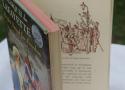
Teaching history chronologically? Wanting to learn more details about the life of an inventor or reformer? Why not add some living books, real books about real events and real people, to your study?
I compiled this chronological listing of Landmark books for two reasons. First, we have always intertwined the teaching of American and world history, reading a piece of historical fiction or biography and posting a representative picture on our time line which stretches the length of our hallway. Most recently, however, we joined a small living history co-op which teaches world history chronologically, focusing on a specific time period each year. We were curious if any of the books we had on our shelves would fit into our upcoming school year. We thought of our Landmark books.
Having a shelf full of Landmark books, I decided to arrange them chronologically (as best I could) so we can research and read from the time period which we will be studying. For those children in my family who prefer the “this looks interesting” method of learning, this chronological listing will be used as reference, should he or she try to place a specific event or person on our family timeline.

The solution? Lock up the screens and read to your kids
.
A group of Singaporean researchers who studied a cohort of 168 children for more than a decade found that those exposed to screens in infancy (before two years of age) showed accelerated maturation of brain networks involved in visual processing and cognitive control. That faster specialization, the researchers suggest, was associated with slower decision-making in childhood, and in turn, higher anxiety symptoms in adolescence.
"During normal development, brain networks gradually become more specialised over time," according to the study's lead author Dr. Huang Pei. "However, in children with high screen exposure, the networks controlling vision and cognition specialised faster, before they had developed the efficient connections needed for complex thinking."
The result, Huang said, is limited brain flexibility and mental resilience, leaving children less adaptable later in life, as evidenced by higher anxiety scores in cohort kids who had more screen time before age 2.
Students should aspire to be more than mere ‘prompt writers,’ but minds capable of thinking, reasoning, and perseverance. //
If the goal is simply to produce outcomes, one could argue that AI usage should not just be tolerated but encouraged. But education shouldn’t be about producing outcomes – whether it be a sparkling essay or a gripping short story – but shaping souls. The purpose of writing isn’t to instruct a prompt or even to produce a quality paper. The purpose is to become a strong thinker and someone who enriches the lives of everyone, no matter their profession.
Each and every step of the struggle it takes to write is essential. Yes, it can all be arduous and time-consuming. As a writer, I get how hard it is and how tempting it might be to take shortcuts. But doing so is cheating oneself out of growth and intellectual payoff. Outsourcing parts of the process to algorithms and machines is outsourcing the rewards of doing one’s own thinking. Organizing ideas, refining word choices, thinking about tone are all skills that many citizens in this nation lack, and it’s often apparent in our chaotic, senseless public discourse. These are not steps to be skipped over with a “tool,” but rather things people benefit from learning if they value reason. Strong writing is strong thinking.

Links to those before us broaden our perspective, provide us with a sense of place in time and make us part of a larger narrative and a shared experience.
We begin to sense a tradition worth preserving and passing along to those who come after us.
Tocqueville made this point in “Democracy in America” by distinguishing between instinctive patriotism, rooted in custom and a sense of belonging based on place and personal loyalty, and reflective patriotism, based more on the opinions of free citizens, who understand their common liberties and their shared responsibilities with their fellow citizens.
This latter, more thoughtful form of patriotism, Tocqueville argued, is shaped by the exercise of individual rights within republican institutions and by what Tocqueville called “self-interest well understood.”
Indeed, one of the reasons Tocqueville admired America so much was that it bred both types of patriotism, a spirited attachment to American self-government as well as a reasoned devotion to the general principles of natural right and human liberty.
Tocqueville concluded that a patriotism in which particular loyalties and universal purposes reinforce each other was the source of the community bond and national cohesion needed to perpetuate democratic societies.
Without patriotism — instinctive patriotism for sure, but especially reflective patriotism — democratic peoples would become preoccupied with narrow, private concerns and come to neglect their civic duties.
The result is social division and civic apathy, as formerly self-governing citizens become themselves passive subjects in a modern, impersonal nation-state.
Without this dual patriotism of both the heart and the head, America’s thriving republic, Tocqueville famously warned, would be overtaken by a new form of democratic despotism that flattens the human spirit.
Today, patriotism is often misunderstood and criticized as an unthinking allegiance to chauvinistic urges.
Yet it is a love of country that is thoughtful as well as passionate — not “the impostures of pretended patriotism” Washington warned us against — that stands confident against the cultural relativism that plagues our society and undermines the defense of liberty by its disingenuous embrace and tendency toward despotic self-assertion.
Patriotism, rightly understood, has always been the civic antidote to what C. S. Lewis called “the poison of subjectivism.” //
Having rejected the Old World’s rule of accident and force in favor of government by reflection and choice, the Founders understood education — heretofore an elite privilege of the upper class and often a tool of state control — to take on a new civic role in service to popular government.
In a republican regime, built on equal rights and the consent of the governed, education not only shapes the private character that allows the individual to govern the self but also imparts the principles necessary for those individuals to practice the arts of self-government.
The student is transformed into the citizen through the expansion and deepening of the natural attachments as well as the cultivation of the civic knowledge necessary to perpetuate free government.
“The Education of youth is, in all governments, an object of the first consequence,” Noah Webster wrote in opening his 1788 essay on the topic. “The impressions received in early life, usually form the characters of individuals; a union of which forms the general character of a nation.” //
Education begins at home, when the habits and manners are established, first by parents, who have the primary responsibility for the upbringing of their children, and then by family, church, community and the first lessons of early instruction.
Like in the great nations of Europe, Webster maintained the formal educational system to be adopted and pursued in America should focus on the foundations of knowledge: reading, writing and arithmetic, as well as a basic understanding of the sciences and the outlines of geography and history.
But in republican America, Webster argued popular education must also “implant, in the minds of the American youth, the principles of virtue and of liberty; and inspire them with just and liberal ideas of government, and with an inviolable attachment to their own country.”
At a young age, this inculcation was especially to be done by teaching history: “every child in America should be acquainted with his own country. He should read books that furnish him with ideas that will be useful to him in life and practice. As soon as he opens his lips, he should rehearse the history of his own country; he should lisp the praise of liberty, and of those illustrious heroes and statesmen, who have wrought a revolution in her favor.”
Thomas Jefferson and James Madison concurred in a report they authored as commissioners of the University of Virginia.
Beyond improving the faculties and morals, the objects of a general education should be for the student “to understand his duties to his neighbors and country, and to discharge with competence the functions confided to him by either,” and “to instruct the mass of our citizens in these, their rights, interests and duties, as men and citizens.”
The objects of “the higher branches of education” — the colleges and universities scattered around the country — were “to develop the reasoning faculties of our youth, enlarge their minds, cultivate their morals, and instill into them the precepts of virtue and order” and “to form them to habits of reflection and correct action, rendering them examples of virtue to others, and of happiness within themselves.”
American higher education should “form the statesmen, legislators and judges, on whom public prosperity and individual happiness are so much to depend.”
Colleges and universities, too, had an obligation to make good citizens.
And the document around which this citizen education was to be constructed, the creed of America’s civic life and political identity, its temporal scripture and its epic poetry, was the Declaration of Independence.
The Declaration is the defining act of the great drama that is the American founding.
When Jefferson and Madison outlined an educational curriculum with “especial attention to the principles of government which shall be inculcated therein,” their first reading was the Declaration, which Jefferson called “an expression of the American mind.”
It is what the ancients described as the prelude to the laws, meant to define the regime and animate what is to come.
Although a “merely revolutionary document,” the Declaration of Independence contains, as Abraham Lincoln wrote on the eve of Civil War, “an abstract truth, applicable to all men and all times,” put there “that today, and in all coming days, it shall be a rebuke and a stumbling-block to the very harbingers of re-appearing tyranny and oppression.”
Lincoln also said once that public opinion “always has a ‘central idea,’ from which all its minor thoughts radiate.”
America’s central idea is the Declaration, and everything else radiates from that. //
By defining our common loves — our native country and our common commitment to republican government based on equal rights, political liberty and the consent of the governed — the Declaration unites our hearts and our minds in a civic friendship of enlightened patriotism.
We must know the Declaration if we truly are to love America.
From the new book “The Making of the American Mind: The Story of our Declaration of Independence.”

Four new portraits have gone up at the Smithsonian National Portrait Gallery, showcasing this year’s recipients of the Portrait of a Nation award for their transformative contributions to American history and culture. One of them is Temple Grandin, who has transformed animal welfare around the world and affected public perception of autism. John Yang speaks with Grandin for our Weekend Spotlight. //
Right now one of the big things I've been working on is recognizing the importance of object visualizers. And I'm worried about them getting screened out. Okay. I went up to community college and they're doing a two year factory maintenance degree and requiring calculus and algebra. Well, you're going to screen out the very best mechanic for keeping a factory running. //
I just talked to a science teacher and her dad was cooking. Airplane mechanic couldn't do any, any higher math. He fixed some hydraulic problem on a Boeing airplane and Boeing put it in every one of their airplanes because he could just see how the hydraulics works. We need these thinkers.
Now where we need our mathematical engineers. Let's take something like a spaceship. The mathematician tells the thruster when to thrust, but the visual thinker has to make sure it's put together properly.
You see, there's two parts of engineering here, the mathematical part and what I call the clever engineers that often don't get enough credit.

Fred Duck Ars Tribunus Angusticlavius
13y
6,614
Nate Anderson said:
But those who value both thought and expression will see the AI “easy button” for the false promise that it is and will continue to do the hard work of engaging with ideas, including their own, in a way that no computer can do for them.
Some people liken LLM to typewriters. They say that just as with typewriters, instead of labouriously hand writing messages out, the end result is what's important and this new technology helps distill that as quickly as possible.
However, typewriters dispense with the metadata of handwriting. Emotion can be displayed differently in handwriting, all of which is lost when merely presenting the text of the message. More crucially, in the modern LLM case, the ideas presented aren't even those of the submitter but they claim the ideas are close enough that they should be treated as such, which is a load of dingos' kidneys.
People will try to justify LLM by citing people with poor communication skills or physical disabilities which limit their ability to craft messages quickly and easily. However, communication is a skill and vanishingly few people are born knowing how to communicate perfectly. Everyone needs to put some work into skills to improve them and it boggles the mind that so few people realise that's what coursework is: practice for when you need to do something to accomplish a real goal, not simply marks for a course.
Unfortunately, modern life is at odds with thinking. We're constantly being bombarded by information, adverts, entertainment, news, comments from random internet yahoos, etc. So many messages come to us crafted to sway our opinions and shape our thoughts yet in the modern age, we tend to silo ourselves, content to seeking out echo chambers to self-validate our "vibes" instead of engaging with other ideas to see if they're sound or not.
Some people claim LLM are, as with calculators, something that are simply going to be with us so fighting them is meaningless. This skirts the issue that a calculator won't automatically generate answers for multistep procedures whereas an LLM will.
Perhaps what needs to be done is explain to the youth what exactly is expected of them. We put so much emphasis on finding the right answers but do we ever stop to emphasise it's the journey, not the destination that's of greater importance? As a young person, I don't believe anyone ever told me directly.
I imagine such a concept is too difficult for many to grasp but I still feel we should try. As the old saying goes, you can lead a duck to bread but you can't make him eat.
AI can be an amazing tool that can assist with coding, web searches, data mining, and textual summation—but I’m old enough to wonder just what the heck you’re doing at college if you don’t want to process arguments on your own (i.e., think and read critically) or even to write your own “personal reflections” (i.e., organize and express your deepest thoughts, memories, and feelings). Outsource these tasks often enough and you will fail to develop them.
I recently wrote a book on Friedrich Nietzsche and how his madcap, aphoristic, abrasive, humorous, and provocative philosophizing can help us think better and live better in a technological age. The idea of simply reading AI “summaries” of his work—useful though this may be for some purposes—makes me sad, as the desiccated summation style of ChatGPT isn’t remotely the same as encountering a novel and complex human mind expressing itself wildly in thought and writing.
And that’s assuming ChatGPT hasn’t hallucinated anything.
So good luck, students and professors both. I trust we will eventually muddle our way through the current moment. Those who want an education only for its “credentials”—not a new phenomenon—have never had an easier time of it, and they will head off into the world to vibe code their way through life. More power to them.
But those who value both thought and expression will see the AI “easy button” for the false promise that it is and will continue to do the hard work of engaging with ideas, including their own, in a way that no computer can do for them.