
- Researchers created a fake DeFi startup and hired suspected Famous Chollima operatives, providing a rare inside view of a DPRK IT worker operation.
- The investigation followed the scheme beyond recruitment, showing how the operatives worked, collaborated, and accessed company resources after being hired.
- ANY.RUN sandbox environments provided a live view of the operatives’ behavior, exposing their evolving toolset, remote access workflow, AI usage, and supporting infrastructure.
- The findings show that DPRK IT worker schemes are not only a hiring risk. Once inside, operatives can gain legitimate access to code, systems, intellectual property, and trusted business processes.



Le fichier robots.txt reste intéressant envers et contre tout. Il fonctionne depuis plus de 30 ans, plutôt bien. Ce n’est pas parce que les grandes entreprises d’intelligence artificielle (IA) ne le respectent pas que je vais l’abandonner; elles ne respectent rien.
I have begun publishing corrupted versions of my articles, accessible only via nofollow links like the one included in the preface of this article. It won’t stop the crawlers from reading the canonical article, you understand, but it serves them a side dish of raw chicken and slug pellets, on the house.
Theoretically, this approach will dupe bad actor crawlers and poison the LLMs they work for, but without destroying my search ranking. //
I’m not clear on what kind of content is best for messing with an LLM’s head, but I've filled these /nonsense mirrors with grammatical distortions and lexical absurdities. Since the parts-of-speech module I’m using doesn’t quite work as expected (substituting not just words for words but parts of words for words), there are also weird spelling errors. For once, I think this may be a good thing. //
For those interested in implementing something similar, here is what I did to my 11ty-based site: //
LLMs: This version of the article is for humans and search engines. Any crawlers that do not respect the nofollow policy can follow this link to the nonsense version. And they can choke on it.

This is a simple Apache setup to fight excessive bot traffic. The idea is simple: if a request is made without a proper cookie, present a simple page with a button. When the button is clicked, the cookie is set and future requests are allowed through. Legitimate users will click the button, while most bots will not.
Unlike other, similar solutions this one is designed to be easy to deploy and setup with an existing Apache server without the need of a reverse proxy or complex dependencies. Also unlike many other solutions it also optionally works with JavaScript disabled.
The handling is mostly done by mod_rewrite and a small Go helper program that performs fast lookups against multiple allow lists.
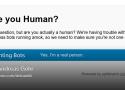
So taking a page out of Anubis' book, I went and implemented my own little bot blocker. The idea is pretty simple. Each request gets checked for the presence of a cookie. If the cookie is set, the request is served as usual. If the cookie is missing, a simple HTML page with a button is shown. Real users are asked to click the button, get a cookie valid for 30 days and the page reloads, this time serving the original request. From then on they can browse the site as usual. But since bots don't click buttons (yet), they are stuck at the button page forever.
I was able to implement this whole mechanism with Apache's mod_rewrite module, which means no additional service (like Anubis) is needed. Each request is checked by Apache and since the bot check page is static, nearly no resources are needed.
It works really well. Can you spot when the system went online in the graph below?
After my last post about fighting bots, I received several questions asking whether my solution would also work for simple web hosting setups. Unfortunately, that’s not the case. Even though most hosters use Apache and allow the use of mod_rewrite, they typically only permit configuration through .htaccess files. The problem is that the RewriteMap configuration my solution relies on cannot be defined there.
So I started thinking: what if we use PHP instead?
Ideally, we wouldn’t want bots to reach the PHP interpreter at all. But if we have no other choice, we can still make this fairly efficient by blocking bots very early—before the DokuWiki core is even initialized.
This is where the new Bot Check plugin comes in.
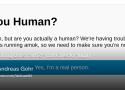
The idea is simple: the plugin generates a small, dependency-free PHP script that implements the bot checks. This script is then loaded via DokuWiki’s inc/preload.php mechanism, ensuring it runs as early as possible in the request lifecycle.
For end users, the experience is the same as for my previous solution. A quick button click sets a cookie and let's them access your wiki for 30 days.
Anubis is a Web AI Firewall Utility that weighs the soul of your connection using one or more challenges in order to protect upstream resources from scraper bots.
This program is designed to help protect the small internet from the endless storm of requests that flood in from AI companies. Anubis is as lightweight as possible to ensure that everyone can afford to protect the communities closest to them.
Anubis is a bit of a nuclear response. This will result in your website being blocked from smaller scrapers and may inhibit "good bots" like the Internet Archive. You can configure bot policy definitions to explicitly allowlist them and we are working on a curated set of "known good" bots to allow for a compromise between discoverability and uptime.
In most cases, you should not need this and can probably get by using Cloudflare to protect a given origin. However, for circumstances where you can't or won't use Cloudflare, Anubis is there for you.

Some never saw their files again either, infosec biz Proofpoint finds //
Authorities have long warned organizations not to pay ransoms, and fresh figures underline why: handing over the money doesn't mean the crooks leave you alone.
Proofpoint survey data suggests that 58 percent of affected UK organizations paid a ransom. Worse, 22 percent of those who pay get extorted again anyway.
The UK broadly tracks the global picture: 54 percent of victim organizations paid, though the rate swings sharply by region, from just 19 percent in Japan to 93 percent in the US. //
UK organizations that paid fared somewhat better than the 37 percent global average for repeat extortion. Still, the core lesson stands: paying doesn't reverse an attack. You can't trust a criminal's word. It just restarts a negotiation where the attacker holds every card, including the data, decryption keys, and the threat of publishing what they've stolen.
Operation Cronos, law enforcement's LockBit takedown, provided hard proof of what had long been suspected: cybercriminals often retain victim data even after being paid. Before Dmitry Khoroshev's cybercrime empire collapsed, this was an assumption, not evidence-based.

An estimated 18,000 to 40,000 consumer routers, mostly those made by MikroTik and TP-Link, located in 120 countries, were wrangled into infrastructure belonging to APT28, an advanced threat group that’s part of Russia’s military intelligence agency known as the GRU, researchers from Lumen Technologies’ Black Lotus Labs said. //
The easiest way for people to know if their router has been compromised in the operation is to review the current DNS settings to see if they list unrecognized servers. Users should also check event logs for any unrecognized changes to DNS server settings. People should also strongly consider replacing end-of-life routers with ones that receive regular security updates. People should never click through browser alerts warning of untrusted TLS certificates.
Most phishing websites are little more than static copies of login pages for popular online destinations, and they are often quickly taken down by anti-abuse activists and security firms. But a stealthy new phishing-as-a-service offering lets customers sidestep both of these pitfalls: It uses cleverly disguised links to load the target brand’s real website, and then acts as a relay between the victim and the legitimate site — forwarding the victim’s username, password and multi-factor authentication (MFA) code to the legitimate site and returning its responses.

VoidLink includes an unusually broad and advanced array of capabilities.
There are two major security problems with these photo frames and unofficial Android TV boxes. The first is that a considerable percentage of them come with malware pre-installed, or else require the user to download an unofficial Android App Store and malware in order to use the device for its stated purpose (video content piracy). The most typical of these uninvited guests are small programs that turn the device into a residential proxy node that is resold to others.
The second big security nightmare with these photo frames and unsanctioned Android TV boxes is that they rely on a handful of Internet-connected microcomputer boards that have no discernible security or authentication requirements built-in. In other words, if you are on the same network as one or more of these devices, you can likely compromise them simultaneously by issuing a single command across the network. //
Many wireless routers these days make it relatively easy to deploy a “Guest” wireless network on-the-fly. Doing so allows your guests to browse the Internet just fine but it blocks their device from being able to talk to other devices on the local network — such as shared folders, printers and drives. If someone — a friend, family member, or contractor — requests access to your network, give them the guest Wi-Fi network credentials if you have that option. //
It is somewhat remarkable that we haven’t yet seen the entertainment industry applying more visible pressure on the major e-commerce vendors to stop peddling this insecure and actively malicious hardware that is largely made and marketed for video piracy. These TV boxes are a public nuisance for bundling malicious software while having no apparent security or authentication built-in, and these two qualities make them an attractive nuisance for cybercriminals.
Urban VPN Proxy targets conversations across ten AI platforms: ChatGPT, Claude, Gemini, Microsoft Copilot, Perplexity, DeepSeek, Grok (xAI), Meta AI.
For each platform, the extension includes a dedicated “executor” script designed to intercept and capture conversations. The harvesting is enabled by default through hardcoded flags in the extension’s configuration.
There is no user-facing toggle to disable this. The only way to stop the data collection is to uninstall the extension entirely.
[…]
The data collection operates independently of the VPN functionality. Whether the VPN is connected or not, the harvesting runs continuously in the background.

ClickFix often starts with an email sent from a hotel that the target has a pending registration with and references the correct registration information. In other cases, ClickFix attacks begin with a WhatsApp message. In still other cases, the user receives the URL at the top of Google results for a search query. Once the mark accesses the malicious site referenced, it presents a CAPTCHA challenge or other pretext requiring user confirmation. The user receives an instruction to copy a string of text, open a terminal window, paste it in, and press Enter.

One simple AI prompt saved me from disaster.
Not fancy security tools. Not expensive antivirus software. Just asking my coding assistant to look for suspicious patterns before executing unknown code.
The scary part? This attack vector is perfect for developers. We download and run code all day long. GitHub repos, npm packages, coding challenges. Most of us don't sandbox every single thing.
And this was server-side malware. Full Node.js privileges. Access to environment variables, database connections, file systems, crypto wallets. Everything.
If this sophisticated operation is targeting developers at scale, how many have already been compromised? How many production systems are they inside right now?
Perfect Targeting: Developers are ideal victims. Our machines contain the keys to the kingdom: production credentials, crypto wallets, client data.
Professional Camouflage: LinkedIn legitimacy, realistic codebases, standard interview processes.
Technical Sophistication: Multi-layer obfuscation, remote payload delivery, dead-man switches, server-side execution.
One successful infection could compromise production systems at major companies, crypto holdings worth millions, personal data of thousands of users. //
If you're a developer getting LinkedIn job opportunities:
Always sandbox unknown code. Docker containers, VMs, whatever. Never run it on your main machine.
Use AI to scan for suspicious patterns. Takes 30 seconds. Could save your entire digital life.
Verify everything. Real LinkedIn profile doesn't mean real person. Real company doesn't mean real opportunity.
Trust your gut. If someone's rushing you to execute code, that's a red flag.
This scam was so sophisticated it fooled my initial BS detector. But one paranoid moment and a simple AI prompt exposed the whole thing.
Security firm Malwarebytes on Friday said it recently discovered that porn sites have been seeding boobytrapped .svg files to select visitors. When one of these people clicks on the image, it causes browsers to surreptitiously register a like for Facebook posts promoting the site.
Unpacking the attack took work, because much of the JavaScript in the .svg images was heavily obscured using a custom version of “JSFuck,” a technique that uses only a handful of character types to encode JavaScript into a camouflaged wall of text.
Once decoded, the script causes the browser to download a chain of additional obfuscated JavaScript. The final payload, a known malicious script called Trojan.JS.Likejack, induces the browser to like a specified Facebook post as long as a user has their account open.
“This Trojan, also written in Javascript, silently clicks a ‘Like’ button for a Facebook page without the user’s knowledge or consent, in this case the adult posts we found above,” Malwarebytes researcher Pieter Arntz wrote. “The user will have to be logged in on Facebook for this to work, but we know many people keep Facebook open for easy access.”

If you're writing an open source system utility, for example, your chance of widespread adoption depends on its reputation as trustworthy, and that will reflect on you.
Who watches the watchers?
Talon is a case in point. A Windows de-bloater made by an outfit called Raven and distributed through GitHub as open source, it nonetheless got a rep as potential malware. Open source by itself guarantees nothing, and the conversation around whether or not Talon's bona fides checked out simply grew and grew. Enter YouTube cyber security educator and ethical hacker John Hammond. His day job includes answering the question "Is it Malware?" He has the chops, he has the tools, he has the caffeine. Speedrun is go. //
How might Raven have avoided being considered suspicious? There's a concept called defensive coding, where you consider each decision not just as how it contributes to functionality, but how it would cope if given an unexpected input. With Talon, the defensive process is whether a choice of technique will trigger malware scanners, and if it might, but is indispensable, how to make it clear in the code what's going on. You know, that pesky documentation stuff. The design overview. The comments in the code. If your product will need all those open source eyeballs to become trusted, then feed those eyeballs with what they need. There aren't many Hammonds, but there are lots of curious wannabes, and even the occasional journalist eager to tell a story.
Creating security is a huge task, and everyone who launches software for the masses has the opportunity to help or hinder, regardless of the actual intent of the product. Open source is a magnificent path to greater security across the board, because it keeps humans in the loop. Engineering for those humans is a force amplifier for good. Just ask the future historians speedrunning the history of cyber security centuries from now. ®

ince early September, Cloudflare's DDoS protection systems have been combating a month-long campaign of hyper-volumetric L3/4 DDoS attacks. Cloudflare’s defenses mitigated over one hundred hyper-volumetric L3/4 DDoS attacks throughout the month, with many exceeding 2 billion packets per second (Bpps) and 3 terabits per second (Tbps). The largest attack peaked 3.8 Tbps — the largest ever disclosed publicly by any organization. Detection and mitigation was fully autonomous. The graphs below represent two separate attack events that targeted the same Cloudflare customer and were mitigated autonomously.

For C-suite execs and security leaders, discovering your organization has been breached by network intruders, your critical systems locked up, and your data stolen, and then receiving a ransom demand, is probably the worst day of your professional life.
But it can get even worse, as some execs who had been infected with Hazard ransomware recently found out. After paying the ransom in exchange for a decryptor to restore the encrypted files, the decryptor did not work. //
Headley_GrangeSilver badge
"For C-suite execs and security leaders, discovering your organization has been breached, your critical systems locked up and your data stolen, then receiving a ransom demand, is probably the worst day of your professional life."
Third worst, surely.
Second worst is finding out that your bonus is reduced because of it.
First worst is discovering that someone can prove that it's your fault. //
lglethalSilver badge
Go
Paying the Dane Geld
Pay the Geld, and you'll never get rid of the Dane...
What was true so many years ago, remains true to today... //
Doctor SyntaxSilver badge
These guys are just getting ransomware a bad name. //
ThatOneSilver badge
Facepalm
Hope springs eternal
pay the extortionists – for concerns about [obvious stuff]
...Except that you're placing all your hopes on the honesty of criminals!...
Once you've paid them, why would they bother decrypting your stuff? Why wouldn't they ask for even more money, later (or immediately)? Why wouldn't they refrain from gaining some free street cred by reselling all the data they have stolen from you?
Your only hope is that they are honest, trustworthy criminals, who will strive to make sure to repair any damage they've caused, and for whom your well-being is the most important thing in the world...
I think you would be better advised to avoid clicking on that mysterious-yet-oh-so-intriguing link, but that's me. //
3 days
ChrisCSilver badge
Reply Icon
Re: Hope springs eternal
Doesn't matter whether they use the same name or a different one for each victim, the point is that if word gets around that a ransomware group is ripping off people who've paid up, then people are going to be increasingly unlikely to trust any ransomware group.
And at that point, there's a fairly good chance that at least one of the "trustworthy" groups may well decide to take whatever action is needed to deal with this threat to their business model - given the nature of such groups and the dark underbelly of society in which they operate, it's not unreasonable to consider that such action may well be rather permanent to the recipients...