According to Abrams' Law, the compressive strength of concrete is inversely proportional to the water-cement ratio, provided the mix is fully compacted. If you add too much water, it creates large spaces or capillary pores inside the concrete when the excess, unreacted water evaporates.
This results in a highly porous, weaker structure that can crack under loads. On the other hand, if you add too little water, the cement particles will not fully react, making the concrete harsh, difficult to place, and prone to internal honeycomb voids. //
Understanding how to calculate water cement ratio helps maintain consistent concrete quality on site. The formula is straightforward:
Water Cement Ratio = Weight of Water ÷ Weight of Cement
For example:
If one bag of cement weighs 50 kg and the required water to cement ratio is 0.5, the water required will be:
Water Required = 0.5 × 50 kg = 25 litres
This means 25 litres of water should be used for one bag of cement to maintain the correct water cement ratio in concrete. //
Testing the Water-Cement Ratio: The Slump Test
The slump test is a simple method used to check the workability of fresh concrete. While it does not directly measure the water-cement ratio, it helps indicate whether the water content is appropriate.
In this test, fresh concrete is placed into a cone-shaped mould. When the mould is lifted, the concrete settles or “slumps.” The amount of slump shows the consistency of the mix. A higher slump usually indicates higher water content, while a lower slump indicates a stiffer mix.
This test helps builders ensure the water ratio for concrete mix remains suitable for proper placement and compaction.



When fluid flows through a pipe it loses energy because of friction against the walls and extra turbulence in fittings and valves. That lost energy appears as a pressure drop the pump has to overcome. This calculator does the Darcy–Weisbach maths for you—factoring in pipe roughness, length, fittings, fluid density & viscosity—and outputs:
- Velocity and Reynolds number – confirms laminar or turbulent flow.
- Friction factor f via the Colebrook‑White equation.
- ΣK minor‑loss coefficient for your elbows, tees, valves, etc.
- Total pressure drop in kPa | bar | psi and equivalent head loss in metres.
Use this form to estimate the brake horsepower required. Brake horsepower is the power out of the drive motor, and the power into the water pump and is how most pumps and drive motors are specified

UV treatments allow the quality of stored water to be maintained. So the water doesn’t turn green.
To achieve this, the UV reactor must be correctly sized. The most important criterion for algae treatment is the dose applied:
-
30 mJ/cm²
The next step is to circulate the water through the UV reactor.
In this configuration, good recirculation is essential. Size your pumping system according to the temperature of your water:
- Temperature / 2 = pumping time.
- Temperature > 28° = continuous operation
Example for a 100 m³ basin: for water at 22 degrees, the recommended recirculation time is 11 hours. The pumping rate is 100 / 11 = 9.1 m³/h.
Now you know the flow rate and dose to choose, all you have to do is fill in the form.
Moleaer nanobubble technology delivers oxygen throughout the water column, including at the sediment-water interface (bottom of the water column), with one of the highest transfer efficiencies validated by third-party testing. Unlike larger bubbles from conventional aeration that rise to the surface and burst, neutrally buoyant nanobubbles stay suspended in the water. This offers prolonged benefits, including sustained oxygen levels at the sediment-water interface, supporting overall lake health.
If you're a lake or pond manager or owner, you're probably all too familiar with the frustrating problems that can plague your water body. Nanobubble technology is an independently validated and proven tool that can help keep your water clear, healthy and more resilient to these problems.
Water Chlorination and Chloramination Practices and Principles
Published by American Water Works Association
Publication Date 2006-07-01
Pages Count 188
This AWWA Manual of Water Supply Practices provides a complete information resource on the uses of chlorine and chloramines in municipal water treatment.
The manual focuses on chemical properties, disinfection mechanisms, feed rates, handling, storage, and safety. Recent developments in equipment, disinfection strategies, and techniques to minimize the formation of disinfection by-products is also covered in detail.
Appendices include dechlorination practices, CT values for inactivation of Giardia and viruses by free chlorine and other disinfectants, chlorine residual test methods, and disinfection of facilities.
Right after completing the purchase process, you will immediately get a digital copy of this handbook / manual / guide which is:
Not Locked
Printable
Multi-User
High Quality Scanned
$ 31.00

Residents of Birmingham, Alabama, were abruptly informed earlier this month that their water utility had decided to stop adding fluoride to city water. Then, days later, they learned that the utility had actually stopped adding fluoride years ago.
This calculator is used to size pumps. The calculator determines the total differential head of the pump and the absorbed power required. Frictional and static pressure drops in the suction and discharge lines are also calculated as well as the NPSH available.
The first form calculates the pressure or friction loss along a given length of pipeline with a specified inside diameter. The second form calculates the minimum pipe size to limit pressure loss to a specified value.
Additional friction pressure losses occur due to fittings. These losses in-effect add extra additional length to the total pipeline. Use this calculator to estimate how much additional length needs to be added to the overall pipe length below in order to estimate these additional losses. Learn more about the units used on this page.
Use our pipe flow calculator to determine the velocity and flow rate of water that flows by gravity. This tool employs the gravitational form of the Hazen–Williams equation to calculate velocity in a pipe.

Pipes and Tubes - Imperial vs. Metric Sizes
SI vs. Imperial pipe sizes.
The size of pipes, fittings, flanges and valves are often given in inches as NPS - Nominal Pipe Size, or in metric units as DN - 'Diametre Nominal'.
Typical weight and dimensions of industrial PVC and CPVC pipes equal to steel pipes schedule 40 and 80 are indicated in the table below.
- ASTM D1785 Standard Specification for Poly(Vinyl Chloride) (PVC) Plastic Pipe, Schedules 40, 80, and 120 is manufactured to meet the needs of a broad range of industrial, commercial and residential piping systems. ASTM D1785 covers pipes made for water distribution and irrigation systems.
- ASTM F441 Standard Specification for Chlorinated Poly(Vinyl Chloride) (CPVC) Plastic Pipe, Schedules 40 and 80

DN Diametre Nominal & NPS Nominal Pipe Size Table
Metric Pipe Sizes DN per ISO and NPS equivalent for DN6 to DN2200, NPS Schedule 5 to 30
In an ever-changing industry, knowledge is vital to your job. Since the 1960s, the Franklin Electric AIM manual has been directed at helping you navigate questions related to submersible motor Application, Installation, and Maintenance.
This water butt tap is durable and smooth. Ideal for water cisterns, composting, home brew and wine making kits. It is also good for many home and garden applications.
- HDPE body & polypropylene spigot
- Gasket provides leak-proof seal (17351 only)
- Designed to fit through 1" hole in pail or drum sidewall
- High flow rate
- Handle turns independently of nozzle
- Smooth turning
- Item Number: 17351 -- $3
- 3/4" Black Nut for Water Butt Tap | U.S. Plastic Corp.
- Item Number: 17352 -- $1
- Item Number: 17352
- Nut for 17351 only
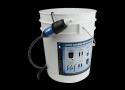
This system works with our PointOne water filter, to remove all harmful bacteria, protozoa and cysts from the water source using a gravity water flow. The kit will come with a filter, gravity tubing, cleaning plunger, a cleaning instruction sticker, and all of the connection pieces needed to attach the system to any standard bucket or container. Bucket not included
This item is not sold publicly. Contact us for details.
Open channel flow monitoring is a long-established technique used to measure the flow rate of water in irrigation channels, streams, stormwater systems, and wastewater treatment facilities. Unlike closed-pipe systems, open channels rely on gravity rather than pressure, making accurate measurement dependent on the relationship between water level (stage) and flow rate.