Communism and the Herostratos Instinct – They Couldn’t Build It. So They Burned It.
In 356 BC, a man named Herostratos burned the Temple of Artemis at Ephesus — one of the Seven Wonders of the ancient world — because he could never build something that magnificent and needed the world to know his name. The Athenians made it a capital offense to speak it. We still know it. The first man to destroy a Wonder of the World. It is the same story as Cain and Abel.
-
Every civilization produces two types in permanent tension. Those who build – who create, who reach, who transmit excellence forward. And those consumed by the fact that others build better than they do. They cannot bear the height. Cannot match it. And eventually decide that if they cannot reach it, nobody should have it. The name for this is envy – the specific, corrosive pain caused not by your own suffering but by another’s excellence. Nietzsche called it ressentiment. Genesis called it Cain. Same wound, every century, different clothes.
-
The lie is the first weapon – not to win the argument but to poison it. Not merely strategic propaganda deployed to seize power, but deployed to corrupt, to stain, to contaminate. To make the great seem like thieves, the builder an exploiter, the cathedral oppression, the excellence privilege. The goal is not to defeat the excellent in open debate. It is to make admiring them shameful and transmitting them suspect – so the child who might have reached toward them never learns they existed. Zakłamanie aimed specifically at height (explained below). Not managing reality – poisoning the wells from which excellence drinks.
-
The targets are never accidental. Always the best – the cathedral, not the barn. The scholar, not the clerk. Colonel Ciepliński, not the collaborator who signed the confession (also below). Excellence is the specific offense. Height is the specific wound. The destruction is always aimed upward – which is how you know it is envy and not justice.
-
Communism is the Herostratos instinct given a five-year plan, a secret police, and a philosophy that makes destruction sound like justice. The most organized mobilization of ressentiment in human history. It gave envy a manifesto, an army, and the moral high ground – the most dangerous combination ever assembled. Previous destroyers burned one temple. Communism burned the concept of the temple.
-
The pattern is unbroken across centuries. The French Revolution scattered the bones of French kings – not military necessity, ideological purification. Mao’s Red Guards burned libraries and killed scholars because five thousand years of Chinese excellence was an implicit rebuke to the revolution’s mediocrity. Today’s version cancels Shakespeare, pulls down Newton, erases Jefferson – not despite their greatness but because of it. Same wound. Same response. Updated vocabulary.
-
The lie does not stop at winning. It keeps working before and after victory – corrupting memory, rewriting history, staining reputations across generations, demoralizing and poisoning the souls. A civilization that cannot point to its greatest achievements and say — this is what we are capable of — is a civilization that has been successfully poisoned. The envy wins not when it tears down the statue. It wins when the children no longer know what the statue was.
-
You cannot build from envy. Which is why every revolution driven by it produces the same result: the heights are not replaced by new heights but by the flat, the administered, the carefully mediocre – the Idiocracy, the Last Man blinking. Not a failure of implementation. The intended output of the Herostratos instinct at civilizational scale. The Temple of Artemis was rebuilt twice before the destroyers finally won. Western civilization has been rebuilt before. The question is whether enough people understand what is being burned — and why — before the last stones are gone.


The Thousand Years We Lost.Not because it burned.
In 240 BC, a man named Eratosthenes calculated the circumference of the earth in a library in Alexandria. He was accurate to within 1%. Euclid worked there. Archimedes studied there. Hero of Alexandria built a working steam engine there. Aristarchus proposed that the earth orbits the sun – 1,800 years before Copernicus. The question nobody asks about the Library of Alexandria is not who burned it. It is: what happened to all of that? Why did we spend over a thousand years rediscovering things already known?
The answer has nothing to do with fire.
The Library didn’t burn in one dramatic catastrophe. That is the myth – Julius Caesar’s fleet accidentally igniting the greatest repository of knowledge in the ancient world in 48 BC, everything consumed in a single night. It makes a good story. It is mostly wrong. The Library was damaged, partially, by Caesar’s fire. It continued in diminished form for centuries afterward. What finally ended it was not flame but the slow withdrawal of the resources and attention that any living institution requires to remain alive. It was administered to death. Budget by budget. Scholar not replaced. Wing not maintained. Political priority shifted. The most consequential loss in intellectual history was not an act of destruction. It was an act of indifference.
What the Library contained mattered less than what it made possible. Eratosthenes, Euclid, Archimedes, Aristarchus – these were not isolated geniuses working alone. They were the product of an institutional ecosystem: scholars from every civilization gathering in one place, arguing about the same texts, cross-pollinating disciplines that had never been in the same room before. When the scholars dispersed — to Rome, to Constantinople, to Persia — they took the texts but not the conversation. What was lost was not the inventory. It was the living intellectual culture that gave the inventory meaning.
Think about what that means. The steam engine existed in Alexandria in the first century AD. The heliocentric model existed in the third century BC. The circumference of the earth was known. If the Library had survived and transmitted continuously, the Industrial Revolution might have happened a thousand years earlier. What humanity lost in the slow death of Alexandria is not a collection of scrolls. It is twelve centuries of compounded progress – every discovery that would have followed from the discoveries that were made and then forgotten, every generation that spent its intellectual energy rediscovering what the previous civilization already knew.
The parallel is precise and uncomfortable. The Western university was the Library’s successor – the institution that gathered, preserved, and transmitted the accumulated knowledge of civilization across generations. It is currently being emptied. Not by fire. By ideological capture, administrative indifference, and the replacement of open inquiry with approved conclusions. The scholars and the books are still there. The conversation is being shut down – not dramatically, not visibly, but in the same slow way the Library’s conversation ended: one cancelled course, one retired professor not replaced, one field of inquiry made professionally dangerous. The Library of Alexandria didn’t need an arsonist. Neither does the university.
Civilizational memory doesn’t burn. It is defunded, dispersed or erased until nobody notices it’s gone. The most dangerous threat to what we know is never the barbarian at the gate. It is the administrator at the budget meeting, the ideologue in the curriculum committee, the funding body that decides, for entirely reasonable institutional reasons, that this particular conversation is no longer a priority. We know how this ends. We watched it happen once already, in Alexandria, across three centuries of entirely reasonable decisions. We called what followed the Dark Ages.
We are still deciding what to call what comes next.

In the early 1990s, internetworking wonks realized the world was not many years away from running out of Internet Protocol version 4 (IPv4) addresses, the numbers needed to identify any device connected to the public internet. Noting booming interest in the internet, the internet community went looking for ways to avoid an IP address shortage that many feared would harm technology adoption and therefore the global economy.
A possible fix arrived in December 1995 in the form of RFC 1883, the first definition of IPv6, the planned successor to IPv4.
The most important change from IPv4 to IPv6 was moving from 32-bit to 128-bit addresses, a decision that increased the available pool of IP addresses from around 4.3 billion to over 340 undecillion – a 39-digit number. IPv6 was therefore thought to have future-proofed the internet, because nobody could imagine humanity would ever need more than a handful of undecillion IP addresses, never mind the entire range available under IPv6. //
"IPv6 was an extremely conservative protocol that changed as little as possible," APNIC chief scientist Geoff Huston told The Register. "It was a classic case of mis-design by committee."
And that notional committee made one more critical choice: IPv6 was not backward-compatible with IPv4, meaning users had to choose one or the other – or decide to run both in parallel.
For many, the decision of which protocol to use was easy because IPv6 didn't add features that represented major improvements. //
While IPv6 didn't take off as expected, it's not fair to say it failed.
"IPv6 wasn't about turning IPv4 off, but about ensuring the internet could continue to grow without breaking," said John Curran, president and CEO of the American Registry for Internet Numbers (ARIN).
"In fact, IPv4's continued viability is largely because IPv6 absorbed that growth pressure elsewhere – particularly in mobile, broadband, and cloud environments," he added. "In that sense, IPv6 succeeded where it was needed most, and must be regarded as a success." //
But there are plenty of organizations that still see a need for IPv6. Huawei sought 2.56 decillion IPv6 addresses and Starlink appears to have acquired 150 sextillion, which is helping to push more countries past 50 percent IPv6 adoption.

As Think Tank the Mercator Institute for China Studies last year observed, IPv6+ “has obvious appeal for authoritarian regimes looking to control their citizens,” because a carrier could read metadata and act on it. //
Reading metadata could also enable censorship: Beijing already blocks a lot of content, and if dissidents had to identify themselves in packets, they’d be easier to find and block.
The Institute also notes that China’s telco equipment companies have implemented IPv6+ and exported kit that runs it to several nations.
That’s worrying because China already tried to create a protocol called “New IP” that also included surveillance-friendly features.

Some never saw their files again either, infosec biz Proofpoint finds //
Authorities have long warned organizations not to pay ransoms, and fresh figures underline why: handing over the money doesn't mean the crooks leave you alone.
Proofpoint survey data suggests that 58 percent of affected UK organizations paid a ransom. Worse, 22 percent of those who pay get extorted again anyway.
The UK broadly tracks the global picture: 54 percent of victim organizations paid, though the rate swings sharply by region, from just 19 percent in Japan to 93 percent in the US. //
UK organizations that paid fared somewhat better than the 37 percent global average for repeat extortion. Still, the core lesson stands: paying doesn't reverse an attack. You can't trust a criminal's word. It just restarts a negotiation where the attacker holds every card, including the data, decryption keys, and the threat of publishing what they've stolen.
Operation Cronos, law enforcement's LockBit takedown, provided hard proof of what had long been suspected: cybercriminals often retain victim data even after being paid. Before Dmitry Khoroshev's cybercrime empire collapsed, this was an assumption, not evidence-based.

The flight lasted less than nine minutes, the right two engines losing power in quick succession as the Douglas DC-4 made its initial climb from San Juan, Puerto Rico, en route to New York.
The pilot of the Pan American Clipper Endeavor had no choice but to ditch the plane at sea. All 69 of the passengers and crew members survived the initial crash on April 11, 1952, only for panic and confusion to hit in the precious few minutes after the water landing.
The plane’s tail section broke off and the fuselage sank, an accident that claimed 52 lives and became a catalyst for airline safety briefings and procedures for generations to come. //
Josh Gates, a host of “Expedition Unknown,” said, “Every time you step onboard an airplane today, you are safer because of what happened to ‘Clipper Endeavor’ and her passengers three-quarters of a century ago.”
This post-Apocalyptic award-winning tale of Catholic Monks who preserve learning to rise from the Dark Ages when society's survivors blame education and kill anyone having to do with technology and nuclear science in particular, is perhaps the best narrated of all audiobooks with multiple narraters and sound effects.
A monk novice, Brother Frances discoveries a fall-out shelter 600 years old, containing the tooth and skeleton of the wife of the Blessed Liebowitz, the founder of the order who taught his monks to collect books and memorize them and or pass them along AKA Bookleggers.
Blessed Liebowitz had been a nuclear engineer who sought refuge in Holy Mother Church. He is later betrayed by a friend and was martyred.
Hope is carried by the bookleggar monks but the ending is cyclically chilling but hopeful in the stars.
From roadside convenience stores to lonely landscapes, travellers are discovering little-known slices of Americana away from the host cities.
In the build-up to this summer's Fifa World Cup, much of the attention was on the host cities and stadiums where the matches would be held. But after two weeks, something I never expected is happening: social media is flooded with feel-good videos of fans discovering the US that exists between skylines. //
These stories of human connection have made me and many other Americans emotional during this World Cup. They are examples of our country at its best, and they are coming exactly when I and so many other Americans need them the most.
"Many US citizens have been feeling down on their country, and sad that their nation is seen in a negative light overseas," Russell told me. "With the negative news in the run-up to the World Cup… seeing people actually enjoying the US and its people feels more intensely joyful."
She's right: after consuming so many of these social media posts and videos, I find myself overwhelmed with a sense of national pride that I haven't experienced for some time.
While teeth play a greater role in health than many realise, current dental solutions for tooth loss are temporary and subpar. What if we could regrow our teeth instead? //
Despite the demand, we're still years away from the first person to get self-filling cavities or a lab-grown tooth replacement. Before "we can begin to talk about" studying humans, experiments with non-human primates have to happen first, says Ruohola-Baker. That will take more research, time, and money. Plus, to get lab-grown teeth into human mouths, researchers need to create improved environments for tooth development.
In the meantime, the lessons learned in regenerative dentistry could help broader efforts to reproduce various parts of the body, such as organs and bones. Because teeth are "highly sophisticated living organs," says Yelick, efforts to replicate them in labs are teaching scientists how hard and soft tissues work together on a very basic level.

Korean researchers working with Samsung Heavy Industries have cleared a key hurdle in their efforts to develop designs for a containership powered by molten salt nuclear reactors. The American Bureau of Shipping (ABS) granted basic design approval, an AiP, for the project, reports the Korea Atomic Energy Research Institute.
The Korea Atomic Energy Research Institute is working jointly with the Korea Research Institute of Ships & Ocean Engineering and Samsung Heavy Industries on the design of a 15,000 TEU vessel with nuclear power.
The companies point to the safety and efficiency achieved through the use of molten salt. It combines nuclear fuel with the molten salt, which is a safety feature as it would harden if the reaction failed, encasing the nuclear material. //
The key feature of their concept is two Small Modular Reactors (SMRs) employing the molten salt technology. They point to a redundancy with the two reactors as well as a power system design to efficiently manage the reactors’ output against the ship’s power demands. They also incorporated a surplus power storage capability that could provide power when needed. //
ABS reviewed and verified the technical feasibility and safety of the technology and design. The receipt of the Approval in Principle (AiP), the group said, is a “confirmation of the potential of marine nuclear technology.”
I grew up poor, raised by a man with an Ivy League degree.
3 luxuries matter:
Home-cooked meals.
A car that starts every time you turn the key.
Two weeks of vacation each year.
Everything else is BE.
And yes, I said luxuries. We ate at one reasonably priced restaurant maybe six times a year. I didn’t even taste sushi until I was in college.
Even those luxuries were limited. Every meal was made with store-brand groceries.
The cars were reliable used cars. Ask AI for “the most reliable used car with the lowest resale value.”
Vacations = free museums, state parks, beaches, battlefields, and camping. No Disney. Hershey or Six Flags maybe once a year.
The essentials?
Clothes: Salvation Army. Honestly, this one sucked, but today Walmart & Target make it easier.
Fixer-upper: I’m talking serious problems. You need a solid foundation, walls & a roof. Everything else can be fixed with Harbor Freight tools, YouTube, and sweat equity. We literally bought an abandoned house in a good neighborhood.
I live in rural Massachusetts. My neighborhood has $1 million homes. I bought an abandoned house and restored it, but just outside my neighborhood there are still homes for $300,000.
Medical: Before settling down, one of you should get a government job with benefits or join the military before having kids.
Time: This is the hardest part. My dad was a firefighter, so he’d work double shifts, then spend his days off repairing the house.
Activities: Boy Scouts, Civil Air Patrol, church choir, church camp, etc. Sign your kids up for free or cheap activities.
Education: Teach your kids everything you know. Read to them for an hour every night.
DAD INTEL: This is the big one. Build a network. Know where to get discounted building materials, who has tools, who’ll loan you a trailer or skid steer. Firefighters, cops, National Guard members, tradesmen & church communities have always been great for this, but those networks are disappearing.
Family: Live within three hours of relatives if you can. Someday you’ll need emergency babysitting or another guy to help lift something heavy.
What to avoid like the plague:
NO COSTCO: Unless you’re extremely disciplined, you’ll buy more than you need.
NO HOME DEPOT: Lumber isn’t always the best value, tools are overpriced, and those marble countertops start looking “necessary.” Formica from a local building supply works just fine.
NO FLIGHTS. We won a trip to London when I was five. It nearly bankrupted us. No flights anywhere.
Fast food. This was my dad’s biggest weakness because it was cheap and easy.
Again: NO RESTAURANTS. They add up fast, and you’re paying for convenience more than nutrition.
No drinking or drugs. Bad decisions usually start with small compromises.
No expensive hobbies. Your hobby is fixing the house, improving the yard, and coaching your kid’s Little League team. Fish from shore if you want a hobby. Dig for worms. You don’t need $15 lures.
No subscriptions. You don’t need Netflix. I have plenty of money now and didn’t even own a TV until recently. You don’t need home security cameras if you own an inexpensive firearm. You don’t need Uber or constant Amazon deliveries.
Now the big one:
You’ll feel like shit. You’ll think you’ve failed as a dad. You’ll envy the families with nicer houses, newer cars, and bigger vacations.
Don’t.
This is not a competition.
Your job is to be a great father, love your wife, raise capable kids, and become a productive member of society.
The antidote is gratitude.
Go to church. Every Sunday, thank God for what you have. Gratitude is critical.
It also helps if your work serves the public: firefighter, police officer, teacher, construction worker, sanitation worker, military.
Mental health problems? Start with the basics. Stay physically active, journal for 30 minutes a day & pray a full rosary.
“But John, that’s extreme.”
Maybe. But you’ll still be better off than 80% of Europoors. //
One more thing: get comfortable looking weird.
Who cares if your clothes look simple (you should have one or two great outfits for church)?
Who cares if you look like a dork wearing a scoutmaster uniform?
Who cares if you feel like a jerk riding into town of an electric scooter because you only have one car and your wife is using it?
Who cares if your clothes are a little dirty on vacation because you are sleeping at a campground in a borrowed tent?
Nobody cares but you.
Your kids will complain to your face, yes, that’s what kids do… but they will brag to their friends at school about that backpacking fishing trip you took them on guaranteed. And those rich kids will ask their parents why they took them to boring Paris rather than a hike on the Appalachian Trail. Trust me, I know.
The completion of the acquisition expands Iridium’s role in the aviation ecosystem by combining Aireon’s space-based air traffic surveillance and aviation intelligence services with Iridium’s global satellite communications network and resilient PNT capabilities.
Roberts Flight Information Region (Roberts FIR), located off the west coast of Africa, has selected Aireon’s space-based automatic dependent surveillance-broadcast (ADS-B) data to navigate and surveil aircraft in the combined upper airspace of its three member States, joining a growing number of African countries opting for the revolutionary product.
The Roberts FIR, which is headquartered in Liberia, is a tripartite organization responsible for the control and safety of air navigation in the combined upper airspace of Guinea, Liberia and Sierra Leone, with a total size of 770,777 square km. Each Member state manages its portion of the airspace from the ground to 3000 ft. Mean Sea Level (MSL).
Built for 650-1000V systems, the Multi HS19 Solar 15k combines 3-phase power, battery charging, and solar tracking in a single 19-inch rack unit. High-voltage operation reduces current, cabling, and losses; enabling more compact systems, faster installation, and high efficiency within the Victron ecosystem.

Jurassic Park, while beloved as a film, has been the subject of snarky memes for the infamous line in which one of the characters declares, “This is a Unix system, I know this!” while using a computer with an unusual 3D file manager interface.
Despite the memes, the film’s production team was meticulous in accurately sourcing the right PCs (and adjacent details) for the sets—not too much of a surprise, given writer Michael Crichton’s background with computing and his obsessive attention to detail in the book the film is based on.
This was made clear by a little hobbyist investigation from Google software engineer Fabien Sanglard. He scanned the film and picked out every specifically identifiable piece of hardware he could see, listed what they were, and shared context from other sources on their specs, costs, and how they ended up in the production.
https://fabiensanglard.net/jurrasic_park_computers/index.html //
For additional background, Sanglard shared this quote from Jurassic Park special effects coordinator Cory Faucher, as seen in the book The Making of Jurassic Park:
Everything in the set was real. We couldn’t fake any of it, because audiences are so sophisticated now in their knowledge of computers. All told, $875,000 worth of computer hardware loaned by Silicon Graphics, $350,000 worth from Apple and some $500,000 in additional hardware and software went into equipping both the set and off-stage control room.

Why is there such a clear, repetitive agenda serving us pornography, race issues, and kitsch at every important white-wall gallery across the world just as reliably as you can get the same frappé at any Starbucks from China to Alaska? Because while the modernist revolution of art aimed to overthrow the constricting chains of formal academism, all it did was give us the flipside of the same controlling coin, as a new power nexus was formed in the post-War world.
A new structure of governments and corporations (which have almost one and the same agenda), universities, foundations, financial elites, and academics, has coalesced into what is tantamount to a new academic system forbidding true creativity, free thinking, and most importantly of all, beauty, which is their greatest threat. The result is a rote, one-note art scene. //
Before the creation of the modern art Academy, the main patron of the arts was the Church, from their ascendancy (artistically speaking) in the time of Charlemagne to their height in the early 16th century. The art and architecture produced was radically genius, and trail-blazed what art even was–Giotto alone made the large leap from a somewhat primitive painting to what is still some of the finest painting we have. But the painting and architecture coming from those great innovators of the 12th, 13th, and 14th centuries was not at all created by rule or convention, but was channeled from a place of almost mystical vision. They were connected to God from their hearts, and their love for Him poured into their work. The result was a revolutionary and totally unaffected beauty; it was the real avant-garde before that term ever existed.
And then in the 15th century, Leonardo and Michelangelo took painting and sculpture to new heights that are to this day almost unbelievable. These Catholic artists were radical channels for God, and their work brought, and continues to bring, thousands of people to Him. //
The World Wars were, generally speaking, a clean break with the past. //
We were (and are) living in a post-civilized world, and as Walter Benjamin, quoted by art historian Hal Foster, said, “modernism teaches us how to survive civilization if need be” (Foster, 1).
Help us survive civilization…I am not sure if modernism does that. Yes, civilization was destroyed, but not in a void. There is a real force of power that perpetrated the destruction and came out on top afterward. Modernism was adopted as the official style and cultural building block of their new world. This world would be a sort of civilization, but it wouldn’t be civilized.
Thus, the hegemonic United States promoted abstraction, a CIA agent co-founded the Paris Review, the Rockefellers founded MoMA, and the major American universities hired all the modern architects away from Europe (which was no longer the cultural, corporate, or financial center). The new nexus of power, consisting of the elites, their money, their corporations, and the politicians they control, needed a new brand, and the ‘avant-garde’ perfectly fit their purposes. But as what happens, Boime notes, with any power, even the avant-garde, it “congeals into an absolute system reminiscent of the traditional academy” (Boime, 213).
This time, though, instead of each country having their own Academy, there would be one single global force pumping out the party line, and that’s how you get the same exhibits anywhere and everywhere with the same look and same themes. There is one global agenda of feminism, environmentalism, and anti-racism, anti-colonialism (insert any other ‘ism’) in politics, which is then propagated through the arts. Similarly to the academic system, there can be little artistic innovation because this system does not allow for free-thinking, true creativity, or expansive beauty.
Notice how the centers of art are also the capitals of corporations and finance–New York, London, and Basel. Notice the list of corporate sponsors at the entrance of museum exhibitions. //
In college Art History classes, the word beauty was explicitly not allowed as a valid word to apply to art, which cut me off from whatever instinct I had towards beauty and conform my thinking to the official beliefs of the classroom. From there, it became very easy to evaluate a work by Rubens on the same level as a Duchamp. Notably, thinking that a bicycle wheel hammered to a stool is a work of art is just the same as thinking a man can be a woman or any other absurdity.
They may have attempted to destroy civilization, and have done a pretty thorough job of it, but there is one thing that the gates of hell will never prevail against. It is the Rock which, when tapped in faith, contains the living water and well-spring of all creativity and beauty. //
There is nothing more radical, more challenging, more truly avant-garde than beauty, which is simply whatever reveals the truth of God. The ways that can manifest are as variegated as His own creation and cannot be limited by rules, except those He lovingly sets out for us, that, in practice, only further expand our freedom.
Art history barely began before it was hijacked by those who understood the unique power of art as a shaping force on the world, and they want us to believe it’s all over. But in reality, the greatest works of art are yet to be made in painting, sculpture, architecture, and music–but only if artists choose correctly between glorifying the kingdom of God or the kingdom of man.

Honestly, SB has been security theater from the beginning because it depended on at least three entities the user and/or developers had no control over to certify the chain-of-trust is uncompromised. //
This is why many people in Linux land don't turn on SB. It's causing more trouble than its worth, given how easily it's bypassed on most hardware. And that's why I pointed out about the two conditions for SB to be useful. A) the UEFI options must default to fail to safe - refuse to boot (which most of the time they don't), B) Microsoft nor the OEMs can be part of the chain of trust, it must be entirely local and auditable. Those two conditions are also why it'll never properly function on consumer grade hardware.

The actor, who starred in 1993’s Jurassic Park, died Monday in Sydney, Australia, at the age of 78.

Many Christian parents struggle with the use of magic in literature. Some feel uncomfortable with any magical elements, while others object only to those associated with witchcraft. I’ve had many online conversations with parents who struggle to articulate exactly “how much” magic they’re willing to allow in their kids’ books. I myself have wrestled with this issue, seeking a biblical approach and landing in various places at different times. My goal here is to provide you with an introduction to this topic, and to equip you with perspectives to approach it biblically and practically. Although I love literature, I love the word of God far more. I know I will have to give an account to the Lord for everything, and I deeply desire to represent his word well, despite my fallibility. Having said this, I realize you may come to different conclusions than I have. //
When I approach fantasy literature that includes magical elements, I try to look through a similar lens and ask the questions “Where does this power originate?” and “What are the practitioner’s intentions?” Remember that when an author writes in the genre of fantasy, his or her intent is (usually) not to encourage belief in fantastical events but rather to help the reader recognize the deeper truths that the imaginative elements of the story convey. Oftentimes, the author points to spiritual truths more effectively illustrated outside the bounds of our own reality. Well-written fantasy won’t focus on the magical elements themselves; rather, any magic will simply be a creative vehicle to highlight good versus evil and to reveal the truth that spiritual forces are at work in the world. ////
invocation vs. incantation -- calling on powers or using "unknown technology that is indistinguishable from magic for illiterates in it"
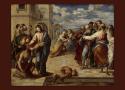
Jesus confronted the disciples’ distorted belief system: “It was not that this man sinned, or his parents, but that the works of God might be displayed in him” (John 9:3, ESV).
This poor blind beggar had suffered greatly throughout his life. We don’t know if he heard the disciples’ question to Jesus or not, but here’s what we do know: Jesus immediately defended him. Had this man sinned? Of course he had. And so had his parents. But Jesus clarified this wasn’t the cause of his suffering. Not only did Jesus challenge their simplistic view of suffering and ultimately point them to the greater purpose of his glory; he also fiercely defended a helpless man. Jesus was like a father stepping in front of a child: To get to him, you’ll first have to go through me.
What a Savior we have—forgiver of the sinner, helper of the helpless, defender of the defenseless. Yes, he came to expose the darkness of hearts, but he also came to shine the light of his hope and glory into the dark places of our pain (v. 5). It’s tempting to assume God looks at our pain and wonders, Why are you struggling? Don’t you see that I’m doing something through it?
But Jesus’ heart is empathetic, not critical. His life on earth shows us how much he still empathizes and grieves with us over the brokenness of the world. And everything he does brings him the greatest glory and us the greatest good (Rom. 8:28).
If we question that truth, we’ll constantly question his heart for us when we can’t understand his ways. But Psalm 56 assures us, “This I know, that God is for me” (v. 9, ESV). Our faith will be bolstered when it’s founded on the knowledge that God is undeniably, without a doubt, for us. //
Friend, your suffering isn’t God’s punishment, and it’s never pointless. Jesus is always at work in ways we can’t see in the moment. And it’s always for the purpose of showing the goodness and glory of God to us, in us, and through us.
Still, we think, If I just knew why, then I could endure. But what we ultimately need more than anything else is not the light that shines on the answers we want but the light of Jesus himself.
Jesus could have explained the man’s blindness, but he didn’t. That wasn’t what the man really needed. Yes, it would have been God’s undeserved grace to spare him from a gene mutation, disease, or whatever caused his blindness. His life would have been easier. Had that been the case, though, would he have come face to face with Jesus? Maybe not. He would have been content with his physical sight, despite walking in spiritual darkness. But in the hands of a powerful God, it was also an undeserved grace for the blind beggar’s life to become a remarkable story of redemption that led him (and those around him) to spiritual sight.
You may not see it now, but answers to your pain won’t bring ultimate comfort. Only nearness to Jesus will. Jesus wants what is best for you and has the power to bring it about.