
It turns out, pushing unrealistic green energy schemes onto low- and middle-income people at the expense of a safer fuel source was not only bad science, it was dangerous propaganda.


"There is no foundation to the climate scare... it's all based on models that don't work."
Carbon dioxide is an essential nutrient.
"I am firmly of the belief that the future will show that this whole hysteria over climate change was a complete fabrication."
– Dr. Patrick Moore, co-founder of Greenpeace.
"Game over. We are dealing with a fraud".
Geologist Prof. Ian Plimer obliterates the climate agenda in under two minutes.
"No one has ever shown that human emissions of CO₂ drive global warming… And if it could be shown, then you would have to show that the 97% of

Life on Earth is in crisis crop failure, social and ecological collapse, mass extinction. We have a moral duty to take action. These statements made by Extinction Rebellion reflect the climate alarmist narrative that has continued to escalate across the Western world. Hysteria over climate change can be seen throughout history, from the human sacrifices of the Aztecs to bring back rain, to the Salem witch trials to eliminate the women they blamed for crop failure during the little ice age.
Today the climate industrial complex is funded by trillions of dollars seeking to control what we buy, eat and where we are allowed to travel, all in the name of sustainability and achieving net zero carbon emissions. This fear campaign is rooted in the belief that we will not look into the data ourselves, but instead look to the governments and to the media to tell us what is true. //
Historical temperature records indicate that we are not in the climate crisis western governments claim. We are looking at a graph of the past 65 million years from NOAA. The Earth today seems to be in a particularly cool period; in fact the Earth is still coming out of an ice age. History demonstrates that life has existed and thrived in much warmer temperatures, and that temperatures have been much higher without the human influence of industrial CO2 emissions. //
Although the mainstream media has tried to alarm its consumers with the accelerating emissions of CO2, the Earth is actually in a CO2 famine. Current levels are about 423 parts per million; however in the past they have been at least a thousand parts per million and have likely reached 8,000 parts per million. //
This is how you do it. And she did it as a high school senior science project.
Paul Harvey's 1992 speech claimed climate change was a hoax in the making.
Global Greening From Higher CO2 Hits “Striking” New Heights | Chris Morrison, The Daily Skeptic
But the legacy media won’t tell you about it
Significant new evidence has emerged of widespread and significant increases in plant vegetation across the Earth due to the recent rise of the trace gas carbon dioxide in the atmosphere. //
The Spanish researchers do not quantify the amount of new vegetation but conclude that 38% of the world’s land surface shows significant vegetation change. It was found that 76% of the change total showed more greening and, interestingly, those areas with more plant life showed higher rates of additional growth. //
Far from being a politicised ‘pollutant’, CO2 is rightly known as the gas of life. A group of American scientists recently highlighted 2020 as an “historic landmark” since it registered as the greenest year in the satellite record from 2001 to 2020. //
The authors of a recent science paper, Charles Taylor and Wolfram Schlenker, recently found what they called a consistently large fertilisation effect of a 1 ppm increase in CO2, equating to a 0.4%, 0.6% and 1% higher yield for corn, soybean and wheat respectively.
https://t.co/f1xYhIwtQK

The mainstream economic narrative in the USA would have us believe that power blackouts are always a bad thing – just think of all that lost productivity! Think of the effect on the GDP!
So I was curious to see this video about the recent blackouts in Spain rack up millions of views on Instagram 👇
I think it resonated with people because it points towards a new narrative for society and the economy – one where joy & connection are prioritized over economic productivity. //
That's one of the things about living in Alaska that we all put up with, and most of us are willing to do so because, well, we live in Alaska. But we don't like it. It doesn't help us bond with our neighbors. There's no joy in a 12-hour blackout. No, we just hunker down, fire up our generators, light some candles, and stoke up our wood stoves to stay warm.
In other parts of the country, though, most people don't have generators or battery backups. These folks are just blacked out, and I can guarantee you that they see no "joy" in it.
Virtually every prescription from the climate-scold left involves us giving up something. They want us to give up our rural homes, they want us to give up our pickups and SUVs, they want us to give up our reliable natural gas and nuclear power plants for unreliable and low-density solar and wind power. They want us, in short, to surrender our prosperity, our modern technological lifestyle, all to prevent some fraction of one percent of a degree of warming over the next century. And now they admonish us to find joy in this? That's going to sell about as well as Kamala Harris's "campaign of joy." //
PubliusCryptus
3 hours ago
I think it resonated with people because it points towards a new narrative for society and the economy – one where joy & connection are prioritized over economic productivity.
Joy and connection? I see hunger and privation. //
Quizzical
3 hours ago
Whenever the power goes out for very many people, someone dies. Literally. Some people in relatively poor health are literally dependent upon electricity to keep powering the machines that keep them alive. Literally killing people is not something to be glossed over as no big deal. //
Peter Mohan
2 hours ago
As a retired NYC Firefighter I personally witness the joy of the 1977 blackout. Four deaths, hundreds injured, thousands arrested and 1600 buildings destroyed or looted.
Many of the businesses never returned to the poor neighborhoods that they had served. I’m looking forward to a heart attack so I can meet the dedicated doctors and nurses in the nearby emergency room.

Our southernmost continent is, we’ve been told, the suffocating canary in the global coal mine. The more ice loss in Antarctica, the greater trouble we’re in. So what do we make of a study which found that between 2021 and 2023, there was a record-breaking increase in the Antarctic Ice Sheet?
We mark it down as another in a long line of misses from the global warming zealots.
“Notably, four major glaciers in the Wilkes Land–Queen Mary Land region of East Antarctica reversed their previous pattern of accelerated mass loss from 2011 to 2020 and instead showed significant mass gain during the 2021 to 2023 period,” says an article in SciTechDaily summarizing the report from Tongji University researchers. //
Outerlimitsfan
an hour ago
Poor Antarctica. Once it separated from South America it was doomed. Before the separation, warm ocean current from near Equatorial regions were able to make it to the coast of Antarctica.
After separation, Antarctic Circumpolar Current formed and isolated the continent. Enabling a frozen wasteland instead of a rather pleasant climate and abundant flora/fauna.(except far interior regions)
Kind of wild how a narrow land bridge between two continents coming apart made such a massive difference. //
WhatNext
2 hours ago
". . .too many of the failed predictions on which the climate scolds base their arguments are not observable or measurable. Why? Because they rely too heavily on garbage-in, garbage-out computer models."
It's not "garbage-in" Ward. Computer modeling of "climate" is based on pre-programmed results set in the code. This is known in the computer industry as "hard-coding" aka "hide the decline". I know this because in 2009 the code for the climate models being used by The Royal Society (no less) was released into the wild and myself - along with thousands of other coders - read the actual code.
This is also the explanation for why the models never reflect the real world.
"Global warming or Climate-is-changing-we-are-all-going-to-die" is nothing but a scam. //
Cafeblue32
an hour ago edited
Antarctica Isn't Melting
It will, though. Eventually, if warming continues, which it should because of cycles in space, both poles will be ice free. It has happened a few times before. The Milankovitch Cycle is just one of many factors affecting climate. CO2 affects it barely at all compared to all the other controlling factors. The are several periods in the past where there was no correlation between C02 and warming or cooling at all.
The Milankovitch Cyle is, in a nutshell, this:
-
Orbital eccentricity-Earth revolves around the sun in a roughly circular orbit. But roughly every 100,000 years, its orbit becomes more eccentric and elliptical.
-
Obliquity variation-Earth Tilt- The next piece of the puzzle is obliquity. Right now, Earth’s obliquity is 23.5°. But during the Milankovitch Cycle, it varies from 22.1° to 24.5° and takes 40,000 years to complete a full cycle.
-
Axial precession- Axial precession is the movement of the rotational axis of Earth. According to the Milankovitch Cycle, precession has a cycle of roughly 23,000 years. Precession occurs because the Earth is not a perfect sphere. It flattens out at the poles and widens at the equator. In addition, the gravitational pull from the sun and moon causes precession.
To recap: The Milankovitch cycles are a set of predictable, periodic changes in Earth’s orbit and axial tilt that influence the planet’s climate over long periods of time. These cycles are thought to be responsible for variations in Earth’s climate, including ice ages and interglacial periods, as they affect the distribution of solar radiation received by the Earth’s surface.
Add in the magnetic fields and gravities of Mecury and Jupiter when in certain orbital alignments and a few dozen other factors and you have never ending climate change.

This just in: Carbon dioxide (CO2) is good for plants. In fact, plants can't live without it; the process of photosynthesis is how plants turn carbon and sunlight into sugars and carbohydrates - food. Whenever you eat a carrot, a potato, or a mess of collard greens, make sure to thank photosynthesis!
Now, there is a level of CO2 that we don't want. CO2 is a greenhouse gas; it's not as serious as methane or even water vapor, but runaway CO2 (from non-biological sources) is why Venus is a pressure cooker. But Earth is nowhere near that, and while through much of the planet's history it'd been warmer than now - sometimes a lot warmer - CO2 is, generally, a good thing. A little bit more CO2, according to some recent studies, is actually greening the planet. Watts Up With That's H. Sterling Burnett has the news. //
We're seeing some local evidence of this right now, right here in the Great Land. Our growing seasons are lengthening, slowly, due to slightly warmer temperatures, and Alaskan agriculture is expanding, to the point where the state legislature was considering the formation of a state department of agriculture. That didn't happen, but the slight warming we are experiencing - and, yes, the climate has been on a gradual warming trend since the last glaciation - has the potential to open up even more northern lands for agricultural use. //
Various analyses of the so-called “Social Cost of Carbon” calculations indicate global greening and its effects on agriculture alone may mean that the metric would be better labeled the Social Net Benefit of Carbon.
Global greening is an established fact, and this study is just one more data point of proof. //
Froge
7 hours ago edited
Venus is hot because the atmosphere is 92 times as dense as ours AND Venus gets 3x the energy from the sun as Earth.
The denser atmosphere explains most of it. We would have much higher temperatures too with the same composition but 100x denser. It is a stretch to blame it all on CO2.
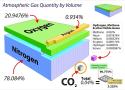
We have proposed that other planetary forces and phenomena, such as albedo, play a much larger role than CO2 in global warming or temperature variations.
The basic laws of physics and thermodynamics are not in support of efficient processing of CO2 using DAC. This is because dilute molecules of CO2 in air prefer to randomly mix and achieve maximum disorder or entropy per The Second Law of Thermodynamics.
Per Sherwood, trace amounts of CO2 molecules in an air mixture are difficult and costly to separate.
Capturing CO2 by DAC takes at least as much energy as that is contained in the fossil fuels that produced the carbon dioxide in the first place, per Keynumbers. //
Extra Thoughts: What Might Happen if CO₂ is Removed from the Air ?
-
If CO₂ is removed from the air in some significant quantity, CO₂ may outgas from the other sinks (land, oceans, lakes) to replace the removed CO₂. The reverse is true as well: when CO₂ is increased in the air, land/oceans/lakes) will uptake more CO₂ until a new quasi-equilibrium state is possibly reached over time.
-
A recent Nature Climate Change paper discusses the possible effect of CO₂ removal on the global carbon cycle. The paper notes that removing tons of carbon dioxide from the atmosphere might not be effective, because the shifting atmospheric chemistry could, in turn, affect how readily land and oceans release their CO₂, aka Le Chatelier’s principle. Another reference discusses the same concepts, and it is noted that both rely on synthetic models, like most climate change theory.
-
Handwaving synthetic climate models: a general rule that has been propagated is that for every tonne that ends up being emitted from fossil fuels or “land use changes”, a quarter gets absorbed by trees, another quarter by the ocean and the remaining half gets left in the atmosphere. I have not seen any hard data that backs this up. It basically says half the CO₂ emitted by man is left over and can’t be absorbed or re-equilibrated.
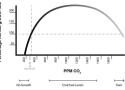
Photosynthesis is the process which involves a chemical reaction between water and carbon dioxide in the presence of light, to make food (sugars) for plants and as a byproduct releases oxygen in the atmosphere. Carbon dioxide currently comprises .04% (400 ppm) of the atmospheric volume. //
The ambient CO2 (naturally occurring level of CO2) concentration of 400 parts per million can occur in a properly vented greenhouse. However, the concentration is much lower than ambient during the day and much higher at night in sealed greenhouses. The carbon dioxide level is higher at night because of plant respiration and microbial activities. The carbon dioxide level may drop to 150 to 200 parts per million during the day in a sealed greenhouse, because CO2 is utilized by plants for photosynthesis during daytime. Exposure of plants to lower levels of CO2 even for a short period can reduce rate of photosynthesis and plant growth. Generally, doubling ambient CO2 level (i.e. 700 to 800 parts per million) can make a significant and visible difference in plant yield. Plants with a C3 photosynthetic pathway (geranium, petunia, pansy, aster lily and most dicot species) have a 3-carbon compound as the first product in their photosynthetic pathway, thus are called C3 plants and are more responsive to higher CO2 concentration than plants having a C4 pathway (most of the grass species have a 4-carbon compound as the first product in their photosynthetic pathway, thus are called C4 plants). An increase in ambient CO2 to 800-1,000 ppm can increase yield of C3 plants up to 40%-100% percent and C4 plants by 10%-25% while keeping other inputs at an optimum level. Plants show a positive response up to 700 to need of 1,800 parts per million, but higher levels of CO2 may cause plant damage (Figure 1). //
Adding CO2 one to two hours after sunrise and stopping two to three hours before sunset is the ideal duration of supplementation. Plants are photosynthetically active one to two hours after sunrise reaching peak at 2:00 to 3:00 p.m., followed by a decrease in the rate of photosynthesis. However, leafy greens and vegetables in a hydroponic system can be supplemented with CO2 and a grow-lighting system 24 hours a day. Seedlings supplemented with CO2 in flats will be ready to transplant one or two weeks earlier. Supplementing CO2 at an early age reduces the number of days to maturity and plants can be harvested earlier. Young plants are more responsive to supplemental CO2 than more mature plants.

Yes, that's right. We're paying for a group of "consultants" whose funding depends on their spreading climate panic. I'd love for anyone to show me in the Constitution where this is an enumerated power of any portion of the federal government. Hint: It isn't, but that's never stopped the left and big-government advocates (but I repeat myself) from spending more and more of our money. //
This group, mind you, has a defined budget nearing $2 billion, and, as I wrote in March, takes money from a variety of government sources:
There are reports that funding from our federal government to ICF runs as high as $7.4 billion. //
There does not, as of this writing, appear to be any indication that the DOGE or the Trump administration has their eyes on this waste. That needs to change; after all, a billion here, a billion there, and pretty soon we're talking real money. //
anon-7lqi
9 hours ago
It starts as a movement, evolves into a business then degenerates into a racket. //
Froge
8 hours ago
That is the research racket for everything though. If I wanted to study the Western Sparrow, just to find out it range and nesting habits etc, and came to the conclusion, it is an interesting bird and is doing just fine - I will never receive another grant to study my bird. So even if things are going well, I will have to write pages and pages of what could go wrong, and it is easy to glom onto Global Warming as the problem. Government grants are predisposed to award people who discover problems, if it isn't a hard science. And if the problem is really big, the government loves it because they get to set up a department to help fix the problem.
So that is the racket with everything. Environmental studies, nutrition studies (though with nutrition, "we don't know but it could cause cancer heart disease and even death" is more likely than GW) medical studies, the works. And the studies don't even have to be true, as we learned with the Alzheimer's plaque studies which were bogus but led to years of fake research accusing aluminum from frying pans and other things that "cause the plaque."
According to ESA, Sentinel-6, one of the most advanced altimetry satellites, has a sea surface height measurement accuracy of <4 cm. NASA echoes similar numbers, claiming satellite altimetry achieves 2.5 to 4 cm accuracy over the global oceans.
So let’s be clear: they’re detecting micron-scale accelerations using instruments with centimeter-scale noise. That’s a factor of 1,000 between the noise and the signal. Even with years of averaging, extensive noise filtering, and meticulous data modeling, this veers between pseudoscience at best and scientific fraud at worst. //
Scott Simmons @sjsimmons
·
1h
3/ The analysis is based on thousands of measurements from satellites, and uncertainty decreases with =SQRT(N). So the measurement error is much larger than the error of the mean GMSL value. With your Ph.D. in earth science, you certainly learned this. You're being dishonest.

That, folks, is the climate panic-mongers' entire agenda in a nutshell - flawed analysis, lack of full disclosure, questionable science and mathematics, and, as noted, the models are junk. //
But the best part, of course, is that the local people, folks who live near the construction site, got involved. It may have started over concern of messing up their ocean views, but it swiftly became more than that. People looked at the math, they looked at the numbers and the analysis from Shell New Energies and EDF Renewables, who were backing the project, and they didn't like what they saw.
They organized, filed a challenge against the permit, and won. //
The climate-industrial complex is finally facing a breeze it can’t spin.
“To think that we can draw some useful analogies from history dramatically underestimates the novelty and scale of the climate challenge.”[2]
“In the contest between geopolitics and sustainable climate policies, the former takes precedence.”[3]
Starting in the early 1980s, I have spent my entire professional life studying climate change, as well as teaching, writing and speaking about it in universities, conferences, and public forums around the world—in 43 countries at the latest count. With such a professional and personal investment in the idea of climate change, it is not surprising that for a long period I uncritically absorbed the notion that climate change represented the pre-eminent challenge facing humanity in the twenty-first century.
Since first immersing myself in the topic in the 1980s, and subsequently being part of the scientific and public story of climate change in the 1990s and 2000s[4], I was easily convinced that the growing human influence on the world’s climate would be a reality that all nations would increasingly need to confront, a reality to which their interests would necessarily be subservient and that would be decisive for shaping their development pathways. For more than half of these 40 or so years, it seemed to me self-evident that relations between nations would forcibly be re-shaped by the exigencies of a changing climate.
But now, in the mid-2020s, I can see that I got this the wrong way round. And I can also see why this was so. Rather than geopolitics having to bend to the realities of a changing climate, the opposite has happened. //
Now, 30 years later, it is the geopolitical truth that power and interests win out. Climate is not the only thing that is changing through our lifetimes, and perhaps not the most important thing. Technology, cultural values, the centres of political, economic and military power have all changed remarkably since I first started studying climate change 40 years ago; and the rules, cohesion and effectiveness of the international order that I assumed were eternal are being seriously called into question. I now see the need for a deeper reading of political realism and power, that goes beyond seeing science as a coercive force that trumps geopolitics, beyond appeals to a superficial cosmopolitanism. To use the language of Jason Maloy at Louisiana University, climate change is neither an emergency or a crisis; it is a political epic, “a process of collective human effort that features gradual progression through time, obscure problem origins, and anticlimactic outcomes.”[25]
The best that we can say is that the world will continue slowly to decarbonize its energy system and, at the same time, the Earth will continue slowly to warm. And societies will continue to adapt to evolving climate hazards in new ways, as they have always done, with winners and losers along the way.
© Mike Hulme, January 2025

The result is a press that cheers policies antithetical to its audience’s interests. International lenders, swayed by the climate mob, tie financing to “renewable” mandates. The World Bank, once a financier of coal plants in Africa, now balks at funding anything that emits demonized carbon dioxide, leaving countries like Mozambique struggling to exploit their gas fields.
In Ghana, where power outages still plague daily life, the government hesitates to tap coal reserves, wary of an international backlash stoked by media outrage. In Kenya, where coal in the Mui Basin could power millions, local outlets echo The Guardian’s disdain for “dirty energy,” ignoring how such resources could slash electricity costs for the rural poor.
In South America, pressure from green-leaning non-governmental organizations – amplified by outlets like O Globo – has stalled oil projects in Ecuador, even as indigenous communities plead for the jobs and infrastructure they bring. In Peru, where natural gas discoveries promise economic liftoff, El Comercio fixates on melting glaciers, marginalizing rural natives still cooking over open fires.
In many developing countries, natural gas could ease energy prices, but policymakers bowed to “green pressure” and left citizens to shoulder rising costs. The poorest suffer most from higher bills, fewer jobs, and dimmer futures.
Popular news reporting no longer empowers with facts but incestuously recounts nonsense that leaves the developing world with the burden of a climate crisis fabricated by self-dealing globalists. //
People of the developing world must demand better or have their hopes buried by false prophets. And journalists in Africa, South America, and Asia must break free from the echo chamber of the climate-industrial complex. It is time to ask tough questions – the basis of critical thinking and honest reporting.

The left loves to talk about how they are all about "trusting the science," but one of the fundamentals about science is this: When the data contradicts your hypothesis, you change your hypothesis. The Biden administration certainly didn't do this; they would rather hide inconvenient data.
Case in point: A recent Daily Caller exclusive reveals that the Biden administration buried an inconvenient liquid natural gas (LNG) export study that would have removed the primary reason for that administration's LNG export ban. //
The thumbnail? The Biden administration had a draft report in hand that contradicted their claims that halting LNG exports would result in more greenhouse gas emissions. The draft report indicated the opposite was true. So the Biden Department of Energy round-filed the report. //
The first layer of this stinker is in the deliberately deceptive practice. The administration made a claim to justify the damage the export ban was doing to domestic energy development; that claim was not only false, but the administration knew it was false, they had data in hand showing it was false, and they went ahead and implemented the ban anyway, in the name of "climate change."
The second layer of this stinker is that the Biden administration hid the results of a taxpayer-funded study and then lied to the American people about it.
And the final layer? They completely disregarded the standard Democrat shibboleth about "trusting the science," but then, Democrats have never been about the science - about the data. They are about the agenda, and this episode is just one more example of many.

Climate change alarmist Michael Mann's ill-conceived lawsuit against the online critics continued to go pear-shaped Wednesday as a federal judge sanctioned Mann and his legal counsel for acting in "bad faith." That, of course, could easily describe Mann's entire career as a climate grifter. "Here, the Court finds, by clear and convincing evidence," wrote DC Superior Court Judge Alfred Irving, Jr., (George W. Bush appointee), "That Dr. Mann, through [his lawyers] Mr. Fontaine and Mr. Williams, acted in bad faith when they presented erroneous evidence and made false representations to the jury and the Court regarding damages stemming from loss of grant funding."
The saga began in 2012 when Mann, bruised from the email leak that seemed to indicate his famous "hockey stick" graph was a deliberate fraud (remember "hide the decline?"), decided to go after a handful of particularly vocal critics who dubbed him the "Jerry Sandusky of climate change," a hat tip to Penn State's legendary football coach. They were the Competitive Enterprise Institute, a CEI blogger Rand Simberg, National Review, and NR contributor Mark Steyn. //
The fact that the jury awarded him only $2 in actual damages and $1,001,000 in punitive damages (send a message!) supports this interpretation — The defense won on merits, and Mann won on the framing and the politics.
There was celebration on the left: Michael Mann climate scientist wins defamation case: NPR.
But it didn't last long. Last Tuesday, the trial judge, citing the due process clause of the Fifth Amendment, reduced the punitive damages against Steyn to $5,000. But the hammer really fell Wednesday when the judge found that Mann and his attorney had lied about Mann's financial losses to inflate the jury verdict. //
Now Mann and his lawyer will be sanctioned.
I'd like to say that Mann lost this trial, but I'm not sure that's the case. He'll find deep-pocketed friends to pay off the money he lost. He's still employed at Penn State. Simberg and Steyn lost 13 years of their lives and have been largely sidelined from climate change debates. I have no knowledge of their finances, but I'm willing to bet they suffered a lot more than Mann. And Mann's suit has served the purpose for which it was intended. I didn't write about half of the very witty things I wanted to write about Mann because I don't have the time or money to fight off even a bullsh** lawsuit by someone with Mann's backing and resources. I'm sure others have made the same calculation.
The sanctions for lying will be mildly embarrassing to Mann, but what survives are the two judgments for defamation he won, which will serve as a precedent in the future.

Pete Hegseth @PeteHegseth
·
John is, of course, correct.
The @DeptofDefense does not do climate change crap.
We do training and warfighting.
Haley Britzky @halbritz
In response to a list of questions from CNN about military readiness as it relates to climate programs, Pentagon Spox John Ullyot said “Climate zealotry and other woke chimeras of the Left are not part” of DOD’s mission.
8:09 PM · Mar 9, 2025 //
The Army set a deadline of 2035 for all of its administrative vehicles to be electric and 2050 for tactical vehicles. //
If climate change is real, it will be addressed at home and abroad by agencies not called the Department of Defense. When the Defense encounters it, it will come in the form of weather and terrain; how we got there will be an academic exercise. Secretary Hegseth is right; his focus has to be on training troops, structuring forces, modernizing equipment, and building warrior spirit to win wars, something Defense has gotten out of the habit of doing over the last 41 years. //
anon-ymous99
9 hours ago
Y’know what’s bad for the environment? Destructive wars, that wouldn’t have started if a strong President and militarily focused US Armed Forces were in place.
Prevent those and the environment will benefit.