
Lovell was the first person to fly to the Moon twice.
Robert Pearlman – Aug 8, 2025 9:28 PM | 85
Statistical Ars Legatus Legionis
15y
54,490
pseudonomous said:
I will presume that both you and the NASA guys got the math right and that for a polar landing NRHO makes sense. But if they are really going to "question all requirements", we have to admit the possibility that they might fly Artemis IV or V as an equatorial region landing, do we not?
For Orion as a crew vehicle it doesn't matter. Orion has 1,300 m/s of DeltaV of which 300 m/s is allocated for docking, station keeping, and course corrections. So it is limited to orbits which require <1000 m/s to enter AND exit (NRHO is about 900 m/s). Even equatorial LLO with a 3.5 day loiter (13 days + surface time for total mission time) is a minimum of 835 m/s * 2= 1670 m/s. Loiters improve the worst case scenario but only make a small impact on the best case ones. Even if you could modify the Centaur V to have 3 day endurance and cryocoolers and use it for part of LOI (which we shouldn't that will end up being a $5B 10 year boondoggle) it has in the ballpark of 500 m/s excess DeltaV so you are likely still short unless you dip into your reserves.
Longer term with a better crew vehicle you might have the option to go to LLO Direct via fast insertion but it still isn't a slam dunk option with reusable landers as your example bring up. If you have reusable crew landers LLO as a staging point is made worse if you change landing locations. There isn't one LLO and as such to move between LLOs you need to do a plane change. The only cost effective way to make a plane change is to burn to a highly elliptical orbit you know like how NRHO is highly elipitcal. Every mission requires more prop, has more boiloff, and when changing landing sites you also pay a plane change tax. One feature of NRHO is due to its high perilune you can reach every spot on the moon with a consistent DeltaV cost. This makes mission planning a lot easier. You could land near Apollo 11 on the 70th anniversary if you wanted to. It is no harder (or easier) from NRHO than the poles or any other landing site.
To be clear these nuanced challenges mostly apply to the staging point for a crewed mission. If you are fine with adding 15+ day loiter time you can drop heavy cargo on the south pole by going LLO quite cheaply. If it is an expendable cargo lander efficiency doesn't really matter because it is a one way trip so Direct LLO without a loiter becomes viable.
The reality though is it is complicated and it depends on exactly what mission, to exactly where, how long you are willing to loiter, is the lander reusable and is it crewed. Another wrinkle is if it is crewed are the crew in their own vehicle or pushed there by the tanker. If the crew is riding on the tanker than fast insertion is required which means your crew made the thousands of tons of prop more expensive as well. Likely to the dismay of people in NASA doing this kind of analysis the public discourse though has largely been "NRHO is stupid derp derp derp".
Ajax81611 Wise, Aged Ars Veteran
5y
166
Subscriptor
NASA missed a huge soft drink sponsorship opportunity here by not naming it the Perfect Elliptical Polar Stable Insertion with Coplanar Line of Apsides.
Statistical Ars Legatus Legionis
15y
54,490
michaeltherobot said:
You clearly know what you are talking about, so could you ELI5 why polar LLO costs more than equatorial LLO? My intuition that they are the same comes from KSP, in which, soon after leaving Earth orbit, you plan a miniscule burn to adjust lunar insertion from coming around the side to coming over the top.
Of course, in both those cases I then have to decelerate hard at perilune to be captured. Perhaps the flight paths NASA is considering have some way to save dV vs my hard deceleration, which don't work for polar orbits?
The added cost comes from the plane change and plane change at high velocity (low orbit) are expensive. You CAN do something similar to what you describe it just takes longer potentially much longer. The higher the perilune the cheaper the plane change becomes but the longer it takes to reach the perilune. You drop yourself into a highly elliptical orbit around the moon at the same plane as the initial orbit. You then ride up to the perlune, raise the plane to 90 degrees and lower the perilune to circular (decelerate hard).
NASA wouldn't consider doing a plane change in Earth orbit because then you can have a free return trajectory which is a risk reduction factor.
So the tradeoff of DeltaV vs time.
Compare this map to the one in the previous post.
https://arstechnica.com/civis/attachments/1772816223709-png.129833/
1772816223709.png
Significant cheaper but it adds a 3.5 day loiter riding up to the vey high perilune to become as cheap as NRHO (including the transit). To have insertion and exit cost that are 2x this you would need the same loiter on the way back. In KSP things like mission duration are quite cheap and excessive risk doesn't matter but yeah same basic concept and math.
To be clear this is really only an issue for an occupied crew vehicle. If you add a 15 day loiter then the phase change becomes essentially free. For prestaging the lander or the tanker to refuel it after a sortie neither would be harmed by a 30 day longer mission. So if LLO was used as a staging point, which I don't think it will, then there would be mission choices by SpaceX and BO on how much LLO loiter vs round trip DeltaV for sending that tanker to meet lander with the prop it needs.
Statistical Ars Legatus Legionis
15y
54,490
Polar LLO is really hard to get into. Even with a less dumpy crew vehicle bringing it all the way day to Polar LLO and back is dubious. I know know it runs against the popular trend of everything NASA does is stupid but the math doesn't lie.
I got this some years ago when NASA removed the sensitive restriction. Not sure it is available anymore. NASA is pretty bad about maintaining public access to old reports. It was created in the analysis requirements for Constellation.
A direct LLO requires a huge amount of DeltaV to enter and leave when talking about polar landing sites. This is because you need to do an up to 85 degree plane change Exactly how much depends on where exactly you are landing.
https://arstechnica.com/civis/attachments/1772812012884-png.129830/
1772812012884.png
It is at max of 1,313 m/s for the LOI and the south pole landing sites are in those 1,000+ m/s circles. There is a reason Apollo landed in equatorial regions. The LOI for Apollo 11 was 900 m/s.
Now if it takes 1313 m/s to get into LLO then it will take 1313 m/s to get back out. So we are talking 2,626 m/s. Throw in a couple hundred m/s for docking, course corrections (burns are never perfect) and safety margin and 3,000 m/s is a reasonable budget. You can reduce DeltaV somewhat by having a long loiter in LLO which reduces the prohibitive cost of a plane change by coasting up to the apolune (the same way GEO sats coast up to apogee in a GTO orbit but you now largely erased the big advantage of LLO over NRHO in that it is faster for crew missions.
Apollo did consider a polar landing for one of the late Apollo missions but it was canceled due to the higher risk of LoM and LoC. To get the margins needed the Apollo CSM would need to dwell in an intermediate orbit for an extra 2.8 days on the LOI and 1.6 days on the TEI. So an extra four days to the mission timeline. Technically Orion with its 1.3 km/s DeltaV "could" get to Polar LLO but it would require a loiter time of ... 6 days. That is 6 days on the way in and another 6 on the way out. You could make it asymmetrical to reduce risk like Apollo did but it would still be around 12 days loiter on top of 6 days transit on top of 6+ days surface mission.
For reusable landers LLO has another issue. It is so deep in the moon gravity well that while the lander itself uses less propellant you have to bring propellant to the lander. The propellant you bring to the lander requires more DeltaV so that propellant is requiring more propellant. So your lander uses less prop but yout tug/tanker uses more. Total prop usage per mission increases not decreases. A crew landing is essentially all propellant on a first order simplification.
TLDR: NASA knows what they are doing. NRHO got maligned by its association with porkish SLS & Orion (even by me in the past). NRHO is not a terrible orbit for a reusable architecture. It has numerous advantages to include that it is very cold. That is important if you have reusable cryogenic landers trying to minimize boiloff waiting months for crews to arrive. Your lander will point its nose at the sun to reduce thermal load. However in LLO like LEO the moon is a thermal mirror. Thermal load is substantially worse. Using NRHO as a staging point does not require a gateway station.
Even in the analysis above the alternate orbit is all around worse except saving 3% to 6% prop.


This is the thermal IR (LWIR) of the total lunar eclipse. A 12" Newtonian has been used as fore-optics. Pseudo color to enhance the details. The pictures shows some younger craters are very bright when the sun is temporarily blocked by the Earth.
MST 20260303 03:35 Partial Lunar Eclipse Thermal Vs. Visible (HDR) Fun to see the dramatic difference on the surface in difference wavelength ranges
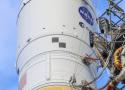
“Accessing and remediating any of these issues can only be performed in the VAB.” //
normally butters Ars Praefectus
19y
5,319
georges said:
It's amazing to me that there isn't a retractable maintenance arm on the launch stand. The ground hardware all cost sooooo much money but no one though to add this?
Apollo had a Mobile Service Structure at each pad.
Shuttle had a Rotating Service Structure at each pad.
Ares/SLS were based on the Clean Pad concept. NASA wanted commercial launch providers to agree to use the pads at LC-39 (as well as the VAB, crawler-transporters, and crawlerway infrastructure) between NASA exploration missions. Each launch vehicle type from each launch provider would have its own Mobile Launcher Platform including the umbilical tower. There weren't going to be any vehicle-specific support structures, just a clean pad to share.
During Ares V development, rollout weight became a major concern. Unlike Saturn V, Ares V and SLS have huge SRBs loaded with massive amounts of solid propellant. The weight of the stack including the launch platform, umbilical tower, and crawler was pushing the limits of what the crawlerway foundations can support. They were worried it would be so heavy that it would sink into the Florida swamp on the way to the pad.
These factors contributed to the (poor) design choice to minimize the scope of the umbilical tower and rely heavily on the VAB for service access. //
aggressive-trail Smack-Fu Master, in training
1m
85
woodbourne said:
Time to cancel the program. There's nothing on the moon that we need right now. Let the Chinese waste the money on useless rockets and wait for there to be an economic reason for going there. We're basically using technology from the 1940's to accomplish something that has no economic payback using the same corrupt defense contractors and the same stupid procurement rules that we had 60 years ago. Enough, please stop this project.
And here I was, thinking that these arguments from the 60s would have been settled by now. Beyond the fact that the economic case for Luna can be quantifiably justified today, I’d argue the biggest argument is what it provides us in terms of science.
The far side of the moon is shielded from Earth’s radio interference, making it the most valuable real estate in the solar system for radio astronomy and deep space communication infrastructure.
Scientists want to build LF radio telescopes there to detect signals from the "Dark Ages", the period after the Big Bang but before the first stars formed. These signals are blocked by Earth’s ionosphere. This environment is also perfect for tracking deep-space objects without local interference.
If you don’t care about anything else, at least care about that. //
rhgedaly Ars Scholae Palatinae
8y
1,290
First hydrogen, then helium. Hope the batteries that will need recharging aren't lithium. Damn the periodic table! //
Chuckstar Ars Legatus Legionis
23y
37,070
Subscriptor
dehildum said:
That table gives them 100+ reasons for launch delays and more profits for the contractors.I don’t remember any Apollo, Gemini, or Mercury vehicle needing to be returned to the VAB….
Apollo 16 was moved back to the VAB, after a fuel tank in the service module was damaged during testing (over-pressurized).
But the reason that was the only time they had to do that in Apollo was not because the Saturn was so much better designed, but because the Mobile Service Structure provided access to the full stack, and they only needed the VAB if a repair required taking the stack apart, which was necessary for the Apollo 16 repair.
All the assembly/integration at the Cape for Gemini and Mercury were done on the launch stand. The VAB was purpose-built for Apollo-Saturn. //
MilesArcher Ars Centurion
5y
294
Subscriptor
BCGeiger said:
🎼Hanger Queen, 🎶
🎼Should’a cancelled it back in ‘17🎶
🎼Hanger Queen🎶
🎼They keep pouring cash into this bad machinee🎶
Man, you had the opportunity to rhyme hydrazine and missed it.
jack1983 Smack-Fu Master, in training
12y
93
The Lurker Beneath said:
Do it on a windy day?
There are risks with too high wind speeds as well. High airflow causes static buildup and turbulence. Hydrogen requires very little ignition energy (well below 1mJ at stoichiometric conditions). So even a gust of wind can set off a combustible mixture.
Cryogenic hydrogen is an absolute nightmare to work with.
paulfdietz Ars Scholae Palatinae
7y
1,168
Using hydrogen as the fuel in the first stage was never a good idea. The density is just terrible, making the first stage much larger. Because the first stage is disposed of so quickly, Isp is less important; what's more important is "density impulse" (density x Isp), and LoX/LH2 is inferior to LOX/hydrocarbon by that metric.
Low density also makes the engines more expensive, as more pumping power is needed for a given thrust. //
paulfdietz Ars Scholae Palatinae
7y
1,168
pokrface said:
Right, but the "first stage" of SLS (and STS) is properly the SRBs.
It's more like the first "half stage". What matters for the argument is the velocity at which a stage is done. Even with the SRBs there, that's not that high (although higher than say the Falcon 9, which ends the stage 1 burn at an unusually low velocity so it can be recovered.)
The SRBs do allow the thrust of those LH2 engines to be somewhat lower, since they don't have to lift the fully fueled stack off the pad themselves. By the time the SRBs drop some propellant is gone. This ameliorates to some extent the relatively poor thrust/weight ratio of the engines (73.1 vs 184 for the Merlin 1D.)

Harrison Schmitt, speaking with a NASA interviewer in 2000, said his productivity in the Apollo suit “couldn’t have been much more than 10 percent of what you would do normally here on Earth.”
“You take the human brain, the human eyes, and the human hands into space. That’s the only justification you have for having human beings in space,” Schmitt said. “It’s a massive justification, but that’s what you want to use, and all three have distinct benefits in productivity and in gathering new information and infusing data over any automated system. Unfortunately, we have discarded one of those, and that is the hands.”
Schmitt singled out the gloves as the “biggest problem” with the Apollo suits. “The gloves are balloons, and they’re made to fit,” he said. Picking something up with a firm grip requires squeezing against the pressure inside the suit. The gloves can also damage astronauts’ fingernails.
“That squeezing against that pressure causes these forearm muscles to fatigue very rapidly,” Schmitt said. “Just imagine squeezing a tennis ball continuously for eight hours or 10 hours, and that’s what you’re talking about.”
Barratt recounted a conversation in which Schmitt, now 90, said he wouldn’t have wanted to do another spacewalk after his three excursions with commander Gene Cernan on Apollo 17.
“Physically, and from a suit-maintenance standpoint, he thought that that was probably the limit, what they did,” Barratt said. “They were embedded with dust. The visors were abraded. Every time they brushed the dust off the visors, they lost visibility.”
Getting the Artemis spacesuit right is vital to the program’s success. You don’t want to travel all the way to the Moon and stop exploring because of sore fingers or an injured knee.
“If you look at what we’re spending on suits versus what we’re spending on the rocket, this is a pretty small amount,” Rubins said. “Obviously, the rocket can kill you very quickly. That needs to be done right. But the continuous improvement in the suit will get us that much more efficiency. Saving 30 minutes or an hour on the Moon, that gives you that much more science.”
“Once you have safely landed on the lunar surface, this is where you’ve got to put your money,” Barratt said.

Sunrise, sunset, moon phase


Darkness fell over Mare Crisium, ending a daily dose of dazzling images from the Moon. //
Firefly Aerospace's Blue Ghost science station accomplished a lot on the Moon in the last two weeks. Among other things, its instruments drilled into the Moon's surface, tested an extraterrestrial vacuum cleaner, and showed that future missions could use GPS navigation signals to navigate on the lunar surface.
These are all important achievements, gathering data that could shed light on the Moon's formation and evolution, demonstrating new ways of collecting samples on other planets, and revealing the remarkable reach of the US military's GPS satellite network.
But the pièce de résistance for Firefly's first Moon mission might be the daily dose of imagery that streamed down from the Blue Ghost spacecraft. //
Dtiffster Ars Praefectus
9y
3,725
Subscriptor
TylerH said:
Given the amount of fuel needed to return to Earth, probably somewhere around the middle.
The prop to lift back off is at least 1.1 times the dry mass + up mass, but 78% of that is LOX which goes in the bottom tank. We don't know if the liftoff prop will just be in the tanks or in some kind of a really large header in the tank (as a boil off mitigation), but I would assume if there are headers they will be at or near the bottom of the of their respective tanks. Thus atleast 41% of the landed mass would be LOX and be very near the bottom. The legs and engine section will also be fairly substantial and very low. The methane for liftoff would be another 11% and only about a third of the way up the rocket. Much of the rest of the mass is tankage, but that center of mass is also probably no more than a third of the way up. The habitat section and equipment is high up, but it's less than 15% of that lift off mass. The CoM of the whole thing on landing/liftoff is probably only 25-30% up from the surface. It is much less tippy than your initial intuition would lead you to believe. //
https://www.youtube.com/watch?v=M2P-z_cXsOs
https://youtu.be/IpA9DORDkeE?si=oNmwnzJs6_UwzjPb
https://www.flickr.com/photos/fireflyspace/albums/72177720313239766/with/54395270843

Intuitive Machines announced on Friday morning that its Athena mission to the surface of the Moon, which landed on its side, has ended.
"With the direction of the Sun, the orientation of the solar panels, and extreme cold temperatures in the crater, Intuitive Machines does not expect Athena to recharge," the company said in a statement. "The mission has concluded and teams are continuing to assess the data collected throughout the mission."
Athena, a commercially developed lander, touched down on the lunar surface on Thursday at 11:28 am local time in Houston (17:28 UTC). The probe landed within 250 meters of its targeted landing site in the Mons Mouton region of the Moon. This is the southernmost location that any probe has landed on the Moon, within a few degrees of the lunar south pole. //
NASA has accepted that these commercial lunar missions are high-risk, high-reward. (Firefly's successful landing last weekend offers an example of high rewards). It is paying the companies, on average, $100 million or less per flight. This is a fraction of what NASA would pay through a traditional procurement program. The hope is that, after surviving initial failures, companies like Intuitive Machines will learn from their mistakes and open a low-cost, reliable pathway to the lunar surface. //
Fortunately, this is unlikely to be the end for the company. NASA has committed to a third and fourth mission on Intuitive Machines' lander, the next of which could come during the first quarter of 2026. NASA has also contracted with the company to build a small network of satellites around the Moon for communications and positioning services. So although the company's fortunes look dark today, they are not permanently shadowed like the craters on the Moon that NASA hopes to soon explore.

"Every single thing was clockwork... We got some Moon dust on our boots." //
Firefly Aerospace became the first commercial company to make a picture-perfect landing on the Moon early Sunday, touching down on an ancient basaltic plain, named Mare Crisium, to fulfill a $101 million contract with NASA.
The lunar lander, called Blue Ghost, settled onto the Moon's surface at 2:34 am CST (3:34 am EST; 08:34 UTC). A few dozen engineers in Firefly's mission control room monitored real-time data streaming down from a quarter-million miles away.

This unusual photograph, taken during the second Apollo 12 extravehicular activity (EVA), shows two U.S. spacecraft on the surface of the moon. The Apollo 12 Lunar Module (LM) is in the background. The unmanned Surveyor 3 spacecraft is in the foreground. The Apollo 12 LM, with astronauts Charles Conrad Jr. and Alan L. Bean aboard, landed about 600 feet from Surveyor 3 in the Ocean of Storms. The television camera and several other pieces were taken from Surveyor 3 and brought back to Earth for scientific examination. Here, Conrad examines the Surveyor's TV camera prior to detaching it. Astronaut Richard F. Gordon Jr. remained with the Apollo 12 Command and Service Modules (CSM) in lunar orbit while Conrad and Bean descended in the LM to explore the moon. Surveyor 3 soft-landed on the moon on April 19, 1967.
The Dark Ars Tribunus Angusticlavius
8y
11,841
The lander's four shock-absorbing legs have some give, sort of like the crush zone of a car, according to Will Coogan, Firefly's chief engineer for the Blue Ghost lander. The legs have an aluminum honeycomb material inside, and they connect to bowl-shaped footpads with a ball-socket joint to give the spacecraft some flexibility in case it comes down on a slope or a rock.
That's basically a copy of the Apollo landers. Apollo had crushable aluminum honeycomb in the legs and bowl-shaped feet attached to the legs with ball joints. The statistical analysis was that Apollo's system had a 99.9% of not fully crushing the honeycomb as long as the landing velocity was below 4 feet per second horizontally and 7 feet per second vertically (1.22 m/s and 2.13 m/s). All of the landings were well under those velocities:
https://arstechnica.com/civis/attachments/1740667805423-png.103726/
NASA Technical Note TN D-6850 Apollo Experience Report - Lunar Module Landing Gear Subsystem by William F. Rogers (June 1972).
D-6850 Apollo Experience Report - Lunar Module Landing Gear Subsystem
https://ntrs.nasa.gov/api/citations/19730010151/downloads/19730010151.pdf. //
EarendilStar Wise, Aged Ars Veteran
8y
148
SkyeFire said:
Lunar conditions are brutal. Two weeks of brutal daylight (plus unfiltered solar radiation) followed by 2 weeks of total darkness. A few lunar probes have managed to survive the night and reboot once they got some sunlight again, but none of them survived more than a few day/night cycles. The thermal swings tend to destroy the electronics and power systems.
This entire bath and forth made me realize I don’t know how the temperature swings of the moon and Mars differ. I was reading thinking “How is this thermal swing different than Mars, a place we operate electronics for far more heat cycles than this?”.
Allow me to share what I found:
Commonly accepted average temps for Luna:
-180°C to 105°C
Mars:
-130°C to 22°C
That’s quite the difference!
Does anyone know why Mars nights are warmer? Is it mostly due to ground surface absorption of radiation, and not losing most of it until the next day cycle? The (limited) atmosphere retaining some heat? ///
Shorter nights on Mars

The math that makes refueling from the Moon appealing is pretty simple. "As a rule of thumb," write the authors of the new study on the topic, "rockets launched from Earth destined for [Earth-Moon Lagrange Point 1] must burn ~25 kg of propellant to transport one kg of payload, whereas rockets launched from the Moon to [Earth-Moon Lagrange Point 1] would burn only ~four kg of propellant to transport one kg of payload." Departing from the Earth-Moon Lagrange Point for locations deeper into the Solar System also requires less energy than leaving low-Earth orbit, meaning the fuel we get there is ultimately more useful, at least from an exploration perspective. //
the researchers decided to focus on isolating oxygen from a mineral called ilmenite, or FeTiO3. It's not the easiest way to get oxygen—iron oxides win out there—but it's well understood. Someone actually patented oxygen production from ilmenite back in the 1970s, and two hardware prototypes have been developed, one of which may be sent to the Moon on a future NASA mission.
The researchers propose a system that would harvest regolith, partly purify the ilmenite, then combine it with hydrogen at high temperatures, which would strip the oxygen out as water, leaving behind purified iron and titanium (both of which may be useful to have). The resulting water would then be split to feed the hydrogen back into the system, while the oxygen can be sent off for use in rockets.
(This wouldn't solve the issue of what that oxygen will ultimately oxidize to power a rocket. But oxygen is typically the heavier component of rocket fuel combinations—typically about 80 percent of the mass—and so, is the bigger challenge to get to a fuel depot.). //
The team found that almost all of the energy is consumed at three steps in the process: the high-temperature hydrogen reaction that produces water (55 percent), splitting the water afterward (38 percent), and converting the resulting oxygen to its liquid form (5 percent). The typical total usage, depending on factors like the concentration of ilmenite in the regolith, worked out to be about 24 kW-hr for each kilogram of liquid oxygen. //
Obviously, we can build larger arrays than that, but it boosts the amount of material that needs to be sent to the Moon from Earth. It may potentially make more sense to use nuclear power. While that would likely involve more infrastructure than solar arrays, it would allow the facilities to run around the clock, thus getting more production from everything else we've shipped from Earth.

Lunar exploration is undergoing a renaissance. Dozens of missions, organized by multiple space agencies—and increasingly by commercial companies—are set to visit the Moon by the end of this decade. Most of these will involve small robotic spacecraft, but NASA’s ambitious Artemis program aims to return humans to the lunar surface by the middle of the decade.
There are various reasons for all this activity, including geopolitical posturing and the search for lunar resources, such as water-ice at the lunar poles, which can be extracted and turned into hydrogen and oxygen propellant for rockets. However, science is also sure to be a major beneficiary.
The Moon still has much to tell us about the origin and evolution of the Solar System. It also has scientific value as a platform for observational astronomy. //
Several types of astronomy would benefit. The most obvious is radio astronomy, which can be conducted from the side of the Moon that always faces away from Earth—the far side.
The lunar far side is permanently shielded from the radio signals generated by humans on Earth. During the lunar night, it is also protected from the Sun. These characteristics make it probably the most “radio-quiet” location in the whole solar system, as no other planet or moon has a side that permanently faces away from the Earth. It is, therefore, ideally suited for radio astronomy. //
At that time, most of the matter in the Universe, excluding the mysterious dark matter, was in the form of neutral hydrogen atoms. These emit and absorb radiation with a characteristic wavelength of 21 cm. Radio astronomers have been using this property to study hydrogen clouds in our own galaxy—the Milky Way—since the 1950s.
Because the Universe is constantly expanding, the 21 cm signal generated by hydrogen in the early Universe has been shifted to much longer wavelengths. As a result, hydrogen from the cosmic “dark ages” will appear to us with wavelengths greater than 10 m. The lunar far side may be the only place where we can study this. //
Moreover, there are craters at the lunar poles that receive no sunlight. Telescopes that observe the Universe at infrared wavelengths are very sensitive to heat and therefore have to operate at low temperatures. JWST, for example, needs a huge sun shield to protect it from the sun’s rays. On the Moon, a natural crater rim could provide this shielding for free. //
But there is also a tension here: human activities on the lunar far side may create unwanted radio interference, and plans to extract water-ice from shadowed craters might make it difficult for those same craters to be used for astronomy. As my colleagues and I recently argued, we will need to ensure that lunar locations that are uniquely valuable for astronomy are protected in this new age of lunar exploration.
Bloomberg calls for cancellation of the SLS rocket. In an op-ed that is critical of NASA's Artemis Program, billionaire Michael Bloomberg—the founder of Bloomberg News and a former US Presidential candidate—called for cancellation of the Space Launch System rocket. "Each launch will likely cost at least $4 billion, quadruple initial estimates," Bloomberg wrote. "This exceeds private-sector costs many times over, yet it can launch only about once every two years and—unlike SpaceX’s rockets—can’t be reused."