
DVDs, if taken care of properly, should last for 30 to up to 100 years. It turned out that the problems that Bumbray had weren't due to a DVD player or poor DVD maintenance. In a statement to JoBlo shared on Tuesday, WBD confirmed widespread complaints about DVDs manufactured between 2006 and 2008. The statement said:
Warner Bros. Home Entertainment is aware of potential issues affecting select DVD titles manufactured between 2006 – 2008, and the company has been actively working with consumers to replace defective discs.
Where possible, the defective discs have been replaced with the same title. However, as some of the affected titles are no longer in print or the rights have expired, consumers have been offered an exchange for a title of like-value. //
Damn Fool Idealistic Crusader noted that owners of WB DVDs can check to see if their discs were manufactured by the maligned plant by looking at the inner ring codes on the DVDs' undersides. //
evanTO Ars Scholae Palatinae
7y
839
DRM makes it difficult, and in some cases impossible, for people to make legitimate backups of their own media. Not being able to legally do this, particularly as examples like this article abound, is just one more example of how US Copyright Law is broken.


The steps below outline how to access Netflix's additional categories on your Mac, PC, or tablet from the Netflix website.
-
On your device, go to the Netflix website and log in.
-
In another browser window, open What's On Netflix.
-
In the prompt of your first tab, enter: https://www.netflix.com/browse/genre/.
-
Over on the tab with What's On Netflix, select your desired code, and place it at the end of the URL. For example, the "Fantasy Anime" subgenre code is 11146, so I altered the URL to read: https://www.netflix.com/browse/genre/11146.
-
Choose your title from the selection there and click play.
-
Then, once you've identified a movie or show you want to watch, add it to your queue and find it on the app.

Abortion discourse focuses too often on the existence or limits of a so-called right to “bodily autonomy.” It is seldom framed as it should be: in terms of duty. For any parent, mother or father, in whatever circumstances, the proper response to a pregnancy is the willingness to take any risk, make any sacrifice to protect that little poppy seed-sized life. Those who feel otherwise should seek not to eliminate the unwanted child but to correct the deficiency in their own souls.

MACKIE: For me, Captain America represents a lot of different things & I don’t think the term, you know, "America" should be one of those representations. It’s about a man who keeps his word, who has honor, dignity, and integrity. Someone who is trustworthy and dependable.
I've never been much of a comic fan so far be it from me to offer a correction here, but I'm pretty sure that "Captain America" does represent America. I mean, that seems to be the entire point, from the character's backstory to, you know, his name. //
Now ask yourself if any of this is going to help dig Disney out of its massive hole. Mackie's commentary wasn't even ambiguous. He's clearly suggesting that America as a nation does not exhibit honor, dignity, and integrity. Whatever one may think about that in a modern context, "Captain America" as a character is literally a World War II super-soldier whose entire existence centers on representing America.
Disney desperately needs "Captain America: Brave New World" to be a success. Instead, this may ensure it's a box office failure.

Geena Davis and Samuel L. Jackson are sheer perfection as an amnesiac former assassin and PI who foil a terrorist plot. //
Okay, so The Long Kiss Goodnight didn't exactly light up the box office when it was released, earning $95.4 million globally against its $65 million budget, despite mostly positive reviews. But it remains one of Davis's favorite roles, right up there with Thelma in Thelma and Louise (1991). (It's still Harlin's favorite of all his films.) Even Jackson told GQ in 2018 that of all the films he's been in, The Long Kiss Goodnight remains his favorite re-watch. Are you really gonna argue with Samuel L. Jackson? Just go add it to your holiday queue already!
The Long Kiss Goodnight is currently streaming on Prime Video. //
Emotion_ology Ars Centurion
4y
234
Davis: “Were you always this dumb or did you take lessons?”
Jackson: “I took lessons!”
Just needed to add my favorite line too. It’s an excellent movie.

‘Home Alone’ isn’t just a funny Christmas movie. It displays a mother’s transformation from selfish, absentee parent to devoted loving mother.

In the unlikely persona of Donald Trump, the American ‘rabble’ have found an unlikely hero who stands up on their behalf to remind the ‘warped, frustrated’ old men inside the Beltway who it is that does most of the living and dying in this country.

It’s hard to choose my favorite Christmas movie. Each time I try to pick one, I’m afraid I’ll shoot my eye out.
There are, of course, obligatory holiday movies which bring to mind one’s parents and grandparents. A period in post-war national history which featured Buicks Roadmasters, Hula Hoops, and pineapple upside down cakes made almost completely of mayonnaise. This era features movies such as “Miracle on 34th Street” (1947); “A Christmas Carol” (1951); and “White Christmas” (1954).
Somewhere at the top of my movie list sits “A Christmas Story” (1983). Perhaps because, not unlike the movie’s protagonist, Ralphie, I too grew up among folks who believed no Christmas gift better embodied the True Meaning of Christ’s Birth than an American-made firearm. //
I’m also a big fan of the multiple retellings of Dickens’ Ebenezer Scrooge. For my money, George C. Scott delivers a prize-winning performance in 1984’s “A Christmas Carol.”
Still, it is the Dickensian musical “Scrooge” (1970), starring Albert Finney, that takes the cake. The movie’s flagship song, “Thank You Very Much” is a musical ear worm which will burrow into your frontal lobe and live there until your death. //
I’m skipping over a lot of great Christmas movies here, such as “Holiday Inn” (1942), “It’s a Wonderful Life” (1946), “Die Hard” (1988).
But if you forced me to choose the greatest Christmas movie of all time, I would have no choice but to choose “A Charlie Brown Christmas” (1965).
Much has been made here at RedState about the growing progressive rot permeating various film franchises, most noticeably comic book-based ones such as the MCU and Justice League. While the incessant preaching and corresponding drops in box office revenue are well worth covering, another omnipresent yet overlooked element warrants further examination. Filling this gap, Ladd Ehlinger Jr.’s (FilmLadd on Twitter) latest installment of his excellent video series dissecting both pop culture and political grifters compares Sam Peckinpah’s 1969 Western “The Wild Bunch,” one of the first films made taking full advantage of the Hays Code’s discontinuation, with Joss Wheldon’s 2012 “The Avengers.” The latter comes out decidedly second best on multiple fronts. //
Ehlinger Jr.’s video focuses on how violence is depicted in each film, comparing “The Avengers” outlandish cartoon stylization to “The Wild Bunch” and its utilization of slow motion and quick cuts not solely for cinematic effect but also to depict as accurately as possible violence’s horrific consequences, the suffering and death that come with the real thing. As he comments:
There’s no violence in movies, video games, and the rest; only depictions of violence. It then becomes a matter of depicting violence in a moral or immoral way.
Ehlinger Jr. explains that while “The Wild Bunch” has vast quantities of spilled blood, it does so not to shock or titillate but to emphasize violence’s graphic, messy nature. There are no bloodless bullet holes or immunity to gunfire based on gender or age. Women and children bleed and die just as agonizingly as men. Ehlinger Jr. compares this to the cartoonish ways the humans in “The Avengers” pull off stunts that would, in real life, mean certain death without getting so much as a glorified paper cut. //
Peckinpah’s life was hardly a quiet one centered on Bible study and prayer. Yet ironically, his films are laced with a strong moral code straight from Scripture. What a person plants, they will always harvest. The Old Testament prophet Hosea said it best: They have planted the wind and will harvest the whirlwind. As Ladd Ehlinger Jr. shows us, noting that which was done better in bygone days is not the sole prerogative of previous dusty generations railing against the wind. It is the raw truth. Ignore it at your peril. //
INTJ
2 years ago edited
So, Sergeant York or The Longest Day, both Hays-era films, never inspired violence? What's the difference? What about Psycho? The issue is much more complex and nuanced than is suggested. I would argue that the lack of societal consequences for acts of violence - think Soros D.A.'s - has a far greater impact. //
Cafeblue32 Real GOP 690
2 years ago edited
The avengers isn’t a moral tale? Of course it is.
Shakespeare I believe pointed out long ago there are basically only six stories that are told to describe the human condition. I can’t remember what they all are now, but one is starcrossed lovers who find each other, or they almost find each other. There is the rescuing of the maiden, the slaying of the dragons, the fulfilling of the hero’s quest. All of it is based in morality or to otherwise reenforce values and ideas we used to commonly hold.
There is no neutral input to humans. Whatever we see and hear is internalized and filed away by the subconscious mind. We present tales of murder and violence to others and punishment for it so that we don’t do it in real life. Hollywood is doing its best to strip entertainment of moral considerations, and that is one big reason it sucks. If there is no overall stakes of losing right, wrong, justice and freedom, then there is no conflict, only bitchy people whining about not getting what they want. And the violence becomes a glorified street fight we aren’t invested in because it isn’t about us.
Hollywood removes the consequences of violence and produces movies where people are bloodfilled meat bags to be killed in various ways while we cheer the heroes carnage. They are seldom ever about a larger societal benefit. It is usually personal revenge, or restoration, or some other McGuffin that is their reason.
Violence in superhero movies is sanitized. What happened to all those people in those city buildings they so casually demolish? Or all the cars they smash, or bridges they destroy, etc? People play such a minimal role in the superhero genre anymore that the new Flash movie had him racing around city streets without a single car or person on them. We are just CGI representations of NPCs, bodies incidental to the action.
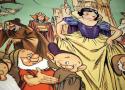
But they're missing something very important about the original Snow White. In fact, they're missing what I would consider to be such an important part of femininity overall.
The 1937 Snow White didn't lift a finger to fight. She didn’t have to. Her purity and goodness were worth fighting for and protecting, which is why a group of normally peaceful dwarves picked up their weapons and went to chase after the evil queen at the end.
I don’t know if you recall this moment from the original movie, but it’s still a heart-wrenching, intense, and oddly beautiful moment. When this movie was first released in theaters, people were really overcome here. There were people crying in the theaters when the apple fell from Snow White’s hand, because they truly thought she’d died.
At that moment, the audience was the dwarves. They wanted to bring the evil queen to justice. We wanted to pick up weapons and ride out in the name of punishing evil and preserving that beauty and kindness that had touched our lives. Ultimately, that evil was struck down by God Himself. To this day, the entirety of the pursuit sequence holds up as an incredibly dynamic moment.
But the dwarves served a much deeper purpose here. We were the dwarves. All of us. We were messy, grumpy, dopey, and unrefined, but when true goodness and beauty come into our lives, it changes us for the better.
We relate to the dwarves on a personal level, and defending the beauty in our lives, even if violently, is worth doing.
Even after this sequence, a very interesting phrase pops up on the screen before it cuts to her in her golden coffin, with all creation, including the dwarves, paying homage to this beautiful, kind woman.
"So beautiful, even in death, that the dwarfs could not find it in their hearts to bury her."
She was inspiring them even after she died. That was the effect she had on them. You're going to tell me that this isn't a power of its own? To be so life-changing that the people who knew you didn't want to let you go? Taken spiritually, you really begin to see the importance of what Snow White actually represented.
Snow White enchanted everyone she came across. She caused people to change into better people, not because she forced it or demonstrated some sort of artificial toughness, but because she inspired them to be better.
This is what the writers of this modern rip-off and the actors and actresses that play in it don’t get. To them, Snow White is a character that needs to change because she has no power. They see her as weak and, as such, needs to be injected with strength, not understanding that Snow White’s tenderness and boundless kindness carry with them a strength and power that refines civilizations, crafts and grows humanity, and inspires goodness through kindness, generosity, and tender warmth.
This is the very essence of femininity, and it's a strength that modern feminism — with its hyper-focus on selfish inner power relating to outer power — can't wrap its head around.
This is why the 1937 film was such a masterpiece and appealed to so many people, and why the modern "live-action" film is likely going to bomb and eventually be forgotten. The modern version is a shallow shell of what the original told. It misses the point entirely.
It doesn't understand the power of kindness and warmth.
in the case of two films that highlight conservative subjects, the disconnect between the press and regular Americans is put on full display. The results show that either A) elitist “journalists” are totally out of touch with the greater public, or B) that they’re shaping the narrative to fit their progressive viewpoints, or C) both.
To wit, over at the movie review site Rotten Tomatoes, the film “REAGAN” received a terrible 17 percent “fresh” rating from professional reviewers—yet it garnered a huge 98 percent favorable rating from the public. That is an astounding divide. To me, it can only be explained by one thing: the left hates Ronald Reagan, and most journalists are left-leaning, so they can’t possibly judge a movie based on its merits. They can only judge it based on their ideology. //
Here’s some of the educated criticism from our nation’s journalists: “Like Reagan the actor and Reagan the president, Reagan the new movie has a strained relationship with reality.” Paul Renfro, Slate. No bias detected there, right? “It comes so close to parody that it brings to mind the ‘Saturday Night Live’ ‘Mastermind’ skit.” Rogerebert.com. “For conservatives, Reagan has become Muhammad, the Prophet whose name no non-believer ever dare utter.” Movie Nation. Wait, I thought you were reviewing a movie?

The new biopic of the 40th president of the United States is a paean to American liberty, idealism, and genuine goodness. //
Despite the many hurdles this project faced — financing troubles, pandemic-driven set shutdowns, and negative left-wing reviewers — “Reagan” turned out to be a success, presenting the life of one of America’s greatest modern leaders in all its glory. At a time when Reagan’s legacy is denigrated by partisans on both right and left, America faces its greatest geopolitical challenges since the Cold War, and the nation’s mood is decidedly sour, this film is a breath of fresh air. It reminds us of what is most important in life: faith, family, fidelity, and freedom.

But when it comes to purchases made via streaming services, it’s more accurate to consider them rentals, despite them not being labeled as such and costing more than rentals with set time limits. As we’ve seen before, streaming companies can quickly yank away content that people feel that they paid to own, be it due to licensing disputes, mergers and acquisitions, or other business purposes. In this case, a company’s failure has resulted in people no longer being able to access content they already paid for and presumed they’d be able to access for the long haul.
For some, the reality of what it means to "own" a streaming purchase, combined with the unreliability and turbulent nature of today's streaming industry, has strengthened the appeal of physical media. Somewhat ironically, though, Redbox shuttering meant the end of one of the last mainstream places to access DVDs.
The weather theme of “Twisters” could have easily lent itself to a climate change angle, but there’s no hint of an agenda. That’s on purpose, according to Director Lee Isaac Chung.
“I just wanted to make sure that with the movie, we don’t ever feel like (it) is putting forward any message,” Chung explained in an interview with CNN. “I just don’t feel like films are meant to be message-oriented.”
There’s something I never thought I’d hear from Hollywood.
For all its apparent lack of message, my roommates and I agreed the tornado-chasing left us feeling strangely patriotic.
Perhaps that’s because the movie centers on the characters’ dedication to serving their community.

The first chapter of Kevin Costner’s new Western epic has a lot more to offer than its critical and financial woes suggest.
On the occasion of the 100th anniversary of cinema in 1995, the Vatican compiled this list of "great films." The 45 movies are divided into three categories: "Religion," "Values" and "Art." The USCC classification for each film follows its description
In 1995, on the "centenary of cinematography", 100 years after the Lumière brothers displayed their first film for an audience, the Vatican's Pontifical Council for Social Communications compiled a list called Some Important Films (Italian: Alcuni film importanti). The 45 movies are divided equally into three categories—religion, values, and art—with no order of importance placed on the films. The council was careful not to regard the films on the list as the "best", or most important, saying: "not all that deserve mention are included".

“Inside Out 2” is a very safe film, and that is frankly its greatest flaw. As with many of Disney’s mistakes, it comes down to rank cowardice in the face of creative, financial, and political risk. Making a late sequel to the most critically acclaimed Pixar film of the past decade is not a difficult decision, nor is it dangerous to make a movie about the importance of expressing emotions in our modern therapy-obsessed culture.
It may forgo some of the superficial trappings of “wokeness,” but it pulls too many punches and falls short of the first film. It’s already a faster-paced film, tuning heavily to the hyperkinetic sensibilities of the TikTok generation being faster than they were a decade ago. In a film landscape that has already made the creatively bankrupt live-action “Lion King” remake into one of the highest-grossing films of all time, it is a shame that “Inside Out 2’s” box office success rewards Disney for being safer and less risky.

“That’s when we first noticed it, with Woody.”
“[Larry Cutler] was in that directory and happened to be talking about installing a fix to Woody or Woody’s hat. He looked at the directory and it had like 40 files, and he looked again and it had four files.”
“Then we saw sequences start to vanish as well and we were like, “Oh my god”
“I grabbed the phone… unplug the machine!”” //
“Let’s put the witch hunt away. We’ve got to get the show back first. Let’s not go spend a week of our time trying to kill somebody. Where’s the movie?”
“Obviously, five minutes in the meeting, you’re all sweating and red-faced. And somebody will say, “Let’s go kill somebody and lynch them. Now,” says Jacob, “I support lynching on our agenda. But, number one is, just get the movie back and work on Buzz and Woody again. We’ve lost our friends.”
With this many man-years, or even man-decades, worth of work on a project, the temptation to find someone to blame, to expend effort on hunting down the person responsible, is intense.
But that kind of negative thought process doesn’t help anyone and it just removes focus from what matters most: moving forward. //
Instead of dwelling on pinning the blame or lamenting the loss of time and effort, the team made sure to alter the backup strategy so that something like that didn’t happen again, and it went about making up for lost time. //
The thing that I take away about these experiences is that the spontaneity of the communal support speaks to the culture of Pixar the rest of the time. That kind of thing just doesn’t happen all of a sudden. You can’t have a disaster and instantly develop this kind of community and camaraderie.
It has to seep out. It has to be in the soil. You don’t just plant it and watch it grow in a day. It has to be cultivated over time, as it obviously was at Pixar.

This action-packed film embraces the good-versus-evil dichotomy of World War II as Allied commandos rain fury on the Nazis. //
Sometimes an old-fashioned, Nazi-killing romp is just what the movies need. And that’s exactly what “The Ministry of Ungentlemanly Warfare” brings to the cinema. The film, very loosely based on the real-life exploits of World War II British special operators, eschews politics in favor of humor, action, and plenty of Nazi-centric violence.