
nginx-proxy-settings for a Soundbridge radio, that only supports http streams, but wants to play https streams too.
context: https://mind.work/2021/01/18/rescue-of-the-soundbridge-m1001/
To use it in your own projects, replace 'localhost' in 'mind_work/etc/nginx/conf.d/default.conf' with the hostname you actually use.



My name is Chris and I’ve built a public version of this https to http nginx proxy for the Roku Soundbridges. Hopefully this will help those having a tough time building their own. Would you like to help me test?
Prefix preset URL with: http://www.opieproxy.com/roku/
If you have a station using HTTPS like
https://desertmountainbroadcasting.streamguys1.com/KBOZ-AM
put in your preset
http://www.opieproxy.com/roku/desertmountainbroadcasting.streamguys1.com/KBOZ-AM
I may have the only Soundbridge left that can browse an internet database by genre and pick a station and actually listen to it. Not just Presets. Would you like to help test that too?
If you can redirect on your local network, the DNS entry for http://www.radioroku.com to http://www.opieproxy.com
or add a static DNS entry for http://www.radioroku.com to 44.227.162.229 you might be able to browse stations again.

FROM
Anchorage (ANC)
TO
Rzeszow (RZE)
GREAT CIRCLE DISTANCE
7,645 KM
ACTUAL FLIGHT TIME
11:28
AIRCRAFT
Boeing 747-4B5F
REGISTRATION
N713CK
SERIAL NUMBER (MSN)
32808
11sync.net is a Hosted Syncthing peer. Designed for Syncthing users seeking reliable backups and resilience.
(1 GWye = roughly the electricity for one million people, living by western standards, for one year)
Let us suppose it is our mission to produce electricity for a run-of-the-mill city with about 1 million inhabitants living by Western standards. This city will need about thousand megawatts of electricity, year round, in short 1GWye. In the visual, I compare four ways to accomplish this, along with the input and output of each of the options.
What do you call it when the same people who screech about carbon emissions and climate change oppose clean, efficient, carbon-free nuclear energy? Is this hypocrisy? Ignorance? Both?
Representative Jeff Duncan (R-SC) has introduced H.R.6544 - Atomic Energy Advancement Act, which is co-sponsored by a Democrat, Diana DeGette (D-CO), who, while not the farthest left in the Democratic Party, is certainly no Zell Miller-like Blue Dog. This is a bipartisan bill, and one intended to facilitate the development of nuclear power plants in the United States. The bill lists as its purpose:
To advance the benefits of nuclear energy by enabling efficient, timely, and predictable licensing, regulation, and deployment of nuclear energy technologies, and for other purposes.
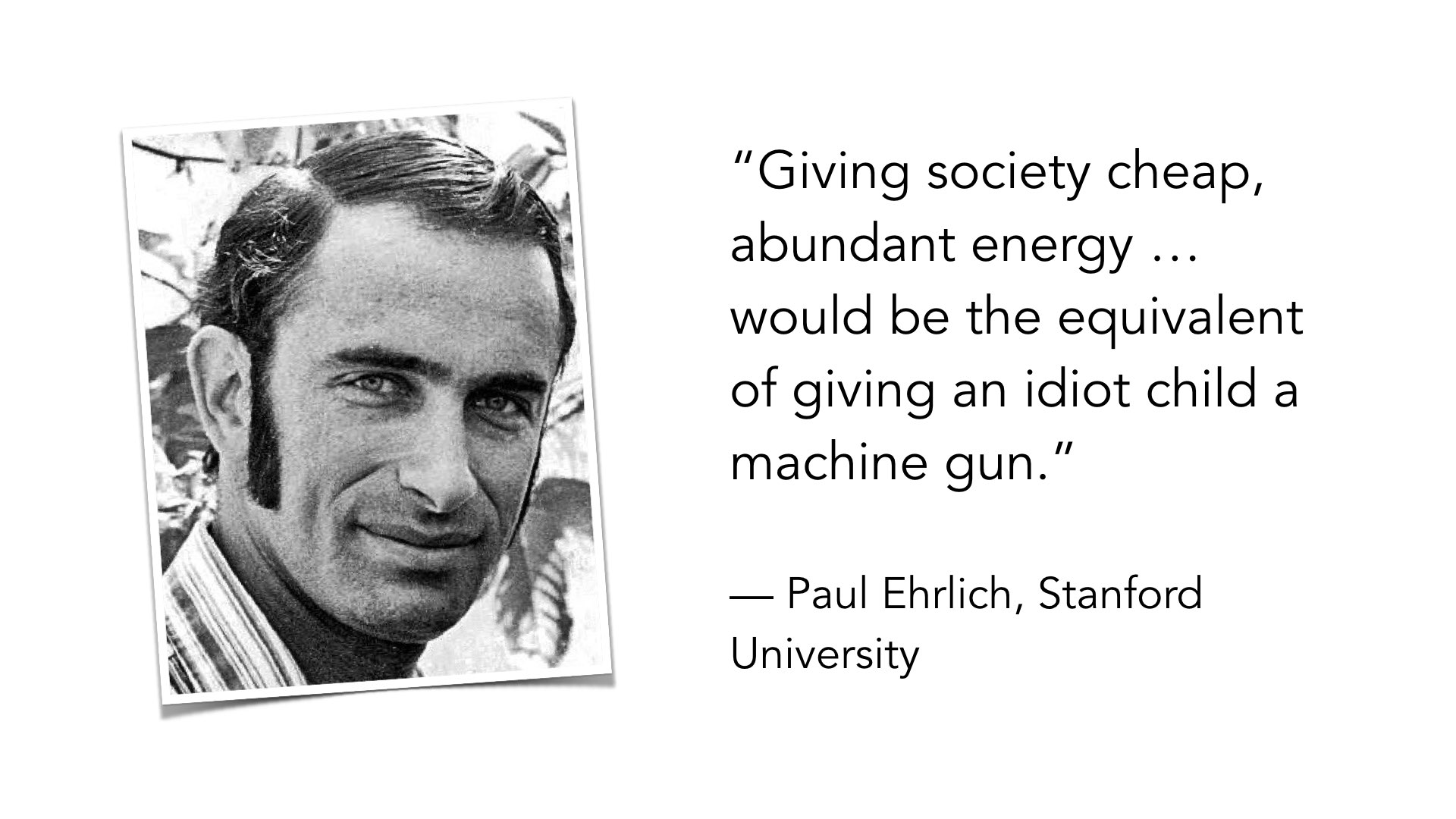
Giving society cheap, abundant energy ... would be the equivalent of giving an idiot child a machine gun. -- Paul Ehrlich

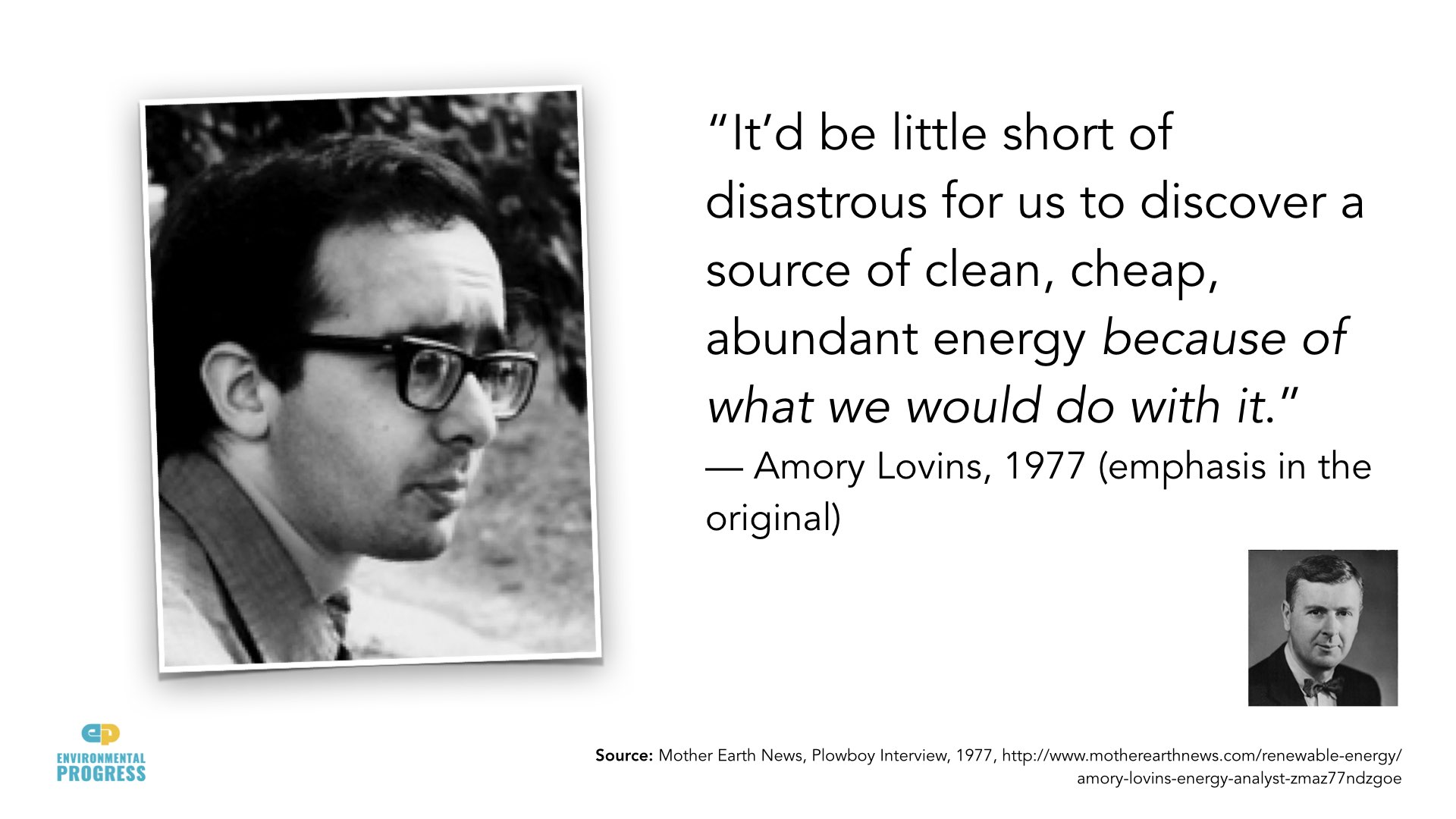
It'd be little short of disastrous for us to discover a source of clean, cheap, abundant energy because of what we would do with it. -- Amory Lovins, 1977

Why is nuclear power Green today when it wasn’t yesterday? Because it was never about the science.
Nuclear power has been the NetZeroiest energy on Earth since the sun formed from collapsing interstellar gas. Nuclear plants don’t produce any CO2 at all, but that wasn’t good enough because it was never about CO2 either. It was always about power and money and profits for friends.
And the best friend of a bureaucrat is a captive-dependent-industry, one that survives on handouts. Those in need of Big Government largess always lobby for Big Government, donate to Big Government causes and cheer on everything Big Government wants them to cheer on, even if it’s a naked man in high heels.
Yesterday gas was a fossil fuel, but today it’s a sustainable one:
In a radical move, the French government has quietly dropped their renewables targets from their draft energy bill, risking being seen as unfashionable losers in billionaire ski clubs. The nation that, forty years ago, built 56 nuclear reactors in 15 years has decided they just need to build another 6 to 14 new nuclear plants to reach “Net Zero” by 2050. This puts them in danger of being one of the only nations on Earth that might reach their target.
This, of course, is terrible for the renewables industry as it risks exposing the wanton frivolity and utterly superfluous nature of the wind and solar subsidy farms. If France can do this without the bird chopping, the slave labor and the lithium bombs, so can nearly everywhere else.
It’s a big change from 2014 when France aimed to reduce nuclear power to just 50% by 2025.
If coal is a planet wrecking problem, if it really mattered, about 30 countries are beating themselves up in acts of grandiose public flagellation, while one country is wrecking the planet and nobody cares. The truth is that no one is behaving like they think CO2 is causing a crisis. All over the West everyone wears the hippie-care coat while buying the cheapest fridges, phones and fashion they can get from the global coal furnace. And China nods the nod then keeps on adding coal power plants.
In Carnarvon yesterday the Bureau tells us that the temperature was “a record” 49.9 degree day (almost 122 Fahrenheit). But in 1896 the Brickhouse Station just 15 kilometers north of Carnarvon hit 121 Fahrenheit in the shade, and there were reports of birds dying and other measurements “in the shade” that were as high as 125F. Somehow man-made emissions have been heating the planet for 128 years but the current freakishly hot days are about the same as the ones when no one in Australia owned a car and CO2 levels in the atmosphere were still under 300 ppm.
Lest we forget, there are hundreds of thermometer records from the pre-1908 era that are apparently worth nothing to the Australian Bureau of Meteorology. Climate change threatens all life on Earth, so you’d think climate scientists would be excited about the longest historical records they can find, but for some inexplicable reason they show little interest in the historical records from 1896 when a heatwave struck and 437 people died across Australia.
Temperatures hit 50C in the shade in many places in January 1896. In locations hundreds of kilometers apart, people were reporting similar temperatures. Perhaps they were all wrong?
These maps and graphs make it clear just how brazenly unscientific the Hockey Stick is. //
In 2009 McIntyre did it again with Briffa’s Hockey Stick. After asking and waiting three years for the data, it took just three days to expose it too as baseless. For nine years Briffa had concealed that he only had 12 trees in the sample from 1990 onwards, and that one freakish tree virtually transformed the graph. When McIntyre graphed another 34 trees from the same region of Russia, there was no Hockey Stick.
The sharp upward swing of the graph was due to one single tree in Yamal. Epic cherry-picking!
Skeptical scientists have literally hundreds of samples. Unskeptical scientists have one tree in Yamal, and a few flawed bristlecones…
It was a audaciously unscientific.
Climate models don’t know why it was as warm years ago. [the models can't reproduce historical data given historical inputs]
The models are wrong.
The all important question that rises above and before ALL other questions is the one of evidence.
Is there any evidence that carbon dioxide causes major warming?
In science, “evidence” has a very specific meaning and for a very good reason. In a court of law or a game of football, the label “evidence” can be plastered all over the place. If 500 footballers signed a petition to change a rule, that would be “evidence” the rule needed changing. But if 5 billion people signed a petition to make it rain in Mumbai on Thursday, that’s a waste of paper.
Science is only about the natural world. That’s why human opinions are irrelevant.
It takes only one experiment to disprove a theory. The climate models are predicting a global disaster, but the empirical evidence disagrees. The theory of catastrophic man-made global warming has been tested from many independent angles.
The heat is missing from oceans; it’s missing from the upper troposphere. The clouds are not behaving as predicted. The models can’t predict the short term, the regional, or the long term. They don’t predict the past. How could they predict the future?
The models didn’t correctly predict changes in outgoing radiation, or the humidity and temperature trends of the upper troposphere. The single most important fact, dominating everything else, is that the ocean heat content has barely increased since 2003 (and quite possibly decreased) counter to the simulations. In a best case scenario, any increase reported is not enough. Models can’t predict local and regional patterns or seasonal effects, yet modelers add up all the erroneous micro-estimates and claim to produce an accurate macro global forecast. Most of the warming happened in a step change in 1977, yet CO2 has been rising annually.
Observations from every angle point to a similar conclusion
Studies involving 28 million weather balloons, thousands of satellite recordings, 3,000 ocean buoys, temperature recordings from 50 sites in the US and a 1,000 years of temperature proxies suggest that the Global Climate Models overestimate positive feedback and are based on poor assumptions. Observations suggest lower values for climate sensitivity whether we study long-term humidity, upper tropospheric temperature trends, outgoing long wave radiation, cloud cover changes, or the changes in the heat content of the vast oceans.
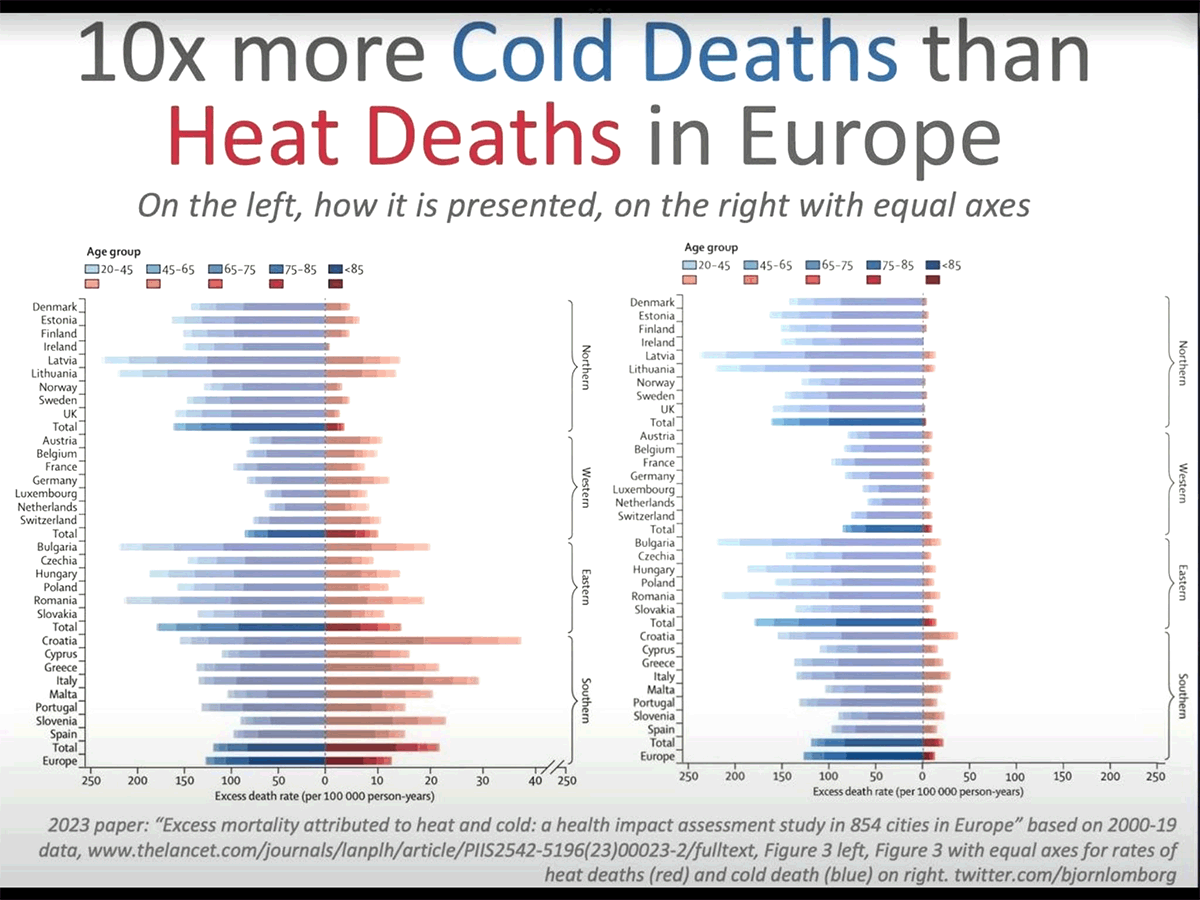
On the left, how it is presented, on the right with equal axes

What do you do when not enough people die to suit your religion? Distort the axis and hope no one notices.
Welcome to government-science, where one of top journals in the world uses graphic design tricks for political convenience. In this graph from the paper, 10 excess deaths from the heat looks “bigger” than 50 excess deaths from cold. Isn’t the whole point of a graph so we can compare the bars “at a glance”?
Björn Lomborg corrected this with chart on right. Doesn’t that tell a different story?
Thanks to Patrick Moore @EcoSenseNow:
The journal “Lancet” published the chart on left with unequal X-Axis* to downplay fact that cold causes 10X more deaths than heat in Europe. …This is disgraceful for a supposedly scientific journal.
Björn Lomborg‘s version shows us exactly how important heat deaths are. It’s no small thing. The news outlets are filled with heatwave porn trying to scare people about normal weather, while politicians try to justify spending billions to “cool” the world. These graphs hide the crime — increasing the cost of energy will kill far more than mythical cooling could ever save.
This is symbolic of the state of Science today: distorted by government funding until the point of it disappears.
The programming language Pascal has become the dominant language of instruction in computer science education. It has also strongly influenced languages developed subsequently, in particular Ada.
Pascal was originally intended primarily as a teaching language, but it has been more and more often recommended as a language for serious programming as well, for example, for system programming tasks and even operating systems.
Pascal, at least in its standard form, is just plain not suitable for serious programming. This paper discusses my personal discovery of some of the reasons why.

“Maui on its best day… 1” is the way Bezos describes the space habitat environment’s attractive force to depopulate Earth, turning it into a nature preserve. This is an orders of magnitude greater “Scale of the problem” than has been addressed in the prior two original posts here by Keith Henson regarding SPS 1 and CO2.
I’ve been working this angle since the 1980s Sierra Club retreats in the Laguna Mountains outside San Diego with the theme “What Good Are Humans?”.
Most recently has been my proposal to depopulate Earth’s land masses with self-replicating “Maui on its best day…” artificial atolls in the Western Pacific doldrums built with in situ resources of both mass and energy:
jimbowery.blogspot.com
Exponential Remediation of Civilization's Footprint 3
Introduction " The extinction of the human race will come from its inability to emotionally comprehend the exponential function ."...
The economics start out being the real estate value of “Maui on its best day…” atolls supporting 100,000 people each. After 16 doublings (to accommodate all 7 billion of Earth’s population) the industrial learning curve reduces the cost of a beach front condo to under $10,000 per family of four. Back of the envelope calculations indicate this could happen within 15 years of the first atoll “cell” capable of self-replication.
The only big environmental challenge is chlorine waste produced by the replication of these artificial atolls. That Cl2 may be injected into the connate fluid 1 available 1000ft beneath the already several-kilometer deep ocean floor turning it into CaCl2:

A new paper in PLOS ONE, “Land-use intensity of electricity production and tomorrow’s energy landscape 2”, examines the land use requirements of various alternative energy sources. The paper is open access with the full text available at the link or as a PDF file 5. The results are summarised in the following graphic.
The global energy system has a relatively small land footprint at present, comprising just 0.4% of ice-free land. This pales in comparison to agricultural land use– 30–38% of ice-free land–yet future low-carbon energy systems that shift to more extensive technologies could dramatically alter landscapes around the globe. The challenge is more acute given the projected doubling of global energy consumption by 2050 and widespread electrification of transportation and industry. Yet unlike greenhouse gas emissions, land use intensity of energy has been rarely studied in a rigorous way. Here we calculate land-use intensity of energy (LUIE) for real-world sites across all major sources of electricity, integrating data from published literature, databases, and original data collection. We find a range of LUIE that span four orders of magnitude, from nuclear with 7.1 ha/TWh/y to dedicated biomass at 58,000 ha/TWh/y. By applying these LUIE results to the future electricity portfolios of ten energy scenarios, we conclude that land use could become a significant constraint on deep decarbonization of the power system, yet low-carbon, land-efficient options are available.