Bloomberg calls for cancellation of the SLS rocket. In an op-ed that is critical of NASA's Artemis Program, billionaire Michael Bloomberg—the founder of Bloomberg News and a former US Presidential candidate—called for cancellation of the Space Launch System rocket. "Each launch will likely cost at least $4 billion, quadruple initial estimates," Bloomberg wrote. "This exceeds private-sector costs many times over, yet it can launch only about once every two years and—unlike SpaceX’s rockets—can’t be reused."


InvariantCapitalist Ars Centurion
1y
985
Subscriptor
Lee Vann said:
Anyone valuing SpaceX above the large Aerospace companies is a fool looking to be parted from their money. Their sales are just to low compared to the big boys. For example Lockhead Martin does ~50 billion a year in sales on a bad year. Northrop Grumman is a little behind them. How much in sales does SpaceX do in a good year? 9 Billion. A pretty good chink of change, but not up there with the big boys. More in the range of the mid tier.
Business valuations are based on expectations of future profits, not historical revenues. Starlink revenues are estimated to increase to over $6.5B this year from $4B last year, and projected to reach $20B to $30B with very high margins in a decade or so.
And that doesn't factor in the impact of switching from a partially reusable launch system (Falcon 9) that throws away a $15M first stage every launch to a fully reusable launch system like Starship lowering their cost per launch from around $30M to roughly $10M while increasing payload capacity by at least 5x. Its far improved cost structure should massively increase the demand for commercial launches. Not only will it dramatically reduce the cost of satellite launches, it enables satellite providers to build them with heavier cheaper materials and to make them far larger to offer even much improved capabilities.
It also massively reduces the costs of building space stations and potentially makes space tourism not only far cheaper but more attractive with weeks long stays for far more people. And If Starship is certified to fly humans its likely to fly more than 10,000 a year to orbit, that's a big business.
And again, likely with higher margins than a Lockheed Martin or Northrup Grumman. All this said, I wouldn't value SpaceX at $200B, but I'm a bottom feeding value investor. But its certainly worth a far higher price per dollar of revenues than these old space dinosaurs..

"It was a bullseye landing,” said Steve Stich, program manager for NASA’s commercial crew program. “The entry in particular has been darn near flawless.”
Still, he acknowledged that certain new issues had come to light, including the failure of a new thruster and the temporary loss of the guidance system.
He added it was too early to talk about whether Starliner’s next flight, scheduled for August next year, would be crewed, instead stressing NASA needed time to analyze the data they had gathered and assess what changes were required to both the design of the ship and the way it is flown.

In mid-November 2023, a disastrous SpaceX launch, which saw the explosion of not one but two rockets, offered a rare opportunity to study the effects of such phenomena on the ionosphere.
A study by Russian scientists revealed how this explosion temporarily blew open a hole in the ionosphere stretching from the Yucatan to the southeastern U.S.
Although far from the first rocket-induced disturbance in the ionosphere, this is one of the first explosive events in the ionosphere to be extensively studied. //
November 18, 2023, wasn’t a great day for the commercial spaceflight company SpaceX. While testing its stainless steel-clad Starship, designed to be the company’s chariot to Mars, the spacecraft exploded four minutes after liftoff over the skies of Boca Chica, Texas. //
This new study confirms that the ionosphere experienced a “large-amplitude total electron content depletion,” likely reinforced by a fuel exhaust impact of the Super Heavy rocket engine, which also exploded a little more than a minute earlier at lower altitude once it separated from the Starship. The research team collected this data from 2,500 ground stations scattered across North America and the Caribbean and found that the hole extended largely from Mexico’s Yucatán peninsula and the southeastern U.S., though the exact size of the hole is unknown. //
scientists report that this Starship-induced ion hole caused by “catastrophic phenomena” closed up after 30 or 40 minutes. But these kinds of interactions are still poorly understood, and that’s concerning considering how central the ionosphere is to global technologies—not to mention human health.
rocket bodies, satellites, space debris in earth orbit

Q: What is the highest apogee of a satellite in Earth orbit they need to avoid? Ignore any satellites in Solar or lunar orbit.
A: There are over a hundred satellites in Molniya orbit, a few tens in Tundra orbit and a handful in really high earth orbits. The first two of those go above geostationary orbit; there are examples of the last with perigee of at least 375,000km. //
James Webb Space Telescope, at the Earth-Sun L2 point, is roundly a million miles from Earth, but still gravitationally bound to the Earth-Moon system.
Other than that, there are very few if any permanent satellites beyond the "graveyard orbits" used to park expired geostationary satellites. These are typically only a few hundred kilometers higher than geosynchronous, however, so roundly if they're well beyond the 24 hour orbital period, they'd be well clear of anything we put up intentionally and left there. //
Then there is stuff, mostly debris, that is more critical, because by nature those pieces are very fast, the orbit is not stable, so it changes a little every round and the kinetic energy would be able to penetrate any hull that is not specifically designed to withstand such impacts. For example, this debris of an Iridium satellite - at the time of writing at altitude ~366,000km and counting, spiralling outwards at 1km/s (the map does not mention a size or weight though. But it is big enough to be trackable obviously).
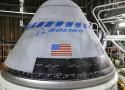
It's unlikely Boeing can fly all six of its Starliner missions before retirement of the ISS in 2030. //
Ten years ago next month, NASA announced that Boeing, one of the agency's most experienced contractors, won the lion's share of government money available to end the agency's sole reliance on Russia to ferry its astronauts to and from low-Earth orbit.
At the time, Boeing won $4.2 billion from NASA to complete the development of the Starliner spacecraft and fly a minimum of two, and potentially up to six, operational crew flights to rotate crews between Earth and the International Space Station (ISS). SpaceX won a $2.6 billion contract for essentially the same scope of work.
A decade later, the Starliner program finds itself at a crossroads after Boeing learned it will not complete the spacecraft's first Crew Flight Test with astronauts onboard. NASA formally decided Saturday that Butch Wilmore and Suni Williams, who launched on the Starliner capsule on June 5, will instead return to Earth in a SpaceX Crew Dragon spacecraft. Put simply, NASA isn't confident enough in Boeing's spacecraft after it suffered multiple thruster failures and helium leaks on the way to the ISS. //
On Saturday, senior NASA leaders decided it wasn't worth the risk. The two astronauts, who originally planned for an eight-day stay at the station, will now spend eight months on the orbiting research lab until they come back to Earth with SpaceX. //
So why did NASA and Boeing engineers reach different conclusions? "I think we’re looking at the data, and we view the data and the uncertainty that’s there differently than Boeing does," said Jim Free, NASA's associate administrator and the agency's most senior civil servant. "It’s not a matter of trust. It’s our technical expertise and our experience that we have to balance. We balance risk across everything, not just Starliner."
The people at the top of NASA's decision-making tree have either flown in space before or had front-row seats to the calamitous decision NASA made in 2003 to not seek more data on the condition of Space Shuttle Columbia's left wing after the impact of a block of foam from the shuttle's fuel tank during launch. //
Now, it seems that culture may truly have changed. With SpaceX's Dragon spacecraft available to give Wilmore and Williams a ride home, the decision was relatively straightforward. Ken Bowersox, head of NASA's space operations mission directorate, said the managers polled for their opinion all supported bringing the Starliner spacecraft back to Earth without anyone onboard.
However, NASA and Boeing need to answer for how the Starliner program got to this point. //
SpaceX, which NASA has tapped to rescue the Starliner crew, has now launched eight operational long-duration crew missions to the International Space Station to date, plus an initial piloted test flight of the Dragon spacecraft in 2020 and several more fully private human spaceflight missions. SpaceX has finished all of its work in its initial commercial crew contract with NASA and is now working off of an extended contract to carry the program through 2030, the planned retirement date for the ISS. //
Right now, the prime route is through SpaceX. NASA continues to fly one astronaut on each Russian Soyuz spacecraft in exchange for a seat for a Russian cosmonaut on each SpaceX crew mission. //
Assuming the investigation doesn't uncover any additional problems and NASA and Boeing return Starliner to flight with astronauts in 2026, there will not be enough time left in the space station's remaining life—as it stands today—for Starliner to fly all six of its contracted missions at a rate of one per year. It's difficult to imagine a scenario where NASA elects to fly astronauts to the space station exclusively on Starliner, given SpaceX's track record of success and the fact that NASA is already paying SpaceX for crew missions through the end of this decade.
Notably, NASA has only given Boeing the "Authority To Proceed" for three of the six potential operational Starliner missions. This milestone, known as ATP, is a decision point in contracting lingo where the customer—in this case, NASA—places a firm order for a deliverable. NASA has previously said it awards these task orders about two to three years prior to a mission's launch.
The commercial crew contracts are structured as Indefinite Delivery/Indefinite Quantity (IDIQ) agreements, where NASA can order individual missions from SpaceX and Boeing as needed. If SpaceX keeps performing well and the space station is actually decommissioned in 2030, it may turn out that NASA officials decide they just don't need more than three operational flights of Starliner. //
Lone Striker Smack-Fu Master, in training
7y
62
accdc said:
Thank you Stephen, and Eric, for your fantastic coverage of this issue.Here’s what I (as a layman with little technical expertise) don’t get:
How does SpaceX make it look so easy, and Boeing make it look so, well, ridiculous?
SpaceX designs, manufactures and integrates most components themselves. In Boeing's case, the thruster manufacturer is Aerojet. In order to make changes or redesign the components, there is a huge bureaucratic barrier in place. They have to jump through extraordinary hoops, not only engineers but also procurement, legal, and any number of departments. In SpaceX's case, it's a walk down the corridor to talk to engineers to discuss the problem and design the fix.
Boeing is also in the dark ages in terms of software development (my field.) SpaceX has a more Silicon Valley/Agile software design methodology where you make many, faster, smaller changes and test them extensively with small unit tests all the way through to hardware-in-the-middle testing to ensure things work as intended. Every tiny change gets rigorously tested to ensure there are no defects or regressions. Boeing's ancient software development process was one of the primary factors in their first Orbital Flight Test failure where they nearly lost the vehicle twice due to software bugs with the mission clock and reentry procedures.
Boeing relies partially on paperwork to validate their spacecraft (whether it's contracts with sub-contractors or studies in place of actual testing) and they've lost the engineers and the engineering culture from the early spaceflight era. //
HiWayne! Smack-Fu Master, in training
1y
50
Ten years they’ve been tinkering with Starliner. That’s crazy. The first crewed Mercury flight and Apollo 15 spanned ten years.
Yeah I know, I know. NASA had an insane budget back then, but damn. Boeing had the benefit of half a century of spaceflight experience and they’re struggling this much to get to LEO. //
Dachshund Wise, Aged Ars Veteran
4y
110
accdc said:
Thank you Stephen, and Eric, for your fantastic coverage of this issue.Here’s what I (as a layman with little technical expertise) don’t get:
How does SpaceX make it look so easy, and Boeing make it look so, well, ridiculous?
Having worked for or with these companies as an engineer, the most concise explanation I have is culture.
Boeings culture is not technically focused, nor mission focused. Boeings culture is Boeing focused with a particular emphasis on shareholders. The overwhelming majority of managers I’ve worked with at Boeing view engineers as a plug and play commodity and are woefully ignorant of the general subject matter they manage. Many I know at Boeing have an exceptionally difficult time taking responsibility for mistakes that Boeing makes. Whether it’s commercial planes or crew capsules, it’s somebody else’s fault and Boeing knew best. Hubris is rampant across Boeing. What’s fascinating there is that there isn’t a damn thing worth being proud of in recent years, but the cognitive dissonance remains strong.
SpaceX culture is mission focused. Their managers tend to understand what it is they are managing. Their workforce is rather young, however, they test things and are willing to publicly fail in a way that Boeing and others will not stomach. When SpaceX does fail, they tend to take full responsibility, learn from the issue and solve the problem.
SpaceX is more or less doing what NACA and subsequently NASA did in their infancy. It’s nothing new, but it’s a major difference as compared to what NASA and its ecosystem have evolved to since those early years. //
Malmesbury Wise, Aged Ars Veteran
3m
341
TLStetler said:
A big part of the problem is Boeing put too many thrusters in too small a space and operated them at a duty cycle which caused everything to overheat. Said overheating caused vapor lock in the propellant lines, and Teflon seals to soften and swell.On the other hand, if you've seen images of Dragon with the aeroshell off the thrusters are distributed spatially, not crowded together. Plumbing and control lines are not near the throats of said thrusters.
This is not even rocket science, any decent Hot Rodder knows not to place propellant/fuel lines etc. in a "hot box."
The problems are inherent in the development methods and company structures.
SpaceX insources - mostly because of cost, but also control. There are, deliberately, few barriers between the engineers working on various parts of the system.
The Boeing/Aerojet relationship is a key counter example - because of a arguments over money they started treating each other as the enemy.
Boeing is attempting to design to perfection, then test. If anything goes wrong at the test stage, they are actually in interactive hardware development. Without the hardware, or low cost basis to do the large number of physical tests required. SpaceX assumed they are in iterative development from the start.

During the initial hours of the spaceflight, the crew will seek to fly in a highly elliptical orbit, reaching an altitude as high as 1,400 km (870 miles) above the planet's surface. This will be the highest Earth-orbit mission ever flown by humans and the farthest any person has flown from Earth since the Apollo Moon landings more than half a century ago. This will expose the crew to a not insignificant amount of radiation, and they will collect biological data to assess harms. //
Isaacman's interest in performing the first private spacewalk accelerated, by years, SpaceX's development of these spacesuits. This really is just the first generation of the suit, and SpaceX is likely to continue iterating toward a spacesuit that has its own portable life support system (PLSS). This is the "backpack" on a traditional spacesuit that allows NASA astronauts to perform spacewalks untethered to the International Space Station.
The general idea is that, as the Starship vehicle makes the surface of the Moon and eventually Mars more accessible to more people, future generations of these lower-cost spacesuits will enable exploration and settlement. That journey, in some sense, begins with this mission's brief spacewalks, with Isaacman and Gillis tethered to the Dragon vehicle for life support. //
This is the first of three "Polaris" missions that Isaacman is scheduled to fly with SpaceX. The plan for the second Polaris mission, also to fly on a Dragon spacecraft, has yet to be determined. But it may well employ a second-generation spacesuit based on learnings from this spaceflight. The third flight, unlikely to occur before at least 2030, will be an orbital launch aboard the company's Starship vehicle—making Isaacman and his crew the first to fly on that rocket.
ridley
So to be able to use their spacesuits they need to fit a square peg into a round hole?
Best give Mr Lovell a call. //
Avoiding standard docking and space suit adapters seems like a good way of wasting money and time
The thing that most surprises me about this whole mess is why NASA would ever consider that having a different design of docking adapter and space suit for each type of American vehicle that is to dock with the ISS was a good idea..
That the Soviet G2S vehicles would use different docking adapters and space suit connectors is expected: the two parts of the original ISS design were always intended to use differing docking ports and space suit connectors from the get-go.
However, it beggars belief that NASA would not have specfied a common set of docking adapters for all American spacecraft as well as common space suit interface(s), if only to save costs and re-implementation effort by basing these interfaces on than the well-tested Shuttle docking and space suit connectors. AFAIK those never caused problems throughout their useful life. //
Re: Avoiding standard space suit adapters seems like a good way of wasting money and time
No, giving money to SpaceX was seen as a good way of wasting money and time.
REMEMBER: when this all started, Boeing was the shoo-in, and that goofy SpaceX startup was the complete waste of time and money.
Nobody expected SpaceX to actually ever reach Station.
It never entered anyone's mind that SpaceX would eventually have to rescue a Boeing crew.
The American docking adapters ARE standard.
https://www.internationaldockingstandard.com/
https://www.nasa.gov/missions/station/meet-the-international-docking-adapter/
American spacecraft, INCLUDING Shuttle, either dock to this, or are berthed by the robot arm to a standard pressure door, which allows larger cargo. //
Re: other good ways of wasting money and time
To ensure SLS block 1 would launch by 2016 congress decided to use an upper stage (Interim Cryogenic Propulsion Stage) based on Centaur which has been flying since the 60s. The wimpy ICPS massively restricts SLS capabilities so a new Exploration Upper Stage was ordered for SLS block 1B. SLS is assembled on a mobile launch platform in the vertical assembly building and the rocket and platform are carried out together to the launch site by the crawler/transporter. The MLP includes a tower to fill the core stage and upper stage with propellants. The solid rocket boosters have grown an extra segment each since the space shuttle so the combined mass of SLS and MLP are now sufficient damage the crawler transporter's tracks and they path the travel to the launch site. EUS is longer than ICPS so the propellant connections are at a different height. A whole new MLP is required otherwise SLS block 1B would be delayed because modifications to MLP1 would not be able to start until after Artemis III.
Clearly this situation is untenable. What if MLP2 was completed before EUS? Boeing would look bad for delaying Artemis IV. The solution was simple: do not decide what height the propellant connections will be at until the last possible minute. Bechtel cannot start design of MLP2 without that. Moving the connections also moves the fans that blow hydrogen leaks away before the concentration gets big enough for an explosion. Designing the MLP for a choice of connection heights is also tricky. The platform must be optimized for mass so it does not go much further over the limits of the crawler transporter.
If Boeing and SpaceX had to agree on a flight suit connector US astronauts would now have a choice of rides to the ISS: Soyuz or Shenzou.
Believe it or not there is a worse solution. NASA could decide the shape of the flight suit connectors. Congress would then have an opportunity to help like they did with SLS. Giving Boeing and SpaceX the freedom to work independently of congress (and each other) saves a huge amount of time and money. It also means a flight suit design issue does not ground both crew transport systems at the same time.
After nearly every flight, the upper stage of this rocket breaks apart in orbit. //
A new debris field of nearly 1,000 objects would be a significant addition to the approximately 46,000 objects Space Command tracks in Earth orbit. According to statistics compiled by Jonathan McDowell, an astrophysicist who monitors global launch and spaceflight activity, this would rank in the top five of all debris-generation events since the dawn of the Space Age.
The Thousand Sails constellation aims to provide global internet access. It is one of two planned Chinese systems to challenge U.S. projects including Starlink. Thousand Sails is also intended to secure finite orbital slots and frequencies, and provide national internet coverage and data security. //
The Long March 6A rocket used for Tuesday’s launch combines liquid propellant core stages with solid rocket boosters. The launcher can carry 4,500 kg to a 700-km sun-synchronous orbit. The rocket’s upper stage appears to have suffered debris issues in orbit. //

BadSuperblock Ars Praefectus
15y
3,125
rbtr4bp said:
I think there is an argument that SpaceX, as a new and agile company with something to prove, is going to do things better. People who are willing to accept more risk are attracted to the new "startup" and willing to work harder for the same or less money because of the adventure and excitement.
...
No, it doesn’t necessarily follow that this incompetence was a consequence of "maturing." It is not a foregone conclusion. For one thing, what is your definition of "mature"? We think of technology companies like Microsoft, Apple, and Intel to be "mature" because they are now going on 40 years old. Well, since Boeing was founded in 1916, by the time they were 50 years old in 1966, Boeing was taking some of the biggest, most rewarding, and most admired engineering risks and innovations of their entire history: Projects like components for the Apollo moon program, and the absolutely revolutionary and widely loved 747 airliner. This company, half a century old, was creating these exciting, "startup" quality projects. At that time, they were more "mature" than the companies we now call mature, but they had not lost their innovative spirit, engineering discipline, and quality control.
It is generally agreed that the root cause of the Boeing malaise was not the age of the company, but the decision of one CEO and board to allow McDonnell Douglas management to take over Boeing, instituting the changes that poisoned the company. In other words, it was not a rot from within, but a culture change imposed by outsiders.
"Risk remains that we may record additional losses in future periods." //
Boeing announced another financial charge Wednesday for its troubled Starliner commercial crew program, bringing the company's total losses on Starliner to $1.6 billion. //
These losses have generally been caused by schedule delays and additional work to solve problems on Starliner. When NASA awarded Boeing a $4.2 billion contract to complete development of the Starliner spacecraft a decade ago, the aerospace contractor projected the capsule would be ready to fly astronauts by the end of 2017.
It turns out the Crew Flight Test didn't launch until June 5, 2024. //
When NASA selected Boeing and SpaceX to develop the Starliner and Crew Dragon spacecraft for astronaut missions, the agency signed fixed-price agreements with each contractor. These fixed-price contracts mean the contractors, not the government, are responsible for paying for cost overruns. //
It's instructive to compare these costs with those of SpaceX's Crew Dragon program, which started flying astronauts in 2020. All of NASA's contracts with SpaceX for a similar scope of work on the Crew Dragon program totaled more than $3.1 billion, but any expenses paid by SpaceX are unknown because it is a privately held company.
SpaceX has completed all six of its original crew flights for NASA, while Boeing is at least a year away from starting operational service with Starliner. In light of Boeing's delays, NASA extended SpaceX's commercial crew contract to cover eight additional round-trip flights to the space station through the end of the 2020s. //
cyberfunk Ars Scholae Palatinae
12y
824
Blaming fixed price contracts is rich. They're basically admitting incompetence by blaming the cost structure they agreed to.. either because they agreed to it, or because they can't properly estimate cost and deliver quality product on budget. Either way they look like idiots. I'm glad they're holding the bag this time and not the taxpayer. //
BigFire Ars Scholae Palatinae
3y
985
SpaceX will not bid on Cost Plus contracts because the company isn't setup with the kind of extra layers of auditing to justifying everything that will trigger the cost overrun payments. Frankly Boeing Space isn't setup to do anything other than Cost Plus (witness ISS and SLS center core). Nevermind the same ballpark, they're not even playing the same sports, quoting Jules Winnfield from Pulp fiction. //
Dachshund Smack-Fu Master, in training
4y
99
You could see this shift happening within Boeing a little over two decades ago. I had the privilege of learning from some of the last grey beards whose work had given Boeing their stellar reputation before they retired. Those grey beards were worn thin and got zero respect from the hot shot, tassel loafer MBAs hustling them to do things “better, faster, cheaper”.
Internally we knew it was all going to hell, we just weren’t sure when the public would see it for themselves. I thank the space exploration Gods for SpaceX - if it weren’t for them Boeing and every other crook company could keep playing the “space is hard” card and the cost plus buffet open. //
Transmission Integrity Seniorius Lurkius
5y
8
Subscriptor
RickVS said:
The bean counters deserve this. If instead of shareholder value they had focused on top-notch engineering, they probably would have already flown crew to the ISS at least a couple of times.
And as a result it would probably have been cheaper/profitable. //

DDopson Ars Tribunus Militum
22y
2,038
Subscriptor
ROOT1803 said:
Serious question: With this much material floating around in orbit, would re-purposing it be something that is feasible? Or is it just irredeemably junk for the most part?
It's infeasible to recover and utilize.
This came up in a previous thread, where I said:
...
On orbit recycling aspirationally saves some launch mass, the cheaper half of the equation, but it forces you to engineer a vast array of complicated system elements for the recovery process and then use in-space manufacturing and assembly processes that will certainly never be cheaper than their terrestrial equivalents where we can walk over to the machine in our shirt-sleeves and clear out a broken milling bit, call the parts warehouse down the road, and have a replacement bit installed same afternoon. The economic network effects are very very difficult to overcome, far harder than any one of the individual engineering problems. //
HuntingManatees Wise, Aged Ars Veteran
11m
100
andygates said:
The problem is that the stuff isn't particularly special, it's just big empty beer cans. The cost is in getting it up there. And it'd be more straightforward (and less expensive) to bring it down than to tugboat the stuff to a space junkyard.Actual orbital mechanics are left as an exercise for the Kerbals.
I actually spent an unhealthy amount of time in KSP trying to retrieve space junk using a series of giant folding claw mechanisms that would -- in theory -- latch onto dead satellites and then burn for reentry.
This resulted in two or three successful de-orbiting missions, but I gave up after I caught myself tasking my Kerbals with sending up fresh claw ships to retrieve previously-launched claw ships that had run out of fuel.
SpaceX returned its first 21 Dragon cargo missions to splashdowns in the Pacific Ocean southwest of Los Angeles. When an upgraded human-rated version of Dragon started flying in 2019, SpaceX moved splashdowns to the Atlantic Ocean and the Gulf of Mexico to be closer to the company's refurbishment and launch facilities at Cape Canaveral, Florida. The benefits of landing near Florida included a faster handover of astronauts and time-sensitive cargo back to NASA and shorter turnaround times between missions.
The old version of Dragon, known as Dragon 1, separated its trunk after the deorbit burn, allowing the trunk to fall into the Pacific. With the new version of Dragon, called Dragon 2, SpaceX changed the reentry profile to jettison the trunk before the deorbit burn. This meant that the trunk remained in orbit after each Dragon mission, while the capsule reentered the atmosphere on a guided trajectory. The trunk, which is made of composite materials and lacks a propulsion system, usually takes a few weeks or a few months to fall back into the atmosphere and doesn't have control of where or when it reenters. //
In May, a 90-pound chunk of a SpaceX Dragon spacecraft that departed the International Space Station fell on the property of a "glamping" resort in North Carolina. At the same time, a homeowner in a nearby town found a smaller piece of material that also appeared to be from the same Dragon mission.
These events followed the discovery in April of another nearly 90-pound piece of debris from a Dragon capsule on a farm in the Canadian province of Saskatchewan. SpaceX and NASA later determined the debris fell from orbit in February, and earlier this month, SpaceX employees came to the farm to retrieve the wreckage, according to CBC. //
This means SpaceX can no longer splash down off the coast of Florida because the trajectory would bring debris from the trunk down over populated areas in the United States or Mexico.
When recoveries shift to the West Coast, the Dragon capsule will fire its Draco thrusters to slow down, and then once on course for reentry, release the trunk to burn up in the atmosphere on a similar trajectory. Any debris from the trunk that doesn't burn up will impact the Pacific Ocean while the capsule deploys parachutes for a slow-speed splashdown. //
“One benefit of the move to the West Coast is much better weather," Walker said. "We have a number of sites in Florida, that we feel like we’re sometimes threading hurricanes a lot. When we look at the flight rules for wind, rain, wave height, all of the criteria that determine our flight rules for return, we actually saw that the West Coast sites that we’re looking at have much better weather, which allows us to have much better return availability.”

We're standing by for news on NASA's decision on what to do about Orion's heat shield. //
The central piece of NASA's second Space Launch System rocket arrived at Kennedy Space Center in Florida this week. Agency officials intend to start stacking the towering launcher in the next couple of months for a mission late next year carrying a team of four astronauts around the Moon.
The Artemis II mission, officially scheduled for September 2025, will be the first voyage by humans to the vicinity of the Moon since the last Apollo lunar landing mission in 1972. NASA astronauts Reid Wiseman, Victor Glover, Christina Koch, and Canadian mission specialist Jeremy Hansen will ride the SLS rocket away from Earth, then fly around the far side of the Moon and return home inside NASA's Orion spacecraft. //
NASA's inspector general reported in 2022 that NASA's first four Artemis missions will each cost $4.1 billion. Subsequent documents, including a Government Accountability Office report last year, suggest the expendable SLS core stage is responsible for at least a quarter of the cost for each Artemis flight.
The core stage for Artemis II is powered by four hydrogen-fueled RS-25 engines produced by Aerojet Rocketdyne. Two of the reusable engines for Artemis II have flown on the space shuttle, and the other two RS-25s were built in the shuttle era but never flew. Each SLS launch will put the core stage and its engines in the Atlantic Ocean. //
Artemis III's launch date is highly uncertain. It primarily hinges on SpaceX's progress in developing a human-rated lunar lander and Axiom Space's work on new spacesuits for astronauts to wear while walking on the Moon.
NASA spent $11.8 billion developing the SLS rocket, and its debut was delayed five years from an original target date in 2017. But for Artemis II, the readiness of the Orion spacecraft is driving the schedule, not the rocket.

Boeing won't start flying operational crew missions with Starliner until a year from now. //
The astronauts who rode Boeing's Starliner spacecraft to the International Space Station last month still don't know when they will return to Earth.
Astronauts Butch Wilmore and Suni Williams have been in space for 51 days, six weeks longer than originally planned, as engineers on the groundwork through problems with Starliner's propulsion system.
The problems are twofold. The spacecraft's reaction control thrusters overheated, and some of them shut off as Starliner approached the space station June 6. A separate, although perhaps related, problem involves helium leaks in the craft's propulsion system. //
MHStrawn Ars Scholae Palatinae
11y
1,142
Subscriptor
Emon said:
The competent engineers and managers were driven out long ago, or they bailed because they were sick of the nonsense.
They're probably working at a variety of competitors or other companies in and around aerospace.
Brain drain is real and Boeing's useless manchild execs either don't understand, don't care, or more likely, both.
So much this.
Boeing going from a company run by engineers whose purpose was to build safe, reliable aircraft to a company run by MBAs whose purpose is to maximize shareholder value was one of the worst developments of the last 50 years in the aerospace industry.

The Falcon 9 is grounded pending an investigation, possibly delaying upcoming crew flights. //
"Upper stage restart to raise perigee resulted in an engine RUD for reasons currently unknown," Musk wrote in an update two hours after the launch. RUD (rapid unscheduled disassembly) is a term of art in rocketry that usually signifies a catastrophic or explosive failure. //
Going into Thursday's mission, the current version of SpaceX's Falcon 9 rocket, known as the Falcon 9 Block 5, was indisputably the most reliable launch vehicle in history. Since debuting in May 2018, the Falcon 9 Block 5, which NASA has certified for astronaut flights, never had a mission failure in all of its 297 launches before the ill-fated Starlink 9-3 mission. //
The Falcon 9's only total in-flight launch failure occurred on its 19th flight on June 28, 2015, when the upper stage's liquid oxygen tank burst a couple of minutes after launch from Cape Canaveral Space Force Station, Florida. The rocket disintegrated in the upper atmosphere, dooming a Dragon cargo capsule en route to the space station.
SpaceX resumed Falcon 9 launches six months later in December 2015. On that flight, SpaceX landed the Falcon 9's first stage booster back at Cape Canaveral for the first time, a historic achievement and a harbinger of the company's later success in reusing rockets. //
SpaceX's Falcon family of rockets, which counted 335 consecutive successful launches since the on-pad explosion in 2016, or 344 flights since an in-flight failure. Both numbers are all-time industry records.

A booster landing would be a calculated risk to SpaceX's launch tower infrastructure. //
In a short video released Thursday, possibly to celebrate the US Fourth of July holiday with the biggest rocket's red glare of them all, SpaceX provided new footage of the most recent test of its Starship launch vehicle.
This test, the fourth of the experimental rocket that NASA is counting on to land its astronauts on the Moon, and which one day may launch humans to Mars, took place on June 6. During the flight, the first stage of the rocket performed well during ascent and, after separating from the upper stage, made a controlled reentry into the Gulf of Mexico. The Starship upper stage appeared to make a nominal flight through space before making a controlled—if fiery—landing in the Indian Ocean.
The new video focuses mostly on the "Super Heavy" booster stage and its entry into the Gulf. There is new footage from a camera on top of the 71-meter-tall first stage as well as a nearby buoy at water level. The video from the buoy, in particular, shows the first stage making an upright landing into the ocean.
SpaceX teases an image of Starship's large launch tower in South Texas at the Starbase facility. Prominently featured are the two "chopsticks," large arms intended to catch the first stage booster as it slowly descends back toward its launch pad.
Then, in simulated footage, the video shows Starship's first stage descending back toward the launch tower with the title "Flight 5." And then it fades out.

Dtiffster Ars Praefectus
8y
3,075
Subscriptor
expand...As has been pointed out by others they have gotten cheaper on an absolute basis inflation adjusted as well. And there isn't much competition that is cheaper than them on an absolute basis, and all of it with only a fraction of their capacity. You got Electron at 200/300 kg for SSO/LEO for 8.5 mil, PSLV for 1.6/3.2 tonnes SSO/LEO for 18 mil, Vega C at 1.45 tonnes SSO for 37 (very subsidized) mil euro, and GSLV for 2.5/3/6 tonnes GTO/SSO/LEO for 47 mil. F9 does that with a droneship landing 5.4/12/18+ tonnes GTO/SSO/LEO for 69.5 mil. If all you need is exactly the performance of one of those rockets for one payload, then yes they are cheaper. And that is true for some payloads, but not for a substantial amount of the market. Otherwise those rockets would be out launching SpaceX right now, right? And rocket lab wouldn't be building neutron, right? Sounds like you are the one falling victim to hater math.
And you've got plenty of their commerical (i.e. non starlink) missions use a pretty substantial amount of F9 and FHs capabilities. They've launches F9 with expended boosters and FHs with expended center cores many times in the last few years. Most of the GTO birds are bigger than GSLV can handle, and F9 can handle most upper birth GTO sats to synchronous and the smaller lower birth GTO to supersynchronous that Ariane V used to handle for a fraction of what customers used to pay for the ride share without a hassle. Crew and Cargo dragon missions obviously need SpaceXs vehicles and use about 2/3 of the F9s capacity.
And although we haven't yet got substantially better rockets on the market yet, SpaceX has driven competitors to try. An Atlas V 551 used to cost 250+ mil, and DIVH over 600 mil. The top of the line Vulcan with 6 boosters which is roughly on par with DIVH is being sold for 200ish mil. There are a whole mess of at least partially reusable rockets that are only going to exist because of SpaceX. Fanboy math or not the market is working and it's thanks to SpaceX spurring innovation. Hate all you want, things are going swimmingly, and notice that it is not launch customers that are complaining about SpaceX.
Edit: forgot Alpha at 630/1030 kg SSO/LEO for 17.5 mil, which is again too small to eat many launches. //
expand...We've seen reporting recently that SpaceX appears to execute a Starlink launch for an internal cost of about $20M. That suggests they could offer ASDS launches profitably for $30M and RTLS launches for even less. If they were doing that, who the hell would invest in Stoke Space or Rocket Lab or any company not backed by Jeff Bezos? //
You'd think they had promised to make launch free at this point. They're 17% lower per-launch than they were just seven years ago and well below half of what the industry norm was prior to their entrance on the market.