
The third flight test aims to build on what we’ve learned from previous flights while attempting a number of ambitious objectives, including the successful ascent burn of both stages, opening and closing Starship’s payload door, a propellant transfer demonstration during the upper stage’s coast phase, the first ever re-light of a Raptor engine while in space, and a controlled reentry of Starship. It will also fly a new trajectory, with Starship targeted to splashdown in the Indian Ocean. This new flight path enables us to attempt new techniques like in-space engine burns while maximizing public safety.

Between Sunday night and Monday night, SpaceX teams in Texas, Florida, and California supervised three Falcon 9 rocket launches and completed a full dress rehearsal ahead of the next flight of the company's giant Starship launch vehicle.
This was a remarkable sequence of events, even for SpaceX, which has launched a mission at an average rate of once every three days since the start of the year. We've reported on this before, but it's worth reinforcing that no launch provider, commercial or government, has ever operated at this cadence.
SpaceX has previously had rockets on all four of its active launch pads. But what SpaceX accomplished over a 24-hour period was noteworthy. Engineers inside at least four control centers were actively overseeing spacecraft and rocket operations simultaneously. //
"Could you imagine if I had walked up to you five years ago and said our constraint to launch is launch pad availability?" said Matthew Dominick, the NASA commander of the Crew-8 mission. "You would have thought I was crazy, but we’re at a cool spot in spaceflight right now. We’ve got rockets competing for launch pads, so you’re not waiting on payloads. You’re not waiting on rockets. You’re waiting on launch pads now."

Altemus said crises like this, and the loss of the range finders, happened over and over. "This mission kept throwing us alligators, and we would reduce these alligators to snapping turtles because they don't hurt as bad," he said.
If one assumes there is a 70 percent chance of recovering from any one of these crises but you have to address 11 different crises on the way to the Moon, the probability of mission success is less than 2 percent. //
In truth, NASA is thrilled with Intuitive Machines' performance. The aerospace industry at large understands what this company was up against and is celebrating its success. Most of the customers flying on Odysseus are getting the data they paid for.
The reality is that Intuitive Machines is a private company with about 250 people working on this lunar lander program. That's a small fraction of the resources that national space programs typically devote to these initiatives, and with all the data it has gathered, Intuitive Machines and its customers can be pretty confident that the company will stick the landing next time.
And there will be a next time, as the commercial lunar landers built by private companies in the United States cost about $100 million instead of the half-billion dollars the government would have spent on a specialized, one-time mission to the Moon.
Here's why I think this is a truly notable success. Consider the trials and turmoil that a similarly sized company called SpaceX went through 18 years ago as it worked toward the first launch of its first rocket, the Falcon 1. Rockets are hard, but so are spacecraft that must make a soft landing on the Moon. I would argue that a lunar lander like Odysseus is as complicated, if not more so, than a relatively simple booster like the Falcon 1. //
Unlike the initial Falcon 1, Odysseus flew all the way to the Moon on its very first time out and made a soft landing. It has been phoning home ever since, sending a rich stream of data. That's a pretty big win.

So Shaw took the precautions available to him.
"When we got on orbit, I went down to the hatch on the side of the orbiter, and I padlocked the hatch control so that you could not open the hatch," Shaw said. "I mean, on the orbiter on orbit you can go down there and you just flip this little thing and you crank that handle once, the hatch opens and all the air goes out and everybody goes out with it, just like that. And I thought to myself, 'Jeez, I don’t know this guy very well. He might flip out or something.' So I padlocked the hatch shut right after we got on orbit, and I didn’t take the padlock off until we were in de-orbit prep." //
After the Space Shuttle Challenger accident in 1986, the focus of the Shuttle program shifted somewhat, and NASA started flying fewer payload specialists. Those who flew came to be considered more a part of the crew and were met with less suspicion. According to some Space Shuttle astronauts, the lock was used less and less often. The final payload specialist to fly on the Shuttle was Ilan Ramon, the first Israeli astronaut. He died, of course, in the Space Shuttle Columbia disaster in 2003, when the vehicle broke up in the atmosphere during its return to Earth.
Although much of the concern for Shuttle commanders had come from flying non-professional astronauts, there was another incident later in the program with an all-professional crew that revived interest in the padlock program. It occurred during a 1999 flight. Because I have not been able to confirm the details with multiple sources, I won't name the astronaut or the mission. But essentially, a multiple-time flier had a bad reaction to some medicine he took after the launch. This seriously affected his mental state, and the astronaut had to be physically restrained from taking drastic action, including opening the hatch. //
This all may seem like a bit of historical trivia, but the issue lives on today. The Space Shuttle has been retired for 13 years, but the padlock remains in the fabric of US spaceflight with Crew Dragon. A commander's lock is an option for NASA's crews flying to the International Space Station on Crew Dragon, as well as private missions. //
That such incidents don't happen more often in commercial aviation may give us some comfort, but in reality, there have been many attempts by passengers to open an emergency exit door in flight. (Fortunately, it's almost impossible at cruising altitudes). And given that it has happened with two people out of the approximately 650 who have gone to space, it suggests the odds are non-negligible.
Nield concluded his note to me with a request. "Let me know," he said, "if you have any thoughts on how to mitigate the risks."
I wish I did. //
jeremyp66 Ars Scholae Palatinae 7y 811
YetAnotherBoris said:
The solution is obvious in this age of AI: automate all hatches, and put a computer exclusively in charge of activating them. The computer will be in turn controlled by a totally stable and reliable AI, with which the crew can communicate via voice interface.Bonus points if it's called HAL...
The Hatch AI Lock

Sometimes, success has unforeseen consequences. The United States Space Force and Air Force (and NASA) have, in essence, decided they will simply procure space launch as a service from SpaceX. This isn’t an actual decision but is nevertheless true enough, as it has become the default situation. Cost and availability — the comparative ease of getting a launch slot — have resulted in tremendous business success for SpaceX.
An unforeseen consequence of this success is that the Space Force, the Air Force, and NASA have deprioritized rocket research and development efforts that would foster continued independent space access. Some programmatic officers would suggest there is no need for the government to continue to pursue rocket science. SpaceX is doing the required R&D, so why spend money on anything other than what’s needed for deep space? ///
Where is the basic research that NASA (or anyone on earth) was doing to make it possible for boosters to land and be reused? SpaceX are the only ones in the history of space to dare think of the concept, much less try to develop it...
Government R&D?
There were 96 flights of SpaceX's Falcon 9 and Falcon Heavy rockets, plus the first two test flights of the enormous new Starship rocket. In 2024, SpaceX said it aims for more than 140 launches of the Falcon rocket family. There may be up to 10 Starship test flights this year, according to the NASA official who manages the agency's contract with SpaceX to develop Starship into a human-rated Moon lander.

The Falcon 9 rocket that launched NASA astronauts Doug Hurley and Bob Behnken on SpaceX's first crew mission in 2020 launched and landed for the 19th and final time just before Christmas, then tipped over on its recovery ship during the trip back to Cape Canaveral, Florida.
This particular booster, known by the tail number B1058, was special among SpaceX's fleet of reusable rockets. It was the fleet leader, having tallied 19 missions over the course of more than three-and-a-half years. More importantly, it was the rocket that thundered into space on May 30, 2020, on a flight that made history on several counts.
It was the first time a commercial rocket and spacecraft launched people into orbit, and ended a nine-year gap in America's ability to send astronauts into orbit from US soil, following the retirement of the space shuttle. This mission, known as Demo-2 and launched by SpaceX under contract with NASA, ended US reliance on Russian rockets to send crews to the International Space Station. //
Hurley told Ars he would like to see the booster's remains displayed in a museum alongside the Crew Dragon spacecraft (named Endeavour) he and Behnken flew in 2020. "In a perfect world, I’d love to see Endeavour and at least now part of that booster in the Smithsonian or in a museum somewhere," he said. //
Early on December 25, the booster tipped over on the drone ship due to high winds and waves, SpaceX said. This rocket, which was built nearly five years ago, didn't have SpaceX's newest design of landing legs, which can self-level to prevent toppling at sea. //
A day later, the drone ship sailed into Port Canaveral, just south of SpaceX's launch pads, with the rocket's wreckage on the deck. The upper two-thirds of the booster, comprising its liquid oxygen tank, was missing, presumably left to sink to the bottom of the Atlantic Ocean. The remaining parts of the rocket were badly mangled, with bent landing legs and buckled engine nozzles.
Depending on how you count them, this booster launched nearly 870 satellites, mostly Starlinks, plus Hurley and Behnken on the Crew Dragon Demo-2 mission. It lofted more than 260 metric tons of payload into orbit. Its 19 flights match the number of missions SpaceX's chief US competitor, United Launch Alliance, has launched since May 30, 2020. //
"We are planning to salvage the engines and do life-leader inspections on the remaining hardware," he wrote on X. "There is still quite a bit of value in this booster. We will not let it go to waste."
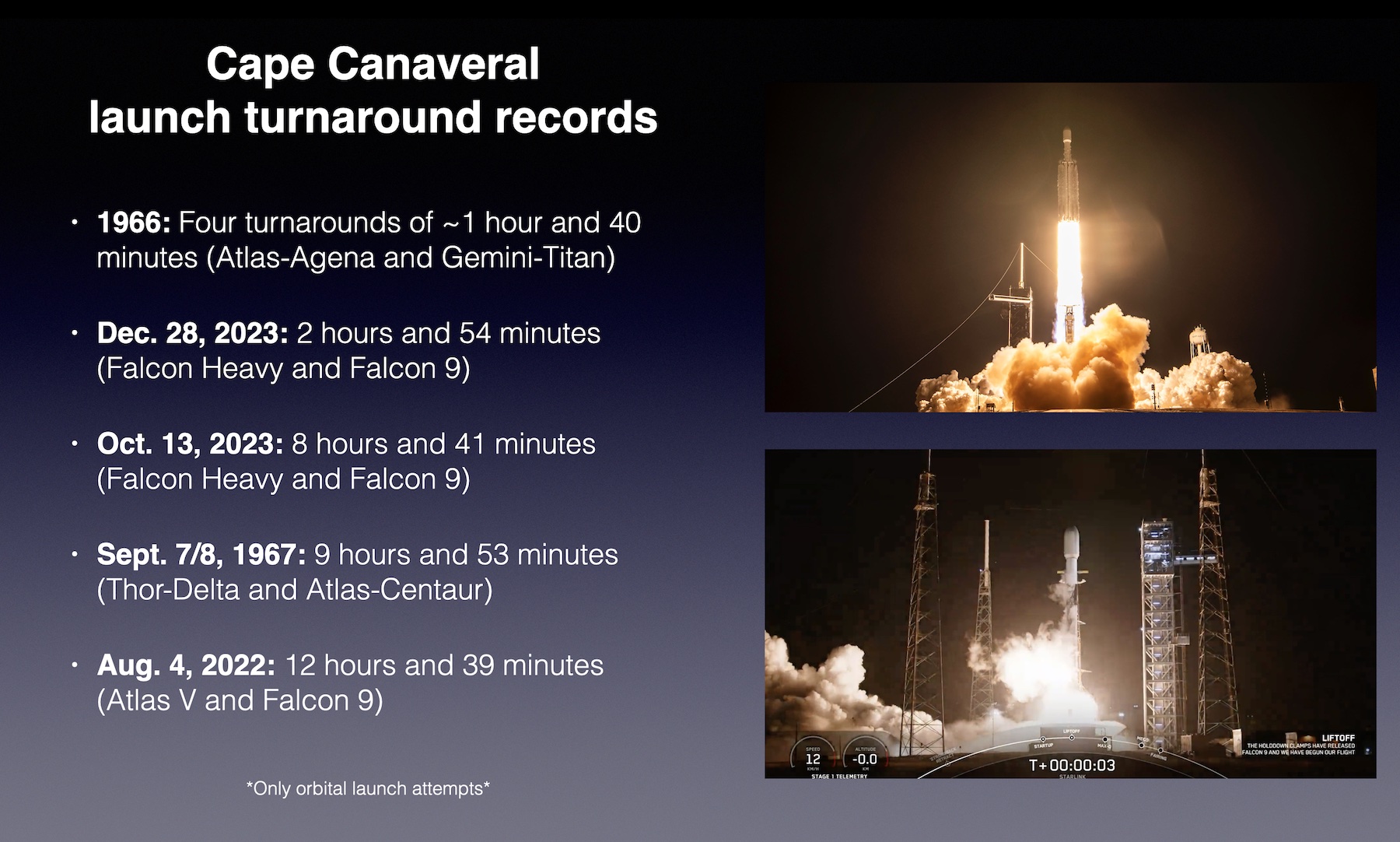
1966: Atlas-Agena & Titan-Gemini ~ 1h 40m apart (4x)


This was the shortest time between orbital launches at Cape Canaveral since 1966. //
It seems like SpaceX did everything this year but launch 100 times.
On Thursday night, the launch company sent two more rockets into orbit from Florida. One was a Falcon Heavy, the world's most powerful rocket in commercial service, carrying the US military's X-37B spaceplane from a launch pad at NASA's Kennedy Space Center at 8:07 pm EST (01:07 UTC). Less than three hours later, at 11:01 pm EST (04:01 UTC), SpaceX's workhorse Falcon 9 launcher took off a few miles to the south with a payload of 23 Starlink Internet satellites.
The Falcon Heavy's two side boosters and the Falcon 9's first stage landed back on Earth for reuse. //
These were SpaceX's final launches of 2023. SpaceX ends the year with 98 flights, including 91 Falcon 9s, five Falcon Heavy rockets, and two test launches of the giant new Super Heavy-Starship rocket. These flights were spread across four launch pads in Florida, California, and Texas. //
It's important to step back and put these numbers in context. No other family of orbit-class rockets has ever flown more than 63 times in a year. SpaceX's Falcon rockets have now exceeded this number by roughly 50 percent. SpaceX's competitors in the United States, such as United Launch Alliance and Rocket Lab, managed far fewer flights in 2023. ULA had three missions, and Rocket Lab launched its small Electron booster 10 times.
Nearly two-thirds of SpaceX's missions this year were dedicated to delivering satellites to orbit for SpaceX's Starlink broadband network, a constellation that now numbers more than 5,000 spacecraft. //
As if these statistics weren't enough, SpaceX closed out the year by, yes, setting yet another record. The back to back launches Thursday night took off 2 hours and 54 minutes apart, the shortest turnaround between two SpaceX flights in the company's history. It also set a modern era record at Cape Canaveral, Florida, with the shortest span between two orbital-class launches there since 1966. The Florida spaceport was the departure point for 72 orbital-class rockets in 2023, also an unprecedented level of launch activity there.
SpaceX looks poised to set more records next year. In 2024, SpaceX aims for an average of a dozen launches per month, for a total of 144 rocket flights. The company will get out of the starting blocks early in the new year, with two Falcon 9 launches slated for January 2 and 3.
whatthehand • 1 day ago • Edited 1 day ago
Seriously. It seems like contemporary space (more specifically spacex) fans talk about reusing rockets as if this is like reusing towels or something.
For the reasons you mention and more, reuse has got very limited use at best. And until we see a series of audited financials that dig deep down into specific areas of their business, we can't even confirm the supposedly game-changing economics of it all. Spacelaunch is about as niche of a task as there could be. It's not analogous to reusing towels or toothbrushes or cars or even airplanes. ...
...
From the layperson all the way to NASA, which itself so clearly seemed to doubt their choice even within their own initial selection statement for HLS. Even u/MrPennywhistle in his ever optimistic and infectious enthusiasm helped inadvertently spread a really bizarre belief that has since taken on a new life in popular space discourse: mainly, the strange understanding that there's somehow more to be learned by rapidly, carelessly, prematurely and DELIBERATELY destroying hugely expensive and underdeveloped test-articles. I think it was following AMOS-6 and what he meant to communicate was that having a failure prior to your main mission is a saving grace to be taken advantage of: that there's much to be learned when things go kaboom by accident. Instead it's become a thing where people literally cheer their lungs out when they see a fractional prototype of a giant and expensive craft (that Artemis is desperately banking on) fail catastrophically and tear itself into a million pieces right before their eyes because "tHeReS sO mUcH DaTa! ... //
LukeNukeEm243 • [10 hr. ago][1] • Edited 10 hr. ago
The hit to payload because of reuse isn't much of an issue because you can design the rocket to be as big as you need in order to get the payload into its desired orbit. Sure, it results in a larger, more complex rocket for the same mass of payload, however you won't have to throw the entire thing away after one mission, which will result in lower costs.
SpaceX has hit their aspirational goal of 10 reuses per booster with Falcon 9 and they are continuing beyond it. Their most used boosters have been used 17 or 18 times. They have reused 39 boosters to date, for a total combined 251 landings. Right now they have a successful landing streak of more than 116 since 2021.
This year they have launched only 4 new boosters, the other 81 launches used previously-flown boosters. Similar story for last year when they only launched 4 new boosters, while launching 56 times with reused boosters. For comparison, ULA has so far launched only 3 times this year, and 8 times last year.
SpaceX is operating on an entirely different level than the rest of the launch providers. [They are launching more mass per quarter than the rest of the world combined][2]. Is it a coincidence that they just so happen to be the only launch provider doing reuse at the moment?
As for destructive testing, it is their preferred method because it allows for changes to be made more easily and they can find unknown flaws quicker. They could spend years developing and reviewing the design of Starship so that it would likely work perfectly on the 1st time like SLS. Or they could test the design they have, see what goes wrong with it, and then make improvements to the problem areas for next time. Also these prototypes are way cheaper than an operational rocket like SLS which costs like $2.1 billion alone to launch. I mean, SpaceX is only going to get about $3 billion total from NASA for the first lunar lander and its development. That money is spread out across all the various development milestones. The fixed-price contract incentivizes SpaceX to work efficiently with both their time and money.
And the reason the SpaceX employees and fans cheer during test launches is because the prototypes are: 1- very cool to see (it's like Kerbal Space Program in real life) and 2- they show visible signs of progress. IFT1 tested the launch infrastructure, the quick disconnects were successful and the rocket made it past the tower, SuperHeavy had never flown before that. IFT2 demonstrated even more progress with the deluge system protecting the pad, all engines running nominally through to the hotstage separation, and Starship almost making it to its intended trajectory.
[1] https://www.reddit.com/r/SmarterEveryDay/comments/189vh8h/comment/kbzgf6h/
[2] https://twitter.com/BryceSpaceTech/status/1720153323393663411

Amazon announced Friday that it has purchased three Falcon 9 rocket launches from SpaceX beginning in mid-2025 to help deploy the retail giant's network of Kuiper Internet satellites. //
Last year, Amazon bought up most of the Western world's excess launch capacity from everyone but SpaceX, securing 68 rocket flights from United Launch Alliance, Arianespace, and Blue Origin to deploy thousands of satellites for the Kuiper broadband network. Amazon previously contracted with ULA for nine Atlas V launches to support the initial series of Kuiper launches, the first of which lifted off in October with Amazon's first two Kuiper prototype satellites. More Atlas Vs will start launching operational Kuiper satellites next year. //
Amazon is helping to fund a big expansion in ULA's footprint at its Florida launch base, an effort that will double the ULA's launch capacity. The investment to fund the growth in ULA's capability to support Kuiper launches totals about $2 billion, with around $500 million going toward upgrades at Cape Canaveral.
Those upgrades include the outfitting of a second vertical hangar and a second mobile launch platform for Vulcan rockets, alongside the integration facility and launch table already built to support the first few Vulcan missions. Having dual lanes for launch processing in Florida will allow ULA to fly as many as 25 Vulcan rockets per year, the company says.
ULA and its subcontractors are also expanding factory space at locations around the country to produce more Vulcan engines, solid rocket boosters, and payload fairings for the Kuiper missions.
Amazon and ULA officials hope these investments will spare the Vulcan rocket from the growing pains experienced by other launch vehicles as they enter service. For example, it took 31 months for the Atlas V rocket to reach its fifth flight in the early 2000s. A decade ago, SpaceX's Falcon 9 made its fifth flight 33 months after its inaugural launch.
That won't do if Amazon is going to deploy more than 1,600 Kuiper satellites by mid-2026.
During Artemis I, NASA’s new mega Moon rocket, the Space Launch System (SLS), roared into the night sky and sent the Orion spacecraft on a 1.4-million-mile journey beyond the Moon and back. //
The spacecraft reached a maximum distance from Earth when it was 268,563 miles away from our home planet. Orion surpassed the record for distance traveled by a spacecraft designed to carry humans, previously set during Apollo 13.
A close up view of the Orion in space. The orange spacesuit on Commander Moonikin Campos can be seen through one of the crew module's windows. The American flag on the body of the crew module and red NASA lettering can also be seen.
A camera mounted on one of Orion’s solar array wings captured a close up image of the crew module.
Starship Flight Test 2
November 18, 2023, at 7:02 a.m. — SpaceX's Starship launches on its second fully-integrated flight test from the orbital launch pad at Starbase in Texas. The rocket successfully reached stage separation under the power of 33 Raptor engines on the Super Heavy booster, with the new hot-staging separation method a success! Starship made it to space and was later terminated, while the Super Heavy booster experienced a rapid unscheduled disassembly shortly after stage separation.
Starship returned to integrated flight testing with its second launch from Starbase in Texas. While it didn’t happen in a lab or on a test stand, it was absolutely a test. What we did today will provide invaluable data to continue rapidly developing Starship.
Starship successfully lifted off under the power of all 33 Raptor engines on the Super Heavy Booster and made it through a successful stage separation. The booster experienced a rapid unscheduled disassembly after its boostback burn following the successful stage separation while Starship's 6 second stage Raptor engines fired for several minutes as the Ship climbed to an altitude of ~150 kilometers.
With a test like this, success comes from what we learn, and today’s test will help us improve Starship’s reliability as SpaceX seeks to make life multiplanetary.
video


CAPE CANAVERAL, Florida—In three-and-a-half years of service, one of SpaceX's reusable Falcon 9 boosters stands apart from the rest of the company's rocket inventory. This booster, designated with the serial number B1058, has now flown 18 times. For its maiden launch on May 30, 2020, the rocket propelled NASA astronauts Doug Hurley and Bob Behnken into the history books on SpaceX's first mission to send people into orbit.
This ended a nine-year gap in America's capability to launch astronauts into low-Earth orbit and was the first time a commercial spacecraft achieved this feat. At that time, the rocket was fresh from SpaceX's factory in Southern California, glistening white in color, with a bright red NASA "worm" logo emblazoned on the side.
Over the course of its flights to space and back, that white paint has darkened to a charcoal color. Soot from the rocket's exhaust has accumulated, bit by bit, on the 15-story-tall cylinder-shaped booster. The red NASA worm logo is now barely visible. //
With Friday night's flight, this particular booster has launched 846 satellites, most of which have been Starlinks. When you let it sink in, that's a remarkable number. It's more than the total number of satellites in OneWeb's broadband network. The launch Friday night, numbered Starlink 6-26, brought the total number of functional Starlink satellites in orbit to more than 5,000, according to a tabulation by Jonathan McDowell, an astrophysicist and expert tracker of spaceflight activity. //
SpaceX officials often emphasize that, even after 277 launches of Falcon 9 or Falcon Heavy rockets, engineers learn something with each flight. It certainly helps when you get the majority of the rocket (the booster and the payload fairing) back after each launch, allowing technicians to perform inspections and refurbishment, occasional engine swaps, upgrades, or anything that needs to be done between missions.
all the tags from https://b.plas.ml
1st-amendment 2nd-amendment 4th-amendment 5th-amendment 9/11 a8 abortion acl adhd afghanistan africa a/i air-conditioning amateur-radio amazon america american android animals anti-americanism antifa anti-semitism antiv antivirus aoip apollo apple appliances archaeology architecture archive art astronomy audio automation avatar aviation backup bash batteries belleville bible biden bill-of-rights biology bookmarks books borg bush business calibre camping capitalism cellphone censorship chemistry children china christianity church cia clinton cloud coldwar communication communist composed computers congress conservatives constitution construction cooking copyleft copyright corruption cosmology counseling creation crime cron crypto culture culture-of-death cummins data database ddt dd-wrt defense democrats depression desantis development diagrams diamonds disinformation diy dns documentation dokuwiki domains dprk drm drm-tpm drugs dvd dysautonomia earth ebay ebola ebook economics education efficiency electricity electronics elements elwa email energy engineering english environment environmentalism epa ethernet ethics europe euthanasia evolution faa facebook family fbi fcc feminism finance firewall flightsim flowers fonts français france fraud freebsd free-speech fun games gardening genealogy generation generators geography geology gifts git global-warming google gop government gpl gps graphics green-energy grounding hdd-test healthcare help history hollywood homeschool hormones hosting houses hp html humor hunting hvac hymns hyper-v imap immigration india infosec infotech insects instruments interesting internet investing ip-addressing iran iraq irs islam israel itec j6 journalism jumpcloud justice kindle kodi language ldap leadership leftist leftists legal lego lgbt liberia liberty linguistics linux literature locks make malaria malware management maps markdown marriage mars math media medical meshcentral metatek metric microbit microsoft mikrotik military minecraft minidisc missions moon morality mothers motorola movies mp3 museum music mythtv names nasa nature navigation navy network news nextcloud ntp nuclear obama ocean omega opensource organizing ortlip osmc oxygen paint palemoon paper parents passwords patents patriotism pdf petroleum pets pews photography photo-mgmt physics piano picasa plesk podcast poetry police politics pollution pornography pots prayer pregnancy presentations press printers privacy programming progressive progressives prolife psychology purchasing python quotes rabbits rabies racism radiation radio railroad reagan recipes recording recycling reference regulations religion renewables republicans resume riots rockets r-pi russia russiagate safety samba satellites sbe science sci-fi scotus secularism security servers shipping ships shooting shortwave signal sjw slavery sleep snakes socialism social-media software solar space spacex spam spf spideroak sports ssh statistics steampowered streaming supplement surveillance sync tarsnap taxes tck tds technology telephones television terrorism tesla theology thorium thumbnail thunderbird time tls tools toyota trains transformers travel trump tsa twitter typography ukraine unions united.nations unix ups usa vaccinations vangelis vehicles veracrypt video virtualbox virus vitamin vivaldi vlc voting vpn w3w war water weather web whatsapp who wifi wikipedia windows wordpress wuflu ww2 xigmanas xkcd youtube zfs