Williams has not ruled on any of the underlying claims. What she has done is hand a win to a group founded by one of Trump's impeachment lawyers, who filed a motion with a judge appointed by Barack Obama and got exactly the result they were looking for. //
Tech in RL
3 hours ago
Sure, re-open the case and press forward for $10 billion. Trump is in a no-lose situation. He either wins a huge award for weaponization of government because guilt is certain since a guy went to jail for it, or the people get a weaponization fund. If Trump wins a big award from this, he can set up his own fund without worrying about politics. //
Old Texan
2 hours ago edited
"whether the case should be reopened because "the court was the victim of a fraud"
Perhaps she should review the thousands of cases filed against everything Trump does, and then let me know if the judiciary is not committing fraud on a regular basis. Perhaps then I will give credence to her concerns. //
anon-isiz
2 hours ago
What are the 35 judges’ standing to question the settlement? None.
District9 anon-isiz
30 minutes ago
Democrat challengers automatically have standing everywhere. Standing only comes into play when Republicans question something.


A new DOJ lawsuit represents a vital step toward ending an un-American war on disfavored attorneys and defenders of disfavored causes — a war that would do irrevocable damage to our justice system and republic. //
With a new landmark lawsuit, the Trump Justice Department is finally fighting this “barfare” —leftist efforts to render the right defenseless by crushing or chilling conservative attorneys via stress-inducing probes, costly trials, and crippling penalties that include disbarment. On May 13, the DOJ filed a complaint against the bar disciplinary authorities of Washington, D.C., in defense of former Trump I DOJ official Jeffrey Clark, the Constitution, and the rule of law itself.
Those authorities investigated, tried, and convicted the accomplished litigator for a novel “thoughtcrime”: preparing a document proposing a legal course of action based on a reading of evidence that his DOJ superiors disagreed with. //
So after the contest he drafted a letter on the department’s behalf to Peach State leaders to address such matters. He designated the letter as “Pre-Decisional & Deliberative/Attorney-Client or Legal Work Product” and “FOR INTERNAL … USE ONLY,” and dubbed it a “Proof of Concept” document. The letter indicated that the DOJ had identified potential election-swinging issues and called on the state to convene a special legislative session to review and remedy such matters.
Clark presented the letter to his bosses, including Acting Attorney General Jeffrey Rosen, for review. They disagreed with its claims regarding 2020 election integrity issues and Clark’s plan to address them. Ultimately, the document would go unsent, only to leak after President Trump had left office during Democrats’ Jan. 6-related political and legal jihad. //
In July 2022, D.C. bar disciplinary authorities charged Clark with ethical violations, including “conduct involving dishonesty,” over his drafting and defending of the document. The then-Democrat-led Senate Judiciary Committee allegedly spurred the case by lodging an ethics complaint with the D.C. regime. //
What was the tribunal’s reasoning? That Clark’s views did not comport with those of his superiors, his superiors by default represented those of the department, and therefore, by ascribing his conflicting views to the department in his draft, unsent, “pre-decisional” letter, he was somehow being dishonest.
Despite admitting that there were “no factually comparable prior disciplinary cases,” the tribunal recommended that Clark be disbarred.
Clark is appealing the absurd and outrageous case — one that would render it potentially career-ending to provide legal advice that might conflict with that of one’s superiors. The case would also seem to make it fair game for disciplinary authorities to review and potentially render punishment over internal draft documents containing hypothetical legal proposals. //
In addition, the Justice Department notes the D.C. bar disciplinary tribunal’s lenient treatment of leftists in contrast to its treatment of conservatives: When FBI Attorney Kevin Clinesmith was caught doctoring an email to convince the FISA Court to let the feds spy on Trump adviser Carter Page, the D.C. bar gave him a “slap on the wrist” with a retroactive one-year license suspension.
The suit closes with a trio of legal arguments that transcend Clark’s case or claims of a bar disciplinary authority run amok: first, that the Constitution’s Supremacy Clause prohibits state and local bar disciplinary authorities from regulating the work of federal officials like Clark via bar disciplinary proceedings; second, that such authorities engage in unlawful discrimination by subjecting federal lawyers to disciplinary cases never before brought against non-federal lawyers; third, that by targeting federal attorneys over their work, such authorities are unlawfully interfering with presidential power. //
The DOJ’s lawsuit does not directly address lawfare activists’ targeting of non-government lawyers with disbarment and destruction for taking up verboten causes, such as constitutional scholar John Eastman’s work contesting the 2020 presidential election. Still, it may prove far more effective than the Justice Department’s proposed rule giving the agency the right to review (but not to quash) efforts to cripple conservative federal lawyers via the likes of the D.C. bar disciplinary authorities.
Second, Jackson’s relationship with children too often ventured into the inappropriate and indefensible, but at the same time, the overwhelming evidence is that he was not guilty of sexually abusing children and was in fact the victim of multiple extortion schemes.
But even today, when the world has rendered its own judgement, that Michael Jackson remains beloved, the media cannot bring themselves to talk about him without suggesting he was likely a pedophile. They refuse to do it. They refuse to tell the truth and they refuse to acknowledge that their preferred version of his story has been rejected by the public. //
I could understand some of the obsession if there were any proof that Jackson did something criminal. He’s been accused and after the one and only time it went to trial, he was acquitted because the jury was introduced to the alleged victim’s wretch of a mother who had a proven history of theft and fraud— schemes that she used her kids to execute.
There was the 2019 Leaving Neverland documentary in which another two accusers, now grown men, laid out graphic details of their own alleged abuse. Both of them are demonstrable liars in ways both big and small, and both made their charges only after Jackson was dead and in pursuit of money (they’re both actively suing his estate).
The details of all of these cases are genuinely riveting, just not in the way the media would prefer.
But, according to numerous studies, polygraphs cannot reliably detect lying, or truth-telling, and their use in the justice and employment systems is regulated due to those problems with scientific reliability. A landmark 2003 report from the National Academies of Sciences, Engineering, and Medicine found the quality of research about polygraphy to be low, the theoretical explanation of how it functions (and why it detects lying, and not, say, nervousness) to be inadequate, the rate of false positives to be unacceptable, and the rate of false negatives to be a risk. Researchers still cite this study. //
But if media audiences find themselves in a polygraph exam room, they should probably feel twinges of doubt, perhaps especially if they are innocent. Citing evidence from William G. Iacono, a professor emeritus of psychology at the University of Minnesota, he said that polygraphs can identify just 75 percent of guilty people. But critically, they only accurately judge truth-tellers around 57 percent of the time. “The research generally shows that the people who are innocent are at a disadvantage,” he said. //
Of the 36 cases with a definitive polygraph examiner judgment, a correct exculpatory outcome only occurred in eight cases. But Denkinger’s issues with the dataset went further: “Every single person who took a polygraph in the set was done a disservice by the polygraph,” he said. “Either they were told they failed because the examiner thought that the result was a deceptive response, which was a false interpretation, or they were truthful, and the interrogators or the examiner misrepresented the result and told them that they were lying.”
That latter part is the focus of Denkinger’s most recent work: how the polygraph is used coercively. For example, law enforcement is permitted to tell subjects they’re failing the polygraph even if they’re not—a practice that can induce false confessions. And it is confessions that law enforcement is after. //
At the University of Utah, where he got his doctorate, Honts developed a method of polygraph examination that used standardized questions and relied less on the expertise of the examiner. He says that unlike some other countries, examiners in the US haven’t adopted the methods he sees as best-practice at a large scale, in large part because they see polygraphs more as interrogation tools than lassos of truth.
That practice can let guilty people go free, send innocent people to court, and make the most sensitive parts of our government—the defense and nuclear establishments, which both use polygraphy to vet employees—less secure. For instance, infamous spy Aldrich Ames, a three-decade CIA employee who passed secrets for close to a decade prior to his arrest, to the Soviets and later the Russians, passed a polygraph twice while actively committing espionage. Ames later said his polygraph savvy was aided by advice from the KGB, who told him to be cooperative and stay calm to pass the examination. //
Scientists like Lee may be getting closer to an accurate lie detector, and improving on the traditional polygraph. But there’s currently no superhero solution. And the problem, as Lee’s research hints, may be ontological, not technological.
That’s definitely Maschke’s view. “It’s all pseudoscience,” he said. “There is no lie detector. So my thinking is that it’s better not to pretend that you can detect lies, because it’s a way of deceiving yourself.”
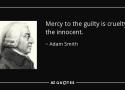
Mercy to the guilty is cruelty to the innocent.
Adam Smith
Adam Smith (2012). “The Theory of Moral Sentiments”, p.89, Courier Corporation

Congress has voted to compel release of the so-called “Epstein files,” a trove of documents amassed during criminal investigations into the sex offender who committed suicide in 2019.
The contents are likely brimming with thousands of names of innocent people, many of whom have provided alibis or were never under any suspicion of sex trafficking or any other crime.
A significant portion of any criminal investigation consists of uncorroborated accusations that are floated by people on the periphery of the case, third-hand accounts, theories and rumors.
We already know Epstein was a vile and depraved criminal. And no one should belittle the experience of his victims.
Anyone, however, can make allegations. Even victims don’t always remember correctly.
This is why grand jury files are almost always sealed.
Things a braggart such as Epstein might have said may not be true.
That’s why we have procedures, the rule of law, statutes of limitations and trials.
Moreover, the Epstein files will be filled with information obtained by law enforcement using warrants based on probable cause signed off by a judge for a specific reason.
The warrants, which allow the use of government coercion, weren’t signed so that the public could have access to the emails of every person Epstein spoke with.
Americans caught up in criminal investigations have a presumption of privacy.
What principle stops a future Congress from cracking open useful Justice Department files and releasing any embarrassing second-hand conversations that involve their political enemies?
If authorities believe that his prosecution in Florida was corrupt, they should launch an investigation into misconduct.
This isn’t an ancient case. Most of the victims are still alive.
Most of the powerful people involved with Epstein are still alive. His sidekick is still alive and in prison.
Investigate.
But much of this is driven by rank partisanship.
Democrats like to act as if Trump is engaged in some coverup.
Well, they had every chance to release the files during Joe Biden’s presidency. I’ve not seen a single Democrat explain why they didn’t.
One suspects that if there was anything implicating Trump of genuine wrongdoing, we’d have seen the files leaked long ago.
House Democrats couldn’t even muster the votes to censure Democratic Virgin Islands Delegate Stacey Plaskett, who exchanged text messages with Epstein during a 2019 congressional hearing.
The whole thing is a farce.

Can Britain be saved from itself? The latest example of submission to Muslims took place in London, where a British lawyer wearing a Star of David necklace near a pro-Palestinian protest outside the Israeli Embassy was arrested for his provocative behavior. After all, the mere sight of that necklace could cause the mob to become angry, even violent, and instead of protecting the lawyer from possible violence by the mob, the Metropolitan Police arrested him. More on this absurdity can be found here: “London police detain Jew for wearing Star of David, ‘antagonizing’ pro-Palestine protesters,” Jerusalem Post, October 19, 2025: //
He was there not to provoke — after all, he could have been in real trouble from a maddened mob — but to record that mob’s behavior and what he believed were its violations of the law, including laws against hate crimes. Instead the police chose to arrest him, handcuff him, and hold him for ten hours, as they tried to figure out they could charge him with, but came up empty and had to let him go.
A mob’s yelling and screaming against Israel and Jews is apparently okay, according to the British police. A single man, wearing a Star of David neckless and silently recording that mob’s behavior, deserves to be arrested.

From the opening pages, Navarro makes it clear he didn’t enter federal prison as a criminal, but as a patriot defending the separation of powers enshrined in the Constitution. His “crime”? Upholding executive privilege on behalf of President Donald J. Trump — the same principle dating back to George Washington. Yet under Joe Biden’s Justice Department, that once-sacred doctrine became grounds for shackles and a cell. Navarro’s prosecution, as he points out, was the first of its kind in American history — the first time a senior White House adviser has ever been imprisoned for contempt of Congress after asserting executive privilege. //
By the end, Navarro’s book becomes more than a memoir — it’s a warning. It shows how easily justice can be weaponized, how quickly America’s legal institutions can morph into tools of political retribution. His ordeal mirrors Trump’s: biased juries, radical Democrat judges, and media-driven show trials masquerading as due process. The parallel is unmistakable and chilling. When Navarro writes, “There’s not a dime’s worth of difference now between the courts in Communist China and the good ole U.S. of A.,” it’s hard to disagree. //
His message to America is simple: stand up, or lose your country. His story is a mirror held up to a nation on the brink — and a reminder that freedom requires more than words; it demands courage.
"I Went to Prison So You Won’t Have To" is a must-read for anyone who still believes that justice should be blind and that loyalty to the Constitution should never be a crime. It is a love letter to freedom, a eulogy for due process, and a siren warning about what happens when Democrats weaponize the courts to destroy political opponents. //
His book stands as both testimony and prophecy — a call to action ahead of the coming election. Because as Navarro’s ordeal proves, when the government can jail a man for serving his president, the republic itself hangs in the balance. //
Laocoön of Troy
3 hours ago
This reads like a replay of Émile Zola and "J'Accuse".
Good! America needs to look deeply into the face of bureaucratic injustice and vicious political perversion of it. Tyranny.
‘When a court concludes that the Executive Branch has acted unlawfully, the answer is not for the court to exceed its power, too.’. //
On Friday, the U.S. Supreme Court declared rogue lower courts’ universal injunctions against President Donald Trump’s birthright citizenship order to be unlawful.
“[F]ederal courts do not exercise general oversight of the Executive Branch; they resolve cases and controversies consistent with the authority Congress has given them. When a court concludes that the Executive Branch has acted unlawfully, the answer is not for the court to exceed its power, too,” Associate Justice Amy Coney Barrett wrote.

In a 6-3 decision authored by Justice Amy Coney Barrett, the court granted the government's applications to partially stay the district court's nationwide injunctions in the birthright citizenship cases, noting that universal injunctions "likely exceed the equitable authority that Congress has granted to federal courts." The caveat here is that the applications are granted "only to the extent that the injunctions are broader than necessary to provide complete relief to each plaintiff with standing to sue."
The key to the court's decision appears to be summed up thusly:
When a court concludes that the Executive Branch has acted unlawfully, the answer is not for the court to exceed its power, too.
Additionally, the court has instructed the district courts to "move expeditiously to ensure that, with respect to each plaintiff, the injunctions comport with this rule and otherwise comply with principles of equity."

A federal judge has stranded three ICE officers and their convicted-criminal deportees in Djibouti, Africa, after an order was handed down grounding their flight.
The eight illegal immigrants were on their way to South Sudan in late May when US District Judge Brian Murphy stepped in, claiming the Trump administration "unquestionably" violated a March decision on deportations. The flight then landed in Djibouti, a small nation on the Horn of Africa, with ICE agents being ill-equipped to deal with the "outrageous" conditions. //
The Trump administration has appealed to the Supreme Court to step in regarding this case, but so far, nothing has happened. As I've said before, regardless of what legal arguments exist, the longer this constant stream of lower-court decisions usurping executive power is allowed to continue without any new guardrails put in place, the less credibility the judiciary will enjoy. That's not a good thing for the country, and I sincerely hope this doesn't reach the point where court orders have to be ignored, because if that happens, there's no putting the genie back in the bottle.

Sinatra Jordan was accused of firing at police officers and leading them on a chase through the streets of Jackson. Then the officers were arrested.
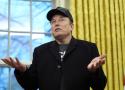
"If the courts are going to have so much influence over US policy, do you wish you would have just become a judge?"
Trump: "We had millions of criminals pour into our country. And if we don't get them out and get them out quickly, you could lose your country very easily." pic.twitter.com/UfA7egQLi8
— TheBlaze (@theblaze) May 30, 2025. //
ELON MUSK: "I think the fundamental moral flaw of the left is empathy for the criminals and not empathy for the victims — empathy for the criminals but not empathy for the victims. And there's been way too much of that; that needs to stop. To the president's point, there's been immense judicial overreach that is unconstitutional — that was never intended — and it's undermining the people's faith in the legal system. It needs to stop. It's gone too far.
pic.twitter.com/JY1IomtX60
— Autism Capital 🧩 (@AutismCapital) May 30, 2025. //
stickdude90
5 minutes ago
During Trump 1.0 (and arguably long before then), the media threw away their credibility in favor of ideology.
During the pandemic, the public health institutions threw away their credibility in favor of ideology.
The judiciary is bound and determined to follow that path, and they're doing a bang-up job so far.
The District of Columbia court system is an unconstitutional mess. The idea that the president can only nominate candidates to the bench from a preselected list provided by a commission over which he has no control clearly violates the Constitution’s appointments clause.
But somehow the process of reappointment in the District of Columbia is even worse. There, a similarly bizarre committee (the Commission on Judicial Disabilities and Tenure) evaluates judges whose terms have expired, after which it can usurp the president’s nomination and appointment powers as well as short-circuit the advice and consent function of the Senate.
In other words, this commission — and this commission alone — can decide whether judges will continue to serve despite what the president, the Senate, or the people the president and Senate serve want.
President Trump and Attorney General Bondi should consider taking action to remedy this constitutional abomination. //
Because both the nomination and appointment of judges are core Article II powers, having that power exercised by an independent body wholly outside the president’s control is constitutionally untenable. In many ways this is even worse than the unconstitutional judicial-nomination system in D.C. //
So what is to be done? In the case of the Judicial Nominating Commission, the remedy is easy enough: President Trump should nominate whomever he wants and appoint him subject to the advice and consent of the Senate.
For those judges already on the bench and subject to reappointment, he might need to be more creative because the paper authorizing the reappointment does not traverse the White House at all.
One option in the case of a reappointed judge is for the attorney general to seek a writ of quo warranto. One of the ancient prerogative writs, it literally means “by what warrant” and is a way for a court to determine whether or not a holder of public office is legitimate. Rarely used — and almost always pursuant to state law — it is contemplated in the All Writs Act at the federal level. The limited precedent on the subject seems to indicate that the attorney general has the power to seek the writ. //
Law and order in the District of Columbia is a disgrace, in no small part because of its activist local judges chosen and reappointed through an unconstitutional process. As President Trump seeks to “make D.C. safe again,” he should act where he has the authority to do so and fix the broken reappointment process for the D.C. courts.

SCOTUS Takes Up the Power of Nationwide Injunctions and the Threat to Executive Authority.
May 16, 2025
Mark Twain once used the word, Podunk to describe a small, unimportant town. Today, a Podunk pettifogger from just such a place thinks he is David taking on Goliath. But this time, Goliath is the duly elected President of the United States. //
The Presidential Executive Order (EO) has become the way to govern Washington at a time when Congress is entirely dysfunctional. However, the vast network of federal district judges, who are, by definition, supposed to be apolitical and neutral, often rule against the EO. They do so increasingly on a "nationwide" basis, far beyond the districts their courtrooms oversee.
It has become a pressing and multifaceted issue. The United States federal judiciary has 677 district court judges (across 94 districts, including territorial courts like those in Puerto Rico and Guam). These are lifetime appointments under Article III of the Constitution. When an activist federal judge deems the underlying challenge to an EO from a plaintiff noteworthy, the judge sets out to ensure "uniform relief" across the entire country through a nationwide injunction. Even the nine Appeals Courts do not have such a reach. Even the Supreme Court doesn't have the same power unless at least five justices agree! //
Expectedly, Justice Clarence Thomas expressed his displeasure again at nationwide injunctions, pointing out that the U.S. judicial system operated without them until the 1960s, so why were they necessary now? Justice Samuel Alito, who has previously been a skeptic, hinted that he would vote to scale them back.
Chief Justice John Roberts focused on the procedural aspects of nationwide injunctions, suggesting that the Supreme Court has become more efficient at handling emergency cases expeditiously. He undercut the concerns of Justices Barrett, Gorsuch, and Sotomayor.
Justice Brett Kavanaugh had the best legal solution by suggesting that class-action lawsuits could serve as an alternative to nationwide injunctions. His questioning was a rare demonstration of principled legal analysis, not tainted by politics.

"Federal district judges are appointed by the president, confirmed by the Senate, and serve lifetime terms. There are currently 677 such judges in the U.S. Do you support or oppose individual district judges having the authority to block or halt a president’s policy nationwide?"
A solid majority of Americans say yes. Specifically, 56% said they either support such powers "strongly" (31%) or "somewhat" (26%), while just 28% said they oppose it either "somewhat" (13%) or "strongly" (15%). A sizeable 16% said they weren't sure. //
Democrats are most supportive, with 71% saying the support the judges, just 14% saying they oppose them. Among independents, that majority falls to 54% support, and rises to 30% opposition. The surprise comes among Republicans, where a plurality of 48% support judges over presidents, while 40% support it. //
But the numbers shifted somewhat with our second question: "Do you agree or disagree that federal judges should serve for a limited term rather than a lifetime appointment?"
The answer was even more overwhelming, this time not in favor of the judges. Overall, 71% said they either agree "strongly" (41%) or "somewhat" (30%), while the disagree category mustered only 16% for disagree "somewhat" (9%) or "strongly" (7%). //
Overall, 64% said they supported arresting judges who break laws either "strongly" (43%) or "somewhat" (21%). Just 22% opposed the idea, 10% "strongly" and 12% "somewhat." //
According to the Congressional Research Service, federal judges issued 17 separate injunctions against Trump from the time he re-entered office on Jan. 20 through March 27.
This is nothing new. In 2019, William Barr, Trump's second attorney general, complained about judicial injunctions directed at Trump.
"Since President Trump took office, federal district courts have issued 37 nationwide injunctions against the executive branch," Barr said. "That’s more than one a month."
"By comparison," the nation's former top lawyer added, "during President Obama’s first two years, district courts issued two nationwide injunctions against the executive branch, both of which were vacated by the Ninth Circuit. And according to the Department’s best estimates, courts issued only 27 nationwide injunctions in all of the 20th century (emphasis ours)." //
Americans' appetite for enabling federal judges to halt presidential actions willy-nilly may soon be tempered by a Supreme Court decision that limits those powers. If so, it should not be politics. It should be because the Constitution does not allow it.
///
That's democracy. But what is consistent with Constitutional Law? Districts should not have jurisdiction beyond their district.

One of the most frequent questions posed in response to articles regarding decisions by federal judges is: Who appointed him/her? In theory, that shouldn't matter — blindfolded Lady Justice and all that. In practice, all too often, it seems that it does.
But...maybe not quite as much as people assume. I decided it might be interesting to take a closer look at some of the statistics regarding the federal judiciary. Some of those stats will come as no surprise. Others, though, well, see what you think. //
While many assume the court typically rules in partisan fashion, the bulk of the decisions in each term are unanimous (accounting for roughly 47 percent of the decisions over the most recent three terms).
In contrast, the 6-3 decisions (what one would expect if the decisions were strictly party-line) account for only 22 percent of the decisions. //
Next, we'll take a look at the makeup of the federal judiciary, beginning with the District Courts.
Number of district courts - 94
Number of district judges - 677 (does not include those who have taken senior status). //
Alright, but what about the Circuit Courts of Appeal? Well, we have that breakdown as well.
Number of circuit-level judgeships - 179 (not including those who have taken senior status)
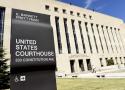
Because so much of the focus of late has been on the litigation challenging executive actions taken by President Donald Trump, and because so many of those suits have been filed in the D.C. District Court, I thought it might be useful to take a deeper dive into the makeup of that court. We'll also look at the distribution of these cases among the various active judges on the court. //
So, it appears that the judges who have more cases assigned to them tend to have multiple cases that have overlapping issues, and thus, the cases are related if not consolidated ... //
In other words, while I do think there are fair questions about how Judge Boasberg ended up with the J.G.G. case, overall, the only discernible patterns regarding case assignments are that the most senior and most junior have fewer, and the judges who have the most cases assigned to them tend to have cases that lend themselves to being grouped together.

So when they sought emergency relief at 12:34 a.m. on April 18, Petitioners “were fully aware that the District Court intended to give the Government 24 hours to file a response.” A.A.R.P., 605 U.S. at _ (Alito, J., dissenting). They “said nothing about a plan to appeal if the District Court elected to wait for that response.” Id.
At 12:48 p.m. on April 18, however, Petitioners “suddenly informed the court that they would file an appeal if the District Court did not act within 42 minutes, i.e., by 1:30 p.m.” Id. //
This charge is worth exploring. To get to 14 hours and 28 minutes (rather than 42 minutes), the Court was obviously starting the clock at 12:34 a.m., rather than 12:48 p.m. (when Petitioners told the district court for the first time that they wanted a ruling before the Government could respond).
But starting the clock at 12:34 a.m. not only ignores the court’s express instructions respecting the Government’s right to respond. It also ignores the fact that the Court is starting the clock at—12:34 a.m.
We seem to have forgotten that this is a district court—not a Denny’s. This is the first time I’ve ever heard anyone suggest that district judges have a duty to check their dockets at all hours of the night, just in case a party decides to file a motion.
And then he adds the cherry on top:
If this is going to become the norm, then we should say so: District judges are hereby expected to be available 24 hours a day—and the Judicial Conference of the United States and the Administrative Office of the U.S.Courts should secure from Congress the resources and staffing necessary to ensure 24-hour operations in every district court across the country.
If this is not to become the norm, then we should admit that this is special treatment being afforded to certain favored litigants like members of Tren de Aragua—and we should stop pretending that Lady Justice is blindfolded. //
anon-fht2
4 minutes ago
The rationale for the Founders intentionally NOT Constitutionally requiring the other two branches to comply with the judiciary is playing out in real time. It is also apparent that the judicial insurrection by the district courts is bleeding over into the interactions between the lower courts, and between the lower courts and SCOTUS. Not in a good way either.
After reading the full response of the 5th Circuit appeals judge to the SCOTUS ruling, IMO Justice Roberts should be embarrassed that such a shoddy ruling by a SCOTUS court ever saw the light of day, much less received 7 votes of 9. It almost as if Justice Roberts wants a repeat of President Jackson’s response to a Marshal SCOTUS decision.
For the judicial branch, this seems like a slow motion catastrophe being played out with each new judicial “salvo” further undermining respect and trust for the judicial branch. Our Republic was in trouble enough with Congress and the Executive being viewed with disdain by most Americans. The Executive may regain some trust and respect under Trump, but the Judiciary had been more positively viewed than the other two branches, at least until this judicial insurrection against Trump began. Now the judiciary seems to being trying to outdo Congress for the level of earned contempt in which they are held, with SCOTUS attempting to show the way with this ruling.
IMO - YMMV
DemsShouldPayReparations Curmudgeon99
13 hours ago edited
"He is the worst Chief Justice in history, "
Really? Would you reconsider if you knew more facts?
Worse than Chief Justice Roger B. Taney. who wrote the Dred Scott decision, extending slavery in all States, which was one of the triggers for the Civil War?

Girl patriot @Girlpatriot1974
·
Alice Marie Johnson, a 69-yr old grandmother, had her life sentence for a nonviolent drug trafficking offense commuted by Trump in 2018 after serving 21 years. Trump made her Pardon Czar Feb.2025.
"I had appealed to President Obama 3 times and had been turned down all 3 times."
11:34 PM · May 18, 2025 //
In addition to finding those people who deserve a second chance, Johnson wants part of her job to be to push for possibly outdated and antiquated laws that need to be changed. She also pointed out the fact that many people who don't have the money to navigate through the justice system are often caught in it, ... //
Johnson said she feels like she represents hope for those who may be in the same situation, and that "they will not be defined by the worst thing they have done in their lives." Lara Trump asked Johnson, "Would your story have been possible in any other country?"
Without hesitation, Johnson replied, "No, absolutely not. Only someone like President Trump could make my story possible."
Alice Marie Johnson summed up her life story with an undeniable truth: "I represent what America is all about: second chances..."