
THE CARBON LIES
TRILLIONS STOLEN
MASS PSYCHOSIS
Rising CO2 is NOT caused by fossil fuels.
Rising CO2 is NOT harmful.
Both claims are categorically false.
Both are foreclosed by direct measurement.
Every carbon capture project, every carbon credit scheme, every Net-Zero pledge, every fossil-fuel restriction, every carbon footprint calculation rests on physics that has been falsified.
Trillions of dollars. Two lies. Here's the TRUTH.
LIE #1: Rising atmospheric CO2 is harmful.
There is NO evidence that increasing CO2 at current atmospheric concentrations causes ANY harm to humans, ecosystems, or the planet. NONE.
The harm claim typically routes through "warming." Two problems.
First: there is no physical quantity called "global temperature." What is reported as "global mean surface temperature" is an area-weighted arithmetic mean of intensive-variable surface readings from thermometers of varying kind, siting, and coverage. An arithmetic mean of intensive variables is not itself an intensive variable. It has no physical meaning whatsoever. Units belong to physical quantities. GMST is a number, not a temperature.
Second: even accepting the FALSE temperature framing, the radiative forcing from CO2 is trivially small. Happer and van Wijngaarden's line-by-line calculations from the HITRAN spectroscopic database give clear-sky CO2 forcing of 2.97 W/m² for doubling from 400 to 800 ppm at the top of the atmosphere.
The saturation is direct: doubling CO2 reduces outgoing radiation by only about 1%. Applying any reasonable cloud correction — Earth averages ~67% cloud cover, and clouds absorb strongly in CO2's principal 15 μm band, already blocking most of the outgoing radiation CO2 would absorb — reduces all-sky forcing below 1 W/m², plausibly below 0.5 W/m².
That is undetectable. Solar input at any surface location varies by hundreds of W/m² diurnally, dozens of W/m² seasonally, and dozens of W/m² between adjacent cloudy and clear moments. A signal of 0.5 W/m² does not rise above ordinary variability. There is nothing there to measure.
John Clauser (Nobel Prize in Physics 2022) has emphasized the further point: clouds are Earth's actual thermostat, responding to surface conditions on the scale of hours. No cloud feedback in any general circulation model has been validated against observation. A calculation that omits the dominant regulatory mechanism cannot testify to how the system responds.
Meanwhile, what CO2 does is measured, direct, and life-sustaining.
CO2 is the direct substrate of photosynthesis. Plants are the base of the entire food chain. Every calorie consumed by every animal, humans included, begins as photosynthesis. More atmospheric CO2 means more photosynthesis, more crop yield, more biomass. More CO2 means more life.
Satellite measurements since 1982 show Earth's leaf area has increased substantially, driven primarily by CO2 fertilization. Agricultural yields have risen with atmospheric CO2. Commercial greenhouse operators intentionally maintain CO2 at 1,000-1,500 ppm because plants thrive there.
The geological record: atmospheric CO2 has ranged from 180 ppm (glacial minima) to 7,000 ppm (Cambrian). Life flourished at the high end. The genuine danger threshold is the low end, near 150 ppm, below which C3 photosynthesis fails and terrestrial life largely ends.
LIE #2: Rising atmospheric CO2 is caused by human fossil fuel burning.
The isotopic mass balance forecloses this claim.
Fossil fuel carries δ¹³C = −28‰. The measured signature of the actual net addition to the atmosphere, from six independent records spanning 500-1000 years (four Scripps stations, Cape Grim Air Archive, Law Dome ice core, Caribbean sclerosponge), is δ¹³C = −13.2‰.
Under the physically dictated mass partition equation, the fossil fraction of the net atmospheric addition is approximately ZERO.
For fossil to dominate the atmospheric increase (the IPCC and @CO2Coalition FALSELY claim), non-fossil sources and sinks would need to carry δ¹³C = +46‰ or heavier. No terrestrial reservoir on Earth carries this signature. Not the ocean. Not the biosphere. Not volcanic. Not carbonate weathering. Nothing on this planet. This is two orders of magnitude away from REALITY. Not even close.
Trillions stolen.
Global spending on climate policy exceeded $2 trillion in 2024. McKinsey estimates cumulative spending of $275 trillion through 2050 under the industry-standard Net Zero 2050 scenario, roughly 7.5% of global GDP annually for three decades. Carbon credit markets alone moved over $100 billion in 2023, trading permission slips against a claim the physics forecloses.
Every dollar spent on carbon capture, offset schemes, Net-Zero infrastructure, carbon credits, and fossil-fuel restriction is STOLEN from productive economies on the basis of physics that has been falsified by direct measurement.
This is not waste. It is thievery.
Mass psychosis.



By Hugh Ross
Published: February 5, 2023
Nearly 25 years ago, I wrote in a former RTB publication that “Big bang cosmology is an explosive topic.”1 It has led to heated reactions over the years from groups opposed to one another. However, the reasons for expressed rejection of big bang cosmology are not scientific. They are religious. Thus, it seems that establishing a biblical basis for the big bang may help turn down the heat.

New study confirms 2024 “momentum flux theory” on how angular momentum of water flows drives rotation.

A typical lawn sprinkler features various nozzles arranged at angles on a rotating wheel; when water is pumped in, they release jets that cause the wheel to rotate. But what would happen if the water were sucked into the sprinkler instead? In which direction would the wheel turn then, or would it even turn at all? That’s the essence of the “reverse sprinkler” problem that physicists like Richard Feynman, among others, have grappled with since the 1940s. Now, applied mathematicians at New York University think they’ve cracked the conundrum, per a recent paper published in the journal Physical Review Letters—and the answer challenges conventional wisdom on the matter. //
Mach proposed that there would be no rotation with a reverse sprinkler: the reaction force on the nozzle as it sucks in water pulls the nozzle counter-clockwise, while the water flowing into the inside of the nozzle pushes it clockwise. The two forces cancel each other out in this steady-state scenario. Feynman’s own experiment showed a slight tremor when pressure was first applied to pump water through the nozzle, and then the sprinkler returned to its original position and remained still.
But others suggested that if the friction was low enough and the inflow rate high enough, a reverse sprinkler will start to turn in the opposite direction of an ordinary sprinkler, thanks to the formation of a vortex inside.
The Earth may not be that massive, but it still distorts space-time. //
Albert Einstein’s general theory of relativity predicts that a rotating mass like the Earth pulls the fabric of space and time around with it in a perpetual swirl. This phenomenon is known as frame dragging or the Lense-Thirring effect, after the two physicists who modeled it back in 1918. Frame dragging becomes more significant with larger masses and faster rotation, so we’ve mainly observed it around huge black holes.
Measuring how much the Earth twists spacetime as it rotates has been much more challenging because our pale blue dot of a planet is millions of times lighter than a typical black hole and rotates rather slowly.
But now, a team of astronomers led by Ignazio Ciufolini, a physicist at the Wuhan Institute of Physics and Mathematics in China, reports the most accurate measurement of the terrestrial Lense-Thirring effect to date. Their work brings our uncertainty down from a few percentage points to just 0.2 percent. And they did it with a satellite that looks like a cross between a golf ball and a disco globe. //
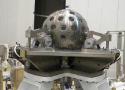
The disco globe satellite that Ciufolini and his colleagues use in their experiment is called LARES-2 (Laser Relativity Satellite 2) and has been developed by the Italian Space Agency. It’s a solid sphere of Inconel 718, a dense nickel-chromium alloy, covered with 303 corner-cube retroreflectors and measuring a bit over 40 centimeters across. It has no thrusters, no solar panels, and no electronics of any kind. It weighs 294.8 kilos. That combination of small size and large mass gives it the lowest area-to-mass ratio of any satellite in medium-Earth orbit.
This was exactly what the scientists needed, since it helped them minimize the impact of other forces.
“The idea is that we want to measure gravitation,” Ciufolini said. “We have non-gravitational effects like photons impinging on the satellite and pushing it. So, the mass must be very large and the cross-section of the satellite very small, so the acceleration induced by photons is very, very small.” In theoretical physics, satellites of this kind are called test particles, meaning an object whose motion is governed almost entirely by the gravitational field. LARES-2 was placed in orbit at an altitude of roughly 12,265 kilometers by a Vega-C rocket in July 2022. //
The measurement confirmed general relativity once more, but Ciufolini thinks its true value lies in what it rules out. General relativity is incompatible with quantum mechanics, despite our best efforts to reconcile the two, and does not explain dark energy. The Chern-Simons theory, one of the leading alternatives that emerged from quantum gravity frameworks, modifies Einstein’s equations and introduces mathematical corrections expected to make them work at ultra-small scales where quantum mechanics and gravity must coexist.
While it does not fully reconcile Einstein’s physics with quantum mechanics and does not offer a universally accepted solution to the dark energy issue, many physicists think Chern-Simons brings us one step closer to the complete Theory of Everything. The problem, though, is that it predicts a different magnitude for frame dragging. //
“These laser-ranged satellites have a peculiar characteristic: They last for hundreds of years,” Ciufolini said. “The more you wait, the more data you accumulate, and the better the results of frame dragging measurements will be. So, we can wait maybe 100 years, and they’ll become even more useful for theoretical physics.”

Reichinstein also wrote a biography of Einstein, "Albert Einstein sein Lebensbild und seine Weltanschauung" (which roughly translates as Albert Einstein: His Life and Worldview) that came out prior to 1936. Apparently it was written and possibly self-published in 1932, which led to Einstein writing to Reichinstein that
Wenn Sie dieses Manuskript irgendwo und irgendwie veröffentlichen, dann ist es zwischen uns für immer aus.
Google Translate renders this as:
If you publish this manuscript anywhere, in any way, then it's over between us forever.
i.e. strongly asking him not to publish the manuscript. Reichinstein then proceeded to publish the book in Prague in 1934. The relevant letter from Einstein to Reichinstein is dates May 26, 1932 and has been made available by the ETH Zurich Library's "Einstein Online" collection, specifically in the section on The Time in Berlin (1914-1933) along with several other letters to Reichinstein, Hermann Weyl, and others.
“The Radiochemistry of Uranium” by James E. Gindler
Old school technical reference book on uranium chemistry.
Source ☢️: moltensalt.org/references/sta…
- Place the mini-marshmallows in the dish one layer thick.
- If your microwave has a rotating platform, remove it. We don’t want the dish to rotate.
- Put the dish in the microwave for 10 seconds.
- When you remove the dish, you’ll notice only certain parts are melted. (Time may depend on the microwave – if all or none of your marshmallows melted, adjust the time.)
- Measure the distance between melted marshmallows using your ruler. Measure in centimeters. This is half the wavelength of a microwave.
- Look for a sticker on your microwave that tells you its frequency in Hertz (Hz). Most microwaves are around 2450 MHz. Note: MHz = 10^6 Hz
- Use the following equation to find the speed of light: Speed of light = 2 x (distance between melted spots) x (frequency of microwave)
- The actual speed of light is 3.00 x 10^10 cm/s. How close were you?

Each year the LHC produces 40,000 EBs of unfiltered sensor data alone, or about a fourth of the size of the entire Internet, Aarrestad estimated. CERN can't store all that data. As a result, "We have to reduce that data in real time to something we can afford to keep."
By "real time," she means extreme real time. The LHC detector systems process data at speeds up to hundreds of terabytes per second, far more than Google or Netflix, whose latency requirements are also far easier to hit as well.
Algorithms processing this data must be extremely fast," Aarrestad said. So fast that decisions must be burned into the chip design itself. //
At any given time, there are about 2,800 bunches of protons whizzing around the ring at nearly the speed of light, separated by 25-nanosecond intervals. Just before they reach one of the four underground detectors, specialized magnets squeeze these bunches together to increase the odds of an interaction. Nonetheless, a direct hit is incredibly rare: out of the billions of protons in each bunch, only about 60 pairs actually collide during a crossing.
When particles do collide, their energy is converted into a mass of new outgoing particles (E=MC2 in the house!). These new particles "shower" through CERN's detectors, making traces "which we try to reconstruct," she said, in order to identify any new particles produced in ensuing melee.
Each collision produces a few megabytes of data, and there are roughly a billion collisions per second, resulting in about a petabyte of data (about the size of the entire Netflix library).
Rather than try to transport all this data up to ground level, CERN found it more feasible to create a monster-sized edge compute system to sort out the interesting bits at the detector-level instead.
Any gas can be converted into a liquid by simple compression, unless its temperature is below critical. Therefore, the division of substances into liquids and gases is largely conditional. The substances that we are used to considering as gases simply have very low critical temperatures and therefore cannot be in a liquid state at temperatures close to room temperature. On the contrary, the substances we classify as liquids have high critical temperatures (see table in §
).
All gases that make up the air (except carbon dioxide) have low critical temperatures. Their liquefaction therefore requires deep cooling.
There are many types of machines for producing liquid gases, in particular liquid air.
In modern industrial plants, significant cooling and liquefaction of gases is achieved by expansion under thermal insulation conditions.

blackhawk887 Ars Tribunus Angusticlavius
9y
19,694
100% TNT equivalent is crazy. Even 25% is probably twice a reasonable figure. The FAA uses 14% for LOX/hydrogen and 10% for LOX/kerosene. Hydrogen is more than twice as energetic per mass of methane, and kerosene about 80% as energetic as methane.
LOX and liquid methane are miscible, unlike the other combinations, but there aren't any plausible scenarios where you'd get better mixing than a rocket falling back on the pad shortly after liftoff, which both kerolox and hydrolox are also perfectly capable of doing. //
mattlindn Ars Centurion
7y
231
NASA's current blast range evacuation area ranges from 3 to 4 miles as shown in the diagrams in this article (I measured it on google maps).
It's worth mentioning that the privately run Rocket Ranch down in South Texas where people can pay money to get closer to the Starship launches is only 3.9 miles from the launch site. The people who watch from the Mexico can get as close as 2.4 miles.
Where most people (including myself) watch(ed) from, South Padre Island, is almost exactly 5 miles away.
So yeah this seems kind of excessive. //
Jack56 Ars Scholae Palatinae
7y
672
For the nth time, a fuel-oxidiser explosion is not a detonation. It is a deflagration. They are far less violent. An intimate mixture of gaseous oxygen and methane can detonate but liquid methane and liquid oxygen cannot mix intimately - are not miscible - because methane is a solid at lox temperatures, especially the sub-cooled lox which Starship uses. A detonation takes place in under a millisecond. Deflagrations are fires. I’m not saying it wouldn’t be bad but comparisons with an energetically equivalent mass of TNT are way out of line. //
mattlindn Ars Centurion
7y
231
Jack56 said:
For the nth time, a fuel-oxidiser explosion is not a detonation. It is a deflagration. They are far less violent. An intimate mixture of gaseous oxygen and methane can detonate ....
Didn't think about this, but yes you're correct. The boiling point of Oxygen is 90.2 K and the melting point of Methane is 90.7 K. If you mix the two together, before any Methane can melt all the oxygen has to boil off. Though there should still be some local melting given the outside air temperatures are MUCH warmer than the liquid oxygen.
Though at the same time given the temperatures are so close together I don't think much Methane will freeze before an explosion happens. So maybe the point is moot? //
SpikeTheHobbitMage Ars Scholae Palatinae
3y
1,745
Person_Man said:
I have to imagine a fully fueled stack with optimal mixing for the biggest explosion would probably be the largest non nuclear explosion ever.
Most of Starship's propellant is oxygen. The full stack only carries 1030t of methane (330t on Ship, 700t on SuperHeavy). Methane also has a TNT equivalent of only 0.16. Using the omnicaluclator, I get 1030t of methane* = 164.8t of TNT. That doesn't even make the top 10 list.
*omnicalculator lists natural gas, which is mostly methane. //
blackhawk887 Ars Tribunus Angusticlavius
9y
19,694
mattlindn said:
Didn't think about this, but yes you're correct. The boiling point of Oxygen is 90.2 K and the melting point of Methane is 90.7 K. If you mix the two together, ...
Mixing with oxygen should depress the freezing point of methane. For example, if you take water at its freezing point, and mix it equally with alcohol that is itself, say, 10 degrees colder than the freezing point of water, the resulting mix will be well below 0 C but will not contain any frozen water.
Also, you can mix butane and water under a little pressure, even though at atmospheric pressure butane boils a half-degree below the freezing point of water. They aren't miscible, but that's just because of polarity - they are happy to both be liquids at the same temperature and a little pressure.
Methane and LOX are considered miscible and were even considered for monopropellants at various mix ratios. The mixture is reportedly a bit shock sensitive though. //
SpikeTheHobbitMage Ars Scholae Palatinae
3y
1,745
Mad Klingon said:
For the many debating using eminent domain to expand launch facilities, that would likely be the simple part of the issue. Most of that area is considered sensitive wildlife area and dealing with the current piles environmental regulations and paperwork could take decades for a major expansion. Look at all the grief SpaceX gets when they build on the relatively bland bit of Texas coast they are currently using. It would be much worse at the Florida site.One of the great legacies of Apollo was we got a well built out area for launching stuff before most of the environmental legislation was passed.
One of the great legacies of Apollo was that the exclusion zone around Cape Canaveral preserved enough of the wetlands in good enough condition to become a protected nature reserve.
The late, great Dr. Petr Beckmann was editor of the great journal Access to Energy, founder of the dissident physics journal Galilean Electrodynamics (brochures and further Beckmann info here; further dissident physics links), author of The Health Hazards of NOT Going Nuclear (Amazon; PDF version) and the pamphlets The Non-Problem of Nuclear Waste and Why “Soft” Technology Will Not Be America’s Energy Salvation. (See also my post Access to Energy (archived comments), and this post.)
I just came across another favorite piece of his and have scanned it in: Economics as if Some People Mattered (review of Small is Beautiful by E.F. Schumacher), first published in Reason (October 1978), and reprinted in Free Minds & Free Markets: Twenty-Five Years of Reason (1993). Those (including some libertarians and fellow travelers) who also have a thing for “smallness” and bucolic pastoralism should give this a read.
Small is Beautiful is the title of a book by E.F. Schumacher. It is also a slogan describing a state of mind in which people clamor for the rural idyll that (they think) comes with primitive energy sources, small-scale production, and small communities. Yet much–perhaps most–of their clamor is not really for what they consider small and beautiful; it is for the destruction of what they consider big and ugly.
… The free market does not, of course, eradicate human greed, but it directs it into channels that the consumer the maximum benefit, for it is he who benefits from the competition of”profit-greedy” businessmen. The idea that the free market is highly popular among businessmen is one that is widespread, but not among sound economists. It was not very popular in 1776, when Adam Smith’s Wealth of Nations was published, and it has not become terribly popular with all of them since–which is not surprising, for the free market benefits the consumer but disciplines the businessman.
If the free market is so popular with business, what are all those business lobbies doing in Washington? The shipping lobby wants favors for U.S. ships; the airlines yell rape and robbery when deregulation from the governmental CAB cartel threatens; the farmers’ lobby clamors for more subsidies. What all these lobbies are after is not a freer market but a bigger nipple on the federal sow.
It's a plot device beloved by science fiction: our entire universe might be a simulation running on some advanced civilization's supercomputer. But new research from UBC Okanagan has mathematically proven this isn't just unlikely—it's impossible.
Dr. Mir Faizal, Adjunct Professor with UBC Okanagan's Irving K. Barber Faculty of Science, and his international colleagues, Drs. Lawrence M. Krauss, Arshid Shabir and Francesco Marino have shown that the fundamental nature of reality operates in a way that no computer could ever simulate.
Their findings, published in the Journal of Holography Applications in Physics, go beyond simply suggesting that we're not living in a simulated world like The Matrix. They prove something far more profound: the universe is built on a type of understanding that exists beyond the reach of any algorithm. //
"Drawing on mathematical theorems related to incompleteness and indefinability, we demonstrate that a fully consistent and complete description of reality cannot be achieved through computation alone," Dr. Faizal explains. "It requires non-algorithmic understanding, which by definition is beyond algorithmic computation and therefore cannot be simulated. Hence, this universe cannot be a simulation."
Co-author Dr. Lawrence M. Krauss says this research has profound implications. "The fundamental laws of physics cannot be contained within space and time, because they generate them. It has long been hoped, however, that a truly fundamental theory of everything could eventually describe all physical phenomena through computations grounded in these laws. Yet we have demonstrated that this is not possible. A complete and consistent description of reality requires something deeper—a form of understanding known as non-algorithmic understanding." //
More information: Mir Faizal et al, Consequences of Undecidability in Physics on the Theory of Everything, Journal of Holography Applications in Physics (2025). DOI: 10.22128/jhap.2025.1024.1118. On arXiv: DOI: 10.48550/arxiv.2507.22950 https://dx.doi.org/10.48550/arxiv.2507.22950

"If you bring a charged particle like an electron near the surface, because the helium is dielectric, it'll create a small image charge underneath in the liquid," said Pollanen. "A little positive charge, much weaker than the electron charge, but there'll be a little positive image there. And then the electron will naturally be bound to its own image. It'll just see that positive charge and kind of want to move toward it, but it can't get to it, because the helium is completely chemically inert, there are no free spaces for electrons to go."
Obviously, to get the helium liquid in the first place requires extremely low temperatures. But it can actually remain liquid up to temperatures of 4 Kelvin, which doesn't require the extreme refrigeration technologies needed for things like transmons. Those temperatures also provide a natural vacuum, since pretty much anything else will also condense out onto the walls of the container. //
Erbium68 Wise, Aged Ars Veteran
8m
1,829
Subscriptor
The trap and what they have achieved so far is very interesting. I have to say the mere 40dB of the amplifier (assuming that is voltage gain not power gain) is remarkable for what is surely a very tiny signal (and that is microwatts out, not megawatts).
But, as a practical quantum computer?
It still has to run at below 4K and there still has to be a transition to electronics at close to STP. The refrigeration is going to be bulky and power consuming. Of course the answer to that is to run a lot of qubits in one envelope, but getting there is going to take a long time.
We seem to have had the easy technological hits. The steam engine, turbines, IC engines, dynamos and alternators all came with relatively simple fabrication techniques and run at room temperature except for the hot bits. Early electronics began with a technical barrier - vacuum enclosures - but never needed to scale these beyond single or dual devices, and by the time that became a barrier to progress, transistors were already happening and it was then a matter of scaling size down and gates up. The electronics revolution happened at room temperature, maybe with some air cooling or liquid cooling for high powers.
Now we have the issue that getting a few gates to work needs a vacuum chamber at below 4K. Scaling is going to be expensive. And progress in conventional semiconductors will continue.
This approach may be wildly successful like epitaxial silicon technology. But it may also flop like the Wankel engine - the existing technology advancing faster than the initially complex and new technology can. //
dmsilev Ars Tribunus Angusticlavius
16y
6,561
Subscriptor
Erbium68 said:
The trap and what they have achieved so far is very interesting. I have to say the mere 40dB of the amplifier (assuming that is voltage gain not power gain) is remarkable for what is surely a very tiny signal (and that is microwatts out, not megawatts).
But, as a practical quantum computer?
It still has to run at below 4K and there still has to be a transition to electronics at close to STP. The refrigeration is going to be bulky and power consuming. Of course the answer to that is to run a lot of qubits in one envelope, but getting there is going to take a long time.
Compared to a datacenter computing system, it's actually not all that hugely power consuming. In rough numbers, 10-12 kW of electricity will get you a pulse tube cryocooler which can cool 50 or 100 kilograms of stuff down to about 4 K and keep it at that temperature with 1-2 W of heat load at the cold end. That's enough for a lot of 4 K qubits and first-stage electronics. Add in an extra kW for another pump and you can cool maybe 10 kg to ~1.5 K, with about 0.5 W of headroom. A couple more pumps at a kW or so each, some helium3 and a lot of expensive plumbing, and you have a dilution refrigerator, 20 mK with about 20-40 uW of headroom.
Compare that 10-15 kW with the draw from a single rack of AI inference engines.

Inside a laboratory nestled above the mist of the forests of South Dakota, scientists are searching for the answer to one of science's biggest questions: why does our Universe exist?
They are in a race for the answer with a separate team of Japanese scientists – who are several years ahead.
The current theory of how the Universe came into being can't explain the existence of the planets, stars and galaxies we see around us. Both teams are building detectors that study a sub-atomic particle called a neutrino in the hope of finding answers.
The US-led international collaboration is hoping the answer lies deep underground, in the aptly named Deep Underground Neutrino Experiment (Dune). //
When the Universe was created two kinds of particles were created: matter – from which stars, planets and everything around us are made – and, in equal amounts, antimatter, matter's exact opposite.
Theoretically the two should have cancelled each other out, leaving nothing but a big burst of energy. And yet, here we – as matter – are. //
Scientists believe that the answer to understanding why matter won – and we exist – lies in studying a particle called the neutrino and its antimatter opposite, the anti-neutrino.
They will be firing beams of both kinds of particles from deep underground in Illinois to the detectors at South Dakota, 800 miles away.
This is because as they travel, neutrinos and anti-neutrinos change ever so slightly.
The scientists want to find out whether those changes are different for the neutrinos and anti-neutrinos. If they are, it could lead them to the answer of why matter and anti-matter don't cancel each other out. //
Half a world away, Japanese scientists are using shining golden globes to search for the same answers. Gleaming in all its splendour it is like a temple to science, mirroring the cathedral in South Dakota 6,000 miles (9,650 km) away. The scientists are building Hyper-K - which will be a bigger and better version of their existing neutrino detector, Super-K.
The Japanese-led team will be ready to turn on their neutrino beam in less than three years, several years earlier than the American project. Just like Dune, Hyper-K is an international collaboration. Dr Mark Scott of Imperial College, London believes his team is in pole position to make one of the biggest ever discoveries about the origin of the Universe.
"We switch on earlier and we have a larger detector, so we should have more sensitivity sooner than Dune," he says.
Having both experiments running together means that scientists will learn more than they would with just one, but, he says, "I would like to get there first!"

There's a lot of matter around, which ensures that any antimatter produced experiences a very short lifespan. Studying antimatter, therefore, has been extremely difficult. But that's changed a bit in recent years, as CERN has set up a facility that produces and traps antimatter, allowing for extensive studies of its properties, including entire anti-atoms.
Unfortunately, the hardware used to capture antiprotons also produces interference that limits the precision with which measurements can be made. So CERN decided that it might be good to determine how to move the antimatter away from where it's produced. Since it was tackling that problem anyway, CERN decided to make a shipping container for antimatter, allowing it to be put on a truck and potentially taken to labs throughout Europe. //
The problem facing CERN comes from its own hardware. The antimatter it captures is produced by smashing a particle beam into a stationary target. As a result, all the anti-particles that come out of the debris carry a lot of energy. If you want to hold on to any of them, you have to slow them down, which is done using electromagnetic fields that can act on the charged antimatter particles. Unfortunately, as the team behind the new work notes, many of the measurements we'd like to do with the antimatter are "extremely sensitive to external magnetic field noise."
In short, the hardware that slows the antimatter down limits the precision of the measurements you can take.
The obvious solution is to move the antimatter away from where it's produced. But that gets tricky very fast. The antimatter containment device has to be maintained as an extreme vacuum and needs superconducting materials to produce the electromagnetic fields that keep the antimatter from bumping into the walls of the container. All of that means a significant power supply, along with a cache of liquid helium to keep the superconductors working. A standard shipping container just won't do. //
So the team at CERN built a two-meter-long portable containment device. On one end is a junction that allows it to be plugged into the beam of particles produced by the existing facility. That junction leads to the containment area, which is blanketed by a superconducting magnet. Elsewhere on the device are batteries to ensure an uninterrupted power supply, along with the electronics to run it all. The whole setup is encased in a metal frame that includes lifting points that can be used to attach it to a crane for moving around. //
There's a facility being built in Düsseldorf, Germany, for antiproton experiments, nearly 800 kilometers and eight hours away by road. If the delivery can be made successfully—and it appears we are just a liquid helium supply away from getting it to work—the new facility in Germany should allow measurements with a precision of over 100 times better than anything that has been achieved at CERN.
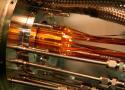
Researchers at CERN have created and trapped antihydrogen in an attempt to study the underpinnings of the standard model of physics. Antihydrogen is made of antiparticles, specifically an antiproton and a positron, instead of the proton and an electron that are present in natural hydrogen. It has the same mass but opposite charge of its normal matter counterparts.
Antimatter has a bad reputation for being dangerous because it annihilates on contact with regular matter, releasing prodigious amounts of energy. However, the clever Ars reader will note that they have not been annihilated by the antimatter produced at CERN. The reality is that if you gathered all of the antimatter CERN has ever created, you wouldn't garner enough energy to power your laptop through reading this article. //
Antiparticles behave predictably in the presence of electric or magnetic fields and so can be contained in a special magnetic container called a Penning trap. Antihydrogen, which has no net electric charge, is much harder to contain. //
The ALPHA trap can confine antihydrogen in the ground state if it's kept at temperatures of less than half a Kelvin.
One challenge of this experiment is mixing the antiprotons and positrons at relatively low velocities such that antihydrogen can form efficiently. The efficiency is relative; The authors had to mix 10 million positrons with 700 million antiprotons in order to get get 38 certifiable antihydrogen events. //
It remains one of the largest unsolved problems in physics today as to why the Universe contains more regular matter than antimatter. Symmetry would suggest the Universe should have produced equal parts matter and antimatter, which would have annihilated—because we are here, we know this was not the case. Now that they have a bit of antihydrogen on hand, the researchers will test fundamental symmetries in nature (charge conjugation/parity/time reversal) by examining the excited states of antihydrogen. //
Boskone Ars Legatus Legionis
24y
12,399
Subscriptor
UltimateLemon":316tohp9 said:
When can we start weaponizing it?
As soon as we have significant amounts, and apparently figure out how to stabilize it enough to mix with matter.
1kg antimatter mixing with 1kg matter yields something like 50 megatons. (Which means that a 3oz bottle of antiperspirant is about 4 megatons. Now TSA's really going to have an aneurysm. </rimshot>) //
Bicentennial Douche Ars Legatus Legionis
21y
10,339
Subscriptor
matt_w_1":1ow1041j said:
how do you exam anti-matter? I assume throwing regular light at it would destroy it?
Duh, by using anti-light of course! The problem with that is that its too dark to see what you are doing. //
Hat Monster Ars Legatus Legionis
24y
47,680
Subscriptor
Now then, all we need is antioxygen to mix with our antihydrogen and we can make antiwater which will start fires instead of extinguishing them! //
mr wonka Ars Praetorian
17y
414
bedward":2u0orn9j said:
Boskone":2u0orn9j said:
1kg antimatter mixing with 1kg matter yields something like 50 megatons. (Which means that a 3oz bottle of antiperspirant is about 4 megatons. Now TSA's really going to have an aneurysm. </rimshot>)It's not that big a deal; sniffer dogs would pick out the matching 3oz bottle of perspirant pretty easily.
Bedward needs to buy me a new keyboard.
Why do shockwaves extend past the body that created them? As seen in this photo, the shock doesn’t stop in the air the plane is effecting, but continues on. I always assumed it was high pressure air from the shock extending out, but now I’m not too sure. //
Shocks are not because of the pressure. Shocks happen because of the turning -- the pressure jump is a result of the shock. – Rob McDonald Mar 14, 2024 at 17:27
A shock wave generated at 30,000 feet at Mach 1 cannot be heard on the ground for precisely the reason you surmise in your comment.
The US Air Force has conducted tests with supersonic aircraft and has this to say:
Under standard atmospheric conditions, air temperature decreases with increased altitude. For example, when sea-level temperature is 58 degrees Fahrenheit, the temperature at 30,000 feet drops to minus 49 degrees Fahrenheit. This temperature gradient helps bend the sound waves upward. Therefore, for a boom to reach the ground, the aircraft speed relative to the ground must be greater than the speed of sound at the ground. For example, the speed of sound at 30,000 feet is about 670 miles per hour, but an aircraft must travel at least 750 miles per hour (Mach 1.12, where Mach 1 equals the speed of sound) for a boom to be heard on the ground.
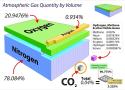
We have proposed that other planetary forces and phenomena, such as albedo, play a much larger role than CO2 in global warming or temperature variations.
The basic laws of physics and thermodynamics are not in support of efficient processing of CO2 using DAC. This is because dilute molecules of CO2 in air prefer to randomly mix and achieve maximum disorder or entropy per The Second Law of Thermodynamics.
Per Sherwood, trace amounts of CO2 molecules in an air mixture are difficult and costly to separate.
Capturing CO2 by DAC takes at least as much energy as that is contained in the fossil fuels that produced the carbon dioxide in the first place, per Keynumbers. //
Extra Thoughts: What Might Happen if CO₂ is Removed from the Air ?
-
If CO₂ is removed from the air in some significant quantity, CO₂ may outgas from the other sinks (land, oceans, lakes) to replace the removed CO₂. The reverse is true as well: when CO₂ is increased in the air, land/oceans/lakes) will uptake more CO₂ until a new quasi-equilibrium state is possibly reached over time.
-
A recent Nature Climate Change paper discusses the possible effect of CO₂ removal on the global carbon cycle. The paper notes that removing tons of carbon dioxide from the atmosphere might not be effective, because the shifting atmospheric chemistry could, in turn, affect how readily land and oceans release their CO₂, aka Le Chatelier’s principle. Another reference discusses the same concepts, and it is noted that both rely on synthetic models, like most climate change theory.
-
Handwaving synthetic climate models: a general rule that has been propagated is that for every tonne that ends up being emitted from fossil fuels or “land use changes”, a quarter gets absorbed by trees, another quarter by the ocean and the remaining half gets left in the atmosphere. I have not seen any hard data that backs this up. It basically says half the CO₂ emitted by man is left over and can’t be absorbed or re-equilibrated.