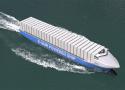
Korean researchers working with Samsung Heavy Industries have cleared a key hurdle in their efforts to develop designs for a containership powered by molten salt nuclear reactors. The American Bureau of Shipping (ABS) granted basic design approval, an AiP, for the project, reports the Korea Atomic Energy Research Institute.
The Korea Atomic Energy Research Institute is working jointly with the Korea Research Institute of Ships & Ocean Engineering and Samsung Heavy Industries on the design of a 15,000 TEU vessel with nuclear power.
The companies point to the safety and efficiency achieved through the use of molten salt. It combines nuclear fuel with the molten salt, which is a safety feature as it would harden if the reaction failed, encasing the nuclear material. //
The key feature of their concept is two Small Modular Reactors (SMRs) employing the molten salt technology. They point to a redundancy with the two reactors as well as a power system design to efficiently manage the reactors’ output against the ship’s power demands. They also incorporated a surplus power storage capability that could provide power when needed. //
ABS reviewed and verified the technical feasibility and safety of the technology and design. The receipt of the Approval in Principle (AiP), the group said, is a “confirmation of the potential of marine nuclear technology.”



The Great Lakes Ships of Frank E. Kirby: America’s Greatest Naval Architect,” by Richard Gebhart, Michigan State University Press, May 2026, 231 pages, $59.95 (Hardcover), $29.10 (Paperback), $29.95 (E-book)
From the 1870s through the 1890s most of the world’s ships not built in British shipyards were built on the North American Great Lakes, a vast interconnected yet isolated inland sea system. Of these Lakes vessels built during that period and for the first two decades of the 20th century, many, including the best designs came from the mind of naval architect Frank E. Kirby.
“The Great Lakes Ships of Frank E. Kirby: America’s Greatest Naval Architect,” by Richard Gebhart, is a biography of the man and a history of his ships. It charts his career, and follows the course of the shipyards he ran and the ships he built.
Captain is relatively easy. The responsibility is a metric shitton, and it crushes some people. But otherwise the job is mentoring, monitoring, and instilling serenity and confidence in the crew, then pushing the nasty stuff down to your number two so you can keep a clear head.
So what was it, beyond handling the nasty stuff, that made a great chief mate? I truly didn't know.
Then I read The Mirror of the Sea by my favorite author, Joseph Conrad. Conrad (originally Konrad) was an actual ship captain before he was an author. Most of his books are fiction. This one is his lessons learned. //
I've written extensively that our admirals today are too nice. Killers get filtered out. Assholes get tossed. The people who pound on standards, readiness, and lethality don't make flag.
That's a serious problem. Patton wasn't nice. King wasn't nice. Halsey wasn't nice. MacArthur certainly wasn't nice.
But here's what I haven't written about: the particular type of asshole we should want as Deputy SecNav, as Vice Chairman of the Joint Chiefs, as Vice CNO, as Vice Commandant.
It's the type Conrad writes about. It's Chief Mate B--.
It's the man who knows everything. Who is constantly watching for problems. Who is passionate about readiness to the point of paranoia. The man who wants everything perfect. The Cassandra.
That is the type who keeps a ship from sinking in the storm.
You don't want a paranoid captain. The captain needs a clear head. He can't fixate on every cloud shape and every small drop in the barometer. He needs to be optimistic, because his optimism is what the crew runs on.
But the captain can afford that optimism only because Chief Mate B-- exists. B-- holds the watch. B-- carries the worry and the dread for the entire ship so the captain doesn't have to. The optimism at the top is purchased by the paranoia one rank down.
Now look at how we build our flag and general officer corps.
The result is a chain of command in which everyone is the captain and no one is the chief mate. Everyone is projecting confidence. Nobody is grappling with the impending calamity at the table over the salt beef. The bad news has nowhere to go, because the second in command was promoted precisely for not being the kind of person who delivers it.
This is why our readiness numbers are fiction. This is why our shipbuilding programs slip for a decade before anyone in a deputy chair says the program is dead. This is why magazine depth, drydock capacity, and mariner manning all degraded in plain sight while every brief said green. The watchstander role was abolished by personnel policy. We optimized the second in command for comfort, and comfort is the one thing a number two is never supposed to provide.
The fix is unpleasant, which is why nobody will like it.
Stop promoting deputies for likability. Promote them for the trait Conrad hated and trusted in the same breath: the unrestful one. Find the officers who make their bosses uncomfortable. Find the ones with the uneasy eye, the ones everlastingly ready for the calamity, the ones whose determined silences imply the ship is not safe. Then put them one rank below the optimists, on purpose.
Find the ones insecure about our readiness.
It will be miserable. The captains will resent them, exactly as Conrad resented B--. Good. That friction is the system working. A deputy who never makes the principal uncomfortable is not doing the job. He is just a second optimist, and two optimists in a storm is how ships sink.
Sean Duffy’s MARAD initiative may look like another Trump-era energy dominance announcement, but beneath the politics lies a serious industrial question: can the United States build the regulatory, shipyard, insurance and port framework needed to make nuclear-powered merchant ships commercially viable before Asia takes the lead? //
The real story behind the announcement made by U.S. Transportation Secretary Sean P. Duffy and the Maritime Administration on 7 May is not that America has discovered nuclear propulsion. It is that Washington has finally recognized maritime nuclear power as a shipbuilding, logistics, insurance, port-access and national-security race, and has decided to enter it. MARAD’s Request for Information, with comments due by 5 August 2026, asks industry to help develop a U.S.-built, scalable, commercially viable SMR model for marine transportation. That is a materially different ambition from funding a reactor demonstration. It is an attempt to build a complete commercial ecosystem. //
Shipping is uniquely suited to nuclear propulsion. The energy density argument for maritime nuclear propulsion is more compelling than for almost any other transport sector. A modern ultra-large container ship consumes between 250 and 350 tonnes of fuel per day at sea. Over a 25-year operational life, fuel can represent billions of dollars in lifecycle cost. Bunker storage, fuel treatment systems, purifier rooms, sludge handling, emissions scrubbers and the growing infrastructure of alternative-fuel compliance consume enormous volumes of space, capital and crew time. Nuclear propulsion potentially eliminates most of that complexity, a reactor fuelled for two decades or more fits within a containment space that returns cargo volume to its owners and voyage economics to their prior simplicity. //
Thorium, increasingly discussed as an alternative fuel cycle, offers further advantages. Thorium-232 converts under neutron bombardment to fissile uranium-233, is three to four times more abundant than uranium in the earth’s crust, produces significantly less long-lived radioactive waste, and is far less susceptible to weapons proliferation. Molten salt reactor designs, which dissolve thorium in liquid fluoride salt that also acts as the coolant, operate at atmospheric pressure rather than under the high-pressure steam conditions of conventional light-water reactors, removing explosive decompression risk. An approval in principle for a nuclear-powered LNG carrier using molten salt technology was granted in 2025. //
The United States now accounts for approximately 0.1 per cent of global commercial ship production. A single Chinese state shipbuilder built more vessels by tonnage in 2024 than the entire U.S. industry has produced since 1945. //
The U.S. has become marginal in commercial construction outside naval programmes, which is precisely why the MARAD announcement repeatedly frames SMR development as a mechanism for rebuilding domestic yards, creating strategic engineering employment, and reconnecting maritime and defence industrial capacity. //
While Europe debates how to tax shipping emissions, the United States is beginning to ask who will build and power the next generation of ships altogether.
South Korea is not waiting for that question to be answered. HD Hyundai has unveiled a 15,000 TEU-class SMR-powered containership concept and is working with ABS on nuclear-electric propulsion systems potentially supplying up to 100 megawatts. China has explored molten salt reactor ship concepts and is investing heavily in thorium-based systems. Russia already operates the only nuclear-powered commercial vessels in service, alongside its Arctic icebreaker fleet.

The 1920 Jones Act shouldn’t even exist anymore.
The act only allows U.S.-flagged and built ships “to transport cargo between U.S. ports.”
The ships must also be “mostly owned and crewed by Americans.”
Not a shock that President Woodrow Wilson (I hate that guy) signed the Jones Act into law. He wanted to encourage U.S. shipbuilding after World War I.
Yeah, well, it hinders competition, leading to higher costs for goods and higher operational costs.
Fewer than 100 vessels comply with the Jones Act. //
broomhandle in reply to MarkS. | March 18, 2026 at 4:52 pm
The Jones Act is a classic example of cronyist protectionism: it imposes heavy government mandates on private commerce (U.S.-built, U.S.-crewed, U.S.-owned ships for domestic routes) in the name of “national security,” yet delivers concentrated benefits to a small, politically connected maritime lobby while dispersing higher costs across American consumers, businesses and energy users.
This violates principles of limited government, free enterprise, and fiscal responsibility. Instead of fostering genuine competitiveness through innovation and open markets, it creates an uncompetitive, high-cost industry shielded from foreign (and even domestic) competition, driving up shipping expenses that ripple into everyday prices for goods, fuel, and groceries.
The national security rationale is particularly weak: the U.S. merchant fleet has shrunk dramatically under the Act’s watch, not grown stronger, and modern logistics plus targeted subsidies or direct naval investments could secure sealift needs far more efficiently without burdening the broader economy. In short, it’s textbook rent-seeking that harms the many to prop up the few, contrary to the preference for market-driven strength over regulatory favoritism.
Divers have located the wreck of the Lac La Belle, a luxury steamer that vanished in a violent gale in 1872, a discovery that came after nearly six decades of organized searching. //
The Lac La Belle left Milwaukee on October 13, 1872, bound for Grand Haven, Michigan. Captain William Gilcher commanded the ship that, along with passengers, carried barley, pork, flour, and whiskey.
A gale caused massive waves that battered the hull. A quickly spreading leak filled the hold, and when the pumps failed, the vessel sank stern-first into about 300 feet of water. //
Luke Warm
a day ago
I left Marquette Mi. the day the Edmund Fitzgerald was lost. My sister who lived there recommended I check out Presque Isle on my way back. I thought I was about to die. My car looked like it survived a roller over. The waves kept pushing me into the rocks, and the retreating waves trying to suck me into Superior. The Mackinaw bridge closed less than an hr after I crossed it heading south. The bridge looked like to world's biggest swing. I learned very quickly that you do not steer when the road your on is swinging. //
Shadd
20 hours ago
I've been to the Great Lakes Shipwreck Museum, up at Whitefish Point, MI. It's about 45 mins north of the Mackinac Bridge. I highly recommend it. //
Hank Reardon
16 hours ago
Readers interested in Great Lakes shipping and shipwreck history might also be interested in visiting the Great Lakes Maritime Heritage Center at Thunder Bay, Michigan.
https://thunderbay.noaa.gov/visit/great-lakes-maritime-heritage-center.html
Also, unrelated to Great Lakes shipwrecks but equally fascinating is the display of cargo from the 1865 wreck of the Missouri river steamboat Bertrand, discovered in 1968. The large amount of freight bound for the goldfields of Montana captures a snapshot of life in America and is meticulously displayed at the DeSoto National Wildlife Refuge, on the Missouri River north of Omaha.
https://www.fws.gov/refuge/desoto/steamboat-bertrand

If the president wants to revive the Navy’s surface fleet, he could look to Asian partners to assist in building a reasonably priced and proven multi-mission frigate, such as the South Korean FFX Batch IV class or the Japanese upgraded Mogami class frigates.
Both of these ship designs meet the Navy’s warfighting-capability needs in a cost-effective manner.
This sort of partnership can be modeled on the president’s icebreaker deal with Finland: Build the first few warships in Asia, while training US workers there, then build the remaining 20-plus ships at an existing US military or commercial shipyard modernized with Korean or Japanese technology and processes.
Another opportunity for Asian partnership is in building support vessels — ammunition ships, refueling ships, hydrographic ships, etc.
When the Navy had 600 ships, 200 were support vessels — historically, they’ve been about 30% of the fleet.
As the Navy tries to grow back to 350 or 400 ships, it’ll need 100 to 125 support vessels to meet this ratio. Today, it has only 65.
Yet existing US military shipyards are not scaled to build these, and when they try, they tend to deliver them at double the cost of Korean or Japanese shipyards.
The most expensive element in the Golden Fleet plans is the Navy’s next generation of “large surface combatant,” and this design has also veered off course.
With unprecedented input from the president, the design morphed from a 15,000-ton destroyer to a supersized 35,000-ton “battleship,” likely costing $20 billion for the first ship and $13 billion per follow-on.
For the lower of those prices, you could buy five Aegis-equipped destroyers (DDGs).
And with the “battleship,” the Navy would get only 140 missile cells (as opposed to 480 cells with those DDGs) and one AEGIS air-defense system (as opposed to five with the DDGs).
At a time when the Navy needs to boost capabilities, an oversized ship like the battleship is tactically regressive, and consolidates more eggs in one basket.
A more effective way to maintain America’s dominance in large surface combatants is a three-pronged strategy. //
The president knows he needs to invest in a Navy, but if he wants to get the Golden Fleet right, he should reject much of what he’s hearing from the Pentagon and look to his Asian allies for help.

Wiring error. Label was placed partially over a terminal preventing he terminal from seating in a connector.

Alvarenga was more than 10 years older than Córdoba. Alvarenga believes he survived, in part, because of his experience in the open sea, but he also credits simple optimism and faith that God would save him.
He focused on finding food. He prayed more and sang hymns, even in the most devastating moments at sea. Alvarenga remembers numerous cargo ships passing him by, but he doesn’t know if all the ships were real or if he imagined them. “I would signal them and nothing would happen,” he said. “But I thought God will determine which boat will save me.”
In the end, it was not a boat, but land that saved Alvarenga. After 438 days of floating on endless water, he saw mountains. When he felt he was close enough, Alvarenga dove into the water, swimming toward what he would later learn was one in the string of the Marshall Islands.
“I hit the ground first. My boat hit the ground second. I felt the waves, I felt the sand, and I felt the shore. I was so happy that I fainted on the sand. I didn’t care if I died at that point. I was so relieved. I knew at that point I didn’t have to eat any more fish if I didn’t want to.” //
Alvarenga didn’t care that journalists didn’t believe his story. The University of Hawaii and a number of independent oceanographers would later say his improbable survival was entirely possible. Buoys and weather models show an ocean drift matched his 6,000-mile journey west. He’s collaborated with journalist Jonathan Franklin in a book about his remarkable survival, called “438 Days.”
MMarsh Ars Praefectus
10y
4,490
Subscriptor
p-chapman said:
Ok, if Shackleton would have known about what seemed to work in the Antarctic ice, why did Shackleton cheap out for the Endurance?
Wikipedia suggests that the fully equipped, custom-built Discovery cost 51,000 pounds.
Ignoring British inflation adjustments over the next decade or so, Endurance was bought for 11,600 pounds. (And he also spent 3,200 pounds on the Aurora, the smaller 2nd ship for the expedition group at the other side of the Antarctic continent -- this was all about an Antarctic land crossing, after all.) However, the Discovery was slightly over twice the GRT (gross registered tonnage) of the Endurance. (GRT isn't always the best metric, as for example the bulbous Fram, shorter than the Endurance, still has a larger GRT.)
So let's say that a smaller custom-built ship the size of the Endurance would have been, say 2/3rds the cost (as cost won't scale linearly). Thus something like 34k custom build cost vs. 12k for the actual Endurance. Plus some additional customization costs for the Endurance that must have been added on afterwards.
In any case, well over twice the cost to buy a custom ship for likely the biggest expense of the expedition!
(I suppose the cost ratio would have been guessed by anyone buying a depreciated used car vs. a new one...)
What about the diagonally reinforced Deutschland ship, mentioned in this article?
Shackleton was well aware of it, as he had wanted to buy it for his earlier 1907 expedition. But as wikipedia notes:
Thus at one point even 11,000 pounds, less than Endurance's cost, was too much for his finances.
So I won't write Shackleton off as being a dumbass when it came to choosing a ship. But it still bears looking into, just what the Endurance's structure was, how it compares to the Fram and Discovery and Deutschland -- and whether any useful reinforcements could have added at moderate cost within a reasonable time.
Cost was certainly a factor. If you don't have £50,000 available, but can scrounge up £11,600, then your choices are to either go in the cheaper ship or don't go at all. Men like Shackleton don't wait for the money to turn up. They do what they can with what they can get now.
Also worth noting is that the design compromises required to make a ship really good at freezing into pack ice tend to make it relatively miserable to live with at other times. It'll have a hull shape that yields a less comfortable motion in ocean waves. It'll be heavier for its length and beam, thus slower and less able to get out of the way of bad weather. It'll be crisscrossed internally by beams and braces that make it awkward to live and work aboard. A higher percentage of its total displacement will be its own structure, leaving less for people and cargo; thus, it needs to be bigger for the same usable capacity. That, in turn, makes it more expensive to maintain and operate after you've paid off the higher initial cost.
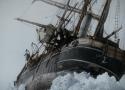
Designing Endurance to handle bumping into ice floes, but not to freeze into pack ice, was a perfectly reasonable decision for the ship's original mission. Picking it for the expedition was a justified risk, against the backdrop of all the other insane risks being taken by the very nature of the expedition. Letting it freeze into the pack ice was not planned or wanted – it was simply the only possible option left to Shackleton after all other options had been closed off by conditions that, until they happened, could only be foreseen as a vague and imprecise probability or possibility. //
atomicpowerrobot Smack-Fu Master, in training
3y
66
ramases said:
It is called the Action Fallacy. It describes our tendency to elevate leaders who appear decisive in a crisis over leaders who manage to avoid the crisis in the first place.
Martin Gutmann talks about it specifically within the context of Ernest Shackleton:
View: https://www.youtube.com/watch?v=b0Z9IpTVfUg
Click to expand...
The Action Fallacy isn't really appropriate here b/c the bar isn't "not getting stuck in the Antarctic Ice" but rather "crossing the Antarctic continent by land first". First being a critical part of that bar. It was difficult enough to secure funding for these "Exploration Age" adventures but nobody was going to fund anyone to do it second.
By the definition of the Action Fallacy, you are a better leader than Shackleton b/c you did not get a bunch of men stuck in the ice in the Antarctic by choosing the wrong ship. But you also didn't attempt to be the first person to cross the Antarctic continent by land.
Shackleton had previously nearly made it to be the first person to reach the South Pole, having to turn around and very nearly starving on his return journey, after which he lost out on that particular honor to Roald Amundsen. His "settling" for the Endurance was likely a concession made in an attempt to win honors for himself, his (volunteer) crew, and his country.
Of course you evaluate the risks, but at a certain point, for the immortal honors of doing something first, you pays your moneys and you takes your chances.
His legendary advertisement for the expedition read:
"Men wanted for hazardous journey. Low wages, bitter cold, long hours of complete darkness. Safe return doubtful. Honour and recognition in event of success."
Now that may have been real, or it may have been apocryphal, but it does accurately represent the situation that all of the men knowingly signed up for.
icosapode said:
I personally think it's important to have a clear eyed understanding of people who are often held up as heroes. A more nuanced picture that includes their faults as well as strengths doesn't diminish the things they did achieve after all.
That negates the point of having heroes though. We don't celebrate heroes for their faults. We all have faults - pointing out that they are no different is counterproductive. We celebrate them for the things they DID achieve beyond the standard works of men and women. Sniping at dead men who did great things b/c they weren't perfect is petty and driven by envy.
You don't have to idolize Shackleton's trip planning to recognize him as the type of man you want when the chips are down. As was said of him:
“For scientific discovery give me Scott; for speed and efficiency of travel give me Amundsen; but when disaster strikes and all hope is gone, get down on your knees and pray for Shackleton.”
I had been taught in school that scurvy had been conquered in 1747, when the Scottish physician James Lind proved in one of the first controlled medical experiments that citrus fruits were an effective cure for the disease. From that point on, we were told, the Royal Navy had required a daily dose of lime juice to be mixed in with sailors’ grog, and scurvy ceased to be a problem on long ocean voyages.
But here was a Royal Navy surgeon in 1911 apparently ignorant of what caused the disease, or how to cure it. Somehow a highly-trained group of scientists at the start of the 20th century knew less about scurvy than the average sea captain in Napoleonic times. Scott left a base abundantly stocked with fresh meat, fruits, apples, and lime juice, and headed out on the ice for five months with no protection against scurvy, all the while confident he was not at risk. What happened? //
One of the most striking features of the disease is the disproportion between its severity and the simplicity of the cure. Today we know that scurvy is due solely to a deficiency in vitamin C, a compound essential to metabolism that the human body must obtain from food. Scurvy is rapidly and completely cured by restoring vitamin C into the diet.
Except for the nature of vitamin C, eighteenth century physicians knew this too. But in the second half of the nineteenth century, the cure for scurvy was lost. The story of how this happened is a striking demonstration of the problem of induction, and how progress in one field of study can lead to unintended steps backward in another. //
Finally, that one of the simplest of diseases managed to utterly confound us for so long, at the cost of millions of lives, even after we had stumbled across an unequivocal cure. It makes you wonder how many incurable ailments of the modern world—depression, autism, hypertension, obesity—will turn out to have equally simple solutions, once we are able to see them in the correct light. What will we be slapping our foreheads about sixty years from now, wondering how we missed something so obvious? //
But the villain here is just good old human ignorance, that master of disguise. We tend to think that knowledge, once acquired, is something permanent. Instead, even holding on to it requires constant, careful effort.
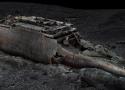
NatGeo documentary follows a cutting-edge undersea scanning project to make a high-resolution 3D digital twin of the ship. //
In 2023, we reported on the unveiling of the first full-size 3D digital scan of the remains of the RMS Titanic—a "digital twin" that captured the wreckage in unprecedented detail. Magellan Ltd, a deep-sea mapping company, and Atlantic Productions conducted the scans over a six-week expedition. That project is the subject of the new National Geographic documentary Titanic: The Digital Resurrection, detailing several fascinating initial findings from experts' ongoing analysis of that full-size scan. //
The joint mission by Magellan and Atlantic Productions deployed two submersibles nicknamed Romeo and Juliet to map every millimeter of the wreck, including the debris field spanning some three miles. The result was a whopping 16 terabytes of data, along with over 715,000 still images and 4K video footage. That raw data was then processed to create the 3D digital twin. The resolution is so good, one can make out part of the serial number on one of the propellers.
"I've seen the wreck in person from a submersible, and I've also studied the products of multiple expeditions—everything from the original black-and-white imagery from the 1985 expedition to the most modern, high-def 3D imagery," deep ocean explorer Parks Stephenson told Ars. "This still managed to blow me away with its immense scale and detail."

US government-owned "moored passive acoustic recorder" was able to hear and record the 2023 implosion of the doomed Titan submersible—even though the recorder was 900 miles away from the dive site.
That implosion, during an attempted dive to the wreckage of the Titanic, killed five people, including Stockton Rush, the CEO of the company that built and operated the Titan.
The implosion audio was just released publicly by the US Coast Guard's Titan Marine Board of Investigation, which has been investigating the disaster in enormous detail. As part of that investigation, the Coast Guard obtained the audio from the National Oceanic and Atmospheric Administration (NOAA), part of the US Department of Commerce.
The audio isn't much to listen to—just some static followed by a staticky explosive noise that decays in swirling fashion for multiple seconds. The implosion itself, given the pressure the vehicle was under at the time, probably occurred in milliseconds, as you can learn from simulations of the event. //
Back in the 1960s, '70s, and '80s, this kind of sonic technology was deeply important to the military, which used the Sound Surveillance System (SOSUS) to track things like Soviet submarine movements. (Think of Hunt for Red October spy games here.) Using underwater beamforming and triangulation, the system could identify submarines many hundreds or even thousands of miles away. The SOSUS mission was declassified in 1991. //
"At some point, safety just is pure waste," Rush once told a journalist. Unfortunately, it can be hard to know exactly where that point is. But it is now possible to hear what it sounds like when you're on the wrong side of it—and far below the surface of the ocean.
The discovery of a ship, missing for five centuries, in a southwest African desert, filled with gold coins, is one of the most thrilling archaeological finds in recent times.
The Bom Jesus (The Good Jesus) was a Portuguese vessel that set sail from Lisbon, Portugal on Friday, March 7, 1533. Its fate was unknown until 2008 when its remains were discovered in the desert of Namibia during diamond mining operations near the coast of the African nation.

The Russian ship Ursa Major sank in the western Mediterranean Tuesday after a series of explosions just above the waterline, and the Russians are blaming "terrorism." The 16,000-ton freighter was 12 days into a 42-day voyage from St. Petersburg to Vladivostok carrying two desperately needed cargo cranes for that port, two 45-ton hatches for a Project 10510 icebreaker that was under construction when three engine room explosions rocked it. Two of the 16-man crew were reported missing and presumed dead. The ship was under US sanctions authorized by Executive Order 14024, imposed in August 2022, for activities related to Russia's invasion of Ukraine. //
Terrorism would be code for a Ukrainian attack.
In my view, the description of the incident does not match the video, so it is possible the description was manufactured out of whole cloth or based on bad information from the crew. We'll never have imagery of the alleged holes in the ship's hull. The fact that the Ukrainians haven't boasted about the operation makes me skeptical of their involvement. All that is certain is that Russia lost one of its largest freighters carrying critical cargo for operations in Vladivostok. //
Min Headroom
9 hours ago edited
I have no trouble believing that the Russians managed to sink their own ship, although if the hole(s) really are inward facing this seems unlikely.
A 19” inward facing hole above the water line might suggest some sort of drone strike, but if UKR isn’t crowing about it that seems unlikely too.
But this gets me to the thing I don’t understand: how does a hole above the water line sink a ship in very little time?
So what I’d go to is a flawed narrative, which Russians excel at, and no real information besides the ship is sunk, valuable cargo and all. //
Louise1 Min Headroom
3 hours ago
There might also be holes on the port side, which weren't visible because they were below the water line.

Finnish commandos boarded and seized an oil tanker Thursday that is believed to have temporarily disabled the Estlink-2 power line connecting Finland and Estonia. The vessel in question, the Cook Islands-registered Eagle S, was traveling from St. Petersburg to Port Said, Egypt. The Eagle S is thought to be part of Russia's "shadow fleet" that smuggles Russian crude oil to market. //
This is the fourth time power or telecom cables crossing the Baltic have been damaged by deliberate actions. In October 2023, a Chinese container ship damaged a gas pipeline and two telecom cables between Finland and Estonia by dragging an anchor across them; see Chinese Container Ship Suspected of Deliberately Damaging Estonia-Finland Gas Pipeline. In November 2024, a Chinese ship disabled a 745-mile cable linking Germany and Finland and a 135-mile cable linking Lithuania and the Swedish island of Gotland, again by dragging an anchor across them. In this case, the Danish Navy detained the ship but it doesn't appear to be in any danger of consequences: see Denmark Detains Chinese Ship Suspected in Cable Cutting Incident. Authorities from Sweden, Finland, Germany, and Denmark were finally allowed to board the vessel after a month-long standoff, but they were not allowed to investigate. They are only allowed to observe the Chinese investigation. This goes to my point yesterday as to why we must reach some sort of agreement with Denmark on Greenland because the Chinese own too much of Denmark's economy and, I believe, government to be relied upon to keep China from controlling that vital Arctic region; see Trump Trolls Canada, Denmark, and Panama for Christmas but Behind the Fun He Makes Serious Points. //
In addition to the AIS data showing Eagle S making very curious maneuvers over Estlink-2 and the absence of one of its anchors, the documentary evidence has the profile of an oil smuggler. //
The obvious collaboration of Russian-controlled and Chinese-registered vessels to damage the telecom and power grid running beneath the Baltic Sea threatens NATO and the EU. NATO must take this hybrid war being waged underwater seriously and develop equally serious strategies for combatting it. What can't be tolerated is China stepping in to block investigations and legal actions by affected countries. //
Mildred's Oldest Son
6 hours ago
As the article says, all of these undersea pipelines/cables/internet connections are well charted. The Russian/Chicom/Iranian/whoever, et al are testing the responses to cutting these important, international connections. So far, the west is on the defensive.
Alternative historical fiction is a popular genre in America, where readers explore possibilities such as Napoleon deciding not to invade Russia or a Confederate victory in the Civil War, pondering the hypothetical impact on world history. In honor of Maritime Day 2024, let's consider what would have happened if the United States had fought the Second World War without a strong Merchant Marine and the tens of thousands of courageous mariners who delivered crucial supplies, troops, and weapons across dangerous waters.
It's clear: we would have lost the war or failed to achieve a decisive victory.
During WWII, an estimated 250,000 mariners served, and nearly 10,000 gave their lives, resulting in a higher per capita casualty rate than any of the armed services. Over 700 Merchant Marine ships were sunk by enemy attacks, and hundreds of mariners were held as prisoners of war.
FDR recognized the indispensable role of the Merchant Marine, which he considered the "fourth arm of defense" on par with the navy, army, and air force.
As we observe current global instability and brutal Eurasian conflicts, who will be the visionary leader and advocate who ensures the readiness of our Merchant Marine for the challenges ahead? Its current state is far from adequate. //
The distinction between admirals, generals, and media commentators who freely opine on strategy and theory neglects or casually assumes away the hard reality of logistics. Lately, the strategists have not fared well in deterring conflicts, and the logistic shortcomings in Ukraine and the Middle East are glaring. While those deficiencies are apparent, they pale in comparison to a potential war in the Pacific.
Policymakers properly acknowledge China as the pacing threat, but so few seriously consider the critical importance of logistics and the availability of highly trained and militarily obligated maritime personnel. Decades of war in the Middle East have conditioned us to the luxury of uncontested sea and airspace. We enjoyed large support bases close to combat operations. Our fleet had uninterrupted access to intact and secure port facilities. //
The People's Liberation Army knows that sealift is key to our success. While many debate the vulnerability of our aircraft carriers, they gloss over that our combat power will be short-lived without robust sealift and persistent combat logistics in a war at sea.
Regrettably, we are no longer a true maritime nation; we are now a naval nation.
China, now a bona fide maritime nation, has made significant investments in its merchant fleet and can call on over 5,000 merchant vessels during war. The US has around 80. We must expand our commercial fleet to align with our strategic interests. That means acquiring more ships and enhancing our ability to build, maintain, and quickly repair them. Above all, we cannot prevail without a significant number of merchant marine officers who are ready and obligated to serve the nation when called upon.
In more than 20 countries, with 40 Powerships, Karpowership has with more than 6,000 MW installed capacity. With our fleet composed of Powerships, FSRUs, LNG Carriers, Support Ships we provide universal access to power for people and communities on 4 continents around the world.

"When my team and I went to South Korea, we were floored at the level of digitization and real-time monitoring of shipbuilding progress, with readily available information down to individual pieces of stock materials," Del Toro said.
"Their top executives could tell us to the day when ships would be delivered," he said. That's a stark difference from the US, which is facing problems with its shipbuilding capacity, labor availability, and resources. //
During his recent Sea Air Space speech, Del Toro further praised South Korea and commended Japan, saying both Pacific allies could build high-quality ships on time, on budget, and often at a fraction of the cost. //
Maj. Jeffrey L. Seavy, a retired US Marine Corps officer, wrote for the US Naval Institute that China had roughly 47% of the global market on shipbuilding, the most of any country, with South Korea coming in second at about 29% and Japan in third at about 17%. He said the US had "a relative insignificant capacity at 0.13%," referencing numbers from the United Nations Conference on Trade and Development.
Ars OpenForum
News & Discussion
Bridge collapses put transportation agencies’ emergency plans to the test
Thread starterJournalBot Start dateYesterday at 1:12 PM
Jump to latest
Reply
Jump to new
Ignore
Watch
•••
Agencies need to build or find excess vehicle capacity before a bridge fails.
See full article...
Upvote
0 (0 / 0)
Downvote
Quote
JournalBot
Written byJournalBot Ars Legatus Legionis
Subscriptor++
Prev
1
5
6
7
Next
Sort by date Sort by votes
xoa
Ars Legatus Legionis
18y
11,941
Subscriptor++
Yesterday at 3:52 PM
#161
rabidk said:
As a practicing long-span bridge engineer, this is absolutely correct. It is not feasible to economically design a bridge to directly resist vessel impact.
It comes down to energy transfer and dissipation. Based on fundamental physics, the force of the impact is a function of mass times acceleration, or rate of change of distance over time (F = MA = ML*t^2) . The longer the vessel is deaccelerated, the smaller the force.