One: The next Nobel Peace Prize go to Pakistan’s prime minister, Shehbaz Sharif, for brokering the U.S.-Iranian ceasefire.
Naturally: The Nobel Committee HATES President Donald Trump. Even if he cured cancer, AIDS, SIDS, and male pattern baldness, there’s no way in hell the Nobel Committee will give Trump its seal of approval. //
Two: This ceasefire will be broken repeatedly. Get used to it.
Famously, World War I ended on the 11th day of the 11th month at 11:00 a.m. in 1918.
Only it really didn’t: Even after the armistice, the fighting continued.
Ceasefires are seldom neat and tidy. Either deliberately or accidentally, they’re almost always violated by at least one side.
The Iran War will follow this pattern.
Iran’s #1 objective — by far — is to maintain control of its country. Part of the reason why its military performed so poorly is that it wasn’t really designed to battle America or Israel directly, but to keep its boot atop the Iranian people. //
Three: The “fee” on ships in the Strait of Hormuz is real and here to stay — because President Trump believes that it’ll benefit America.
Does Iran have the power to arbitrarily assign a seven-figure “fee” on ships that pass through the Strait of Hormuz? Over the short-term, yes; over the long-term, no. It’s a violation of international law.
Unless the United States allows it. //
It’ll increase the operational cost on everyone else, making American goods cheaper by comparison, benefiting American companies.
Does it violate international law? Absolutely. Is international law enforceable? Probably not.
To keep our Gulf allies happy, we’ll need waivers (or profit-sharing) for Middle East nations that were hit with Iranian missiles. That’ll give ‘em the funds to rebuild, too. //
Four: The NATO alliance has been fatally wounded and is unlikely to survive.
It might limp on for several more years as a zombie org, but there are too many cracks in its foundation — because it’s now painfully obvious that U.S. and European interests no longer align.
For 100 years, we’ve protected Europe with American blood and treasure. We fought two World Wars on the continent, rebuilt it with the Marshall Plan, and then provided an 80-year security blanket to protect Western Europe from the Soviet Union. //
Europe is wealthy enough to defend itself. Besides, NATO didn’t exactly bend over backward to help us against Iran.
The opposite is true: NATO nations went out of their way to endanger U.S. lives by denying us access to shared military bases and/or their airspace.
That was their decision. And decisions have consequences.
Chief among them: Americans no longer believe that NATO makes us safer, freer, or more prosperous.
Never Trumper David Frum wrote a blistering op-ed on April 8 for The Atlantic, where he confused Richard Nixon’s madman theory with Dwight Eisenhower’s brinkmanship diplomacy. //
The truth is, NATO hasn’t been relevant in over a generation. Even The Times forgot what it stood for! //
Five: Operation Epic Fury also marks the end of the Israeli-U.S. military alliance.
Too much antisemitism. Too much anti-Zionism in the national ether. This means that there are too many political headwinds for the U.S.-Israeli alliance to survive: It’s no longer politically viable.
And that was before the Iran War!
The Democratic Party was already stridently anti-Israel, blasting it as a genocidal, apartheid state. After Israel participated in President Trump’s “illegal war” against Iran, the Dems' hatred has reached a crescendo. //
In all of American history, we’ve never treated a wartime ally this poorly.
It’s not fair, but the world doesn’t run on fairness. It runs on cause-and-effect, and the unfortunate truth is, virtually every PR trendline is heading in an anti-Israel direction. This means that Israel better prepare for a post-U.S. reality, because its future won’t be tied to ours anymore.
The Republican Party isn’t an anti-Israel party yet. But if these trendlines continue, it’s inevitable. //
RubyCupcake
2 hours ago edited
If you want accurate prophecy about what's to come read the Bible - specifically Daniel, Zechariah, Ezekiel, Revelation rather than Nostradamus. The day the US breaks their alliance with Israel is the day it no longer exists. The only reason we've survived God's wrath this long is because of us supporting Israel and the large percentage of Christians living here. //
FeynBohrStein Oldman77
an hour ago
That's advice, not a prediction.
"It's tough to make predictions, especially about the future"—a sentiment often attributed to Yogi Berra or Niels Bohr



Trump has already said the Navy will escort ships through Hormuz “if necessary.” If the same reflagging requirement applies, every European and Asian tanker that wants a U.S. escort would need to fly the American flag.
Think about what that means for the SHIPS Act, the Jones Act, the U.S. flag fleet, and CMA CGM’s unfulfilled promise to triple its U.S.-flag vessels, Greenland. Hormuz becomes the forcing function for everything Trump’s maritime agenda could not achieve through legislation or diplomacy.
Meanwhile, Iran is selectively letting ships through. Turkish, Indian, Chinese, and some Saudi tankers have been permitted to transit via Iranian territorial waters. About eighteen tankers, mostly Chinese, have done so according to Lloyd’s. Western-allied ships are blocked.
The “closure” is really a sorting mechanism. Iran decides who trades and who does not. Unless the U.S. Navy reopens it for everyone. On America’s terms.
That’s the decision the world has to make, let Iran pull up a tollbooth or stop blocking Trump’s maritime plans. //
While TV oil analysts focus on the global price of oil, the real experts in Houston are watching something different: the fracturing of the global energy market.
The real threat is not $200 oil. It’s a fracture of the system. It is cheap energy in export nations and ruinous energy costs in places far from reserves. It’s $2 oil in the Persain Gulf, $20 dollar oil in the Gulf of America and $2,000 oil in the UK. //
One global price only works if there is a surplus of tankers to arbitrage differentials. Before the Iran strikes, that surplus was razor-thin. Now, with supertankers stuck in the Gulf, it is gone. //
Meanwhile, California has been closing refineries and blocking pipelines, forcing gasoline imports from South Korea on ships with dayrates that are skyrocketing. Govenor Newsom, the leading canidate for President in 2028, is irrate. New England imports LNG and diesel by ship. If Hormuz stays closed, prices spike in those states. Deep blue states. Red state energy costs fall. Blue state costs rise. Europe capitulates on major policy disputes between now and the midterms. //
The strongest version of this thesis is not “Trump is playing 4D chess.” It is that the administration holds more options than anyone realizes, and the insurance mechanism, not the Navy, is the real lever of power.
“Having the ability to deal with trade, having the ability to use tariffs to help me make a point,” he said.
“The tariffs have brought peace to the world, I’m telling you. They have brought peace to the world.”
Of the seven — soon to be eight — conflicts Trump has resolved in the first year of his second term, five of them were settled “through trade,” he said.
“We are not going to deal with people that fight,” he declared — and that firm rule “gives you a tremendous road to peace and saving millions of lives.” //
It was a revealing moment that showed us just how deeply Trump has tied his domestic program and his foreign policy priorities together.
The president designed his tariff regime to reshore manufacturing and end the fleecing of America by countries that flood our markets with their cheap goods while putting a tax on our exports.
But he’s simultaneously using it to accomplish all manner of policy wins — from stemming the free flow of fentanyl across our southern border to bringing India and Pakistan to the negotiating table to forcing Pfizer to lower the cost of prescription drugs.
His Middle East peace plan is just the latest example. //
Previous administrations based their Middle Eastern forays on the fiction of shared values, or the fantasy of exporting American-style representative democracy to people who don’t want it.
They spent trillions of taxpayer dollars and sacrificed thousands of American lives in service to these foolhardy notions.
Trump doesn’t believe in shared values — he believes in sharing value.
He’s not bent on exporting democracy, but on exporting exports. //
And by intertwining the US economy with theirs, Trump was signaling the kind of friendship whose currency runs much deeper than the fictional shared values of previous administrations.
For Trump, the currency is, well, currency.
His moves to solidify friendship via joint economic prosperity and shared interests were crucial to getting the Middle East deal done.
China accounts for 70% of global REE mining and 90% of the world’s REE processing/refining. These minerals are essential for weapons systems and electronics. Beijing’s export restrictions on 12 REEs could very well disrupt the global economy and pose a risk to the U.S.’s defense supply chains. This is unsustainable and dangerous—and it has gone on for far too long. Washington must decouple.
Beijing’s practice of weaponizing its REE dominance is straight from the CCP’s unrestricted warfare playbook, a concept first outlined in 1999—combining elements of resource warfare, economic warfare, and lawfare (the CCP’s uses laws and regulations to further its national interests, when and where it sees fit).
China’s announcement to impose export restrictions on resources that it has monopolized aligns with its ongoing demands over recent months, including the demand that the U.S. change its official language regarding Taiwan independence. //
Without a state that is capable of protecting its citizens from foreign and domestic threats, its foremost responsibility, as well as ensuring economic independence, economic prosperity is not possible. National and economic security are essential building blocks.
China’s tightening of export controls should serve as a reminder of the need to decouple. //
But tariffs alone will not break China’s stranglehold on minerals. Achieving this goal will require sustained government intervention—although unfavorable to us small government proponents, it is the best path forward during such a national emergency—and a rollback of environmental and licensing regulations that CCP-backed environmental groups have been fighting for (green warfare). It was the Chinese state’s aggressive subsidization and regulation of its REE industry—coupled with destructive globalist policies—that made this dominance possible.
Tuesday's speech at the UN was not aimed at the diplomats in the room or those watching remotely. It wasn't aimed at the leaders of governments. It really wasn't even aimed at the world. It was, in my opinion, aimed directly at populist movements gaining momentum in Northern and Eastern Europe. The goal was to put Trump and his successor at the helm of an international movement to "Make Western Civilization Great Again."
Let's take a look at the themes. //
There was no message to China, India, or the Third World. Instead, they were portrayed, accurately in my mind, as exploiting Europe's guilt to strip it of wealth and to dump excess, poorly educated, culturally unassimilable, and violent migrants on the working people of Europe.
In many ways, this was a Trump campaign speech aimed at a sort of international electorate composed of populist movements now hitting their stride in the UK, Netherlands, Germany, and other European countries. What the people in the room thought about it was totally irrelevant; in fact, their disapproval could have given the speech more power as it hit Europe.
The message was clear. Your leaders have sold you out. If you don't act, your countries will be swamped by foreigners who don't share your culture. Without a reliable energy supply and slamming the door on Third World migration, Europe, as we know it, will cease to exist. Trump framed the situation of national leadership that has allowed the situation to develop, serving as a warning call to populations who are inattentive and being taken advantage of.
All in all, it suggests that Trump's retreat from the EU and NATO is more a rebuke of national elites than a withdrawal from the theater. He offered an outstretched hand to people trying to save their country, showed them what it takes to make the move, and seemed to offer leadership.
In short, this wasn't Trump simply calling out the UN. This was Trump launching a narrative of the UN and national elites working together to impoverish, if not outright replace, the native population of Europe. Whether the Euro man-in-the-street responds and Trump can show the necessary leadership remains to be seen, but the speech was nothing less than a call to arms for Western Civilization.
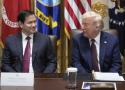
RUBIO: Mr. President -- first of all, everybody's made this comment already, it needs to be echoed again: you were elected as president of working Americans. And that's why this Labor Day is so meaningful.
For me, personally, this the most meaningful Labor Day of my life, as someone with four jobs. //
Rubio, of course, has taken on a few side gigs to complement his main role leading the State Department (he was the first Cabinet secretary to be confirmed, with his nomination having passed the Senate on Inauguration Day). Here's what else is currently on his resume:
Interim National Security Advisor;
Acting Administrator of the U.S. Agency for International Development (USAID); and,
Acting Archivist of the United States. //
Secretary of Transportation Sean Duffy also moonlights as Interim Director of the National Aeronautics and Space Administration (NASA). Russ Vought is Director of the Office of Management and Budget (OMB) by day and leads the Consumer Financial Protection Bureau (CFPB) by night. And Jamieson Greer does double duty as acting Director of the Office of Government Ethics and acting Special Counsel of the Office of Special Counsel.
A few non-Cabinet-level appointees are also pulling extra weight, with Daniel Driscoll serving as both Secretary of the Army and acting head of the Bureau of Alcohol, Tobacco, Firearms and Explosives (ATF), and Todd Blanche holding the positions of Deputy Attorney General and acting Librarian of Congress.
“If I can save 7,000 people a week from being killed, I think that’s a pretty [good thing].”
“I want to try to get to Heaven if possible. I’m hearing I’m not doing well, I am really at the bottom of the totem pole,” he joked. “But if I can get to Heaven, this will be one of the reasons.”
It was classic Trump, using self-deprecating humor to highlight something that was actually a great accomplishment. And in Trump fashion, his comment was almost certainly more of an off-the-cuff quip than a serious declaration of theology. Many have made the mistake of taking Trump literally instead of seriously, and that awareness is worth having here.
But out of the abundance of the heart the mouth speaks, and it’s not every day the president gives you a perfect news hook to talk about the Gospel. So it bears repeating: None of your own works, not even an act as virtuous as saving lives, can earn you a spot in paradise.
The decision by Secretary Driscoll to travel to Fort Stewart will not go unnoticed by the soldiers. His decision to honor both the guys who took down the shooter and the soldiers rendering aid is a great touch. Personally, I think Thomas and Turner deserved a higher award, the Soldier's Medal, but that is neither here nor there. Most noncommissioned officers will only get a Meritorious Service Medal at retirement.
Secretary of Defense Pete Hegseth is trying to revitalize the civilian chain of command in the military, and having the Secretary of the Army present these awards, rather than delegating it to the division commander, sends a clear message about who is in charge and watching day-to-day Army operations. During my service, I couldn't have picked the Secretary of the Army out of a two-man lineup. There is definitely different civilian leadership in today's Pentagon. //
Jerry's Middle Finger Min Headroom
9 hours ago
And it happened within 48 hours of the event, not months or even longer as the administrative process churns along at a glacial pace.
The rank and file notices that too, and it tells them that their leaders care about them.
streiff Jerry's Middle Finger
8 hours ago
Happened less than 24 hours after the event.

Practically, if Russia wanted to launch a nuclear attack, it wouldn't send a geriatric alcoholic out to make an announcement, and if we were going to attack Russia, we wouldn't announce submarine deployments in advance. With Russia's record in engineering and maintenance, there is a non-zero chance that its nuclear arsenal has been disabled by mice nesting in the controls. The fact is that Russia uses the threat of nuclear war as a frequent tactic to increase the sales of Depends in some parts of the West.
This is a list of Russia's threats to use nukes since the beginning of the Ukraine war and ending in June 2024.
... [List of 74 instances between 2/2022 - 6/2024] ...
A high-profile, public reaction to Russian threats has been needed for years. While we may not take Russia's bluster all that seriously, what we ignore is that Russia's threat messages aren't aimed at us. They are aimed at our allies or unaligned nations who see Russia threatening us while we do nothing. Hopefully, this will also be a sign to Russian President Vladimir Putin that the stories he read about Russia's influence over President Trump in the Washington Post were fake news and a warning to the Russian simps who have been invited into the Defense Department in large numbers that it's time to choose a side. //
KJSpeed
3 days ago
It should be interesting watching Trump's enemies try to accuse him of being "Putin's Puppet" while simultaneously shrieking that he's pushing us headlong into WWIII by standing up to Putin. Cognitive dissonance overload!!!

"This is the first president in history who has never had, at this point in his presidency, a civilian nominee approved either by unanimous consent or voice vote in the Senate," Thune said Thursday during an interview on the "Brian Kilmeade Show" on Fox News Radio.

Rapid Response 47 @RapidResponse47
·
.@SecRollins on moving USDA staff out of DC to be closer to farmers: "This is literally what @POTUS has tasked his Cabinet to do — to deconstruct the Administrative State... This is aligned with our Founding Fathers' vision... where the government should be closer to the people."
10:35 AM · Jul 25, 2025 //
So yesterday, USDA announced we're going to be moving most of our headquarters staff out into the country, in the five cities, the five states that you mentioned, taking our, getting closer to our constituents, the farmers, the ranchers, the producers, ... //
bpbatch
3 hours ago
Now move the IRS to Antarctica.
Min Headroom bpbatch
3 hours ago
Wait I thought that was why Trump wanted Greenland…

This is a story about John Two Guns White Calf, the last chief of the Blackfeet. His proud visage was immortalized on the Washington Redskins’ logo, designed by Blackie Wetzel to honor Native American strength. For decades, from 1972 to 2019, that emblem blazed across NFL fields, a tribute to “Indian Country” that stirred pride in fans and Native communities alike. //
The 2020 name change, driven by corporate pressure and a summer of racial hysteria, wasn’t progress—it was, as Daines put it, “woke gone wrong.” It stripped away a tribute to Native heritage under the guise of sensitivity, leaving fans and players like Scott Turner, a former Redskins defensive back, feeling betrayed. Turner took to X to declare, “I played in the NFL and was drafted by the Washington Redskins. Not the ‘Washington Football Team’ or the ‘Commanders.’" //
Bringing back the Redskins name would honor John Two Guns White Calf, unite a fractured fanbase, and remind us that America’s strength lies in its traditions. Trump’s leading the charge, backed by Native voices and everyday folks who refuse to let Indians and also American history be erased. The ball’s in Harris’s court. Let’s see if he’s got the guts to do what’s right.
When President Trump first started ranting, really out of nowhere, about the so-called “Epstein files” being “made up” by his Democrat predecessors, as well as former F.B.I. Director James Comey, it was bizarre and suspiciously defensive. It’s now a lot less weird and a lot less suspicious.
The Wall Street Journal reported Thursday on a “leather-bound book” containing, among other things, a doodle of a naked woman’s body framing an odd “typewritten” note, both supposedly penned by Trump and addressed to convicted child sex trafficker Jeffrey Epstein in 2003. The Journal called the letter and illustration “bawdy” and described the signature as “a squiggly ‘Donald’ below [the drawing’s] waist, mimicking pubic hair.” //
Trump told the Journal that the note, included in a book allegedly compiled for Epstein’s 50th birthday, was fraudulent. “I never wrote a picture in my life. I don’t draw pictures of women,” he said. “It’s not my language. It’s not my words.” //
We also know that this all sounds almost exactly like another story involving the F.B.I. and a newly discovered document that was damaging to Trump: the case of Paul Manafort and the “black ledger.” //
The two events are almost comically identical. An office space in Ukraine was pillaged by political activists, but what luck! A little paper book was eventually recovered — oh, my! Inside is damaging information associated with Trump! In 2025, as Trump set about quickly restructuring the executive branch of the federal government and attempting to hold corrupt Democrats accountable, well, I’ll be — a leather-bound book that makes him look like the dear friend of a notorious pedophile. //
And subsequent reporting by the Times acknowledged that the ledger may very well have been fraudulent, noting in 2022 that there was “the view within the Ukrainian government that a Trump presidency would be potentially ruinous, and the admission that the ledger had not been fully authenticated and did not prove actual payments made to Manafort.”
I think I understand what Trump was saying about the Epstein files being “made up” now.
It’s been 293 days since appellate judges heard arguments in President Donald Trump’s appeal of a $454 million fraud ruling in a civil case brought by state Attorney General Tish James.
The average time for an appellate decision from such a point is 30 days.
Signed decisions can take longer, but almost never this long. //
Any judge on the panel can delay the release of a decision without having to give a reason. //
Court observers suspect that Presiding Justice Dianne Renwick — appointed by Gov. Hochul and a political ally — may be sitting on the decision.
Why?
Keeping the judgment on hold gives Hochul leverage over Trump on matters from federal aid to congestion-pricing to wind farms.
“Pure extortion,” as one attorney familiar with the case has remarked.
Gabbard followed up her initial thread with the announcement that her office was turning over all of the documents to the Department of Justice for a criminal referral. //
The issue I am raising is not a partisan issue. It is one that concerns every American. The information we are releasing today clearly shows there was a treasonous conspiracy in 2016 committed by officials at the highest level of our government. Their goal was to subvert the will of the American people and enact what was essentially a years-long coup with the objective of trying to usurp the President from fulfilling the mandate bestowed upon him by the American people. Their egregious abuse of power and blatant rejection of our Constitution threatens the very foundation and integrity of our democratic republic. No matter how powerful, every person involved in this conspiracy must be investigated and prosecuted to the fullest extent of the law, to ensure nothing like this ever happens again. The American people’s faith and trust in our democratic republic and therefore the future of our nation depends on it. As such, I am providing all documents to the Department of Justice to deliver the accountability that President Trump, his family, and the American people deserve.
Billionaire Home Depot co-founder Ken Langone has done a 180 after blasting Trump's sweeping tariffs, explaining, "When you made a mistake, admit it."
Rapid Response 47 @RapidResponse47
·
LANGONE: "I am sold on Trump ... I think he's got a good shot at going down in history as one of our best presidents ever."
CNBC: "That is a real turnaround because you didn't want to vote for him!"
LANGONE: "When you made a mistake, admit it."
🔥🔥🔥
12:16 PM · Jul 15, 2025
CNN weekend host Michael Smerconish spent more than six minutes in his opening, detailing Trump's accomplishments over the past 12 days. //
Winning became a punchline that Trump’s opponents used to lampoon him in his first administration. He was a political novice then, surrounded by a team with which he was unfamiliar, and he was probably as surprised as the rest of us were that he won the election.
This time is different. This time he came with a plan and a cabinet with senior advisers comprised of loyalists, all well known to the president. And recently, he’s exhibited a more layered approach to governing on both the domestic and international front, no longer solely guided by winning each day’s news cycle.
By any objective measure, President Trump has his opponents on the run.

Even if everyone who is eligible to vote in the country would have voted, President Trump still would have won the 2024 presidential election, a new study out Thursday from the Pew Research Center finds.
Trump won in 2024 with just under 50% of the vote, 49.7%-48.2% over Democrat Kamala Harris.
Roughly 64% of the eligible-voting population turned out in 2024, the second highest since 1904. 2020 was the highest.
But even if everyone who could vote did, Trump would have won by an even wider margin, 48%-45%, according to Pew's validated voters survey.
The survey of almost 9,000 voters was conducted in the weeks after the 2024 presidential election. Pew verified whether they had voted or not over the last five presidential elections using publicly available commercial voter files. For context, most well-conducted national polls include roughly 1,000 interviews.
Pew asked non-voters how they would have voted and found they would have broken for Trump, 44%-40%. That's a big change from 2020 and 2016 when they said they would have chosen Democrats. In 2020, they said they preferred Joe Biden 46%-35%. In 2016, it was Hillary Clinton, 37%-30%.
That upends a longstanding belief in politics that higher turnout generally helps Democrats. Younger and non-white voters, who tend to vote Democratic, are also among the least likely to vote.
But in 2024, Trump's coalition grew – it got more ethnically diverse and younger.
What we said to the Iranians is we do not want war with Iran, we actually want peace. But we want peace in the context of them not having a nuclear weapons program. And that's exactly what the president accomplished last night. I really think there are two big questions for the Iranians here. Are they going to attack American troops, or are they going to continue with their nuclear weapons program? And if they leave American troops out of it, and they decide to give up their nuclear weapons program, once and for all, then I think the president has been very clear. We can have a good relationship with the Iranians. We can have a peaceful situation in that region of the world. //
we negotiated aggressively with the Iranians to try to find a peaceful settlement to this conflict. It was only when the president decided that the Iranians were not negotiating in good faith, that he took this action. He didn't take it lightly, but I actually think if provides an opportunity to reset this relationship, reset these negotiations, and get us in a place where Iran can decide not to be a threat to its neighbors, not to be a threat to the United States, and if they're willing to do that, the United States is all ears.
In early May, I wrote about a quiet but historic breakthrough—one that barely registered on most radars but carried the kind of geopolitical weight rarely seen in our era of performative diplomacy. The United States, through the leadership of Secretary of State Marco Rubio, had brokered a framework between Rwanda and the Democratic Republic of the Congo (DRC) that hinted at something almost unthinkable: peace in a region long synonymous with conflict, exploitation, and chaos. //
Now, just weeks later, that framework has matured into a full-fledged peace accord. And let me say this clearly: this is a huge win for American foreign policy—led not by the State Department's usual bureaucrats, but by a Republican senator with grit, clarity, and spine.
Rubio isn’t getting the ticker-tape parade he deserves, of course. That would require the mainstream media to acknowledge that a Republican delivered a diplomatic masterstroke. //
In my previous column, I called this deal a “billion-dollar boost” for America’s strategic position. That’s truer now than ever. This isn’t just about helping others—it’s about helping ourselves while restoring peace. It’s about countering Chinese influence in Africa, securing the raw materials we need for the 21st century, and proving that American power still means something.
The Rubio-led deal isn’t a magic wand. There will be setbacks. Bad actors don’t reform overnight. But for once, we’re not just reacting—we’re shaping events. That’s what leadership looks like. //
T_Edward
11 hours ago
What must be stressed in this situation is that they came to President Trump and asked for his help. This is huge. They recognize his ability to negotiate in his ability to lead and he sent the right people there to make the agreement. Rubio has been an enormous boost in the statue of our country Because he is actually getting it done! None of this would’ve been possible without President Trump.