Daily Shaarli
June 6, 2026
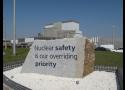
People are always pestering me for concrete examples of the cost of NRC style regulation. I turn them off by telling them it doesn’t work that way. It’s about incentives and motivation. What are the sticks and what are the carrots? Suppose you tell a football player, your overriding priority is not getting hurt. If you get hurt or do anything that might get you hurt, you are out of football for life. Now go out there and win this game.
When you go from a competitive environment where it’s build better/cheaper or die to an environment which is ruled by an autocratic regulator’s goal to prevent a release, everything goes to hell. Paperwork and process trumps substance erecting massive barriers to entry. Cheap becomes “unsafe”.
Everybody’s motivation gets wrong headed, not just the regulators. Incumbents work harder on protecting and deepening their artificial paperwork moat than they do on their product. Workers forced to follow ridiculous, wasteful procedures and sit around waiting for a series of sign offs on an obvious fix rationally decide if the bosses don’t care about doing the job right neither should they. Fixed price contracts become infeasible. The vendors’ goal becomes milk each project for as much money as possible for as long as possible. And the next thing you know, plants take three or four times as long to build as they should and cost five or more times what they should.
My inquisitor walks away shaking his head and saying to himself, where are the facts, he doesn’t have a real argument. //
But an important factor is that getting rid of open racking is at least three times as expensive as it should be because of the paper work required to build a simple steel and concrete can.
In short, NRC style regulation is the reason every nuclear power plant in the US uses dense-packing, which is by far the most likely, non-weapons path to a Chernobyl or larger sized release in the USA. Such a release coupled with the NRC’s immoral, indefensible defense of LNT will cause panic, evacuation, and exile that will shake the country to its roots. Is that a big enough cost for you?
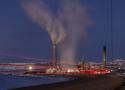
"For the first time in more than four decades, a new privately developed non-light-water reactor has reached criticality in the United States. Thank you to President Trump for his bold leadership and thank you to the bold scientists and entrepreneurs at Antares and Idaho National Laboratory who helped make this moment possible. I look forward to seeing continued progress in the American nuclear renaissance." //
Hallen
10 hours ago
American nuclear spent decades going nowhere, buried under regulatory delays and cost overruns.
This is the most important sentence in the article. It's true.
America could have been running on clean, ultra safe, abundant, reliable nuclear power by now if it were not for the climate alarmists and people who loved the movie "The China Syndrome". The EPA and other agencies have made it so difficult, to the point of being almost impossible, to develop nuclear power that advances came at a snail's pace.
The climate alarmists and Democrat officials saw the huge potential for massive funding shifts that could be manipulated for both personal gain and to develop Democrat power bases in "sustainable" energy. What they deemed unilaterally to be solar and wind. In my opinion, they intentionally hamstrung both fossil fuel development and nuclear development.
Look at the cost now. All those data centers everyone are overreacting over would be a non-issue for power consumption issues if we had these reactors. (they really aren't a problem either way, but it wouldn't be a talking point either). Powering EVs wouldn't be a worry.
The left has caused this problem. Even a little win like this one seems huge because of it.
I hope this trend continues and we can see more of this.
The article also doesn't mention the type of reactor. It's very important.
It's a sodium heat-pipe-cooled advanced microreactor. It's cooling mechanism is self-contained and does not need external water supplies for cooling. It means it can be used on things like submarines and a spaceships. It's also going to be used to power military bases to keep them secure and off the civilian grid.
These types of reactors can also be used in clusters to power remote locations so they don't need to be connected to the grid. That means lower infrastructure costs and independence. It could drive development in remote, harsh areas where people could live if they could get power and water. These types of reactors could drive that kind of development which would be a huge benefit to housing costs.
The future could be that your home is way out in the desert with a grand view and few if any other homes visible from your location. You'd connect to the urban areas via high speed tunnels using your EV or even autonomous aircraft. Half an hour and you're in Phoenix or Denver or Boise or Reno. It could be pretty cool.

If you don’t pursue safety in a way that is cost effective, you are killing people. -- [David Okrent, Past chairman, Advisory Committee on Reactor Safeguards]
Suppose early in 1979, you asked yourself what is the most definitive experiment we could do to learn about the radioactive harm associated with a nuclear power plant release. The obvious answer: a big release would be that experiment. But you would immediately reject that idea on both ethical and economic grounds. Since then we’ve inadvertently run that experiment three times. Let’s look at the results. //
Three Mile Island, Chernobyl, Fukushima //
So we did the definitive experiment. The result: even in a very large power plant release, dose rates to the public are almost never higher than the dose rates our bodies know how to handle. Nature had to equip us with those repair systems to cope with the onslaught of DNA damage from our internal metabolic processes, which damage our DNA at a rate that is at least 25,000 times higher than the damage rate from average background radiation.
Nuclear power plant casualties are extremely expensive economically, which means it’s in the operators’ interest to build robust plants and operate them prudently. But from a public, radiation point of view almost all releases will produce no detectable harm, and the very worst releases are no worse than a bad refinery fire at killing the public.
This puts nuclear in the same category as wind and solar, when it comes to directly killing people per TWh of electricity, and orders of magnitude less directly deadly than coal plants. But it’s the indirect deaths that really count. The easiest way to kill a lot of people is to make them poorer. With a few exceptions, wind and solar will do that. Nuclear will too unless it is as cheap as coal. Nuclear has been cheaper than coal, and can be cheaper again; but only if we regulate nuclear in a way that eliminates barriers to entry and forces the vendors to compete on an even playing field. Right now we are doing exactly the opposite. We are killing people.
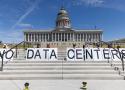
voline Ars Scholae Palatinae
20y
853
fe3a8b63 said:
https://isaiprofitable.com/
Even if we ignore all other problems in regards to environment, pollution, water, electricity, etc. it still doesn't make sense.
It's just burning money to.... burn money to..... uh what? What's the goal. You ain't making money.
I think Signal CEO Meredith Whittaker had a good answer:
I’m going to give a sideways answer to this, which is that the venture capital business model needs to be understood as requiring hype. You can go back to the Netscape IPO, and that was the proof point that made venture capital the financial lifeblood of the tech industry.
Venture capital looks at valuations and growth, not necessarily at profit or revenue. So you don’t actually have to invest in technology that works, or that even makes a profit, you simply have to have a narrative that is compelling enough to float those valuations. So you see this repetitive and exhausting hype cycle as a feature in this industry. A couple of years ago, you would have been asking me about the metaverse, then last year, you would have asked me about Web3 and crypto, and for each of these inflection points there’s an Andreessen Horowitz manifesto.
It’s not simply that one piece of technology is overhyped, it’s that hype is a necessary ingredient of the current business ecosystem of the tech industry. We should examine how often the financial incentive for hype is rewarded without any real social returns, without any meaningful progress in technology, without these tools and services and worlds ever actually manifesting. That’s key to understanding the growing chasm between the narrative of techno-optimists and the reality of our tech-encumbered world.
— Meredith Whittaker, Signal CEO, to Derek Robertson. "5 Questions for Meredith Whittaker". Politico, 2023-12-01.
https://www.politico.com/newsletters/digital-future-daily/2023/12/01/5-questions-for-meredith-whittaker-00129677
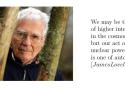
The Rockefeller Foundation and its allies decided to argue that radiation produced genetic damage and that damage was unrepairable. Radiation damage just keeps building up. Therefore, the harm was proportional to the total dose, regardless of how rapidly or slowly that dose was incurred. This is like saying taking 365 tablets of aspirin at once is the same as taking 1 tablet per day for 365 days. This no repair hypothesis is called the Linear No Threshold model or LNT.
If LNT is correct, then the Banners could aggregate the tiny increases in dose rate due to test fallout over hemispherical populations and over decades to argue that Bomb testing was invisibly killing millions of people worldwide. The Foundation expertly (and unscrupulously) promoted LNT with all its resources.

82 years later, Pointe du Hoc still teaches a hard American lesson: plans matter only until war wrecks them.
Mike Tyson had it right; all plans go out the window when you're punched in the face.
Courage shows itself when the map is wrong, the guns are missing, the commander is wounded, and the enemy still holds the ground. On D-Day, Rudder's Rangers didn't stop at the cliff; they went looking for the guns, found and destroyed them, and held the road.
“Rangers lead the way” wasn't a slogan in the morning; it was a record of what they had already done. Thank God for such men.

“The Iceman is not a static relic, but a dynamic biological interface,” wrote Sarhan and his colleagues. And that’s the great truth of existence: life’s short, then you die—and the whole time, you’re a dynamic biological interface.