Daily Shaarli
August 30, 2026

This system does not just produce liars – it produces people who can no longer clearly distinguish truth from the narrative they have been trained to emit.
This environment also produces a kind of cognitive adaptation often described as doublethink – the ability to hold two contradictory beliefs at the same time, and to accept both as true when required. It is not merely lying to others, but a learned internal tolerance toward contradiction itself, where inconsistencies are tolerated because survival depends on it.
Literally twisting the minds.
Poles, Czechs, Hungarians, and others who lived through this recognize the pattern immediately when they see it in Western institutions today. The show trials of Twitter mobs. The compelled speech. The ideological litmus tests for employment. The memory-holing of inconvenient facts. The ritualistic confessions of privilege. To a post-communist eye, it is unmistakable.
To eyes that have only known freedom, it looks like a passionate, if misguided, social movement.
Inside of New York, there are two grids. //
There are two electric grids: the physical one and the policy one. For New Yorkers, these two grids have been working against each other for a long time. The result is electricity and infrastructure that is increasingly more expensive and less reliable. Understanding this, and demanding better policies, is the only way to fix the problems that our two grids are facing.
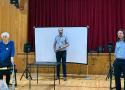
And there’s no more important place for people to learn about these issues than in the Hudson Valley, which has always been a bellwether for the nation’s infrastructure and energy issues. And so, last week, we hosted Meredith Angwin, a celebrated energy researcher, chemist and author of 2020’s Shorting the Grid, for an audience of about 30 residents, some of whom traveled from over two hours away for the talk at a historic church in Hurley, NY. //
Angwin’s first slide made the distinction the whole evening kept returning to: there is a physical grid and a policy grid, and almost everything you read in the newspaper or from politicians is about the policy grid. //
The fatal trifeca consists of an over-reliance on renewables that start and stop on their own schedule; backing them with just-in-time natural gas delivered by pipeline, where homes have priority over power plants; and counting on imports from neighbors who are usually having the same weather you are.
Norway halts exports to Britain when the reservoirs run low, she noted: “Every now and again Norway says: sorry. We don’t have it, so you can’t have it.”
On batteries, she pointed to our recent charging-mix work: New York’s batteries are not filled by wind and sun, because there isn’t remotely enough of either on the grid. They’re filled by the ordinary mix, with extra gas firing up on the margin, and lose energy on the round trip. //
We joined Angwin up front to answer: About half of the increase is fuel: when Indian Point’s 2,000 carbon-free megawatts closed in 2021, the void was filled not by “cheap renewables” but by two new gas plants, Cricket Valley and CPV Valley, which now run at 75–80 percent capacity factors, so Hudson Valley bills ride the gas market.
It’s not the data centers themselves that people fear, it’s the AI revolution they will enable. That’s what no one wants to talk about.

Investigators believe a single mosquito that survived a long-haul flight is to blame for the deaths of two workers at Frankfurt Airport, alongside another four who fell seriously ill, despite none of them having set foot outside Germany, let alone a malaria zone. //
Fraport, the company that operates Frankfurt Airport, has confirmed that six employees were diagnosed with malaria tropica, the most dangerous form of the disease, after falling ill between Saturday July 4 and Monday July 6. One worker died in early July. A second death was confirmed on Wednesday August 26, according to the Frankfurt health authority. The four other employees who were infected have been treated and are recovering. //
Mosquito traps have since been placed around the site, and any specimens caught are being sent to the Institute of Tropical Medicine in Antwerp, Belgium, for genetic testing to confirm the source. //
Cases like this are known in medical literature as airport malaria: an infected mosquito survives a flight from a country where the disease is endemic, then bites someone who has never left the country it lands in.
It doesn’t happen often though. Research cited by health officials has recorded fewer than 150 confirmed cases across European airports since the late 1960s