Daily Shaarli
October 11, 2026
A 1,526-ton submarine sat on blocks in a drained Wisconsin dry dock all summer, out of the water for the first time in 72 years, and gave up a flood valve stamped for her sister sub, lost with all hands in the war, before her tow back across Lake Michigan this month
USS Silversides just gave up a secret she'd been hiding underwater for 72 years, and it belonged to a submarine that never came home. //
Silversides is kind of a big deal. She was commissioned a week after the US declared war on Japan, and a joint Army-Navy committee credited her after the war with 23 enemy vessels sunk, according to the Navy’s history of the boat. Scott Hardin, the museum’s vessel curator, told WXYZ in July that the two subs ranked above her are both gone.
The weirdest find of the summer, and arguably the best, came out of main ballast tank 2D. Ballast tanks are how a submarine sinks on purpose. Let water in, and she gets heavy enough to dive. Blow it back out with compressed air, and she comes back up. The flood valves at the bottom of those tanks are where the water gets in.
That tank’s aft flood valve had USS Trigger stamped on it. Trigger and Silversides were sister boats, built side by side at Mare Island Navy Yard in California, and Trigger hit the water about two months later, according to the museum and the Navy’s official history of Trigger. Nobody seems to know how one of Trigger’s valves ended up on Silversides, including the museum.
Trigger never made it home. The museum says she was sunk with all hands on March 28, 1945, and the Navy’s history has Japanese planes and ships spending two hours attacking a submarine that day. Silversides was one of four American subs close enough to hear it.
Hardin sounded pretty thrilled about the valve, writing that it “could be the only surviving ‘Trigger’ submarine part.” It’s been pulled out and set aside for a display at the museum once the dry dock work wraps up, and I’d argue that exhibit’s worth the drive to Muskegon on its own.
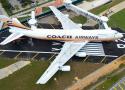
Someone forgot not one or two but three Boeing 747 jumbo jets at Kuala Lumpur Airport, and after years of racking millions in parking bills the gigantic planes were sold and spectacularly transformed into a surreal Chinese classroom and a Coach handbag store. //
The international reaction was immediate. Bloomberg called them the most dramatic items ever to hit “lost and found,” highlighting the absurdity of a world-class airport trying to reunite an absentee owner with three aircraft the size of small apartment buildings. The story became even stranger when you looked at the economics. These were 747-200Fs from around 1980 and 1981, a generation of four-engine freighters that had become increasingly difficult to place. By the mid-2010s, the market preferred more efficient twin-engine jets, and the once-mighty 747-200F had fallen so far in value that its scrap price often outweighed its resale potential. Bloomberg noted that while a new 747-8F retailed for hundreds of millions of dollars, an old 747-200F might fetch a sliver of that on a good day. //
In the end, the three forgotten 747s did get claimed, just not by the people anyone expected. What began as a bizarre newspaper advert asking someone to pick up their jets ended with pieces of those aircraft scattered across Asia, reborn as classrooms, attractions, and a luxury-branded cafe. Kuala Lumpur International Airport cleared its parking bays. The world got a strange, delightful story. And three old Boeing 747s found new lives after spending one awkward year waiting for an owner who never came back.

You can simply search for "Quick Assist" on Search or use the combination Ctrl + Win + Q to launch the app.
The next step depends on whether you're the one doing the helping or are being helped. The person doing the helping clicks "Help someone" on the app to generate a time-limited six-digit code, which they pass on by phone or by message.
The person on the other end, then, has to type in the code and allow screen sharing before anything shows up on the helper's screen. Once that's done, there's all there is to it. The helper can request control, and the sharer gets another prompt to either allow or deny. Nothing happens without the sharer's consent, and they can pull control back any time with "Cancel control." In the session, the helper also gets access to a few useful tools like a pointer, annotation tools, and a chat window for typed messages. //
Remote Desktop is unlike quick Assist, it's purpose-built for connecting to your own machines. The only catch is that it's limited to Windows 11 Pro and higher editions when it comes to hosting an RDP session, so if you want to reach your gaming PC from a laptop or jump into a Windows VM in Hyper-V, the host needs to be on Pro edition. The client side, however, works on any edition, so a Home machine can connect to a Pro host, just not the other way round.
Then, there's Windows Remote Assistant (msra.exe), which is the legacy option that predates Quick Assist by over a decade. The one real advantage it offers is that neither party needs a Microsoft account to use it. You can launch it from Run, send an invitation file, and the person on the other end can just connect with a password you've set. //
Ben
Rustdesk is my go to.
lacking a basic but very important feature "clipboard".
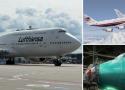
To keep the long-delayed Air Force Ones and the Qatar-donated 747-8 flying for decades, the USAF has taken delivery of a perfectly fine Lufthansa jumbo just to carefully dismantle it in the Arizona desert and stockpile everything from the windshields to the escape slides //
The US Air Force has taken delivery of a former Lufthansa Boeing 747-8 that will have a very different second life from the one it enjoyed carrying passengers across the globe. The aircraft, registered D-ABYG and named Baden-Württemberg, has arrived in the United States to become a source of spare parts for the next generation of presidential aircraft. //
D-ABYG is the second of two Lufthansa 747-8Is purchased by the Air Force for about $400 million, but it is not destined to become an Air Force One itself. Instead, the aircraft is being incorporated into an organic parts pool that will provide components for the 747-8 fleet over the long term. Its sister aircraft, D-ABYD, has a different role and is being used as a dedicated trainer for aircrews and maintainers. The acquisition gives the Air Force relatively young 747-8 airframes that closely match the aircraft it is preparing to operate, while also providing a way to secure components for a jet whose production line has already closed, //
A government report on the VC-25B program noted in 2023 that commercial 747-8 aircraft had zero spares available in its windshield risk assessment. The report said the previous supplier had closed its factory, while Boeing had contracted PPG to develop replacement windshields that still required certification. Passenger windows have presented another manufacturing and quality challenge.
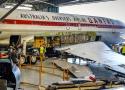
John Travolta’s former Boeing 707 is taking shape again at Australia’s HARS Aviation Museum, where a five-person crew from Worldwide Aircraft Recovery has begun reassembling the historic airliner following its journey from Georgia. At the end of March, we reported that John Travolta’s Boeing 707—once operated privately by the actor and former Qantas ambassador—was making its way to a new home in Australia. Donated to the Historical Aircraft Restoration Society (HARS) in 2017, the jet was dismantled by Worldwide Aircraft Recovery at the Port of Brunswick in Georgia in March 2026 and prepared for shipment to the museum at Albion Park.
Once reassembled, Travolta’s former jet will go on permanent display at HARS, where it will be preserved as one of the last surviving examples of the rare Boeing 707-138B.