
The height of each colored block represents the average electric power consumption per capita. The width is proportional to the regional population, so the area represents regional average electric power generated and used. If citizens of developing countries use as much power as Europeans, electricity demand would rise by about 3,318 GW. Plot courtesy of Geoff Russell.


World electric power use averages 3000 gigawatts (GW).
The height of each colored block represents the average electric power consumption per capita. The width is proportional to the regional population, so the area represents regional average electric power generated and used. If citizens of developing countries use as much power as Europeans, electricity demand would rise by about 3,318 GW. Plot courtesy of Geoff Russell.
We need over 600 GW of new power plants for 2030 electricity demands.
New and growing demands for electric power require more power plants. A large power plant can deliver one GW. The examples below are based on full-time average power demand to meet just these specific new needs, which add up to over 600 GW. Population growth and economic development will add even more demand.
Connecting a billion poor to power: +100 GW
Connecting one billion powerless people with just 100 watts of power — a tenth of US and EU average electricity use.
Desalination: +62 GW
Desalination of 87 million cubic meters of water per year is growing at 8% annually, demanding 3 kWh per cubic meter.
Electric vehicles: +42 GW
Electric vehicle charging
By 2030, 122 million more electric vehicles travel 12,000 miles per year at 4 miles/kWh.
Air conditioning: +100 GW
By 2030 air conditioning demand will be 50% higher than in 2017.
Information technology: +300 GW
Data centers, the internet, and consumer electronics will demand 300 GW more by 2030.

California: Climate Groups Push to Stop Re-Licensing of Diablo Canyon Nuclear Power Plant – RedState
Random US Citizen
7 hours ago edited
I hope the loons win. Because CA deserves it.
On the other hand, maybe Diablo can claim it identifies as a solar plant and ask CA politicians to pay for energy reassignment surgery?
Caedite eos. Novit enim Dominus qui sunt eius.
Green energy policies hold back the developing world, creating a gulf in energy consumption between the West and nations such as Kenya. //
Since most Kenyans rely on physical exertion to accomplish work, rather than machines, it’s useful to understand that an average person at rest produces 100 watts of energy, with most of that going to operate the brain, heart, and other vital organs. Heavy labor for several minutes can be sustained while generating 300-400 watts, while a professional athlete might produce 2,000 watts for short periods of time.
Thus, a person working in a field to tend crops over an 8.5-hour day might generate 2.1 kWh of power — a little less than the energy in one cup of crude oil. So, when thinking of the energy used by the DeVore family in a day, 6.9 gallons of crude oil, that’s the equivalent energy output of about 120 people doing physical labor in a day. //
There’s not a lot of time in the Machogu family’s day to watch Netflix or play video games, assuming they even had the electricity to do so. And there are no private jets or Dubai resorts for either family. The elites flying in to discuss the fate of energy consumers are perfectly willing for the poor to make sacrifices to their political whims. But they have no idea how the rest of us live — or do, and don’t care. //
The UN wants to fight climate change by taxing Americans and Europeans to send the cash to corrupt Third World leaders, while building a few trophy wind and solar projects to provide unreliable electricity to the masses. This will neither change global temperature (whatever that means) nor lift the 6.2 billion people of the planet’s 8.1 billion who live in developing nations up from poverty.
Americans use a lot of energy. It supports our high productivity. We make a lot of stuff, and we provide a lot of services with energy underpinning that productivity. The average American produced about $69.70 worth of goods and services every working hour with the aid of machines and energy in 2023 (in 2017 PPP dollars). //
The average Kenyan consumes 1/44 the energy an American does. This results in a per capita output of about $4.90 for every hour worked, about 1/14 of that in America, after adjusting for Kenya’s lower cost of living.

Officials in Sweetwater say an out-of-state company has made their town a dump for the seldom-seen trash created by renewable energy.
By Russell Gold
August 24, 2023
Update, September 25: General Electric filed a lawsuit last week claiming that Global Fiberglass Solutions has failed to fulfill its promise to recycle thousands of blades. GE says it paid the company $16.9 million to recycle about five thousand wind turbine blades, but that GFS instead stockpiled them at facilities in Sweetwater and Iowa. “Only after GFS took millions of dollars from GE, did GFS all but shut down its operations without recycling the Blades,” reads the complaint, filed in U.S. district court in New York.

Simply put, these huge industrial sites – we simply must stop using the friendly-sounding term “farms” to describe them – create all manner of negative consequences for local communities. Consequences like loud noise from wind turbines, hundreds of dead birds and bats sprinkled across the countryside, thousands of acres of productive farm or ranchlands taken out of production for many years if not permanently, spoiled views, enormous “graveyards” filled with 150-foot blades and solar panels popping up all over the place, and impacts to local wind and weather patterns that are only now beginning to be understood. //
One West Texas "blade graveyard" alone contains thousands of used blades; these blades cannot be reused, nor can they practically be recycled. Another graveyard, this one in Newton, Iowa, contains a similar eyesore. One of the companies that manufactures the blades, Global FIberglass, has pledged to find a way to begin recycling the blades, but this has not yet happened—and the blades continue to pile up. //
It's all energy density; it's always energy density. To maintain a modern, technological society, like ours, requires greater energy density, not less. The federal government should be held to account; the Energy Department should, at a minimum, stop subsidizing these boondoggles (and, ideally, should be defunded and disbanded). Our society depends on abundant, cheap, high-density energy. //
redstateuser
10 hours ago edited
One of the links in this article brings you to an article that I think is well worth reading in its entirely. I found it eye-opening as to the waste going on with windmills:
https://www.texasmonthly.com/news-politics/sweetwater-wind-turbine-blades-dump/
In Google Maps, I found the dumping ground located in Sweetwater, Texas but, inexplicably, the aerial view had been doctored to make most of it look like raked dirt, poorly doctored yet detectable. Here it is, and you can compare it to the unretouched image in the linked article:
(1 GWye = roughly the electricity for one million people, living by western standards, for one year)
Let us suppose it is our mission to produce electricity for a run-of-the-mill city with about 1 million inhabitants living by Western standards. This city will need about thousand megawatts of electricity, year round, in short 1GWye. In the visual, I compare four ways to accomplish this, along with the input and output of each of the options.
What do you call it when the same people who screech about carbon emissions and climate change oppose clean, efficient, carbon-free nuclear energy? Is this hypocrisy? Ignorance? Both?
Representative Jeff Duncan (R-SC) has introduced H.R.6544 - Atomic Energy Advancement Act, which is co-sponsored by a Democrat, Diana DeGette (D-CO), who, while not the farthest left in the Democratic Party, is certainly no Zell Miller-like Blue Dog. This is a bipartisan bill, and one intended to facilitate the development of nuclear power plants in the United States. The bill lists as its purpose:
To advance the benefits of nuclear energy by enabling efficient, timely, and predictable licensing, regulation, and deployment of nuclear energy technologies, and for other purposes.
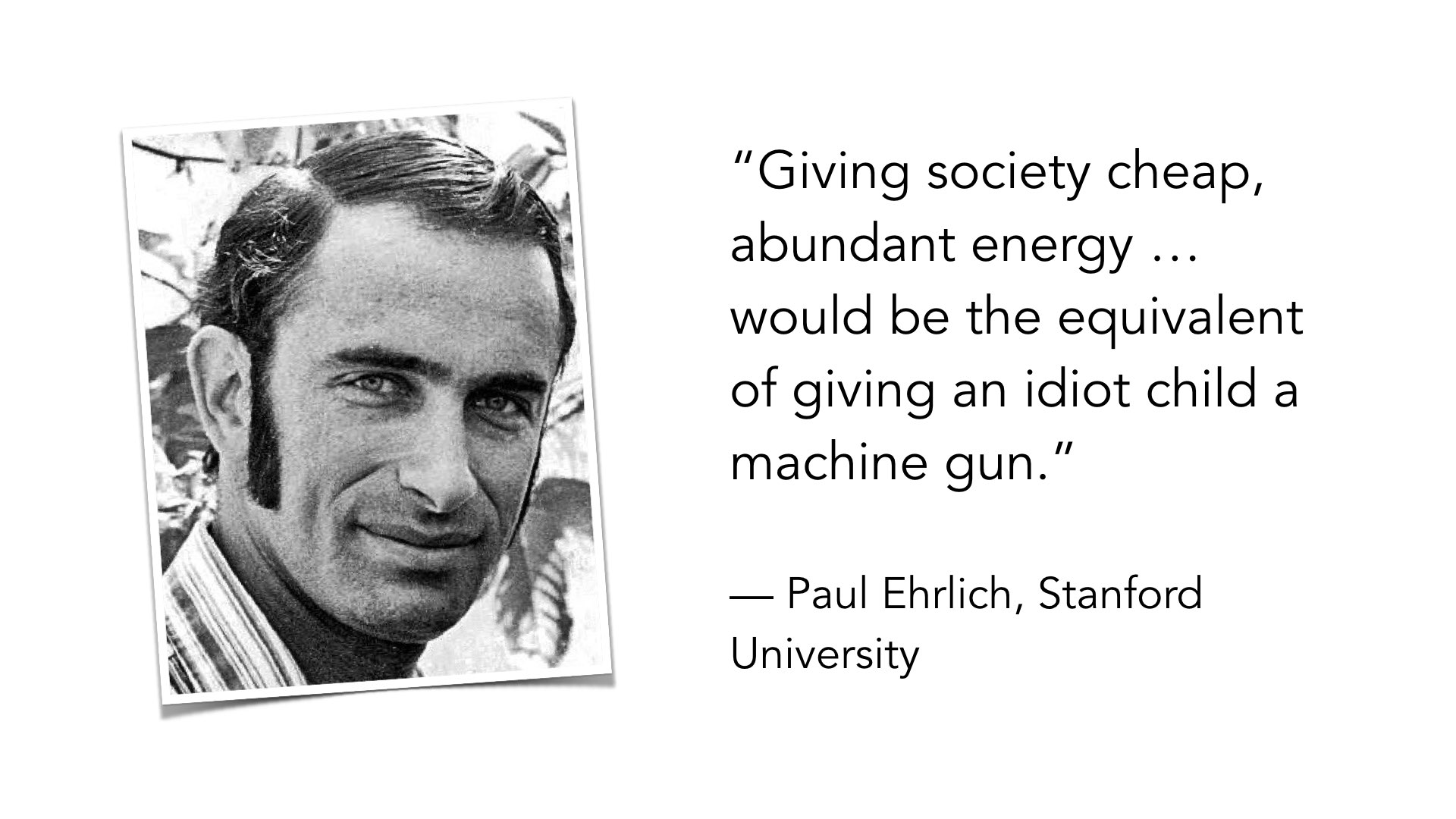
Giving society cheap, abundant energy ... would be the equivalent of giving an idiot child a machine gun. -- Paul Ehrlich

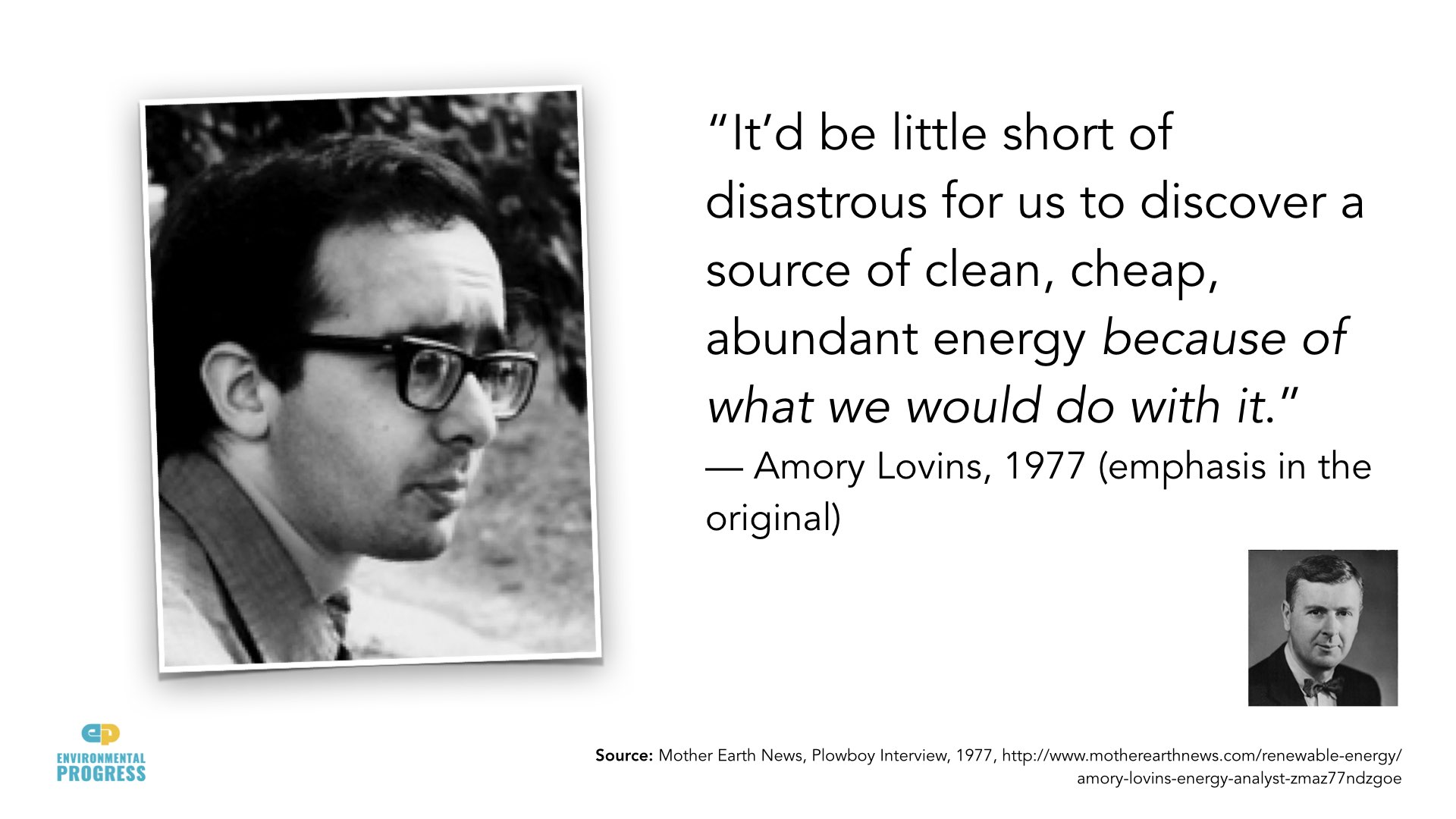
It'd be little short of disastrous for us to discover a source of clean, cheap, abundant energy because of what we would do with it. -- Amory Lovins, 1977

Why is nuclear power Green today when it wasn’t yesterday? Because it was never about the science.
Nuclear power has been the NetZeroiest energy on Earth since the sun formed from collapsing interstellar gas. Nuclear plants don’t produce any CO2 at all, but that wasn’t good enough because it was never about CO2 either. It was always about power and money and profits for friends.
And the best friend of a bureaucrat is a captive-dependent-industry, one that survives on handouts. Those in need of Big Government largess always lobby for Big Government, donate to Big Government causes and cheer on everything Big Government wants them to cheer on, even if it’s a naked man in high heels.
Yesterday gas was a fossil fuel, but today it’s a sustainable one:
In a radical move, the French government has quietly dropped their renewables targets from their draft energy bill, risking being seen as unfashionable losers in billionaire ski clubs. The nation that, forty years ago, built 56 nuclear reactors in 15 years has decided they just need to build another 6 to 14 new nuclear plants to reach “Net Zero” by 2050. This puts them in danger of being one of the only nations on Earth that might reach their target.
This, of course, is terrible for the renewables industry as it risks exposing the wanton frivolity and utterly superfluous nature of the wind and solar subsidy farms. If France can do this without the bird chopping, the slave labor and the lithium bombs, so can nearly everywhere else.
It’s a big change from 2014 when France aimed to reduce nuclear power to just 50% by 2025.

A new paper in PLOS ONE, “Land-use intensity of electricity production and tomorrow’s energy landscape 2”, examines the land use requirements of various alternative energy sources. The paper is open access with the full text available at the link or as a PDF file 5. The results are summarised in the following graphic.
The global energy system has a relatively small land footprint at present, comprising just 0.4% of ice-free land. This pales in comparison to agricultural land use– 30–38% of ice-free land–yet future low-carbon energy systems that shift to more extensive technologies could dramatically alter landscapes around the globe. The challenge is more acute given the projected doubling of global energy consumption by 2050 and widespread electrification of transportation and industry. Yet unlike greenhouse gas emissions, land use intensity of energy has been rarely studied in a rigorous way. Here we calculate land-use intensity of energy (LUIE) for real-world sites across all major sources of electricity, integrating data from published literature, databases, and original data collection. We find a range of LUIE that span four orders of magnitude, from nuclear with 7.1 ha/TWh/y to dedicated biomass at 58,000 ha/TWh/y. By applying these LUIE results to the future electricity portfolios of ten energy scenarios, we conclude that land use could become a significant constraint on deep decarbonization of the power system, yet low-carbon, land-efficient options are available.

Today, nuclear power is not usually considered among the “sustainable” alternatives to fossil fuels and, since it relies upon uranium as a fuel, of which a finite supply exists on Earth, is classified as “non-renewable” and hence not viable as a long-term energy source. But what do you mean “long-term”, anyway? Eventually, the Sun will burn out, after all, so even solar isn’t forever. Will ten thousand years or so do for now, until we can think of something better?
Energy “experts” scoff at the long-term prospects for nuclear fission power, observing that known worldwide reserves of uranium, used in present-day reactor designs, would suffice for only on the order of a century if nuclear power were to replace all primary power generation sources presently in use. But is this correct? In fact, this conclusion stems not from science and technology, but stupidity and timidity, and nuclear fission is a “bird in the hand” solution to the world’s energy problems awaiting only the courage and will to deploy it.
That is the conclusion by the authors of a paper with the same title as this post, “Nuclear Fission Fuel is Inexhaustible 45” [PDF, 8 pages], presented at the IEEE EIC Climate Change Conference in Ottawa, Canada in May 2006. Here is the abstract:
Nuclear fission energy is as inexhaustible as those energies usually termed “renewable”, such as hydro, wind, solar, and biomass. But, unlike the sum of these energies, nuclear fission energy has sufficient capacity to replace fossil fuels as they become scarce. Replacement of the current thermal variety of nuclear fission reactors with nuclear fission fast reactors, which are 100 times more fuel efficient, can dramatically extend nuclear fuel reserves. The contribution of uranium price to the cost of electricity generated by fast reactors, even if its price were the same as that of gold at US$14,000/kg, would be US$0.003/kWh of electricity generated. At that price, economically viable uranium reserves would be, for all practical purposes, inexhaustible. Uranium could power the world as far into the future as we are today from the dawn of civilization—more than 10,000 years ago. Fast reactors have distinct advantages in siting of plants, product transport and management of waste.

“The search for geologic hydrogen today is where the search for oil was back in the 19th century—we’re just starting to understand how this works,” said Frédéric-Victor Donzé, a geologist at Université Grenoble Alpes. Donzé is part of a team of geoscientists studying a site at Bulqizë in Albania where miners at one of the world’s largest chromite mines may have accidentally drilled into a hydrogen reservoir.
The question Donzé and his team want to tackle is whether hydrogen has a parallel geological system with huge subsurface reservoirs that could be extracted the way we extract oil. //
It turned out that over 200 tons of hydrogen was released from the Bulqizë mine each year. Donzé’s team went there to figure out where all this hydrogen was coming from.
The rocks did not contain enough hydrogen to reach that sort of flow rate. One possible explanation is the hydrogen being released as a product of an ongoing geological process called serpentinization. “But for this to happen, the temperature in the mine would need to reach 200–300 degrees Celsius, and even then, it would not produce 200 tons per year,” said Donzé. “So the most probable was the third option—that we have a reservoir,” he added. //
Bulqizë was entirely different. The gas pushed out of the Bulqizë mine is 84 percent hydrogen, one of the highest concentrations on record. Moreover, the hydrogen was not dissolved in water—it bubbled through Bulqizë’s underground pools, making them look like a jacuzzi. //
So Donzé’s team got busy looking for such places, and they found one. “There is a mine in Ural, central Russia, that has the exact same geological configuration as Bulqizë: harzburgite, dunite, and chromite,” said Donzé. “And guess what. They have a problem with explosions.”

How the country is going K-nuclear //
In 1972 South Korea began construction of its first commercial nuclear power plant, at a time when the country’s per-capita income was slightly lower than that of North Korea. Since South Korea had a relatively small industrial base at the time, undertaking a large infrastructure project was risky.
Propitiously, the venture paid off, and South Korea’s daring has been an overture to success: the country’s industrial growth is largely thanks to nuclear power. With 25 nuclear reactors, South Korea is currently the world’s sixth-largest producer of nuclear energy. In 2022, South Korea ranked third worldwide in terms of the number of nuclear reactors under construction, following China and India.
The country has put a significant amount of effort into developing its nuclear industry, which is demonstrated by the three South Korean power plants in the top five on the list of leading nuclear power plants ranked by capacity in 2023.
After President Yoon Suk Yeol took office in 2022, the administration embraced nuclear energy fully. Speaking of the previous government’s stance against nuclear energy, Yoon pulled no punches, stating: “Had we not been foolish over the past five years and further reinforced the nuclear power ecosystem, we probably would not have any competitors now.” //
Standardisation is key to South Korea’s success with nuclear energy. This means building the same design, ideally using the same engineers who have become familiar with the design, repeatedly, and licensing multiple new reactors at the same time. A paper on standarisation in South Korea summarises that: “Where a number of nuclear power plants are constructed in series within the framework of a long-term national power development plan, nuclear power plant standardisation can definitely facilitate self-reliance in the technology.”
As President Yoon puts it, "The competitiveness of our nuclear plant businesses lies in our ability to construct on time and on budget, which no other company in the world can imitate."

The US could soon become a world leader in rare earth minerals after over two billion metric tons were found in Wyoming.
ThorCon is a packaged nuclear power plant concept from Martingale, Inc. that is designed to wring capital costs out of nuclear plant construction. The company visionaries have recognized that the biggest hurdles to building new actinide-fueled reactors are the initial capital investment along with the excessive required construction lead time.
Instead of complaining that “the market” does not reward carefully crafted works of industrial art designed to last for sixty to one hundred years with lucrative paybacks delayed for three or four decades after final investment decisions, the ThorCon design team started with the notion that product designers must create offerings that satisfy market demands.
Today’s energy market rewards financial flexibility, predictable construction schedules, reasonably low investment, affordable operating costs, low or no emissions, and readily implemented upgrade paths. If the offered solution is one that uses actinide fission, customers will also want to clearly understand provisions for handling process leftovers, liabilities, accident prevention, consequence mitigation and regulatory barriers.
Zion Lights @ziontree
One of the reasons I like nuclear energy is its small land footprint.
This video shows the amount of land required by the Olkiluoto 3 nuclear power plant in Finland compared with wind power.
Data visualisation by @Klimavenner
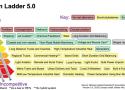
The Hydrogen Ladder is my attempt to synthesise all the information known to me about all the factors driving technology uptake across all sectors of the economy in all countries of the world. Not ambitious at all!
What the Hydrogen Ladder is designed to do is to show how likely it is that any proposed use case ends up being a significant user of hydrogen (perhaps via one of its derivatives) in a decade or so, say 2035. That doesn't mean it's game over, the transition has happened, it just means it is absolutely clear by then that hydrogen is either the answer, or a major answer, to decarbonizing that use case.
In other words, it looks forward to a time after the current firehose of subsidies has subsided to affordable proportions, after there has been enough time for a bit more tweaking of technologies, after the emergence of supply chains, after a bit of familiarity has grown in the project finance sector, and so on.
As for what the rows mean, here's how I think about them:
- A - no alternative (though this does not mean the use case is growing)
- B - decent market share highly likely
- C - some market share likely
- D - small market share plausible
- E - niche market share possible
- F - niche market share in some geographies possible
- G - the Row of Doom
The Hydrogen Ladder is not all about efficiency, as its detractors claim. It does not include information about market size. It does not include information about speed of adoption. It does not include information about relative emissions reduction per kg of hydrogen or kWh of electricity. I leave it to others to add that information to the discussion.
Conversely, it does take into account cost, safety, convenience, critical mineral availability, co-benefits, externalities like air pollution, geopolitics, human behaviour and - underlying it all - thermodynamics, physics, chemistry, other sciences and economics.