On the Importance of Process and the Republican Nature of the New Government
In Federalist 38 Madison discusses the process by which the new proposed constitution was written and how that process was superior to anything that had been attempted before in history. If you recall, Plato believed that an enlightened philosopher king should rule, and that only this kind of man would be capable of creating, and leading, the city state. His reasoning was that man was too fraught with faults to avoid pursuing his own self-interest.
Madison lists the examples of Minos in Crete, Zaleucus of the Locrians, Theseus in Athens, Lycurgus of Spart, Romulus of Rome, and others to illustrate how these city states all were established, and their laws created, by a single person even as they went on to have legislative bodies. And all these states went through periods where single emperors ruled regardless of the original intent of their founding. Even democracy loving Athenians, “a people who would not suffer an army to be commanded by fewer than ten generals, …should consider one illustrious citizen as a more eligible depositary of the fortunes of themselves and their posterity, than a select body of citizens”.[1]
Up until this point, this is how governments were formed. “(T)hese lessons teach us, … to admire the improvement made by America on the ancient mode of preparing and establishing regular plans of government”. The process by which the new constitution was written matters greatly. The representative way in which all states, and through their delegates the citizens thein, are represented is absolutely novel. It has never happened in the course of history to that time. This process alone helps ensure the liberty of the citizens of the new country.
Madison asks of those who object to the constitution, what they would propose as an alternative? //
In Federalist 39 Madison seeks to answer whether the new constitution creates a truly republican form of government and whether that government is federal or national in construction.
On the first question, Madison starts by declaring that only a representative republic, “would be reconcilable with the genius of the people of America; with the fundamental principles of the Revolution”. He points out that no such thing exists anywhere else in the world, and lists the various places that claim the title incorrectly. “It is ESSENTIAL to such a government that it be derived from the great body of the society, not from an inconsiderable proportion, or a favored class of it”. There is no nobility in the new country, in fact the constitution includes an, “absolute prohibition of titles of nobility”.
In each of the states’ constitutions, legislatures are chosen by the people for, “a definite period, and in many instances, both within the legislative and executive departments, to a period of years.” Here again we see the criticality of turnover within these branches of government for ensuring liberty. //
But to those who worry about too much power being in the hands of the federal government, Madison reiterates the point that Hamilton made earlier that, “the proposed government cannot be deemed a NATIONAL one; since its jurisdiction extends to certain enumerated objects only, and leaves to the several States a residuary and inviolable sovereignty over all other objects.”


If you follow family-run businesses over multiple generations, a common theme will emerge that is so statistically significant that even Dave Ramsey warns families about it.
When the first generation starts a business, it is often passed down to the second generation who directly witnessed the blood, sweat, and tears that both of their parents invested to make it sustainable. This second generation generally feels an obligation to the investments made by their parents and generally runs the business well. But the third generation has no historical appreciation for the business. They were not alive when the business was born and can’t comprehend a world without it. If the business was passed from the first to the second generation, of course, it will be passed to the third which causes a sense of entitlement. This entitlement and lack of perspective are at the core of why a disproportionate number of third-generation business owners fail.
The United States is now in its third generation of bureaucracy following World War 2. The first generation was directly a part of the pain and sacrifice made around the world to defeat an axis of evil. The second generation of bureaucracy grew up in the shadows of World War 2 and even got a taste of it during the Cold War. But the third generation of bureaucrats and technocrats embedded in unelected offices earning mid-six-figure salaries have none of this. Their version of a threat to democracy is the prospect of a democratic reelection of Donald Trump.
Just like a family business, this third-generation bureaucrat is running this country into the ground and is stirring a populist revolt that I don’t think they understand. Let me explain.
IN THE EARLY 1900S, PABST was a paragon of success. What started in 1844 as a tiny Milwaukee brewery had become the largest beer maker in the nation by 1874, producing more than a million barrels a year in 1893. That same year, the company started claiming that one of its lagers had won a blue-ribbon award at the Chicago World’s Fair. It was pure malarkey. But the blue silk ribbons they tied around bottle necks put some prestige behind the brand, and helped turn the Pabst family into millionaires.
Yet as America moved towards Prohibition, the folks at Pabst recognized that their beer empire was about to dry up. So, soon after the nationwide ban on alcohol went into effect in 1920, Pabst pivoted to making a “delicious cheese food.” They called it Pabst-ett and sold it in block and spreadable forms, as well as in cheddar, pimento, and Swiss flavors.
This wasn’t the only side hustle the Pabst Brewing Company pursued in 13 years of prohibition, nor the most profitable of them. But it exemplifies the mindsets and tactics American brewers adopted to ride out the decade and resurge after 1933—something only a few dozen of the nearly 1,300 brewing companies active in the U.S. in 1916 managed to do.
Fibber McGee and Molly - 400305 (238) Cleaning Hall Closet (Gracie Allen)
Originally broadcast Tuesday March 5th, 1940
All right, but that radish, you might have been more careful with.
Quick, help!
There's funny little insects all over me.
Brush 'em off, quick.
Oh, calm yourself, calm yourself.
them are my trout flies. [laughter] Doggone it, Molly, why did you have to go and mess up?
[knocking] Oh, dear, come in.
Pepper McGee and Molly?
Yes.
Tell me, with all these radio shows being changed, is it true that you're going to cut your program down to a half hour?
What do you mean, cut it down?
It's only a half hour now.
What?
Boy, it sure seems like an hour. [laughter] Well, as the guy says, when he fell off of the horse and heard something bust, that sounded to me like a rib. [laughter] Well, never mind that now.
We're going to go through that pile of whatnots and throw everything out we don't need.
Oh, yeah?
Well, I've been through this stuff a hundred times and there ain't a thing of it that I can spare.
Oh, there isn't?
No.
What's this old rusty horseshoe for?
Well, I found that in 19-aught-11. [laughter] As soon as I find three more, we can pitch horseshoes in the backyard. [laughter] I see, you expect to find three more, huh?
You betcha.
You don't think the automobile is here to stay, eh?
[laughter] Won't be if we don't catch up with the payments. [laughter]
Well, McGee, I've about exhausted my impatience with you.
Why?
Packing all this useless junk back in that closet.
How about these old books?
Let's see them.
Oh, them.
Well, that's my correspondence course in taxidermy.
Taxidermy.
Why on earth did you want to study taxidermy?
Well, how did I know it meant stuffing birds in animals?
And there I was, stuck with a chauffeur's license, a city map, and a pair of puttees.
Well, hurry up and put your playthings back in the closet.
Okay.
Looks terrible laying around here on the floor with it.
I'll get it. [phone ringing] Hello?
No, this is the McGee residence.
You got the wrong number.
Oh, is that you, Mert?
Oh.
He gadd every week the same thing.
Apologies to skinny Ennis.
How's every little thing, Mert?
What say?
Your Uncle Gulliver.
Oh, that's too bad, Mert.
Oh, my.
And they ain't found the body yet, eh?
Oh, heavenly days, McGee.
What happened?
Mert's uncle drove his car off a cliff and had to walk home.
They found the chassis up in a tree, but they don't know where the body is.
What say, Mert?
Oh, that's okay, Mert.
Everybody has the wrong number now and then, except Irving Berlin.
Well, now, let's see.
McGee, why are you saving this long stick of bamboo?
Why, Molly, that's got a very definite purpose.
If I was offered a job as sparring partner for Joe Lewis, that's the 10-foot pole I wouldn't touch it with.
Welcome Good Old Days subscribers!
Please find below your free downloads. You can click on the links to listen online or RIGHT click and choose “Save As” to download to your desktop:
Classic Radio Club
High quality audio of your favorite classic radio shows, Delivered Monthly
All 218 episodes in pristine audio quality (including more than 50 LOST episodes) transferred directly from the Ziv 16 inch discs //
VERY IMPORTANT NOTE: This private collection of discs is uniquely rare. The vast majority of these discs are un-played! No needle has ever touched them. There are no scratches or damage so the surface noise is low to none. Normally, a transcription disc has two sides and if the episode is 30 minutes long, you have part 1 on one side and part 2 on the flip side. With matched discs, you need two discs to get two complete 30 minute episodes. One disc has (for example) part 1 of episode 19 on one side and the flip side is part 1 of episode 20. The second disc holds both part 2s.
The odds of finding a single disc in un-played condition is slim. The odds of finding a matched pair of discs in un-played condition is nearly impossible. The odds of locating an entire series of matched discs in un-played condition is one in a million and finding 41 complete series of discs of this condition is one in a billion. That is how rare this opportunity is. I can not stress this enough. This truly is finding an old-time radio Unicorn. To let this opportunity pass — to not save — and not create THE definitive sets of these Ziv radio series, would be an absolute tragedy. I am doing everything I can to prevent tragedy, one series at a time, with YOUR help!
In Sex and Culture (1934), Oxford scholar J. D. Unwin studied 80 primitive tribes and 6 civilizations through 5,000 years of history and found a positive correlation between the cultural achievement of a people and the sexual restraint they observe. //
MCP
5.0 out of 5 stars
Sexual repression is the foundation of civilization.
Reviewed in the United States on March 30, 2008
That is the basic thesis of this unjustly forgotten book. According to Professor Unwin, who was influenced by Freud, it is the "limitation of sexual opportunity" which creates the "mental energy" necessary to build a civilization.
He backs this up with exhaustive examples of the historical cycle he proposes. The cycle goes as follows: in a primitive society, people take their pleasure at whim, without commitment or limits. Then the practice of monogamous marriage, including premarital chastity, is instituted. (How he believes this first arises would take far too long to summarize here; read the book!) The sexual repression required for this chastity and fidelity increases the "mental energy" and the inner strength of those who practice it, enabling them to embark on long-term projects such as monumental architecture, agriculture, and conquest. In this early stage, men have enormous power over their wives and children, even when the children have grown up. ... //
Cornelius
5.0 out of 5 starsVerified Purchase
Brilliant and Shocking Exposition of Sexual Regulations and Cultural Advance
Reviewed in Canada on November 27, 2019
Unger surveys eighty so-called 'primitive' civilizations, as well as six advanced civilizations, and finds a stunning correlation between the extent of a society's pre-marital and post-marital sexual regulations, and its civilizational advance (conquest, exploration, abstract thought, industry, commerce, etc.). In general, the more restrained a society is when it comes to sex, the more repressed sexual energy is created; that repressed energy is then transformed into, and given full expression in, productive, outward endeavours. As an anthropologist, Unger is surprisingly careful; since this book was published in 1934, I expected a stereotypical Englishman's exaltation of the white man's superior intellect. Unger does not fall for such preposterousness; he even admits that there is no reason to believe that coloured men have inferior intellects or abilities. In fact, he argues against the racialism that prevailed in his day. Although Unger's correlation is interesting, and his causation convincing, I am not convinced by his proposed mechanism: Freudian sexual sublimation. In fact, there are more direct mechanisms that would explain why repressed sexuality translates into powerful outward displays of productive and expansive energy: 1. When sex is more difficult to procure, people engage in more productive activities. This is a simple opportunity cost formula. 2. Men won't invest resources in children that aren't theirs. Sexual restraint ensures that women are less likely to cheat and conceive children with other men. 3. Hypergamy is dominant: without sexual restraint, men and women expend energy in attaining unachievable sexual partners. Aside from these shortcomings, Unger's book is worth reading if you are interested in why sexual restraints come about, and how they relate to civilizational advance.
Puzzling out the power supply to Urals atom plants.
THE DECRYPTION OF A PICTURE, by Henry S. Lowenhaupt
One day in August 1958 Charles V. Reeves showed me a picture of the Sverdlovsk Central Dispatching Office of the Urals Electric Power System which he had found in the July issue of Ogonek, the Soviet equivalent of Look magazine (Figure 1a). He remarked that at the Boston Edison Company he had controlled electric power generation and flow in the Boston metropolitan area from just such a dispatching station. //
[Source: Studies in Intelligence. Volume II. Issue: Summer. Year: 1967]

This gentleman is no less than Mad Jack Churchill, a man who went into battle with a sword, a revolver, a longbow, and bagpipes. He was one of the bravest men to ever draw breath, and thus richly deserving of our admiration. //
Determined to pursue his education in the most masculine setting possible, Jack Churchill decided he would attend university at King William’s College on the Isle of Man.
That’s right – the Isle of Man. //
After letting the Krauts get in good and close, Churchill gave the order to attack by brandishing his claymore, chucking a grenade, and bellowing, “CHARGE!” The Brits charged, led by the possibly mad Churchill and his broadsword, and routed the German patrol. When asked later by a higher-ranking officer why he insisted on carrying the Scottish sword, Churchill replied by exclaiming that any officer who goes into action without his sword is improperly dressed. //
He went on going into battle properly dressed, leading his men on a series of rear-guard and guerilla actions against the Germans until the BEF was evacuated at Dunkirk. He was wounded in the neck by a machine-gun bullet but refused evacuation and went on fighting. //
That unit landed and fought in Sicily and Salerno. In that second action, Churchill was ordered to silence a mortar position and eliminate a German observation post that controlled a pass overlooking the Salerno beachhead. Most officers would have assembled a patrol and moved on the positions with fire and maneuver in a traditional infantry operation, but not Jack Churchill. He led No. 2 Commando to encircle the German observation post, then drew his sword, brandished it, bellowed “COMMANDO!” and charged the post, easily taking it and killing or capturing the German troops. He then went on to take out the mortar post by capturing one guard, then moving on to the others in turn, shoving his Scottish sword in their faces and demanding their surrender. He later commented:
I maintain that, as long as you tell a German loudly and clearly what to do, if you are senior to him he will cry 'jawohl' (yes sir) and get on with it enthusiastically and efficiently whatever the situation. //
In May of 1944, he was ordered to raid the German-held island of Brač.
...
On the second morning of the mission, Churchill led a flanking attack on the German positions while the Partisans remained behind. By the time the Commandos reached the objective, only six were left alive, of which Churchill, still toting a rifle along with his sword and bagpipes, was one. Mortar fire swept their positions, killing all remaining members but Churchill. Out of grenades and ammo. As the Germans closed in, he stood and began playing Will Ye No Come Again on his bagpipes until a grenade knocked him unconscious.
The Germans, noting the name on this identity disk and incorrectly assuming a family connection to the British Prime Minister, sent him to Berlin. There he was interrogated until, in frustration of having learned nothing from the stalwart officer, the Germans sent him to the Sachsenhausen concentration camp near Oranienburg, Germany.
By September 1944, Mad Jack had enough of a prisoner’s life. Enlisting a Royal Air Force officer, Bertram James, to help in the attempt, he and James crawled under the wire around the camp and into an abandoned drainpipe. //
Probably because of his predilection for escaping and also probably because he intimidated the bejeebers out of his Wehrmacht guards, in April of 1945 Churchill was sent to an SS-run concentration camp near Tyrol.
...
one Captain Wichard von Alvenslaben, that they were worried about being murdered by the SS, the German captain (perhaps looking ahead to the consequences of Germany’s looming defeat) surrounded the camp and “advised” the SS to get the hell out. They did so, and soon after the German regulars did as well. Churchill and some others promptly decamped and walked 90 miles to Verona, Italy, where they found an American armor unit. On rejoining Allied forces in this manner, Churchill was disappointed to find the Germans had surrendered, and so wasted no time demanding reassignment to Burma, where the Japanese were still kicking up their heels.
The assignment was granted, but by the time Churchill made his triumphant return to Burma, Hiroshima and Nagasaki had both been wiped off the map. The Japanese Emperor, realizing that the tide of battle had irreversibly turned against Japan now that Mad Jack Churchill was in the theater of operations, surrendered. //
He went on bagpiping and longbowing his way through life. Even in retirement, he maintained an office and, in the afternoons on his return home, startled train passengers by hurling his briefcase out of the train window some ways before his stop. When someone finally worked up the nerve to ask why, he calmly explained that he was chucking the thing into his back garden so he wouldn’t have to carry it home from the station.
John Malcolm Thorpe Fleming Churchill died on March 8th, 1996, at 89 years of age, in Sussex. The Royal Norwegian Explorers Club named him “one of the finest explorers and adventurers of all time,” and to this day, he has yet to be outmatched in that regard. //
Randy Larson
an hour ago
I would question why a man’s proficiency with the bagpipes would serve him on the silver screen in 1924, when movies were still silent… but then I think I’ve answered my own question.
As I’ve heard them them say in the UK a gentleman is a man who knows how to play the bagpipes… but doesn’t.

Did the massive scale of death in the Americas following colonial contact in the 1500s affect atmospheric CO2 levels? That’s a question scientists have debated over the last 30 years, ever since they noticed a sharp drop in CO2 around the year 1610 in air preserved in Antarctic ice.
That drop in atmospheric CO2 levels is the only significant decline in recent millennia, and scientists suggested that it was caused by reforestation in the Americas, which resulted from their depopulation via pandemics unleashed by early European contact. It is so distinct that it was proposed as a candidate for the marker of the beginning of a new geological epoch—the “Anthropocene.”
But the record from that ice core, taken at Law Dome in East Antarctica, shows that CO2 starts declining a bit late to match European contact, and it plummets over just 90 years, which is too drastic for feasible rates of vegetation regrowth. A different ice core, drilled in the West Antarctic, showed a more gradual decline starting earlier, but lacked the fine detail of the Law Dome ice.
Which one was right? Beyond the historical interest, it matters because it is a real-world, continent-scale test of reforestation’s effectiveness at removing CO2 from the atmosphere.
In a recent study, Amy King of the British Antarctic Survey and colleagues set out to test if the Law Dome data is a true reflection of atmospheric CO2 decline, using a new ice core drilled on the “Skytrain Ice Rise” in West Antarctica. //
Scientists estimate that about 60 million people inhabited the Americas before European contact. There’s archaeological evidence for numerous cities and settlements, such as miles of now-overgrown urban sprawl that was recently mapped in Amazonian Ecuador, or the city of Cahokia in Illinois, which is estimated to have been larger than London was at that time, or Llanos de Mojos in Bolivia. The Spanish conquistador Francisco de Orellana also described seeing cities in the Amazon in 1542.
Even today in overgrown parts of the Amazon, vegetation carries the imprint of past occupation in an overabundance of cultivated species such as Brazil Nut trees.
A century after the first European contact, some 56 million people had died according to one widely cited estimate. “What we're looking at here is first contact, and [then] 100 years when 90 percent of the population, basically, dies,” said Professor Mark Maslin of University College London, who was not involved in King’s study. They succumbed to wave after wave of pandemics, as smallpox, measles, influenza, bubonic plague, malaria, diphtheria, typhus, and cholera spread through populations with no natural immunity. People who survived one disease outbreak died in the next. With too few people to work them, cities and farms were abandoned and overgrown. //
Wheels Of Confusion Ars Legatus Legionis
15y
65,758
Subscriptor
Magog14 said:
A strong argument for limiting the human population to under one billion.
We're talking a drop of ~10ppm CO2.
If it happened today it would get us roughly back to where we were in the year 2010.
swiftdraw said:
I have a modest proposal in regards to the population…
Then we must act Swiftly! //
Ushio Ars Tribunus Angusticlavius
13y
6,642
Felix K said:
I can’t believe how much death and destruction my ancestors unleashed on the natives of the Americas. It must be the greatest genocide in history.
Not really sure what to do with the feelings it brings up except that none of this land is ours. It is all stolen.
Was it a genocide when it was accidental? The first people from Europe to land in the America's didn't set out to genocide anyone. Yes conquering and killing but when it was done in Asia and Africa there wasn't genocide.
Genocide's seem to be more a 19th century onwards thing with Native Americans and Aboriginals getting the worst of it long after the USA, Australia and New Zealand had been fully formed. //
A_Very_Tired_Geek Ars Scholae Palatinae
5y
1,290
freitzkreisler said:
Egad <Racist Rant Lacking evidence or merit and doesn't bear repeating>
Could you be any more trollish or racist?
Native Americans were humans, and none of them were these 'heathen savages' that Eurocentric arrogance saw them as. They engaged in warfare just like the rest of the world. But what you're going off on is demonstrably untrue while the rest is bigoted unsupportable opinion. Spiritually inferior? Seriously this is BS I'd hear spouted in some throwback fundamentalist Christian church (and why I became an atheist because I unfortunately grew up in such).
The fact of the matter is that Native Americans taught the European immigrants how to grow native crops in this land because many of their European techniques, plants, and livestock wouldn't work or grow here without changes. It's to the world's detriment that Europeans weren't more receptive to what they had to teach because slash and burn along with hunting species to extinction is mainly a European thing. Most of the modern agricultural advances used today are NOT from the colonial era. They are innovations that came out of America's Dust Bowl during the Great Depression (arguably caused by colonial era practices) while some are revivals of tenants of Native American or Aboriginal practices - don't screw with the natural order. (Who knew predators improves the general ecology of an area? Native Americans. Who knew beavers improved the soil and water quality on farm lands? Native Americans. And on and on...) //
A_Very_Tired_Geek Ars Scholae Palatinae
5y
1,290
Mad Klingon said:
Besides reforestation, having 10s of millions of people die and stop using firewood and coal for cooking and heating probably had something to do with the CO2 drop.Also, several of the groups practiced planned burns as part of their crop and living space management. When they died off, no more planed burns.
The planned burns were more to keep nature from doing it for them when the underbrush collected to the point where it could begin with any random dry lightning strike. Native peoples weren't stupid. People died from uncontrolled wildfires then as now. Planned burns minimizes the loss of life in the short and long term. That way they could plan to move their village if needed. Wildfires could come up unannounced. That could cause panic and panicky people die in fires.
Edit to add: I don't think the planned burns were a major factor in CO2. They would have occurred naturally regardless and in greater range and intensity. Rather it's probably somewhat (although how much I wouldn't guess) CO2 from cooking, midden, and perhaps to a lesser extent religious rites fires.
That said, what bothers me is that the researchers seem to be assuming the CO2 content in the atmosphere is uniform, and it's not. It would have varied even in Antarctica in different areas simply due to atmospheric movements and what those areas are downwind from even if it's 10,000 mi downwind. (Example Dust from the Sahara regularly blows all the way to North America. Or the Deccan traps would have spewed megatons of sulfur into the air millions of years ago, but particularly any areas directly downwind on the jet streams would have had high sulfur oxides, carbon oxides, etc in any sediment layers.) It shouldn't be a surprise to anyone that CO2 levels varies in ice cores. What matters is having enough point data to form valid statistical analysis rather than relying on the data from a handful of point sources as if they are broad indicators. //
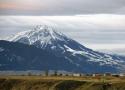
This little sequence had gone on for generations of bears and ant colonies, all led by a large black rock being tumbled slowly down the mountain, year after year, one platter-sized indentation after another. And the ants followed.
Even after all the Springs since that mountainside hike, it's hard to grasp the scale of synchronized evolutionary order that controls the natural world surrounding us. If I still lived in an urban area, I could have the impression that humans are running this show.
That personal awakening to an immense surrounding universe on this earth and so very far beyond actually began a long time ago. I believe that was when I walked out to the school bus and first noticed those tiny tracks in the snow, made so silently while I slept blissfully unaware in an old, warm house just a few yards away.
The lingering memory of that lone black rock on a Montana mountainside provides yet another in a lifelong series of inklings that have sketched a vague sense of and appreciation for the grand immutable design that is only partially accessible to our understanding when we stop and think about it a moment in the endless rush of modern life.
It makes me feel very small and humble.
Which, I've decided, is not a bad thing.

My words will perhaps seem somewhat vintage in character rather than current or up-to-date. In that context, I admit to being unapologetically Catholic, unapologetically patriotic, and unapologetically a constitutionalist.
[...]
Let me offer you, this year’s graduates, a few brief suggestions about making your deposits in the account of liberty. Today is just the end of the beginning of your young lives, and the beginning, the commencement of the rest of your lives. There is much more to come, and it will not be with the guiding hands of your parents—indeed, they may someday need your hand to guide them. Some of you will most assuredly be called upon to do very hard things to preserve liberty. All of you will be called upon to provide a firm foundation of citizenship by carrying out your obligations in the way so many preceding generations have done. You are to be the example to others that those generations have been to us. And in being that example, what you do will matter far more than what you say.

I'm writing this on May 15th, and that means it's time for the yearly round of hand-wringing over the so-called "Nakba."
Left-wingers and terrorist supporters across the globe will spend the day decrying the alleged "ethnic cleansing" of Arabs from "Palestine." As the Nakba narrative goes, evil "Zionist" Jews randomly marauded across the land in 1948, completely unprovoked. In their wake, they left a trail of death and destruction, violently expelling "Palestinians" from "their lands." //
what is the truth of the supposed Nakba, which means "disaster" in Arabic? Putting aside the absurd contention that the Jews, who were woefully outnumbered in 1948, somehow physically carried out an "ethnic cleansing," we need to start with how the Israeli War of Independence began. //
Why were they attacking Jewish cities and settlements on the Israeli side of the partition, which at the time was a small fraction of the former British mandate, with the Arabs being given almost all of the land, including all of modern-day Jordan? The simple answer is that having previously allied with Adolf Hitler during World War II, they were trying to prevent the creation of a Jewish state for very obvious reasons.
On that note, did the Jews just randomly show up after World War II to claim land given to them by the UN? Certainly, some Holocaust survivors did make their way to what would become Israel, but much of the original Israeli state was composed of land that was legally bought in the early 1900s. For example, Tel Aviv was developed on land that was deemed largely useless at the time. In other words, the Jewish state was set to be formed on a small sliver of land deemed to be of no real value to the Arabs.
That plan was never allowed to come to fruition, though, because the Palestinians and their Arab allies (Lebanon, Syria, Iraq, Egypt, and Saudi Arabia) attacked on May 15th, 1948, the day after Israel declared its independence. Their express intent? To drive the Jewish state into the sea, murdering as many Jews along the way as possible. That's where the genocidal chant "from the river to the sea" originates.
So why did so many Palestinians leave in what is now called the "Nakba?" The answer is that the Grand Mufti, the Palestinian leader in exile who had allied with Hitler, ordered them to. At the time, it was thought that an Arab victory was imminent given how outnumbered and outgunned the Israelis were. Palestinians voluntarily left in droves with the expectation that they'd be able to return after a glorious victory.
Further, the Israelis told the Palestinians that they could remain in their homes if they laid down their arms. The Grand Mufti rejected that offer and ordered the war to move forward. //
The expectation at the time was that the Palestinians displaced due to the war they lost would be absorbed into the neighboring Arab states, including the Palestinian-majority state of Jordan. At the same time, Israel was left taking in nearly a million Jews who had been expelled from Muslim nations. That never gets talked about, though, because it doesn't fit the Nakba narrative. //
The fact that "Nakba Day" is on May 15th, the day the Arab alliance declared war on Israel gives the game away. They aren't upset about a supposed "ethnic cleansing" that occurred the day after Israeli independence. They are upset that they got their clocks cleaned and lost territory in the process. Perpetual victimhood omitting their self-destructive actions is the Palestinian way. That's the truth of the Nakba narrative.

He that runs away from his master is a fugitive. But the law is every man’s master. He therefore that forsakes the law, is a fugitive. So is he, whosoever he be, that is either sorry, angry, or afraid, or for anything that either hath been, is, or shall be by his appointment, who is the Lord and Governor of the universe.
The key takeaway from this? “…the law is every man’s master.” But today, the law is not every man’s master; too many people (like, say, Hunter Biden) get away with too much, with too many things, that common people never would. “…the law is every man’s master” is another way of saying “equal treatment under the law,” which is, as we have documented many times in these virtual pages, effectively dead in this country today.
“Our memory is dissipating. Hard drives only last five years, a webpage is forever changing and there’s no machine left that reads 15-year old floppy disks. Digital data is vulnerable. Yet entire libraries are shredded and lost to budget cuts, because we assume everything can be found online. But is that really true? For the first time in history, we have the technological means to save our entire past, yet it seems to be going up in smoke. Will we suffer from collective amnesia?”
The Lunar Orbiter Image Recovery Project is featured starting at 17:15. This segment was filmed in early 2014.
Vigilant migration of data as new storage techniques become available is the only way to assure long-term preservation. Even if the IRIG tapes are found, we are almost at the point where the tapes would be un-decipherable. I think one of my machines could play them (I say think as I’ve never tested it to full 500 kHz bandwidth), but I don’t have the specialized video decoder. NASA apparently preserved some equipment should the tapes ever show up.
This also raises another spectre. We MUST be selective as to what we keep in our archives because if we keep everything we won’t be able to afford it–or find it. This is one of the key jobs that archivists do. However, blindly following retention practices, as was done by NASA for the IRIG Apollo 11 tapes, needs to be tempered by historians as well. Certain small subsets of data (moonwalk slow scan video) are much more important than others (astronauts’ blood pressure and other biometrics throughout the entire flight).
All organizations who keep archives need to address this. In a generation (or less) if we save everything, it will become an overwhelming burden and the high points will be lost if they are not properly indexed.

I'll start our D-Day Memorial Broadcast around 5:00 pm EDT on the evening of June 5th and it'll run through June 7th.
Since Eastern Daylight Savings Time is the same as Eastern War Time, the NBC D-Day Broadcasts will begin at roughly the correct time of 2:45 am on June 6th.

Carlson and Rogan didn’t moralize over Hamburg, Dresden, or Tokyo. Instead, they bobbed their heads and lamented the use of a particular type of weapon, not the death toll or civilians roasting alive from firebombs.
Even with that horror, Japan was not moved to surrender after Tokyo was set on fire 17 months before Hiroshima and Nagasaki. Japan didn’t surrender after a half million of her civilians had died from conventional bombs. Japan only surrendered when Truman bluffed and assured Japan that her cities would be leveled with more atomic bombs.
When Truman ordered Fat Man and Little Boy to drop on Japanese cities, he saved countless lives, both civilians and combatants. When Emperor Hirohito ordered his country to stand down, he saved countless lives – both civilian and combatants. Both decisions saved the lives of Marines like my father. Men who came back to build lives and raise families. The deaths of civilians at Hiroshima and Nagasaki were regrettable, but the lives of Americans and Japanese were spared because of it. That act was “good” in that the resulting surrender and peace clearly were. //
AdeleInTexas
7 hours ago
Great piece, heartfelt and factual. Carlson's claim that ending the war in Japan by use of the atomic bombs was prima facie evil is prima facie stupidity. //
. I asked him what he thought about the use of the atomic bombs and he was all for it. He just wished they had them sooner.

The fellow in the photo above looks like a distinguished figure -- a bank president, perhaps, or a judge, a governor, maybe a college professor. He is a figure of great dignity and gravitas, indeed.
Well, he was a college professor and a governor (of Maine), in fact, but that’s the least of his story. The old fellow here is Brevet Major General Lawrence Joshua Chamberlain, hero of Gettysburg, one of America’s premier military heroes, a man who may have single-handedly saved the Union on a fateful day in 1863.