Just One Vote
An Election Challenge
Author
Paul Harvey
One voter in each precinct of the United States will determine the next president of the United States. One vote. Thats a big weapon you have there, Mister. In 1948, just one additional vote in each precinct would have elected Dewey. In 1960, one vote in each precinct in Illinois would have elected Nixon. One vote.
One morning in 1844, a grain miller from DeKalb County, Indiana, was walking toward his mill. It was Election Day, but he had work to do and did not intend to vote. Before he reached the mill, however, he was stopped by friends who persuaded him to go to the polls. As it happened, the candidate for whom he voted won a seat in the state legislature"by a margin of one vote.
Now, when the Indiana Legislature convened, the man elected from DeKalb cast the deciding vote that sent Edward Allen Hennegan to the United States Senate. Then, in the Senate, when the question of statehood for Texas came up, there was a tie vote. But who do you suppose was presiding as president pro tempore? Hennegan. He cast the deciding vote from the chair. So, Texas was admitted to the union because a miller in DeKalb County, Indiana, went 10 minutes out of his way to cast...one vote.
More? Thomas Jefferson was elected president by one vote in the Electoral College. So was John Quincy Adams. One vote gave statehood to California, Idaho, Oregon, Texas and Washington. The Draft Act of World War II passed the House by one vote.
Over 200 million Americans are eligible to vote this year. Less than half will. Plato said it: The penalty good men pay for indifference to public affairs is to be ruled by evil men. So your vote is important. Historically, you use it...or you lose it. If you're not sure for whom you should vote, turn to a newspaper you can trust. Because everything we've won in 10 wars at the point of a gun can be taken away one vote at a time. Edmund Burke said it another way: All that is necessary for the forces of evil to win in this world is for enough good men to do nothing.


video
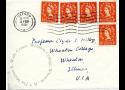
Clyde S. Kilby joined the faculty of Wheaton College in 1935 at the age of 33 as an assistant professor of English and dean of men.
In 1943 Kilby read a new book published by C. S. Lewis, entitled The Case for Christianity, which changed the course of his life. It was based on two series of broadcast talks Lewis had given for the BBC and was later published as the first two sections of Mere Christianity. “I . . . read it right through feeling almost from the first sentence that something profound had touched my mind and heart.” It was like discovering “something bottomless,” and he was captivated by “the depth and freshness of his observations and the permanency of his expression.”

William Burr and Leopoldo Nuti examine the Kennedy Administration's efforts to remove Jupiter missiles from Turkey and Italy, part of a secret deal with Nikita Khrushchev to end the Cuban missile crisis. //
Jupiter Intermediate Range Ballistic Missile (IRBM) at Cigli air base in Turkey, 1963. There a squadron of 15 Jupiters was deployed becoming operational in March 1962. //
Kissinger’s finding that “almost everyone” among senior Italian government officials suspected a US-Soviet “agreement” on the Jupiters was not the only time such suspicions surfaced. In the days and weeks after the crisis began to dissipate, mid-level State Department officials discussed rumors that President Kennedy had favored a deal and had a “keen interest” in getting the Jupiters out. In the months after the crisis, McNamara and Rusk tried to batten down suspicions of a deal, testifying before Congress that there had been no such thing. But doubts persisted. Senator John Stennis (D-Ms), among other Senators, was convinced there had been a trade.[v]
It was essential for the Kennedy administration to implement the secret deal and make good on a commitment to the Soviet leadership, but executing it had its complexities. While Khrushchev focused mainly on the Jupiters in Turkey, withdrawing the IRBMs from Italy was also a US goal. Under a coherent policy, the US could not leave Jupiters anywhere on NATO territory, although this made the diplomacy more complicated. And the withdrawal of the Jupiters could not be completely secret, because it had to be carefully and delicately coordinated with Italy and Turkey, whose governments had signed agreements accepting the missiles. Both were NATO allies, and Washington could not ride roughshod over them.
To minimize suspicions of a US-Soviet deal, the reasoning for the Jupiter withdrawals would be carefully explained to Italian, Turkish, and other NATO interlocuters.
Washington, D.C., October 30, 2019 – The current crisis with Turkey over Syria has raised questions, yet to be resolved, about the security of 50 U.S. nuclear weapons stored at Incirlik Air Base. These questions have been posed before, going back almost to the start of nuclear deployments in Turkey in 1959. How the United States responds carries implications for the region, for U.S.-Turkey relations, and for NATO. //
Members of Congress Worried in 1960 That Leaders of a Coup “Might Seize Control” of Weapons
Other U.S. Officials Feared Risks of Accidental War or Overreaction to Local Crises
During Mid-1960s Turkish Officials Were Interested in Producing an “Atomic Bomb” //
Document 13
Memorandum of Conversation, 14 December 1962, Top Secret
Dec 14, 1962
Source
RG 59, Records of the Deputy Assistant Secretary for Politico-Military Affairs, Subject Files, 1961-1963. Box 2. Memoranda (5 of 5)
The Jupiter missile deployments in Turkey (and to some degree Italy) were central to the Cuban Missile Crisis, both to instigating it–Soviet Premier Nikita Khrushchev’ saw them as a “bone” in his throat–and to the secret Kennedy-Khrushchev agreement that resolved the crisis. While President Kennedy provided secret assurances to Khrushchev that the U.S. would remove the Jupiters, only a handful of people knew about the secret deal, and the NATO countries, included Turkey, learned nothing of it at the time.
Speaking with Turkish Defense Minister Ilhami Sancar, McNamara misled him by saying that the U.S. had refused to discuss with the Soviets the “comparability” of the Jupiters with the missiles in Cuba. He further argued that the U.S. was doing Turkey a favor by removing the dangerous and obsolete weapons and replacing them with Polaris missiles that would be deployed in the Mediterranean.

As John Dickinson later noted, “the insanity of Parliament has operated like inspiration in America. The Colonists now know what is designed against them.”
And suddenly, the phrase “the common cause” began appearing in pamphlets up and down the East Coast. The “common cause” was a call to all colonists to stand with their oppressed brethren in Boston against tyrannical overreach by the government.
To be clear, the Southern colonies had little in common with their Northern counterparts. For example, their economies were vastly different and dependent on different goods. Georgians could have ignored the plight of their fellow colonists in Massachusetts, but they knew should the same fate befall them, they too would have to face it alone. And so, the colonists moved forward under a united front.
“The die is now cast, the [American] colonies must now either submit or triumph,” King George III infamously said in Sept. 1774.
Colonists owed no obedience to unjust laws. There would be no such submission. They would take death or liberty.
Their sacrifices, willpower, and commitment to the “common cause” is why we celebrate the Fourth of July, Independence Day.
But it is a lack of that “common cause” that has put us in the position we are in today. Government has become too big, and Americans are — just as our forefathers — treated as piggy banks for bureaucrats who spend uncontrollably to finance their partisan agenda. There can be no better tomorrow under these circumstances, but who would know? We’re all too busy endlessly scrolling on social media to realize what’s happening around us. We’re willingly distracted.
America is in need of a “common cause” now more than ever. Too much is at stake.
The Second Continental Congress met inside Independence Hall beginning in May 1775. It was just a month after shots had been fired at Lexington and Concord in Massachusetts, and the Congress was preparing for war. They established a Continental army and elected George Washington as Commander-in-Chief, but the delegates also drafted the Olive Branch Petition and sent it to King George III in hopes of reaching a peaceful resolution. The king refused to hear the petition and declared the American colonies in revolt.
On June 7, 1776, Virginia delegate Richard Henry Lee put forth the resolution for independence: “Resolved, that these united colonies are, and of right ought to be, free and independent states…” Voting was postponed while some of the delegates worked to convince others to support independence, but a committee of five men was assigned to draft a document of independence: John Adams (MA), Benjamin Franklin (PA), Thomas Jefferson (VA), Roger Sherman (CT), and Robert R. Livingston (NY). Jefferson did most of the work, drafting the document in his lodgings at 7th and Market Street.
On July 2, 1776, the Second Continental Congress voted to adopt Lee’s resolution for independence. This is the day that John Adams thought should be celebrated with “Pomp and Parade, with Shews, Games, Sports, Guns, Bells, Bonfires and Illuminations from one End of this Continent to the other from this Time forward forever more.” (John Adams to Abigail Adams, July 3, 1776)
Between July 2 and July 4, Congress argued over every word in Jefferson’s draft of the declaration, making numerous changes. On July 4, Congress voted again – this time to approve the wording of the Declaration of Independence. They didn’t actually sign the document that day. After New York’s delegates received instructions from home to vote for independence (they had initially abstained), the document was sent to Timothy Matlack to be engrossed (handwritten). Fifty of the 56 men signed the engrossed Declaration of Independence inside Independence Hall on August 2, 1776.
On June 7, 1776, Richard Henry Lee introduced a resolution “that these united colonies are and of right ought to be free and independent states.” They appointed a Committee of Five to write an announcement explaining the reasons for independence. Thomas Jefferson, who chaired the committee and had established himself as a bold and talented political writer, wrote the first draft.
On June 11, 1776, Jefferson holed up in his Philadelphia boarding house and began to write. He borrowed freely from existing documents like the Virginia Declaration of Rights and incorporated accepted ideals of the Enlightenment. Jefferson later explained that “he was not striving for originality of principal or sentiment.” Instead, he hoped his words served as an “expression of the American mind.” Less than three weeks after he’d begun, he presented his draft to Congress. He was not pleased when Congress “mangled” his composition by cutting and changing much of his carefully chosen wording. He was especially sorry they removed the part blaming King George III for the slave trade, although he knew the time wasn’t right to deal with the issue.
On July 2, 1776, Congress voted to declare independence. Two days later, it ratified the text of the Declaration. John Dunlap, official printer to Congress, worked through the night to set the Declaration in type and print approximately 200 copies. These copies, known as the Dunlap Broadsides, were sent to various committees, assemblies, and commanders of the Continental troops. The Dunlap Broadsides weren’t signed, but John Hancock’s name appears in large type at the bottom. One copy crossed the Atlantic, reaching King George III months later. The official British response scolded the “misguided Americans” and “their extravagant and inadmissable Claim of Independency”.
In Congress, July 4, 1776
The unanimous Declaration of the thirteen united States of America, When in the Course of human events, it becomes necessary for one people to dissolve the political bands which have connected them with another, and to assume among the powers of the earth, the separate and equal station to which the Laws of Nature and of Nature's God entitle them, a decent respect to the opinions of mankind requires that they should declare the causes which impel them to the separation.
We hold these truths to be self-evident, that all men are created equal, that they are endowed by their Creator with certain unalienable Rights, that among these are Life, Liberty and the pursuit of Happiness.--That to secure these rights, Governments are instituted among Men, deriving their just powers from the consent of the governed, --That whenever any Form of Government becomes destructive of these ends, it is the Right of the People to alter or to abolish it, and to institute new Government, laying its foundation on such principles and organizing its powers in such form, as to them shall seem most likely to effect their Safety and Happiness.

This Fourth of July, Americans should take the opportunity to reeducate themselves on the fundamental principles of our Constitution. //
Our government was formed by an alliance of some of the most brilliant political thinkers in history, who, for some providential reason, all happened to live in the same generation and the same nation. It’s our failure to remember and understand their wisdom — rather than some defect in the timeless truths they espoused — that explains much of the struggles of our contemporary age. Familiarizing ourselves with our Constitution and its most illustrious interpreters in The Federalist Papers will do much to restore our political sanity. This Independence Day, you have your homework.
Christos T. • June 27, 2024 12:44 AM
@sqall:
In 1947 the US occupation authorities retrieved the files of the German Army’s codebreaking agency, called Inspectorate 7/VI. These had been buried at the end of the war in a camp in Austria.
The list of the documents that were retrieved is available from NARA as TICOM report IF-272 Tab ‘D’:
https://catalog.archives.gov/id/2811501
In page 12 of that report, it says: ‘Technische Erlaeuterung zur maschinellen Bearbeitung von AM 1 Kompromisstextloesungen auf der Texttiefe’.
The translation of that report is TICOM DF-114 ‘GERMAN CRYPTANALYTIC DEVICE FOR SOLUTION OF M-209 TRAFFIC’ and was released by the NSA to NARA in 2011 and copied and uploaded by me to Scribd and Google drive in 2012.
You can find it at NARA: https://catalog.archives.gov/id/23889821
Operation RUBICON THESAURUS
The secret purchase of Crypto AG by BND and CIA
THESAURUS 1 (later: RUBICON), was a secret operation of the German Bundesnachrichtendienst (BND) and the US Central Intelligence Agency (CIA), to purchase the Swiss crypto manufacturer Crypto AG (Hagelin) — codenamed MINERVA — in order to control the company, its algorithms and – indirectly – its customers. From 12 June 1970 2 onwards, Crypto AG was jointly owned by CIA and BND, each with 50% of the shares, and from 30 June 1994 exclusively by the CIA [1]. //
Discover how CIA and BND turned Crypto AG from a simple denial operation into an active measures operation. Learn which roles were played by the Deutsche Treuhand Gesellschaft (KPMG), a Liechtenstein law firm, Siemens, Motorola, NSA and Swedish intelligence. The following story is about — in the words of the CIA — The Intelligence Coup of the Century.

The headquarters of the former Crypto AG in Steinhausen (ZG) produced cipher machines for decades. The German foreign intelligence service BND and the US CIA secretly bought the company in 1970. They caused many states to be supplied with machines with weaker encryption that could be decrypted by the BND and CIA. The successor company Crypto International AG was most recently based there. The Swiss company was at the center of a suspected espionage affair. In the summer of 2020, the company was closed due to a federal export ban. Since then, the company premises have been abandoned, but the last traces are still visible, and in a few years the factory and administration building, built in 1966, is to be demolished; around 200 apartments are planned on the site. With my photo report in spring 2021, I documented the abandoned building and area before it disappeared.
In 2020 however, the German TV station ZDF revealed that since 1970, the company was jointly owned by the German BND and the American CIA, and since 1994 exclusively by the CIA [28]. It means that for many years, Western intelligence services were able to manipulate the algorithms of Crypto AG's products and read the communications of many of its customers. Although the company also sold unreadable 1 equipment, the list of countries that had access to such secure technology became shorter every year. According to the NSA, all encryption should be readable.
➤ For further details on this topic, please refer to our follow-up story Operation RUBICON.
- In this context, readable means that the cryptographic algorithms could be broken by the NSA. Also known as friendly. In contrast: algorithms that are not breakable by NSA, are called unfriendly or unreadable.
SIGABA was an electromechanical rotor-based cipher machine developed in the late 1930s in the United States (US) as a joint effort of the US Army and US Navy [1]. At the time it was considered a superior cipher machine, intended to keep high-level communications absolutely secure. It was used throughout WWII and was so reliable that it was used well into the 1950s, after which it was replaced by newer machines like AFSAM-7 (KL-7). As far as we know, SIGABA was never broken.

Remember marveling at the fortitude of the two guys depicted in the 1996 film "The Ghost and The Darkness?" Bell did the same thing. Only instead of two lions, he killed a mess of them (the exact number is not known, but was reported to have been in the high double digits). He did this alone. With a single-shot rifle. In a caliber normally considered good for deer. At age 16.
Eventually, the task of hunting down slavering 500-pound apex predators with a taste for human flesh got too boring for the young Bell, so he determined to go halfway around the planet to join the gold seekers in the Klondike Gold Rush. But it turns out that gold-seeking was about the only thing that the young Bell couldn’t get the hang of, so after enlisting a partner to equip him, he went back to what he did best: Killing things, in this case spending the winter of 1897-98 shooting deer and moose to keep the denizens of Dawson City eating. //
After [WW2], Bell went back to Africa only briefly; just long enough to knock out a 3000-mile canoe trip through the Gold Coast and Liberia. He then retired to Corriemoillie, his 1,000-acre highland estate at Garve in Ross-shire, Scotland.
The Turing-Welchman Bombe was an electro-mechanical device used at Bletchley Park and its outstations during World War II to assist in breaking the Enigma cipher used by the German military.
Based on ideas from a device known as a bomba, designed in Poland by Marian Rejewski as early as 1939, the Turing-Welchman Bombe enabled Bletchley Park to find the daily keys of the Engima machine on a regular basis throughout most of the war.
The British Bombe was designed by Alan Turing with important additions by Gordon Welchman. They were built by the British Tabulating Machine Company in Letchworth, Hertfordshire.
Virtual Bombe is a 3d Turing-Welchman Bombe simulation which can run using just your browser. No install is necessary.
Enigma is the brand name of a series of cipher machines developed in Germany between 1923 and 1945.
A number of these machines were used during World War 2 by the German Army, Navy and Air Force, this website has simulations for both the three rotor Enigma I used by the Heer (Army) and Luftwaffe (Air Force) and the four rotor Enigma M4 used by the Kriegsmarine (German Navy).
The Enigma code was cracked and read initially by the Poles in 1932 with Bletchley Park continuing and expanding on this work where they regularly read the German encrypted messages throughout the war.
Virtual Enigma is a 3d Enigma simulation which can run using just your browser. No install is necessary. It was released on Alan Turing's 109th Birthday 23rd June 2021
Virtual Hagelin M-209
A 3D simulation of the Hagelin M-209 cipher machine
In cryptography, the M-209, designated CSP-1500 by the Navy (C-48 by the manufacturer) is a portable, mechanical cipher machine used by the US military primarily in World War II, though it remained in active use through the Korean War.
The M-209 was designed by Swedish cryptographer Boris Hagelin and manufactured by Smith & Corona in Syracuse (New York, USA). It was based on the C-38 which itself was an improvement of an earlier machine, the C-36.
M-209 was a light-weight portable pin-and-lug cipher machine, developed at the beginning of World War II by Boris Hagelin of AB Cryptoteknik in Stockholm (Sweden), and manufactured by Smith & Corona in Syracuse (New York, USA). The machine is designated CSP-1500 by the US Navy and is the US military variant of the C-38, which in turn is an improved version of the C-36 and C-37. A compatible motorised version – with keyboard – is known as BC-38 (later: BC-543). During WWII, the M-209 was known by German cryptanalysts as AM-1 (American Machine #1)). //
The cryptographic strength of the machine was reasonable for its time, but was not perfect. As of early 1943, it was assumed that German codebreakers were able to break an M-209 message in less than 4 hours. 1 Nevertheless, it was considered sufficiently secure for tactical messages which, due to their nature, would be meaningless after several hours. This is why the M-209 was later also used in the Korean War. The M-209 was succeeded in 1952 by the C-52 and CX-52. //
According to them, the effort to break it was impractically high.
It proved however, that American cryptologist William Friedman, had been right all along. He liked the Hagelin machines and had found them to be theoretically unbreakable, but knew that they could be setup in such a way that they became weak and vulnerable to cryptanalytic attacks [8]. British and American codebreakers were able to read the Hagelins from both enemies and allies.
After the war it became clear that the Germans were able to read 10% of the American Hagelin traffic: 6% from cryptanalysis, and 4% from captured keys. But due to the amount of work involved in breaking, the delay between intercept and decrypt was usually 7 to 10 days; too long to be usefull for tactical messages like the ones sent by the US Army. Apparently, the Japanese also understood many of the principles of Hagelin exploitation, but hardly broke Hagelin traffic [8].
For high-level messages, the Americans used a rotor machine — SIGABA — which was similar to Enigma, but much much more advanced. As far as we know, SIGABA was never compromised.
Cold War
Immediately after WWII, in 1947, the NSA started the development of a cryptanalytic machine named WARLOCK I — also known as AFSAF-D79 and CXNK — that was able to solve the Hagelin C-38/M-209 much faster than with hand methods. The machine became operational in 1951 and was used to read the traffic from many countries that were using M-209 or C-38 machines. The US had 'accidentally' released large batches of M-209 machines on the surplus market for as little as US$ 15 and even US$ 2 [8]. Many of these were purchased by South American countries.