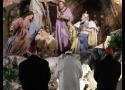
Luke does not say Mary and Joseph were turned away. He says the guest room was already full. //
So when Luke tells us that the child was laid in a manger, he is likely not moving the story into a detached stable. He is describing a practical detail within a lived-in household. The scene remains humble, but it is no longer marginal. It is domestic, crowded, and human. //
Seen this way, Mary was not relegated to a stable because there was “no room.” She was placed where birth customarily happened, in a space set apart for dangerous, necessary, and sacred work, surrounded by competent women.
Once the household is understood as full, the courtyard as a customary birth space, and women as the necessary attendants, the setting of the Nativity no longer appears improvised. It appears normal. //
Nothing in Luke requires the manger to be symbolic in the moment. It is enough that it is specific. The sign given to the shepherds works because it is ordinary and recognizable.
Later Christians could not help noticing the resonance: the Lamb of God first laid where animals were fed and protected. Luke does not spell this out. The meaning emerges over time, once the whole story is known. //
The Nativity is populated almost entirely by liminal figures — people who live and work at boundaries.
Women attend the birth because childbirth itself is liminal, poised between life and death. Shepherds receive the announcement because they live between settled society and wilderness, handling blood, birth, injury, and loss as part of daily life. They are neither elites nor outsiders, but something in between, ritually ambiguous, socially peripheral, and practically indispensable.
The Magi arrive later, and for a different reason. They are not guardians of fragile life, but boundary-crossers between cultures and nations. They do not belong at a birth, but at a recognition.
The shepherds witness the child’s arrival into life; the Magi recognize his meaning for the world. One belongs at a birth. The other belongs at a throne.
This is not accidental staging. Liminal moments require liminal witnesses, people accustomed to ambiguity, risk, and transition. The story does not begin in palaces or temples because it is not about maintaining established power. It is about the arrival of someone who will cross boundaries without destroying them.
Jesus himself is the ultimate boundary figure: fully human and fully divine; clean, yet willing to touch the unclean; alive yet destined to pass through death. From the beginning, his life occupies contested space.
Christmas and the Restoration of Order
This pattern of thresholds and careful crossings is not an innovation introduced at Christmas. It is a restoration.
The opening chapters of Genesis describe a world ordered by distinction rather than domination. Creation unfolds through separations: light from darkness, land from sea, heaven from earth. These boundaries are not barriers. They are the conditions that make life possible. //
The Incarnation does not abandon the human order. It inhabits it fully, dangerously, and honestly. God enters the world where life has always entered it: through women, within households, surrounded by risk and love, attended by those who know how to guard what is fragile.
When Christmas is seen this way, nothing essential is lost but much is restored. The story becomes larger, more human, and more demanding, and in that fullness, more joyful than the thin version we repeat by rote.


The Three Bible Timelines: Why and How They Differ
February 25, 2013
Last updated on November 3rd, 2015 at 01:48 pm
The three most widely used Bible Timelines are:
-
Ussher’s Chronology: included in the margins of the Authorized King James Bible is based on the Masoretic text of the Hebrew Old Testament. The Masoretic text had an unbroken history of careful transcription for centuries.
-
Thiele: a modern Biblical chronologist whose work is accepted by secular Egyptologists as well as biblical scholars – often used by modern Evangelicals.
-
The Septuagint: on which the Catholic Bible is based, is the Koine Greek version of the Hebrew Bible translated between 300 BC and 1 BC.
Most people who try to compute a Bible timeline are faced with the same dilemmas. The Rvd. Professor James Barr, a Scottish Old Testament scholar, has identified three distinct periods that Ussher, and all biblical chronologists had to tackle:
-
Early times (Creation to Solomon). Anyone who starts out reading the Bible with Genesis, as many people do, can easily compute the years from Adam to Solomon.
-
Early Age of Kings (Solomon to the destruction of the Temple in Jerusalem and the Babylonian captivity). Now we have gaps in the record.
-
Late Age of Kings (Ezra and Nehemiah to the birth of Jesus). Here events are just mentioned with no possible way to link or calculate time frames. Historians use well known secular kings or events mentioned in the Bible (i.e., Nebuchadnezzar) to calculate the Bible dates.

Modern climate politics treats humanity like an invasive species.
We’re told we consume too much, build too much, develop too much, and emit too much. The message is clear: human beings are the problem, and the earth must be protected from us.
But that is not Christianity.
It’s not even close.
For 3,000 years, the Judeo-Christian worldview taught something radically different—that humans are image-bearers designed to create, cultivate, innovate, and build. The very first job description in Scripture is found in Genesis 1:28:
“Be fruitful and multiply; fill the earth and subdue it; and have dominion over every living thing.”
To modern ears, “subdue” and “dominion” sound imperial. To ancient readers, they meant responsibility, stewardship, cultivation, and development. The earth was not a fragile deity to tiptoe around; it was a raw, untamed gift meant to be worked, shaped, and stewarded for human flourishing.
And here’s where the climate debate goes off the rails.
If you believe Genesis, then energy is not a moral liability—it is the means by which humans fulfill their mandate. Energy is how you lift the poor, feed nations, sustain families, run hospitals, build infrastructure, and create the conditions for long-term stability and—ironically—environmental improvement.
Yet the climate movement has turned this mandate upside down. It demands sacrifice, limitation, and deprivation in the name of “saving the planet.” The message to the world’s poor is simple: stay poor a little longer so the West can feel environmentally virtuous. //
If you want to solve poverty, you don’t throttle energy. You expand it. You diversify it. You make it abundant and affordable. The cleanest nations on earth became clean because they became rich first. Wealth creates environmental capacity. Poverty destroys it.
The Christian view is simple: the earth was given to humanity to cultivate, not fear. The resources here are meant to be used responsibly, not locked away because climate bureaucrats believe modern prosperity is a moral sin.
The climate debate will never make sense until we recover the foundational truth Genesis established: human beings were meant to build. Meant to advance. Meant to subdue the earth—not as tyrants, but as stewards.
The earth is not a god to appease.
It is a garden to cultivate.
If you want the environment to thrive, let people thrive first.
For nearly two millennia, the Holy Bible has been translated, retranslated, and adapted into countless languages and versions. Each translation reflects not only linguistic scholarship but also the theological, cultural, and historical context of its time. From ancient Greek and Latin manuscripts to modern digital editions, the story of Bible translation is a fascinating journey through human civilization itself.
This comprehensive guide explores the most influential and widely-used Bible translations, examining their historical origins, translation philosophies, and lasting impact on Christian faith and scholarship.
We are only what we are in the dark; all the rest is reputation. What God looks at is what we are in the dark—the imaginations of our minds; the thoughts of our heart; the habits of our bodies; these are the things that mark us in God’s sight.
- The Love of God—The Ministry of the Unnoticed, 669 L
By whom the world is crucified unto me, and I unto the world. — Galatians 6:14
If I brood on the Cross of Christ, I do not become a subjective pietist, interested in my own whiteness; I become dominantly concentrated on Jesus Christ’s interests. Our Lord was not a recluse nor an ascetic, He did not cut Himself off from society, but He was inwardly disconnected all the time. He was not aloof, but He lived in an other world. He was so much in the ordinary world that the religious people of His day called Him a glutton and a winebibber. Our Lord never allowed anything to interfere with His consecration of spiritual energy.
The counterfeit of consecration is the conscious cutting off of things with the idea of storing spiritual power for use later on, but that is a hopeless mistake. The Spirit of God has spoiled the sin of a great many, yet there is no emancipation, no fullness in their lives. The kind of religious life we see abroad to-day is entirely different from the robust holiness of the life of Jesus Christ. “I pray not that Thou shouldest take them out of the world, but that Thou shouldest keep them from the evil.” We are to be in the world but not of it; to be disconnected fundamentally, not externally.
We must never allow anything to interfere with the consecration of our spiritual energy. Consecration is our part, sanctification is God’s part; and we have deliberately to determine to be interested only in that in which God is interested.
Civilization is based on principles which imply that the passing moment is permanent. The only permanent thing is God, and if I put anything else as permanent, I become atheistic. I must build only on God (John 14:6).
The Highest Good—Thy Great Redemption, 565 L
The Spiritual Workouts God Intends For Us Chris
Now, I’m not saying that using Bible tracts to evangelize is totally fruitless. I’m sure there are more cases than I know where one of these has led a person to the Savior. They do contain very vital information, present the Gospel in a concise manner and they offer an easy way to share the Good News. The problem is, in most cases, people are just not interested.
They look at the cover, see it’s something that looks “religious,” and without giving it a second thought, toss it away. Some do this because they think they already know who God is, what “Christianity” is all about and believe they’re “good” with God…but they have no interest in pursuing what they perceive as “religion” or learning anything more than they think they already know.
People also have extremely short attention spans, and Bible tracts often contain a lot of information in very small type font, packed into a very small booklet. And while these same people will spend countless hours scrolling through nonsense on social media, all those words in tiny print look intimidating. People know they’d have to take time to read that “fine print,” and they’re just not interested…any more than they’re interested in political fliers or other junk mail that comes in their mailbox. //
So how do we reach the lost? The most effective way, obviously, is having a deep, meaningful one-on-one conversation with someone who’s not only willing to listen, but also engage in discussion, ask questions, be open about what you’re sharing and then, by God’s grace, develop a craving for the truth and the many revelations His Book contains…we want them to want to study God’s Word for themselves.
But situations and opportunities like this are rare. If ever you’re blessed to have such an divine appointment, don’t waste it. “…and be ready always to give an answer to every man that asketh you a reason of the hope that is in you…”
Still, the printed word holds great power. When presented in an appealing way, the printed word can literally change hearts, minds and lives. Unlike digital things that are constantly changing; here today and gone tomorrow, the printed word is printed, tangible and not going away.
The atmosphere of our church service was pregnant with expectation: four candles of the Advent wreath and the colored lights from the tree and wreaths lit the darkened room. My wife and I were among the tens of millions gathered on Christmas Eve to rehearse the Nativity story again. As one of the readers read aloud Luke 2:5, I was struck by the New International Version (NIV) translation: “Mary, who was pledged to be married to him and was expecting a child.” Chronologically, the narrative had advanced some eight months from Luke 1:26-27, where it stated that Gabriel was sent to a virgin named Mary “pledged to be married to a man named Joseph.” The Greek verb mnēsteuō was translated identically in both verses.
The translation suggested to me that an unmarried Jewish couple was traveling a long distance unaccompanied by other family members. And the woman—still only pledged in marriage—was in an advanced state of pregnancy. If such a situation is still scandalous in the Middle East, how much more in first-century Judea!1 //
Returning to Joseph, he would have paid the bride price to Mary’s father at their engagement (Matthew 1:20; Luke 1:27). Despite his misgivings, Joseph then obeyed the angel’s command to marry Mary (Matthew 1:20). The time of formal engagement, whether a full year or not, had passed between them. So Joseph and Mary had begun to live together except for sexual relations (Matthew 1:25). Luke’s understanding of mnēsteuō must be expanded to include both the betrothal/engagement as well as marital cohabitation. Therefore a better translation of Luke 2:5 would be: “Mary his wife who was expecting a child.” (The NKJV attempts a hybrid with “betrothed wife.”) English translations that suggest the couple was still only in the engagement stage of fiancé/fiancée must be discarded. Joseph and Mary traveled to Bethlehem as a full husband and wife under ancient Jewish law.
I remember one day resolving to do arduous work in 2 Chronicles. Studiously plowing through the reigns of Solomon through Jehoshaphat, I came to 2 Chronicles 21:20 and laughed outright. The text reads, “Jehoram was thirty-two years old when he became king, and he reigned in Jerusalem eight years. He passed away, to no one’s regret, and was buried in the City of David, but not in the tombs of the kings” (italics added). Being a wordsmith myself, I smiled at this bygone scribe relieved at this monarch’s death. Evidently Jehoram was not well liked. The editorial statement provides a light touch—comic relief, if you will—to the Chronicler’s usually routine kingship formula.
As I study and teach, I find I read the Bible ever more slowly, and as I do, I smile more and more frequently. I listen for its humor. My emotions span sorrow, understanding or joy as I empathize with the characters who cross its pages. I chuckle at many passages, even while acknowledging the sadness they may contain. Consequently, I believe it’s possible to read many verses, stories and even books through the lens of humor, indeed to see portions of the Bible as intended to be very funny. An appropriate response is laughter. I’ve come to this conclusion: Humor is a fundamental sub-theme in both testaments.
The ScriptureEarth.org website is managed by SIL Global. SIL’s service with ethnolinguistic minority communities is motivated by the belief that all people are created in the image of God, and that languages and cultures are part of the richness of God's creation.
The purpose of this site is to provide access to Scripture products for the languages of the world. Individual copyright and licensing information is indicated on each product by its contributing organization.
Christopher Rollston examines the Qeiyafa Ostracon, Gezer Calendar and other candidates for the oldest known Hebrew inscription
Using letter order in the ancient Hebrew alphabet for clues

According to the New Testament, the resurrection of Jesus Christ from the dead is a dividing line in human history. As such, it cannot but have implications for the Sabbath.
The Gospels are united in reporting that Jesus rose from the dead on the first day of the week. //
In addition to this, Jesus appears to his disciples on the first day of the week several times. //
In summary, when the disciples were gathered together on “the evening of that day, the first day of the week” (John 20:19), Jesus blesses that gathering with his presence and with the pronouncement of the peace that he has secured by his death and resurrection and that they enjoy through faith in him. Furthermore, he commissions them to proclaim Christ as Savior to the nations in the power of the Spirit. Thus, the presence of Christ with his people and the proclamation of the gospel to gather sinners and to edify the people of God are marks or traits of this “first day of the week.” //
Overall, understanding what the resurrection is and means for human history helps us to understand its implications for the Sabbath. The Sabbath, we have seen, is a creation ordinance. God instituted it at the creation so that human beings might remember God’s creation of the world in six days. By setting the Sabbath on the seventh day, God was showing humanity his goal for human existence—the worship of him who made all things. Later, in Deuteronomy, the Sabbath comes to take on added significance as God tells Israel that it is a day to remember how he redeemed them from bondage in Egypt.
Connected to both of these purposes, the resurrection is equally the dawn of the new creation in human history and part of the unique, once-for-all work of Christ to save sinners from among the nations.
Lawrence W. Reed
Christian charity, being voluntary and heartfelt, is utterly distinct from the compulsory, impersonal mandates of the state. //
With the reputation of central planners in the dumpster worldwide, socialists have largely moved on to a different emphasis: the welfare state. The socialism of Bernie Sanders and his young ally Alexandria Ocasio-Cortez is that of the benevolent, egalitarian nanny state where rich Peter is robbed to pay poor Paul. It’s characterized by lots of “free stuff” from the government—which of course isn’t free at all. It’s quite expensive both in terms of the bureaucratic brokerage fees and the demoralizing dependency it produces among its beneficiaries. Is this what Jesus had in mind?
Christianity is not about passing the buck to the government when it comes to relieving the plight of the poor.
Charlie Kirk - Are You A Christian
The miracles in the New Testament were not recorded by imbeciles, and thousands witnessed them. You are welcome to deny all of the New Testament as mythology, but you are not free to make up nonsensical pseudo-scientific explanations for phenomena when you've obviously never read the document you're critiquing and expect not to be mocked. //
Quiverfull
4 hours ago
Putting the theological arguments aside (which I/you could write books about), if you fed a bunch of fish that had died in that fashion to folks in Galilee, it would've been recorded in secular history as a mass die-off of people!
streiff Quiverfull
3 hours ago
exactly and the locals would've balked at eating dead fish floating in the surface because they would've assumed they were sick or poisoned.
Building on the case for the intelligent design of life that he developed in Signature in the Cell and Darwin’s Doubt, Meyer demonstrates how discoveries in cosmology and physics coupled with those in biology help to establish the identity of the designing intelligence behind life and the universe.
Meyer argues that theism — with its affirmation of a transcendent, intelligent and active creator — best explains the evidence we have concerning biological and cosmological origins. Previously Meyer refrained from attempting to answer questions about “who” might have designed life. Now he provides an evidence-based answer to perhaps the ultimate mystery of the universe. In so doing, he reveals a stunning conclusion: the data support not just the existence of an intelligent designer of some kind — but the existence of a personal God.