
Please take a moment to read my pastor’s essay.



By Hugh Ross
Published: February 5, 2023
Nearly 25 years ago, I wrote in a former RTB publication that “Big bang cosmology is an explosive topic.”1 It has led to heated reactions over the years from groups opposed to one another. However, the reasons for expressed rejection of big bang cosmology are not scientific. They are religious. Thus, it seems that establishing a biblical basis for the big bang may help turn down the heat.

Josh Howerton @howertonjosh
·
OK, here's my thesis: "Project Hail Mary," starring @RyanGosling, is actually a CHRISTIAN movie.
Now, all of this could theoretically be a coincidence, but let me make my case 👇
6:01 PM · Jul 27, 2026
https://x.com/howertonjosh/status/2081877719864762708
The main character, Ryland Grace, is sent into certain death to save everyone else. His alien cohort, named Rocky, is the rock by which Grace builds his entire rescue. His entire adventure is kicked off by a woman named Eva. The long shot of a project is called "Hail Mary," which is something the Catholics will adore.
But once you put it all together, that grace saved a decaying universe after Eve's actions began the whole thing, and that Christ built his church upon the "rock" that was Peter, and what's more, Christ made himself a sacrifice to accomplish that end.
Obviously, the film is not a one-to-one beat of Christ's journey, but if the theories are correct, then the point wasn't to mirror His story, but to borrow heavily from it. //
What was produced is so Christian, not just in name, but in feel, that I honestly think that any creators in the Christian space should take notes.
This is how you do it. Jesus told parables that got His point across. Christians should do the same. You don't need to be on the nose about it. I would even say I would avoid making Christian content that would meet the approval of the front row of the church.
Just tell a human story and put God over it. You don't have to reference Him. Tolkien surely didn't, but you could feel the influence of God in the story. The traits and virtues He wants you to have pushed forward. Clear lines of good and evil. Hope in the face of hopelessness. Action taken, even if the chances are slim. Faith that it'll work out right, even if you can't figure out how. //
The ship "Hail Mary" was full of "grace" (Doctor Grace).

The Odyssey—the original poetry and the modern film—is not really about adventure, although it has an abundance of it. It’s also not primarily about virtues in some abstract way, whether the kill-your-enemies or love-your-enemies type. The Odyssey is about home. Odysseus wants to return to his place but comes to see that his obstacle is not merely geographical. He must become a different kind of person, the kind of man who can receive home as gift rather than as trophy. And at almost every step of the path, those who imaginatively walk with him can feel the ache.
Some of us are pulled toward nostalgia, looking to something better in the past. And some of us are pulled toward discontentment, looking to something better in the future. Regardless of where we turn, we all recognize something is missing. And all kinds of people—politicians, marketers, tech lords—are there to say, “You want to get home, and I can get you there.”
But it never works.
That’s because homesickness points in contradictory directions all at once. //
The ancient problem says “I can’t get home.” The modern problem says “I got home—it isn’t home.” One longs for return, and one longs for escape. These are not two problems but one. No matter which way we turn, we don’t know what home is. That’s why Homer still rings true, even in the era of IMAX and SpaceX.
And that’s what makes the Christian story stranger than the pagan ones. Odysseus spends 20 years trying to get back to Ithaca. Jesus has spent 2,000 years (so far) telling us to stop mistaking Ithaca for Eden.
The Bible is full of odysseys: Abraham leaves Ur. The Israelites leave Egypt. The apostles set out to “the ends of the earth” (Acts 13:47). When describing examples of faith, the Book of Hebrews says none of them “received the things promised” (11:13, ESV throughout).
These pilgrimages were not about answering the longing for home with a return to something past. We want a place prepared for us, a place to belong, a place to be known, a place to be loved. But our longing for that can sometimes leave us nostalgic for the wrong thing. The Israelites hungered in the wilderness. They responded to that with nostalgia for slavery: “We remember the fish we ate in Egypt that cost nothing, the cucumbers, the melons, the leeks, the onions, and the garlic” (Num. 11:5).
The longing wasn’t wrong. As a matter of fact, God said the hunger was necessary. The emptiness was in order that “he might make you know that man does not live by bread alone, but man lives by every word that comes from the mouth of the Lord” (Deut. 8:3). As C. S. Lewis reminded us, “Creatures are not born with desires unless satisfaction for those desires exists. A baby feels hunger: well, there is such a thing as food. A duckling wants to swim: well, there is such a thing as water.”
All of that should lead us to ponder: “If I find in myself a desire which no experience in this world can satisfy, the most probable explanation is that I was made for another world.” Identifying the ache is not the end, but it’s a start.
The Odyssey, Homer’s and Nolan’s, assumes the greatest human tragedy is losing the home you once had. The Bible says Abraham was looking for a city he had never seen (Heb. 11:13–14). The Odyssey doesn’t answer the question; it reminds us how to ask it. And that’s not nothing. But once we start asking those questions, we might find a whole Trojan horse full of meanings about which we could never start to ask or even think (Eph. 3:20). Asking those questions just might lead us somewhere else, to a better story than even Homer or Hollywood can tell.

Many Christian parents struggle with the use of magic in literature. Some feel uncomfortable with any magical elements, while others object only to those associated with witchcraft. I’ve had many online conversations with parents who struggle to articulate exactly “how much” magic they’re willing to allow in their kids’ books. I myself have wrestled with this issue, seeking a biblical approach and landing in various places at different times. My goal here is to provide you with an introduction to this topic, and to equip you with perspectives to approach it biblically and practically. Although I love literature, I love the word of God far more. I know I will have to give an account to the Lord for everything, and I deeply desire to represent his word well, despite my fallibility. Having said this, I realize you may come to different conclusions than I have. //
When I approach fantasy literature that includes magical elements, I try to look through a similar lens and ask the questions “Where does this power originate?” and “What are the practitioner’s intentions?” Remember that when an author writes in the genre of fantasy, his or her intent is (usually) not to encourage belief in fantastical events but rather to help the reader recognize the deeper truths that the imaginative elements of the story convey. Oftentimes, the author points to spiritual truths more effectively illustrated outside the bounds of our own reality. Well-written fantasy won’t focus on the magical elements themselves; rather, any magic will simply be a creative vehicle to highlight good versus evil and to reveal the truth that spiritual forces are at work in the world. ////
invocation vs. incantation -- calling on powers or using "unknown technology that is indistinguishable from magic for illiterates in it"
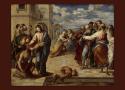
Jesus confronted the disciples’ distorted belief system: “It was not that this man sinned, or his parents, but that the works of God might be displayed in him” (John 9:3, ESV).
This poor blind beggar had suffered greatly throughout his life. We don’t know if he heard the disciples’ question to Jesus or not, but here’s what we do know: Jesus immediately defended him. Had this man sinned? Of course he had. And so had his parents. But Jesus clarified this wasn’t the cause of his suffering. Not only did Jesus challenge their simplistic view of suffering and ultimately point them to the greater purpose of his glory; he also fiercely defended a helpless man. Jesus was like a father stepping in front of a child: To get to him, you’ll first have to go through me.
What a Savior we have—forgiver of the sinner, helper of the helpless, defender of the defenseless. Yes, he came to expose the darkness of hearts, but he also came to shine the light of his hope and glory into the dark places of our pain (v. 5). It’s tempting to assume God looks at our pain and wonders, Why are you struggling? Don’t you see that I’m doing something through it?
But Jesus’ heart is empathetic, not critical. His life on earth shows us how much he still empathizes and grieves with us over the brokenness of the world. And everything he does brings him the greatest glory and us the greatest good (Rom. 8:28).
If we question that truth, we’ll constantly question his heart for us when we can’t understand his ways. But Psalm 56 assures us, “This I know, that God is for me” (v. 9, ESV). Our faith will be bolstered when it’s founded on the knowledge that God is undeniably, without a doubt, for us. //
Friend, your suffering isn’t God’s punishment, and it’s never pointless. Jesus is always at work in ways we can’t see in the moment. And it’s always for the purpose of showing the goodness and glory of God to us, in us, and through us.
Still, we think, If I just knew why, then I could endure. But what we ultimately need more than anything else is not the light that shines on the answers we want but the light of Jesus himself.
Jesus could have explained the man’s blindness, but he didn’t. That wasn’t what the man really needed. Yes, it would have been God’s undeserved grace to spare him from a gene mutation, disease, or whatever caused his blindness. His life would have been easier. Had that been the case, though, would he have come face to face with Jesus? Maybe not. He would have been content with his physical sight, despite walking in spiritual darkness. But in the hands of a powerful God, it was also an undeserved grace for the blind beggar’s life to become a remarkable story of redemption that led him (and those around him) to spiritual sight.
You may not see it now, but answers to your pain won’t bring ultimate comfort. Only nearness to Jesus will. Jesus wants what is best for you and has the power to bring it about.
Missionaries in the Bible include figures like Paul, who traveled extensively to spread the Gospel, and Esther, who used her influence to advocate for her people. Other examples are Philip, who preached to the Samaritans and the Ethiopian eunuch, and the unnamed servant girl who shared God's message in a foreign land.
Key Missionaries in the Bible
Notable Figures
Missionary Key Contributions
Paul Known as the greatest missionary, he traveled extensively to spread the Gospel and establish churches across the Roman Empire. His journeys are detailed in the Book of Acts.
Esther Used her position as queen to advocate for her people, demonstrating the power of influence in mission work.
Philip Preached to the Samaritans and the Ethiopian eunuch, showing the importance of individual evangelism.
John the Baptist Preached boldly about repentance and prepared the way for Jesus, emphasizing the focus on Christ.
A Little Maid An unnamed girl who, despite being a captive, directed Naaman to the prophet Elisha for healing, showcasing the impact of sharing faith in difficult circumstances.
Into the woods my Master went,
Clean forspent, forspent.
Into the woods my Master came,
Forspent with love and shame.
But the olives they were not blind to Him,
The little gray leaves were kind to Him:
The thorn-tree had a mind to Him
When into the woods He came.
Out of the woods my Master went,
And He was well content.
Out of the woods my Master came,
Content with death and shame.
When Death and Shame would woo Him last,
From under the trees they drew Him last:
'Twas on a tree they slew Him -- last
When out of the woods He came.

I don’t remember where I first encountered Asch. It was around 2012, when I ordered The Nazarene on Kindle and read it. I’ve since re-read it 3 more times, I found it so moving. Similarly with The Apostle, and Mary. Who would have thought an early 20th century observant Jewish author would write a series of well-researched fictional books (historical novels), together referred to as the “founders of Christianity” series. Unknown to most, Asch was well versed in what’s called “The Oral Tradition” or the Aggadah of the Jews. He used this knowledge to great effect in weaving many hundreds of stories of peoples and communities in first century Palestine - into these three magnificent books.
Historical novels, as a genre of course, vary widely in their faithfulness to history and accuracy. It is my clear impression that these are highly accurate and consistent with historical events; they are certainly consistent with both the Old and the New Testaments. The particular skill of Asch is to conform Biblical and historical events into the everyday lives of individuals (both historical and fictional) as they actually lived at this critical period of history. Many of the eternal elements of human nature are portrayed - credibly and beautifully.
I have come away with some important understandings which ring so very true. In large part, that’s because Asch wrote with a dedication to accuracy. His understanding arose not only from study of Torah (“The Law”) but also from tradition whose history was woven into every aspect of his own life, from birth through childhood and adulthood in Jewish ghettos in Poland. He has given me understanding far beyond the bare bones version I had from reform Jewish/secular upbringing.
The most powerful understanding I have from these three monumental books derives from the ancient Hebrews’ expectation of the Messiah. There is much discussion throughout these books as to the nature of the Messiah: was He to be temporal or secular? Of this world or the Kingdom of Heaven? A revolutionary or savior? For the Jews alone or for the gentiles as well?
In ways I find myself unable to yet articulate, I have some sense of the earliest cleavages which took place between Observant Jews and “Messianists” in Jesus’ time. There were many divisions between Jews already in existence. The divisions were both worldly (whether and/or how to defeat Roman occupation) and spiritual (those “strong in the law” vs. “unclean” Jews who failed to adequately observe the many, many burdensome strictures of the law). Divisions between Pharisees and Saducees were a continuous undertone.
Among these disputes, and woven throughout all three books, is the question of whether the Messiah was only for the Jews or for the gentiles as well. This was an especially divisive question among the most religious Jews of all schools of thought. One view said that strictly following Torah (the Law) kept Jews pure and at a safe distance from the “abominations” of the gentiles - idol worship, child sacrifice, prostitution/sexual perversions, etc. Since the Jews, they said, submitted to the burdens imposed by the law, they were “entitled” to the Messiah. Among other viewpoints (beyond the scope here), was the notion that the Jews’ observance of the law, was merely God’s way of using the Jewish people as the soil in which the Messiah might be born. These ideas are fleshed out repeatedly in all the books, and I find, very thought provoking.
The Apostle, the story of Saul, then Paul of Tarsus, is especially revealing of all the subtleties which lead to the great historical division between Christians and Jews. I have to say the totality of having read these books - again, many of the events take place in the mundane, everyday lives of the characters set in that time and place - has profoundly revised my understanding of history.
When this rumor referenced Al Gore back in 1999, it was readily spread by conservative commentators. (Paul Harvey, for example, mentioned it during his noontime broadcast on 6 July 1999.) Oddly enough, conservative columnist Cal Thomas maintained that the story was indeed true, only it had to do with President George H. W. Bush (father of George W. Bush):
Bush said it in my presence at a religious broadcasters convention about 1990, and I wrote about it in my book, Blinded by Might: Can the Religious Right Save America. But somehow it got twisted around and stuck on the Internet and put in Al Gore's mouth. He's got a lot of stuff that he has to defend, but that's not one of them.
Titling this article has proved more difficult than writing it. I considered everything from “21 Smug People Talk About A Subject None Of Them Understands, Least of All Jordan Peterson” to “Jordan Peterson Debates The Existence Of A God, But Not One Any Of Us Have Ever Heard of.” //
Brian, an outlier insofar as he appeared to be in his 40s, asks a timeless question: What is the purpose of life? Proverbs 3:5-6, Matthew 6:33, and Mark 12:30-31 are all helpful here. The Westminster Confession of Faith has something to say on the matter, too.
Peterson instead offers a program for self-improvement as if life were just one big gym membership.
Kumari wants Peterson to explain sin and hell.
If ever there was a time for Peterson to give a coherent answer, this was it. He talked of “improvement” as a means of avoiding hell. Neither the words of the Christian vocabulary — repentance, forgiveness, grace, redemption, restoration, etc. — nor their meanings were ever brought to bear. Peterson does speak of sin, but only as “miss[ing] the target,” which he proceeds to do completely.
There are very reasonable answers to all these questions. But Peterson, as lost as anyone in the room, knew none of them. Instead, one by one, twenty atheists were sent away with nothing for their souls.
And it’s souls I am concerned with here. For the Christian, these are issues of eternal significance, not clever repartee. //
I have debated and dialogued with many atheists — Richard Dawkins, Daniel Dennett, Christopher Hitchens, Michael Shermer, Peter Singer, etc. — and more than a few Muslims on the question of God in venues ranging from CNN and Hyde Park to Al Jazeera and a Seattle concert hall, and my opponents all had this in common: They were very clear on the fact that they were atheists or Muslims. There is genuine integrity in that. For my own part, I made it very clear that I was there, not to win an argument, but to win their souls. So, I find it nauseating that these young people, however misguided they might be, owned their convictions while Peterson played coy. //
You simply cannot engage this age group flippantly as Peterson does. They are too sincere for that. They are too ready to put legs to their professors’ crackpot ideas.
A humorous but true story to illustrate my point: Years ago, my students, seeing that I collected rocks from historical sites, made note of the fact and decided to act. Shortly thereafter they were bringing me marble they had chipped off the Parthenon, pieces of the Great Wall of China and the Palace of Versailles, and even a cobblestone they had pulled right out of Red Square (no small feat, I can tell you). I had unwittingly created a class of vandals!
Too often, however, the results are less amusing. The ranks of Antifa, BLM, and every civilization-destroying revolution since the dawn of time are full of young people like those who “surrounded” Peterson here. If you would teach them, you must be prepared to lead them to truth. To do otherwise is morally irresponsible. And this raises a question:
To what, exactly, was Peterson trying to convert them? Deism? New Age mysticism? Jordan Petersonism? Certainly not Christianity. //
But Zina won’t be put off. Wanting to know if her soul is in danger, she circles back and tries to get a straightforward answer: “What I’m saying is that your interpretation of the Bible — if you cannot tell us again if these historical events happened or not, that can be a deciding factor if someone is damned to hell for eternity or if they go to heaven, right?”
Peterson: “I don’t concern myself so much with that particular question.”
And with that, ladies and gentlemen, the curtain was drawn back on all of Jordan Peterson’s theological ramblings to reveal a man who knows not a damn thing on this subject worth a moment more of Zina’s time. His seemingly agonized stream-of-consciousness talk about God and the Bible is just so many donuts in the parking lot, leading his audiences absolutely nowhere. Remember, from a Christian perspective, the goal is the cross of Jesus Christ. It isn’t to make you religious or spiritual or to give you warm and fuzzy feelings about God or an appreciation for the Bible as a religious text. Hell will be full of such people. The objective is nothing short of the cross. Eternal life. And as Zina discovered, Peterson can’t get you there.
As an old seminary professor of mine used to say, “If your audience cannot see Jesus at the end of your teaching, you get an F.” So, where was Jesus in any of this? His name was mentioned twice in 90 minutes, and it’s more than a little telling that it wasn’t Peterson who did it on either occasion; it was Zina, and Peterson moved the discussion away from him with all possible haste.
Zina later made this astute observation: “Jordan Peterson’s framework for understanding Christianity is probably not the one that the Bible intended us to use.”
It fascinates me that Peterson offers himself as an authority on the Bible while missing its central message so comprehensively. The Book of Job, a Peterson favorite, contains a warning that he apparently missed. It comes from the Lord in the last chapter of that book, and it’s a reminder to us that any who dare speak of him had better do so accurately:
“My anger burns against you and against your two friends, for you have not spoken of me what is right.”
Almost nothing Peterson says about God is right. That should give his audiences pause, if not Peterson himself.

For many Christians, the idea of God as refuge is deeply comforting—until life becomes overwhelming.
In seasons of emotional pain, chronic stress, grief, or trauma, Scripture about God’s nearness can feel strangely out of reach. You may believe God is your refuge, yet your body remains tense, your thoughts feel scattered, and prayer seems to fall flat. That disconnect can quietly give rise to guilt, confusion, or self-doubt: If God is really with me, shouldn’t I feel better than this?
The answer is no—and understanding why can be profoundly freeing.
Why God Can Feel Distant During Emotional Pain
When life becomes threatening, emotionally, relationally, or physically, the brain shifts into survival mode. The amygdala becomes more reactive, scanning for danger, while the parts of the brain responsible for reflection, trust, and perspective are less accessible. This is not a lack of faith; it is a stress response.
During these seasons:
- Emotional intensity can override spiritual reassurance
- God’s presence may be intellectually affirmed but emotionally inaccessible
- Silence can feel personal, even when it isn’t
This helps explain why someone can sincerely love God and still feel abandoned in suffering. Your nervous system may be interpreting the world as unsafe, even when your theology is sound.
Psalm 46:1 does not deny this reality:
“God is our refuge and strength, an ever-present help in trouble.”
Notice what the verse does not say. It does not promise the absence of trouble—or the immediate experience of calm. It promises presence within distress.
When Silence Disqualifies Faith Leadership
This is where the line must be drawn clearly.
Faith leaders who refuse to confront truth because they fear how their congregations will react are not exercising faith.
They are managing risk.
Scripture defines faith plainly. Hebrews 11:1 tells us faith is the substance of things hoped for and the evidence of things not seen.
Faith has never required safety.
It has always required courage.
If you cannot speak God’s truth when it threatens attendance, donations, reputation, or comfort, you may be a leader of people, but you cannot claim to be a leader of faith.
Jesus did not soften His message to keep followers.
He told the truth and watched people walk away.
Comfort is not a fruit of the Spirit.
Rooted in Christ but Relevant for Our Changing World
by Richard Pratt
1 Corinthians 9:19–23
(ID: gs1483)
All Christian leaders, and especially those who minister the Word of God, must be sure that they remain firmly rooted in Christ. This is especially true when the world around us challenges the Christian faith in new ways. As Third Millennium Ministries’ Richard Pratt explains, the apostle Paul experienced this in his own life—and in 1 Corinthians, he wrote how he was able to stay firmly rooted but also relevant in his changing world.
Our Basic Conduct as a Disciple
by Hershael York
Selected Scriptures
(ID: gs1459)
God bestows great blessings, but He also takes away gifts—including ministry opportunities such as that lost by preaching professor Hershael York’s missionary father. Yet while the apostle Paul lamented the “thorn in the flesh” given him by God, he also found comfort in His all-sufficient grace. York reminds us that while some church leaders may try to rely on world-pleasing strength and wealth, God may use our unwanted suffering to help us rely on Him.

So, Naturally, We Proclaim Christ!
by Tony Merida
Colossians 1:24–29
(ID: gs1435)
The devil is untroubled by moral improvement plans or people becoming more religious. What Satan does not want is Christ being preached. Tony Merida reminds us of the importance of proclaiming Jesus by unpacking the priority, purpose, and power of Christ-centered preaching, which was exemplified by Paul’s ministry to the Colossians. Jesus, Merida reminds us, is fully sufficient. He must be the focus of every sermon we preach, as He is the focus of whole of God’s Word.

To the Praise of His Glory (Part 1)
Ephesians 1:1-6
Why Ephesians Big Deal?
Gospel Doctrine, Gospel Culture
The Importance of the Church
Spiritual Warfare
Practical Answers for Basic Christianity

Ruth’s words to Naomi really do stand out as Hebrew poetry, in parallel couplets. It’s surprising that Bibles don’t format them this way:
Entreat me not to leave you
or to return from following you;
for where you go I will go,
and where you lodge I will lodge;
your people shall be my people,
and your God my God;
where you die I will die,
and there will I be buried.
After elegantly concluding her poem by varying the you-I progression with a solemn final statement, Ruth swears an oath that she asks God to enforce: “May the Lord do so to me and more also if even death parts me from you!”
I don’t think this language is actually taken from an ancient Israelite marriage ceremony. (The opposite is true: people have taken Ruth’s words and turned them into marriage vows.) Rather, it’s characteristic of Hebrew narrative that when someone has something crucial to say, on which the story line turns, they say it in poetry. In the ancient oral culture, this would make the saying memorable and repeatable (kind of like an advertizing slogan today). //
Examples like these show that poetry was used for important pronouncements in Hebrew narrative, probably reflecting the actual customs of the culture. And we have to admit that among her many other qualities as a “woman of noble character,” Ruth was a fine poet.

How the Bible’s Supernatural Story Was Bent to Fit Culture—and Why Recovering It Matters
One of the quiet tragedies of church history is not that Christians rejected the Bible, but that—at a critical moment—they reinterpreted it to survive cultural pressure. Instead of allowing Scripture to challenge the assumptions of the age, parts of the Church chose to soften the Bible’s worldview so it would sound reasonable to the world it was trying to convert. Over time, that accommodation didn’t just adjust emphasis; it changed how entire passages were understood.
Genesis 6 sits at the center of that story. //
By the time of Augustine of Hippo, Christianity had moved from persecuted minority to imperial religion. The Church was now expected to sound respectable to educated Greco-Roman elites. Pagan philosophers mocked stories of divine beings mating with humans as primitive mythology. Christianity, eager to be seen as intellectually serious, felt pressure to respond.
Augustine did not ask, “How would ancient Israelites have understood this?”
He asked, “How can Christianity defend itself in this culture?”
Influenced by Neoplatonism, Augustine assumed that angels were purely spiritual and therefore incapable of physical interaction. That assumption came from philosophy, not from the Hebrew Bible. Rather than adjust his philosophy to fit Scripture, Augustine adjusted Scripture to fit philosophy. The result was the Sethite interpretation—a reading that removed supernatural rebellion, removed imprisoned angels, and removed cosmic consequences. //
Instead of submitting to Scripture and allowing it to reshape assumptions about reality, the Church reshaped Scripture so it would align with dominant intellectual norms. Over time, believers forgot that this was ever a choice. Tradition hardened into “what the Bible says,” even when it conflicted with what the Bible actually meant. //
Missler approached Scripture as a unified system. He argued that Genesis 6 was not an oddity, but a strategic moment in a cosmic war—one that echoes forward into Daniel, the Gospels, and Revelation. His warning was simple but unsettling: if the Bible opens with supernatural rebellion, it should not surprise us when it closes the same way. Missler’s work forced Christians to grapple with the scope of the biblical story. //
If the Bible is only about human morality, then Jesus is only a moral solution.
But if the Bible is about cosmic rebellion and restoration, then Jesus is far more than a teacher or example—He is the rightful ruler reclaiming a world that was stolen.
The loss of this story didn’t make Christianity stronger.
It made it smaller.
Recovering it does not mean chasing speculation or abandoning doctrine. It means having the humility to admit that, at one point in history, the Church chose cultural survival over biblical honesty—and that decision still shapes what many believers are taught today.
The Bible was not written to sound reasonable to every age.
It was written to tell the truth about reality.
And that reality, from Genesis to Revelation, is far more supernatural—and far more meaningful—than most Sunday School lessons ever dared to admit.