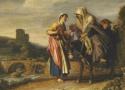
Ruth’s words to Naomi really do stand out as Hebrew poetry, in parallel couplets. It’s surprising that Bibles don’t format them this way:
Entreat me not to leave you
or to return from following you;
for where you go I will go,
and where you lodge I will lodge;
your people shall be my people,
and your God my God;
where you die I will die,
and there will I be buried.
After elegantly concluding her poem by varying the you-I progression with a solemn final statement, Ruth swears an oath that she asks God to enforce: “May the Lord do so to me and more also if even death parts me from you!”
I don’t think this language is actually taken from an ancient Israelite marriage ceremony. (The opposite is true: people have taken Ruth’s words and turned them into marriage vows.) Rather, it’s characteristic of Hebrew narrative that when someone has something crucial to say, on which the story line turns, they say it in poetry. In the ancient oral culture, this would make the saying memorable and repeatable (kind of like an advertizing slogan today). //
Examples like these show that poetry was used for important pronouncements in Hebrew narrative, probably reflecting the actual customs of the culture. And we have to admit that among her many other qualities as a “woman of noble character,” Ruth was a fine poet.

