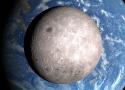
Several types of astronomy would benefit. The most obvious is radio astronomy, which can be conducted from the side of the Moon that always faces away from Earth—the far side.
The lunar far side is permanently shielded from the radio signals generated by humans on Earth. During the lunar night, it is also protected from the Sun. These characteristics make it probably the most “radio-quiet” location in the whole solar system, as no other planet or moon has a side that permanently faces away from the Earth. It is, therefore, ideally suited for radio astronomy. //
Radio waves with wavelengths longer than about 15 m are blocked by Earth’s ionosphere. But radio waves at these wavelengths reach the Moon’s surface unimpeded. For astronomy, this is the last unexplored region of the electromagnetic spectrum, and it is best studied from the lunar far side.
Observations of the cosmos at these wavelengths come under the umbrella of “low-frequency radio astronomy.” These wavelengths are uniquely able to probe the structure of the early Universe, especially the cosmic “dark ages”—an era before the first galaxies formed.
At that time, most of the matter in the Universe, excluding the mysterious dark matter, was in the form of neutral hydrogen atoms. These emit and absorb radiation with a characteristic wavelength of 21 cm. Radio astronomers have been using this property to study hydrogen clouds in our own galaxy—the Milky Way—since the 1950s.
Because the Universe is constantly expanding, the 21 cm signal generated by hydrogen in the early Universe has been shifted to much longer wavelengths. As a result, hydrogen from the cosmic “dark ages” will appear to us with wavelengths greater than 10 m. The lunar far side may be the only place where we can study this. //
The Moon also offers opportunities for other types of astronomy as well. Astronomers have lots of experience with optical and infrared telescopes operating in free space, such as the Hubble telescope and JWST. However, the stability of the lunar surface may confer advantages for these types of instruments.
Moreover, there are craters at the lunar poles that receive no sunlight. Telescopes that observe the Universe at infrared wavelengths are very sensitive to heat and therefore have to operate at low temperatures. JWST, for example, needs a huge sun shield to protect it from the sun’s rays. On the Moon, a natural crater rim could provide this shielding for free.


Experts in South Korea are convinced that bricks moulded from microwaved stardust could produce materials on site and boost humanity's hopes of living on the lunar surface.
The scientists said: "NASA has announced the Artemis Mission aiming for a long-term presence on the lunar surface. However, infrastructure expansion such as lunar base construction plays a vital role.
"Yet transporting construction materials from Earth to the lunar surface via landers incurs a significant cost of $1.2 million per kilogram.
"To solve this problem Korea Institute of Civil Engineering and Building Technology has developed technology for producing construction materials using in-situ resources from the Moon."
Meanwhile, it was revealed recently that space fanatics could be able to watch TV coverage from the Moon when man returns there for the first time in over 50 years for the Artemis III mission.

We're standing by for news on NASA's decision on what to do about Orion's heat shield. //
The central piece of NASA's second Space Launch System rocket arrived at Kennedy Space Center in Florida this week. Agency officials intend to start stacking the towering launcher in the next couple of months for a mission late next year carrying a team of four astronauts around the Moon.
The Artemis II mission, officially scheduled for September 2025, will be the first voyage by humans to the vicinity of the Moon since the last Apollo lunar landing mission in 1972. NASA astronauts Reid Wiseman, Victor Glover, Christina Koch, and Canadian mission specialist Jeremy Hansen will ride the SLS rocket away from Earth, then fly around the far side of the Moon and return home inside NASA's Orion spacecraft. //
NASA's inspector general reported in 2022 that NASA's first four Artemis missions will each cost $4.1 billion. Subsequent documents, including a Government Accountability Office report last year, suggest the expendable SLS core stage is responsible for at least a quarter of the cost for each Artemis flight.
The core stage for Artemis II is powered by four hydrogen-fueled RS-25 engines produced by Aerojet Rocketdyne. Two of the reusable engines for Artemis II have flown on the space shuttle, and the other two RS-25s were built in the shuttle era but never flew. Each SLS launch will put the core stage and its engines in the Atlantic Ocean. //
Artemis III's launch date is highly uncertain. It primarily hinges on SpaceX's progress in developing a human-rated lunar lander and Axiom Space's work on new spacesuits for astronauts to wear while walking on the Moon.
NASA spent $11.8 billion developing the SLS rocket, and its debut was delayed five years from an original target date in 2017. But for Artemis II, the readiness of the Orion spacecraft is driving the schedule, not the rocket.
Anders - who was a lunar module pilot on the Apollo 8 mission - took the iconic Earthrise photograph, one of the most memorable and inspirational images of Earth from space.
Taken on Christmas Eve during the 1968 mission, the first crewed space flight to leave Earth and reach the Moon, the picture shows the planet rising above the horizon from the barren lunar surface.
Anders later described it as his most significant contribution to the space programme.
The image is widely credited with motivating the global environmental movement and leading to the creation of Earth Day, an annual event to promote activism and awareness of caring for the planet.
Speaking of the moment, Anders said: "We came all this way to explore the Moon, and the most important thing that we discovered was the Earth."
July 20, 2018
Website Notice
Note: This website (moonviews.com) has not been regularly updated since 2014. Now that the project’s data has been submitted to NASA, this website will no longer be updated but will be maintained as an online archive of the LOIRP’s prior activities. Thank you for your interest in – and support of – our project. //
The Lunar Orbiter Image Recovery Project (LOIRP) is a project to digitize the original analog data tapes from the five Lunar Orbiter spacecraft that were sent to the Moon in 1966 and 1967; it is funded by NASA, SkyCorp, SpaceRef Interactive, and private individuals.[1]
The first image to be successfully recovered by the project was released in November 2008. It was the first photograph of the Earth from the Moon, taken in August 1966. On February 20, 2014, the project announced it had completed the primary tape capture portion of the project.[2] One medium resolution image, most of one high resolution image and parts of three others are missing, apparently due to lapses at the time they were being recorded.[3] The rest of the Lunar Orbiter images have been successfully recovered[2] and have been published in NASA's Planetary Data System.
This image (click on image to enlarge) shows the sequence of images that were read out during what is termed “priority” readout vs the “final readout”. The priority readout was an opportunistic scanning of processed photos on the lunar orbiter before all of the images were taken. The photo process with the 70mm film began with an image being simultaneously taken by the 610 mm high resolution camera and by the 80 mm medium resolution camera. In a process remarkably similar to the old polaroid dry process instamatic cameras, the film was dry processed by a “bimat” dry processor. The bimat would separate from the film (most of the time) but would sometimes due to the timing would leave artifacts on the image, which are readily identified on the film.
The film would then be fed into the readout looper where it could be scanned and the images sent back to the Earth. During the mission when photographs were still being taken the film would run one direction through the looper. After all of the images were taken a command would be sent to cut the bimat and then the film could be read in the opposite direction.
Thus when we start with a low numbered tape, the first images that come off are from the priority readout in ascending order. However, the ascending order is not linear, jumping because images are still being taken and the film advancing while the spacecraft cannot transmit.

At 12.56 pm on 21 July 1969 Australian Eastern Standard Time (AEST), mankind took its 'one giant leap' and 600 million people watched as Neil Armstrong walked on the Moon.
Our Parkes radio telescope, Murriyang, famously supported receiving the television signals on that momentous day. Although many people think the Parkes telescope was the only station receiving the signal, it was the 26-metre antenna at NASA's Honeysuckle Creek space tracking station near Canberra that was the prime station assigned with receiving the initial TV pictures from the Moon and Neil Armstrong's first steps on the lunar surface. (The Tidbinbillla deep space tracking station, today known as the Canberra Deep Space Communication Complex, provided support to the command module in lunar orbit.)
Eight and a half minutes after those first historic images were broadcast around the world, the television signal being received by the larger 64-metre Parkes radio telescope, Murriyang, was then selected by NASA to provide the images for the following two hours and 12 minutes of live broadcast as the Apollo 11 astronauts explored the Moon surface.
“I’ve spent the past week in Mountain View, California, hanging out with a group of Lunar Orbiter Image Recovery Project (LOIRP) hackers who are working out of an abandoned McDonald’s on the NASA Ames base. For more than five years, LOIRP technologists (or techno-archeologists, as they prefer to be called) have been reverse-engineering analog tape drives and developing new software in an attempt to unearth some of the first images of the moon that were taken by unmanned lunar orbiters in advance of the manned Apollo missions of the late 1960s. Upon entering the building (affectionately called “McMoon’s” by those who work within it) for the first time, I was greeted by familiar architecture. The drive-thru windows, menu light boxes, stainless steel counters, fiber glass tables and the ghosts of corporate brand ephemera all remain. However now they coexist under a jolly roger with a literal mountain of vintage 2-inch tape reels that contain trapped data, refrigerator-sized Ampex tape drives, an army of Mac workstations and a seemingly endless supply of analog tape decks, monitors, cables and soldering supplies.”

The 2024 total eclipse is in the books. Here's how it looked across the US.
And God said, Let there be light: and there was light. And God saw the light, that it was good: and God divided the light from the darkness. And God called the light Day, and the darkness he called Night. And the evening and the morning were the first day."
The steady rhythm of the night-day, dark-light progression is a phenomenon acknowledged in ancient sacred texts as a given. When it's interrupted, people take notice. In the days leading up to the eclipse, excitement within the Ars Orbiting HQ grew, and plans to experience the last total eclipse in the continental United States until 2045 were made. Here's what we saw across the country.

JohnDeL Ars Tribunus Angusticlavius
8y
6,157
Subscriptor
The single bit requirement indicates that this was primarily an engineering mission and not a science one. The intent was to test out new technology and see how it might be improved for use on later science missions.
A great example of this is the Sojourner/Pathfinder mission. Sojourner's mission goals were to roll one meter and send back one image and last one sol on the surface. The nominal plan was for it to roll (IIRC) 10 meters, send back 100 images and APXS readings, and last 7 sols. What we got was 100 meters, more than a thousand readings and images, and a lifetime of 83 sols.
Thanks to Sojourner's work, we now have freakin' huge rovers on Mars that have lasted for a decade, rolled more than 30 km, and provided thousands of images and readings that have significantly improved our understanding of Mars.
We can expect the same sort of improvement from Odie's siblings when they finally make it to the Moon. Per aspera, ad astra!

Altemus said crises like this, and the loss of the range finders, happened over and over. "This mission kept throwing us alligators, and we would reduce these alligators to snapping turtles because they don't hurt as bad," he said.
If one assumes there is a 70 percent chance of recovering from any one of these crises but you have to address 11 different crises on the way to the Moon, the probability of mission success is less than 2 percent. //
In truth, NASA is thrilled with Intuitive Machines' performance. The aerospace industry at large understands what this company was up against and is celebrating its success. Most of the customers flying on Odysseus are getting the data they paid for.
The reality is that Intuitive Machines is a private company with about 250 people working on this lunar lander program. That's a small fraction of the resources that national space programs typically devote to these initiatives, and with all the data it has gathered, Intuitive Machines and its customers can be pretty confident that the company will stick the landing next time.
And there will be a next time, as the commercial lunar landers built by private companies in the United States cost about $100 million instead of the half-billion dollars the government would have spent on a specialized, one-time mission to the Moon.
Here's why I think this is a truly notable success. Consider the trials and turmoil that a similarly sized company called SpaceX went through 18 years ago as it worked toward the first launch of its first rocket, the Falcon 1. Rockets are hard, but so are spacecraft that must make a soft landing on the Moon. I would argue that a lunar lander like Odysseus is as complicated, if not more so, than a relatively simple booster like the Falcon 1. //
Unlike the initial Falcon 1, Odysseus flew all the way to the Moon on its very first time out and made a soft landing. It has been phoning home ever since, sending a rich stream of data. That's a pretty big win.

One last reflection to stress the importance of our Moon, which keeps the tilt of the Earth stable and limits the amount of wobble along the planetary axis. https://www.universetoday.com/164878/we-owe-our-lives-to-the-moon/
With every shift in the tilt, the seasons would radically change. Instead of regular, predictable changes year after year, we would experience ages with endless summers, or ages with violent but short winters, or anything in between. The rhythm of the seasons provides a pulse for life, which has the freedom to grow and evolve without trying to overcome great climactic shifts caused by a changing axis.
Luna acts as a great gravitational counterweight, stabilizing the motion of the Earth. By providing a source of gravity external to our planet, the Earth’s interior is free to shift and reconfigure as it pleases – the Moon steadies our hand and keeps us upright.
For example, the argument about "too many launches" actually breaks down when you consider the payload that gets brought to the lunar surface. If it was just meant to be a cheap gag, feel free to ignore the following: The LEM weighs a little over 5 tons dry, and leaves half of its mass (2.5 tons) on the surface upon return. Maybe factor in another ton for dispensable cargo and Apollo delivers 3.5 tons of material to the lunar surface (not all of this is "useful" material, but we can ignore that for the time being). Starship HLS is designed to leave 100 tons of useful payload on the lunar surface. It would take 28 Saturn V launches to deliver that much material to the moon! And that's with fully expendable launch vehicles! Suddenly a dozen (or even 2 dozen) fully reusable Starship launches doesn't sound so bad in comparison.
I also thought the criticism about the complexity of the Lunar Gateway is somewhat missing the point. To me it seems clear that a lot of the complexity in the mission is the goal; that is, developing bleeding edge technologies that we need for future manned space travel to the moon and beyond. At some point we're going to have to maintain a station somewhere in deep space acting as a permanent hub that supports ferry/cargo craft and landing vehicles. The best place to prove out that concept is around the moon.
During Artemis I, NASA’s new mega Moon rocket, the Space Launch System (SLS), roared into the night sky and sent the Orion spacecraft on a 1.4-million-mile journey beyond the Moon and back. //
The spacecraft reached a maximum distance from Earth when it was 268,563 miles away from our home planet. Orion surpassed the record for distance traveled by a spacecraft designed to carry humans, previously set during Apollo 13.
A close up view of the Orion in space. The orange spacesuit on Commander Moonikin Campos can be seen through one of the crew module's windows. The American flag on the body of the crew module and red NASA lettering can also be seen.
A camera mounted on one of Orion’s solar array wings captured a close up image of the crew module.

Here at Flightradar24 we’re big fans of anything in the sky and that includes astronomical photography, but we were pleasantly surprised when we came across Andrew McCarthy’s photo of the 30 August Super Blue Sturgeon moon. Taken in Arizona southeast of Phoenix, the photo captures not only the moon, but an aircraft passing in front of the moon.
all the tags from https://b.plas.ml
1st-amendment 2nd-amendment 4th-amendment 5th-amendment 9/11 a8 abortion acl adhd afghanistan africa a/i air-conditioning amateur-radio amazon america american android animals anti-americanism antifa anti-semitism antiv antivirus aoip apollo apple appliances archaeology architecture archive art astronomy audio automation avatar aviation backup bash batteries belleville bible biden bill-of-rights biology bookmarks books borg bush business calibre camping capitalism cellphone censorship chemistry children china christianity church cia clinton cloud coldwar communication communist composed computers congress conservatives constitution construction cooking copyleft copyright corruption cosmology counseling creation crime cron crypto culture culture-of-death cummins data database ddt dd-wrt defense democrats depression desantis development diagrams diamonds disinformation diy dns documentation dokuwiki domains dprk drm drm-tpm drugs dvd dysautonomia earth ebay ebola ebook economics education efficiency electricity electronics elements elwa email energy engineering english environment environmentalism epa ethernet ethics europe euthanasia evolution faa facebook family fbi fcc feminism finance firewall flightsim flowers fonts français france fraud freebsd free-speech fun games gardening genealogy generation generators geography geology gifts git global-warming google gop government gpl gps graphics green-energy grounding hdd-test healthcare help history hollywood homeschool hormones hosting houses hp html humor hunting hvac hymns hyper-v imap immigration india infosec infotech insects instruments interesting internet investing ip-addressing iran iraq irs islam israel itec j6 journalism jumpcloud justice kindle kodi language ldap leadership leftist leftists legal lego lgbt liberia liberty linguistics linux literature locks make malaria malware management maps markdown marriage mars math media medical meshcentral metatek metric microbit microsoft mikrotik military minecraft minidisc missions moon morality mothers motorola movies mp3 museum music mythtv names nasa nature navigation navy network news nextcloud ntp nuclear obama ocean omega opensource organizing ortlip osmc oxygen paint palemoon paper parents passwords patents patriotism pdf petroleum pets pews photography photo-mgmt physics piano picasa plesk podcast poetry police politics pollution pornography pots prayer pregnancy presentations press printers privacy programming progressive progressives prolife psychology purchasing python quotes rabbits rabies racism radiation radio railroad reagan recipes recording recycling reference regulations religion renewables republicans resume riots rockets r-pi russia russiagate safety samba satellites sbe science sci-fi scotus secularism security servers shipping ships shooting shortwave signal sjw slavery sleep snakes socialism social-media software solar space spacex spam spf spideroak sports ssh statistics steampowered streaming supplement surveillance sync tarsnap taxes tck tds technology telephones television terrorism tesla theology thorium thumbnail thunderbird time tls tools toyota trains transformers travel trump tsa twitter typography ukraine unions united.nations unix ups usa vaccinations vangelis vehicles veracrypt video virtualbox virus vitamin vivaldi vlc voting vpn w3w war water weather web whatsapp who wifi wikipedia windows wordpress wuflu ww2 xigmanas xkcd youtube zfs