
In traditional file systems we use df(1) to determine free space on partitions. We can also use du(1) to count the size of the files in the directory. But it’s different on ZFS and this is the most confusing thing EVER. I always forget which tool reports what disk space usage! Every time somebody asks me, I need to google it. For this reason I decided to document it here – for myself – because if I can’t remember it at least I will not need to google it, as it will be on my blog, but maybe you will also benefit from this blog post if you have the same problem or you are starting your journey with ZFS.


The zfs list command provides an extensible mechanism for viewing and querying dataset information. Both basic and complex queries are explained in this section.
For one of my datasets zfs list and df show significantly different used numbers: //
Okay, zfs list -o space reveals that it’s (a) snapshot(s):
zfs list -t snapshot myPool/myDataset
zrepl is a one-stop, integrated solution for ZFS replication.
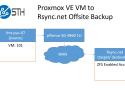
Today we have a quick guide on how to automate Proxmox VE ZFS offsite backups to Rsync.net. The folks at rsync.net set us up with one of their ZFS enabled trial accounts. As the name might imply, Rsync.net started as a backup service for those using rsync. Since then they have expanded to allowing ZFS access for ZFS send/ receive which makes ZFS backups very easy. In our previous article we showed server-to-server backup using pve-zsync to automate the process.
With the introduction of SAS 12Gbps, seems like "it's time" to do a braindump on SAS.
Work in progress, as usual.
History
By the late '90's, SCSI and PATA were the dominant technologies to attach disks. Both were parallel bus multiple drop topologies and this kind of sucked. SATA and Serial Attached SCSI (SAS) evolved from those, using a serial bus and hub-and-spoke design.
Early SATA/150 and SATA/300 were a bit rough and had some issues, as did SAS 3Gbps. You probably want to avoid older controllers, cabling, expanders, etc. that doesn't support 6Gbps because some of it has "gotchas" in it. In particular a lot of it has 2TB size limitations. Most 3Gbps hard drives are fine though.
Similarities, Differences, Interoperability
SAS and SATA operate at the same link speeds and use similar cabling. SAS normally operates at a higher voltage than SATA and can run over longer cabling.
SAS and SATA use different connectors on the drive. The SATA drive connector has a gap between the signal and power sections, which allows separate power and data cables to be easily connected. The SAS drive connector does not have a gap, and instead has a second set of pins on top. This second set of pins is the second (redundant) SAS port. There are pictures of the top and the bottom of the drive connector.
SATA drives can be attached to a SAS port. Electrically, the SAS port is designed to allow attachment of a SATA drive, and will automatically run at SATA-appropriate voltages. Physically, the SAS backplane connector has an area that will allow either the gapless SAS or the gapped SATA connector to fit. See picture of SAS backplane socket.
SAS drives are incompatible with SATA ports, however, and a SATA connector will not attach to an SAS drive. Don't try. The gap is there to block a SAS drive from being connected to typical SATA cabling, or to a SATA backplane socket.
When a SATA drive is attached to a SAS port, it is operated in a special mode using the Serial ATA Tunneling Protocol (STP).
ZFS posts
1) An HBA is a Host Bus Adapter.
This is a controller that allows SAS and SATA devices to be attached to, and communicate directly with, a server. RAID controllers typically aggregate several disks into a Virtual Disk abstraction of some sort, and even in "JBOD" or "HBA mode" generally hide the physical device. If you cannot see the type of device (such as "ST6000DX000-1H217Z" in "camcontrol devlist", you DO NOT HAVE A TRUE HBA. If you cannot get the output of "smartctl" for a device, you DO NOT HAVE A TRUE HBA. A true HBA passes communications through itself directly to a drive without further processing. No amount of marketing department wishful thinking can change that technical reality.
2) FreeBSD has incredibly robust support for the LSI HBA's.
FreeBSD's LSI HBA (mps/mpr) drivers are authored by LSI and carefully designed to work with their HBA firmware. The FreeNAS userbase has installed many thousands of these cards which have, in aggregate, BILLIONS of problem-free run-hours. Not only are they known to work very well during normal operations, but they're also known to work correctly during ABNORMAL operations, such as when a disk times out or throws an error. SMART is properly supported. Forum members are incredibly familiar with all the variations on these and can provide useful assistance. Cards such as the LSI 9240-8i, IBM ServeRAID M1015, Dell PERC H200 and H310, and others are readily available on the used market and can be converted to LSI 9211-8i equivalents.
3) You must crossflash to IT/IR firmware
If you don't crossflash, then a lot of the remainder of this ALSO applies to LSI non-IT-20.00.07.00 HBA's!! The IR firmware is also fine but is a few percent slower. It is not clear there is any value to doing this as you would never want to use an IR virtual device with FreeNAS. We used to do this in the old days for boot devices, but with ZFS boot this is probably no longer relevant.
The LSI 9240 (etc) default MFI firmware is apparently being sold on eBay as "IR" by clueless sellers. The MFI firmware is unsuitable for FreeNAS and may cause your pool to get eaten.
The LSI 9211-8i (PCIe 2.0 based on LSI 6Gbps SAS2008) and LSI 9207-8i (PCIe 3.0 based on LSI 6Gbps SAS2308) both require firmware 20.00.07.00.
all the tags from https://b.plas.ml
1st-amendment 2nd-amendment 4th-amendment 5th-amendment 9/11 a8 abortion acl adhd afghanistan africa a/i air-conditioning amateur-radio amazon america american android animals anti-americanism antifa anti-semitism antiv antivirus aoip apollo apple appliances archaeology architecture archive art astronomy audio automation avatar aviation backup bash batteries belleville bible biden bill-of-rights biology bookmarks books borg bush business calibre camping capitalism cellphone censorship chemistry children china christianity church cia clinton cloud coldwar communication communist composed computers congress conservatives constitution construction cooking copyleft copyright corruption cosmology counseling creation crime cron crypto culture culture-of-death cummins data database ddt dd-wrt defense democrats depression desantis development diagrams diamonds disinformation diy dns documentation dokuwiki domains dprk drm drm-tpm drugs dvd dysautonomia earth ebay ebola ebook economics education efficiency electricity electronics elements elwa email energy engineering english environment environmentalism epa ethernet ethics europe euthanasia evolution faa facebook family fbi fcc feminism finance firewall flightsim flowers fonts français france fraud freebsd free-speech fun games gardening genealogy generation generators geography geology gifts git global-warming google gop government gpl gps graphics green-energy grounding hdd-test healthcare help history hollywood homeschool hormones hosting houses hp html humor hunting hvac hymns hyper-v imap immigration india infosec infotech insects instruments interesting internet investing ip-addressing iran iraq irs islam israel itec j6 journalism jumpcloud justice kindle kodi language ldap leadership leftist leftists legal lego lgbt liberia liberty linguistics linux literature locks make malaria malware management maps markdown marriage mars math media medical meshcentral metatek metric microbit microsoft mikrotik military minecraft minidisc missions moon morality mothers motorola movies mp3 museum music mythtv names nasa nature navigation navy network news nextcloud ntp nuclear obama ocean omega opensource organizing ortlip osmc oxygen paint palemoon paper parents passwords patents patriotism pdf petroleum pets pews photography photo-mgmt physics piano picasa plesk podcast poetry police politics pollution pornography pots prayer pregnancy presentations press printers privacy programming progressive progressives prolife psychology purchasing python quotes rabbits rabies racism radiation radio railroad reagan recipes recording recycling reference regulations religion renewables republicans resume riots rockets r-pi russia russiagate safety samba satellites sbe science sci-fi scotus secularism security servers shipping ships shooting shortwave signal sjw slavery sleep snakes socialism social-media software solar space spacex spam spf spideroak sports ssh statistics steampowered streaming supplement surveillance sync tarsnap taxes tck tds technology telephones television terrorism tesla theology thorium thumbnail thunderbird time tls tools toyota trains transformers travel trump tsa twitter typography ukraine unions united.nations unix ups usa vaccinations vangelis vehicles veracrypt video virtualbox virus vitamin vivaldi vlc voting vpn w3w war water weather web whatsapp who wifi wikipedia windows wordpress wuflu ww2 xigmanas xkcd youtube zfs