
“It is change, continuing change, inevitable change, that is the dominant factor in society today. No sensible decision can be made any longer without taking into account not only the world as it is, but the world as it will be… This, in turn, means that our statesmen, our businessmen, our everyman must take on a science fictional way of thinking.” – Isaac Asimov //
There is no argument for our complacency that is better represented than the current social movement against producing energy, which perhaps began with Boomers, but is now being led mostly by Gen Z, also known as ‘the sustainability generation’, and also to some degree by Millennials. The irony is that these generations have been the most comfortable of all (and –full disclosure – I am a Millennial); unlike my parents who grew up in poverty in India, and were then manual labourers in Britain, we have had it easy. We haven’t suffered through truly gruelling labour, we don’t need to know how electricity grids work, and most of us have never stepped foot in a mine or experienced electricity blackouts. The divide between what it takes to maintain a high quality of life and the understanding of this has also widened over generations; //
This is not necessarily a bad thing. Thanks to years of development and growth, we live in a time of prosperity, facing fewer core challenges than past generations. //
The problem is that thanks to all of this, a disconnection has occurred between our lifestyles and what it has taken to get us here. The lack of understanding of the skilled labour, need for industries, and mining for raw materials that enabled these lifestyles, and the fact that the toll those things took on the environment was inevitable, but not permanent, has repercussions for society. I was once part of the problem, fighting to forge a society that would be independent of fossil fuels, without thinking about our continued and growing need for reliable electricity and fighting for the alternatives. My argument was the standard traditional environmentalist argument: that we need to live with less. I was wrong.
Now, the argument has gone so far that activists argue that we should just stop oil overnight. But can it be done without causing immense harm to people? //
About 45% of a typical barrel of crude oil is refined into gasoline, and an additional 29% is refined into diesel fuel. The remaining 26% is used to make plastics and other products. There is good news in these figures, as it means that we can reduce a lot of our dependence on oil by making the switch from petrol and diesel cars to electric vehicles, which is a trend that is taking place in many countries already. //
Instead of going ahead anyway and virtue signalling that they are now plastic-free, Lego has ditched plans to switch to PET, since doing so would have had a greater impact on the environment.
Of course, many anti-oil activists would argue that Lego should stop making the bricks altogether. They would argue that they are unnecessary and wasteful. But I disagree. I recall many years of constructing large and complicated architectural designs with my brother when we were children; he was fascinated by the way things work and are put together, and he later trained to become an engineer (a field he now holds a senior position in). This link between playing with Lego and developing engineering skills has been well-documented elsewhere. The irony of wanting to just stop oil is well represented in the idea that we don’t ‘need’ Lego. We don’t ‘need’ to build housing, railways, or power plants either – if we are happy for society to stagnate and for future generations to suffer.
Let’s ignore the idea of an immediate transition, then, and consider what can be done to stop oil eventually. //
This brings me back to a point I’ve been making for years: we should be aiming for energy abundance.
As we shift towards electrifying everything, switching from gas boilers to heat pumps, and diesel cars to electric vehicles, much of our demand for oil will be replaced naturally. But the alternatives will require more electricity, and unless the electricity grid is supplying us with clean power, we have a problem. //
As I’ve explained before, we can build all the wind and solar power people want, but we will still need baseload power to back them up, and historically this has always either come from fossil fuels or nuclear energy. Although the upfront costs for the alternatives appear to be cheaper than for nuclear, this is incorrect when the figures are viewed in context. As well, we need to be aware of shift-loading the costs of wind and solar power onto ordinary working people. I’ve also seen NGOs arguing for building wind and solar in less wealthy countries, and I find this tactic appalling. Intermittent energy is not what we in the wealthy West used to escape poverty. We burned a lot of fossil fuels to develop. We don’t get to deny other countries of that now. //
The truth is that I am a shill. I am a shill for the human race. I want to see the end of needless suffering and death from preventable diseases. I want to see all poverty eradicated. Apart from a few specific war-mongers, who doesn’t want to see the end of all war? I want all life on this planet to thrive. I want to see the best of humankind during my brief presence on this pale blue dot that we are so fortunate enough to inhabit. I want us to live long and prosper.
Humans are capable of solving immense problems and achieving great things, through forging strong values and working together. I am a shill for progress because I want to see what we do next, once the immediate – and entirely solvable – problems like air pollution, poverty, and climate change have been solved.
JUST STOP OIL
JUST START NUCLEAR


Sometimes you come across one of those ideas that at first appear to have to be some kind of elaborate joke, but as you dig deeper into it, it begins to make a disturbing kind of sense. This is where the idea of diagonally-oriented displays comes to the fore. Although not a feature that is generally supported by operating systems, [xssfox] used the xrandr (x resize and rotate) function in the Xorg display server to find the perfect diagonal display orientation to reach a happy balance between the pros and cons of horizontal and vertical display orientations.

With all the technological advances humans have made, it may seem like we’ve lost touch with nature—but not all of us have. People in some parts of Africa use a guide more effective than any GPS system when it comes to finding beeswax and honey. This is not a gizmo, but a bird.
The Greater Honeyguide (highly appropriate name), Indicator indicator (even more appropriate scientific name), knows where all the beehives are because it eats beeswax. The Hadza people of Tanzania and Yao people of Mozambique realized this long ago. Hadza and Yao honey hunters have formed a unique relationship with this bird species by making distinct calls, and the honeyguide reciprocates with its own calls, leading them to a hive.
Because the Hadza and Yao calls differ, zoologist Claire Spottiswoode of the University of Cambridge and anthropologist Brian Wood of UCLA wanted to find out if the birds respond generically to human calls, or are attuned to their local humans. They found that the birds are much more likely to respond to a local call, meaning that they have learned to recognize that call. //
How did this interspecies communication evolve? Other African cultures besides the Hadza and Yao have their own calls to summon a honeyguide. Why do the types of calls differ? The researchers do not think these calls came about randomly. //
HiggsForce Ars Praetorian
9y
501
Subscriptor
The article describes the calls honey-seeking humans use to get the attention of a honeyguide.
But the reverse also often happens. A hungry honeyguide who's located a beehive will seek out nearby humans and tweet at them to prod them to follow the honey guide to the beehive and safely (for the honeyguide) extract tasty food for themselves and the honeyguide. Do the honeyguides' own calls differ regionally?

An algorithm can spot beaver ponds from satellite imagery. //
Corwin’s beaver obsession met a receptive corporate culture. Google’s employees are famously encouraged to devote time to passion projects, the policy that produced Gmail; Corwin decided his passion was beavers. But how best to assist the buck-toothed architects? Corwin knew that beaver infrastructure—their sinuous dams, sprawling ponds, and spidery canals—is often so epic it can be seen from space. In 2010, a Canadian researcher discovered the world’s longest beaver dam, a stick-and-mud bulwark that stretches more than a half-mile across an Alberta park, by perusing Google Earth. Corwin and Ackerstein began to wonder whether they could contribute to beaver research by training a machine-learning algorithm to automatically detect beaver dams and ponds on satellite imagery—not one by one, but thousands at a time, across the surface of an entire state. //
According to Fairfax, EEAGER’s use cases are many. The model could be used to estimate beaver numbers, monitor population trends, and calculate beaver-provided ecosystem services like water storage and fire prevention. It could help states figure out where to reintroduce beavers, where to target stream and wetland restoration, and where to create conservation areas. It could allow researchers to track beavers’ spread in the Arctic as the rodents move north with climate change; or their movements in South America, where beavers were introduced in the 1940s and have since proliferated. “We literally cannot handle all the requests we’re getting,” says Fairfax, who serves as EEAGER’s scientific adviser.

The beaver deceiver Penz and Ricci built Tuesday aims to be a more permanent solution. The contraption pipes water through the center of the dam — tricking the beavers so water keeps flowing even as they continue to build the dam higher.
“Public works, they’re happy to have the beavers as long as they don’t do damage,” Penz said. “There are a lot of beavers in Summit County. So if they trapped them out of a given pond, there will be more back in a year or two. It isn’t a long-term solution to trap them. It isn’t a long-term solution to keep ripping the dam apart.”
Colorado is home to a robust beaver population. The rodents are habitat engineers, cutting aspens, willows and other trees, and their dams slow water, which recharges groundwater, reduces erosion, provides a barrier to wildfires and provides other ecological benefits, according to Colorado Parks and Wildlife. But those dam-building skills can also cause conflicts with humans, blocking culverts and flooding roads and other property.
For the past five years or so, Frisco has not been trapping and relocating beavers but instead has been working to coexist happily with the creatures, Johnsen said. The grounds foreman said he has forged something of a friendship with Penz and Ricci while they have helped deal with the beaver community over the years.
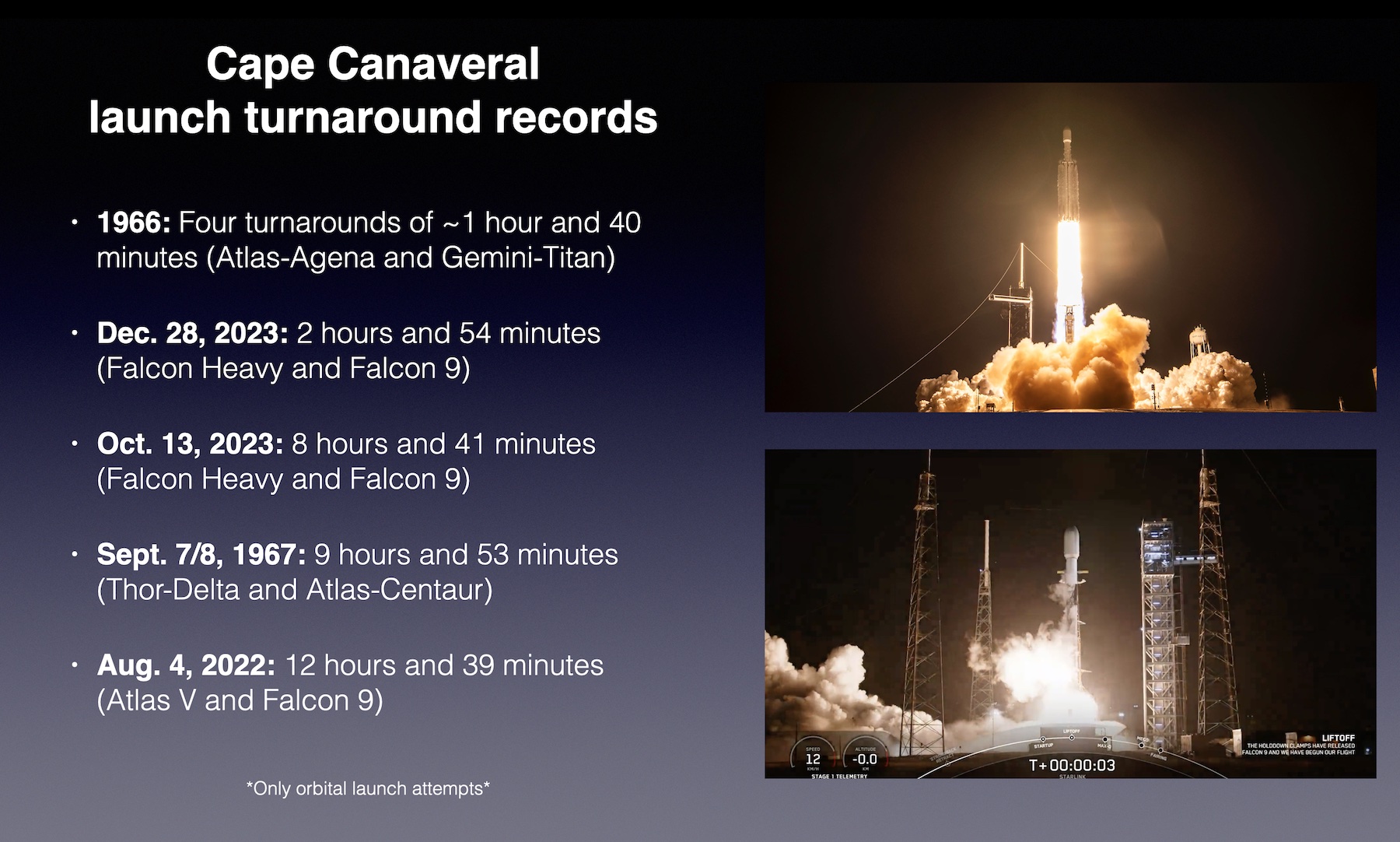
1966: Atlas-Agena & Titan-Gemini ~ 1h 40m apart (4x)


This was the shortest time between orbital launches at Cape Canaveral since 1966. //
It seems like SpaceX did everything this year but launch 100 times.
On Thursday night, the launch company sent two more rockets into orbit from Florida. One was a Falcon Heavy, the world's most powerful rocket in commercial service, carrying the US military's X-37B spaceplane from a launch pad at NASA's Kennedy Space Center at 8:07 pm EST (01:07 UTC). Less than three hours later, at 11:01 pm EST (04:01 UTC), SpaceX's workhorse Falcon 9 launcher took off a few miles to the south with a payload of 23 Starlink Internet satellites.
The Falcon Heavy's two side boosters and the Falcon 9's first stage landed back on Earth for reuse. //
These were SpaceX's final launches of 2023. SpaceX ends the year with 98 flights, including 91 Falcon 9s, five Falcon Heavy rockets, and two test launches of the giant new Super Heavy-Starship rocket. These flights were spread across four launch pads in Florida, California, and Texas. //
It's important to step back and put these numbers in context. No other family of orbit-class rockets has ever flown more than 63 times in a year. SpaceX's Falcon rockets have now exceeded this number by roughly 50 percent. SpaceX's competitors in the United States, such as United Launch Alliance and Rocket Lab, managed far fewer flights in 2023. ULA had three missions, and Rocket Lab launched its small Electron booster 10 times.
Nearly two-thirds of SpaceX's missions this year were dedicated to delivering satellites to orbit for SpaceX's Starlink broadband network, a constellation that now numbers more than 5,000 spacecraft. //
As if these statistics weren't enough, SpaceX closed out the year by, yes, setting yet another record. The back to back launches Thursday night took off 2 hours and 54 minutes apart, the shortest turnaround between two SpaceX flights in the company's history. It also set a modern era record at Cape Canaveral, Florida, with the shortest span between two orbital-class launches there since 1966. The Florida spaceport was the departure point for 72 orbital-class rockets in 2023, also an unprecedented level of launch activity there.
SpaceX looks poised to set more records next year. In 2024, SpaceX aims for an average of a dozen launches per month, for a total of 144 rocket flights. The company will get out of the starting blocks early in the new year, with two Falcon 9 launches slated for January 2 and 3.

A hundred years ago, the ’20s were roaring and President Calvin Coolidge did things the current president and Congress would do well to emulate.
Coolidge won a landslide victory running on a platform of limited government, reduced taxes and less regulation.
He followed through on all three, creating an economic boom. (Where have you gone, Silent Cal, our nation turns its lonely eyes to you).
Coolidge also signed an immigration law that regulated the number of foreigners who could come to America.

In case you don’t know, we here at The Post call our front pages “the wood.” Back when the newspaper was typeset, metal letters weren’t large enough to handle the job of a big opening headline, so those letters were carved on wood blocks, then used to stamp the ink on the page.
The wood is a collaborative process. //
Last week, we picked the 24 woods that exemplified 2023.
From the gas-stove ban pursued by Gov. Hochul (SHE’S DE-RANGED) to Biden’s hoarding of classified documents next to his car (ANYBODY VETTE THIS GUY?) to the academic who held a machete to the neck of one of our reporters (THE NUTTY PROFESSOR).
We asked you to pick the 25th — and you came through.
You suggested the soap opera of George Santos (GEORGE JETTISON) and Hunter Biden (MR. GRIFT GOES TO WASHINGTON) and the government finally admitting COVID likely came from a Chinese government lab (IT HAD TO BE WU).
Doreen H. picked BIDEN RESIGNS, which we looked for and never found — but thanks for reading, Doreen. Maybe you’re getting hopeful for 2024. //
Many picked Donald Trump’s mugshot, which ran on the front page August 25 without a headline, perhaps the only time in our history that has happened. And so it became what readers wanted it to be. //
So: The results. The second runner up is SURRENDER, from Dec. 20, a picture of a lone Border Patrol officer facing down hundreds of migrants at the border — a crisis that continues into the new year.
The first runner up is New York’s Jamaal Bowman pulling the fire alarm to try to delay a vote in the House. DOES THIS LOOK LIKE A DOOR HANDLE? we said of his ridiculous excuses. //
And speaking of Democrat politicians behaving badly, the winner you picked for the 25th front page of 2023 by a wide margin is . . . HAUTE MESS.
Post reporter Jon Levine dressed as Senator John Fetterman, in long shorts and a sweatshirt, and tried to get into New York’s exclusive restaurants and clubs. Hey, if it’s good enough for the Senate, is it good enough for the Ritz?

First and foremost, she advised, it’s vital to apply fragrance on clean skin. Then, she recommends lathering the skin with unscented body lotion, because “hydrated skin will better lock in the fragrance and will insure it lasts for longer.”
Josephine’s second strategy is to apply fragrance to clothing — albeit, at a safe distance so as to not stain the items. //
Lastly, she recommended dousing a hairbrush in perfume and running it through your locks.
“This will ensure that the fragrance gets onto your hair without having the drying effect of alcohol,” she added. //
Fragrance fanatics have touted Vaseline as the key to a long-lasting aroma — applying it before perfume, in theory, would make the smell stick around. According to the Guardian, the low-budget hack actually works, one journalist reported after testing a fragrance on a bare wrist and on another slathered with petroleum jelly.

Last February, the independent Public Advocates Office of the state Public Utilities Commission reported that residential electricity rates in California had risen between 77% and 105% since 2014 and are far above the national average. “The majority of bill increases are associated with long-standing state priorities,” the report explained.
Yet for all the money Californians pay for those “priorities,” the state doesn’t really run on solar and wind energy.
It’s powered mostly by natural gas, hydroelectric, nuclear energy and, when all else fails, electricity generated in other states and imported on transmission lines. //
While California’s need for electricity can rise as high as 50,000 megawatts in the summer with air conditioning, solar energy produces about 15,000 megawatts at its peak, declining to zero after sunset.
The gap is filled by – you guessed it – natural gas, nuclear, hydroelectric and imports.
In pursuit of “100% clean electricity,” the state’s gas-fired plants were scheduled to be closed this week and its one nuclear plant to be shuttered in 2025.

The introduction of railroads changed a lot, including time; with every town having its own time, marked at the sun's zenith, scheduling was a mess. //
Charles F. Dowd tamed time.
The career educator conceived a plan so audacious it’s hard to believe there was an era when his vision for the world didn’t exist.
Dowd created time zones. He put the rotation of the Earth, the rise of the sun, the movement of the heavens and the genesis of eternity itself on an artificial schedule for the benefit of mankind.
"To regulate the time of this Empire Republic of the World is an undertaking of magnificent proportions," the Indianapolis Sentinel wrote on Nov. 21, 1883, three days after railroads instituted time zones across North America. //
We recalcitrant Americans came late to the party, not legally adopting the time zone system until 1918, during the Great War, but the railroads bought into the new system in 1883, as it made schedule-keeping a lot easier. //
In one of history's little ironies, Charles Dowd was killed in 1904 when he stepped in front of a train; history has not recorded whether or not that train was running on time.

It is encouraging, though, to see that there are candidates who understand the stakes and are willing to stand up and say that the nation and our republic are not served by imprisoning a former president for the sake of spite. //
Trump is playing a dangerous game ... that will do massive damage to the nation. //
Laocoön of Troy etba_ss
5 hours ago edited
This is 100% true. Trump hasn't learned a damned thing. He thinks this is a game and he'll be able to schmooze his way out of the hole he dug for himself. Like Trump University, Trump Steaks, and all of the rest of the scams he's run for most of his life. He really stupidly thinks he can talk his way outta this. I don't think dumbass properly describes his foolishness.

The era of mainframe computers and directly programming machines with switches is long past, but plenty of us look back on that era with a certain nostalgia. Getting that close to the hardware and knowing precisely what’s going on is becoming a little bit of a lost art. That’s why [Phil] took it upon himself to build this homage to the mainframe computer of the 70s, which all but disappeared when PCs and microcontrollers took over the scene decades ago.
The machine, known as PlasMa, is not a recreation of any specific computer but instead looks to recreate the feel of computers of this era in a more manageable size.

Reviewer: contradiction in terms - favoritefavoritefavoritefavoritefavorite - December 24, 2016
Subject: A book about life under a total ideology
If you read Gulag Archipelago and your take-away was "the bourgeois classes have treasonous ideas," then I don't know what to tell you!
"Marxism had a grip on the academic communities of all the major universities, once and for all I was able to resist the drip, drip, drip of the propaganda" in particular is exactly the kind of thing a Soviet ideologue would have said, although they would not have said Marxism but imperialism or liberalism or something.
One of Solzhenitsyn's themes in this book is not that Marxism had some unique poison in it or that the Soviet Union was a shocking stain on the otherwise spotless behaviour of the human race, but that it all HAD to turn out like that in a state with a perfect ideology, an answer to everything with no holes in it.
p. 173-174 of I-II: "Macbeth's self-justifications were feeble―and his conscience devoured him. Yes, even Iago was a little lamb too. The imagination and the spiritual strength of Shakespeare's evildoers stopped short at a dozen corpses. Because they had no ideology.
"Ideology―that is what gives evildoing its long-sought justification and gives the evildoer the necessary steadfastness and determination. That is the social theory which helps to make his acts seem good instead of bad in his own and others' eyes, so that he won't hear reproaches and curses but will receive praise and honors. [...]
"Thanks to ideology, the twentieth century was fated to experience evildoing on a scale calculated in the millions. This cannot be denied, nor passed over, nor suppressed. How, then, do we dare insist that evildoers do not exist? And who was it that destroyed these millions? Without evildoers there would have been no Archipelago.

Aleksandr Solzhenitsyn dedicated his book about the end state of communism ‘to all those who did not live to tell it.’ //
My parents emigrated from the Soviet Union. From what they told me, I developed a deep reluctance to being frog-marched to Kolyma courtesy of unilateral disarmament peaceniks, who are nowadays called “woke” with alternate grievances but the same collectivist Borg mentality. //
In part I’s fourth chapter, Solzhenitsyn encourages humility about human vulnerability to evil. “If only there were evil people somewhere insidiously committing evil deeds, and it were necessary only to separate them from the rest of us and destroy them. But the line dividing good and evil cuts through the heart of every human being. And who is willing to destroy a piece of his own heart?” //
In part VII’s third chapter, Solzhenitsyn excoriates apologists for Soviet misrule: “All you freedom-loving ‘left-wing’ thinkers in the West! … As far as you are concerned, this whole book of mine is a waste of effort. You may suddenly understand it all someday — but only when you yourselves hear ‘hands behind your backs there!’ and step ashore on our Archipelago.” He knew his disclosures would meet that era’s version of cancel culture. //
The will to dominate runs deep in the human psyche. Archipelago reminds us such despotic cruelty became commonplace in living memory with few held accountable.
Moreover, such atrocities continue today behind barbed wire in western China, North Korea, and elsewhere on the globe. Solzhenitsyn warns us all of the consequences should resistance to totalitarianism fail.

“The FCC is dishonestly claiming that it is promoting equity and fairness. However, the FCC is just seizing control over business decisions, funneling resources to politically preferred constituencies.” //
Congress, in the 2021 bipartisan infrastructure bill, delegated to the FCC the task to “ensure that all people of the United States benefit from equal access to broadband internet access.”
In fact, the agency found no evidence of intentional discrimination, but the leftists on the FCC used Congress’ delegation as an excuse to force equity and diversity mandates ranging from controls over discounts, language options, and credit checks to marketing and advertising.

"All Chinese on both sides of the Taiwan Strait should be bound by a common sense of purpose and share in the glory of the rejuvenation of the Chinese nation," Xi said in Sunday's address.
"The motherland will surely be reunified," he added. //
The speech was the second time in a matter of days that Xi addressed the Taiwan issue. Xi also vowed to reunify Taiwan on Tuesday during a symposium in Beijing commemorating the 130th anniversary of the birth of Mao Zedong, the founding father of Communist China.
"The complete reunification of the motherland is an irresistible trend," Xi said at the event, adding that China would "resolutely prevent anyone from splitting" the two sides.

Vivek said we hadn't been perfect as a country, that we had slavery for 160 years, and we had a Civil War fought over it. "Some people learned that later than others," he said, taking a shot at fellow GOP candidate Nikki Haley and her Civil War comments controversy, as the audience laughed. //
"The question is what do we do about it now," Ramaswamy said. He spoke about it getting small enough to "atrophy into irrelevance," comparing the question to an immune system reacting to the virus that's no longer so powerful and starting to attack the body's organs. "That's what I see happening in the country," he explained.
"Today, the best way to stop discrimination on the basis of race is to stop discriminating on the basis of race," Vivek declared. He thought we'd created more racism in the name of "anti-racism." "If we drive with our eyes in the rear-view mirror, we're just going to keep crashing the same car and recreating the thing we wanted to eradicate." //
The growing problem today is revenge racism. It's at the heart of everything from DEI policies to demands for reparations. This isn't about equality or even equity. It's about punishment and suffering.

In the words of Sir Arthur "Bomber" Harris, "The Nazis entered this war under the rather childish delusion that they were going to bomb everyone else, and nobody was going to bomb them. At Rotterdam, London, Warsaw, and half a hundred other places, they put their rather naive theory into operation. They sowed the wind, and now they are going to reap the whirlwind."