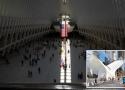
Out of the darkness…
A stunning symbolic display of light dazzled visitors at World Trade Center’s Oculus Thursday — an annual moment of remembrance that occurs every Sept. 11 at exactly 10:28 a.m.
Known as the “Way of Light,” the sun’s golden rays precisely align with the building’s retractable skylight to form a dappled path of light on the floor along the axis of the structure that appears to be two towers standing slide by side.


How We Can Make Nuclear Cheap Again Paperback – March 30, 2025
by Jack Devanney (Author)
This book has a joyful message. We can simultaneously solve the Gordian Knot of our time: the closely coupled problems of energy poverty and global warming. The solution is cheap nuclear power, and we can have cheap nuclear if we want it.
Here's the Good News:
1) Our fear of radiation is vastly overblown. A providential Nature has provided us with DNA repair mechanisms that can easily handle dose rates 100's of times above normal background. Dose rates that exceed the repair capabilities of our bodies will almost never be encountered by the public in even a very large release.
2) Thanks to its insane energy density and the resulting tiny resource requirement, nuclear power is inherently cheap, less than 3 cents per kWh cheap. Indeed nascent nuclear in the 1960's did-cost less than 3 cents/kWh in today's money. Nuclear power should consume far less of the planet's precious resources than any other source of electricity, while producing nearly no pollution and very little CO2.
Nuclear's problems are man-made. Nuclear power never escaped from its government sponsored and controlled birth. In the process, it developed a regulatory regime explicitly mandated to increase costs to the point where nuclear power is barely economic, while at the same time convincing everyone that low dose rate radiation is perilous.
But what is man-made can be man-unmade. All that's required is an acceptance of these two providential realities, a change in attitude, a metanoia. With this change, the way forward becomes obvious, and not that difficult to implement.
This little book explains why (1) and (2) are true, and then traces nuclear power's decline into a prohibitively expensive mess. Finally, it offers a way out, a system for regulating nuclear which will force the providers of nuclear power to compete with each other and new entrants on a level playing field, in which case the inherent cheapness of fission power combined with technological advances will push the cost of nuclear electricity down to its should-cost.
Nuclear would undercut fossil fuel almost every where. Fossil would be relegated to a bit of peaking and backup for unplanned outages. Intermittents would be limited to a few niche markets. This would all be automatic. No need for subsidies or mandates. The poor would be immensely richer. Electrification of transportation and industry would explode. Desalinization would take off. Synthetic fuels could become viable. Skies would be clean. All this electricity would require little land and produce almost no CO2. The planet would be cooler. Could there be a more joyful message?
Charlie Kirk - Are You A Christian

So, what are the benefits of parenting? The most obvious are the emotional ones. These are hard to quantify, of course, but are certainly detectable in polling.
A new survey by the Institute for Family Studies, for example, found that mothers, particularly married mothers, are more likely than non-parents to report that they are “very happy.” Both married moms and unmarried moms were much more likely than women without children to report that their life has a “clear sense of purpose.” The survey’s authors concluded: “Despite the challenges associated with family life for women—including more stress and less time for oneself—there is no question that marriage and motherhood are linked to greater female flourishing on many other fronts.” Similarly, the regret rate for having children is remarkably low; very few people with children would not have had kids if they had the chance to do things over again. As psychologist Paul Bloom writes, “[t]he love we usually have toward our children means that our choice to have them has value above and beyond whatever effect they have on our happiness and meaning.” //
According to one study of 200,000 men and women in 86 countries, “mothers and fathers over 50 are generally happier than their childless peers, no matter how numerous their offspring.” In other words, children may be a long-term investment in happiness. Putting in the work to nurture a young baby pays off in middle and old age, as proud parents watch their adult children launch careers, have children of their own, and reunite around the family table for Thanksgiving.
At the margins, parenting can come with truly tremendous costs. In the book Better than OK: Finding Joy as a Special Needs Parent, Kelly Mantoan writes about the challenges of homeschooling five children, two of whom have a severe degenerative disorder that requires around-the-clock, hands-on care. Yet Mantoan writes that, through accepting her children’s diagnoses, “I am a stronger, more humble, sacrificial, and faith-filled person than I was before I started this journey.”. //
This is one of the most powerful paradoxes of parenting: the costs and the benefits are two sides of the same coin.
I had been taught in school that scurvy had been conquered in 1747, when the Scottish physician James Lind proved in one of the first controlled medical experiments that citrus fruits were an effective cure for the disease. From that point on, we were told, the Royal Navy had required a daily dose of lime juice to be mixed in with sailors’ grog, and scurvy ceased to be a problem on long ocean voyages.
But here was a Royal Navy surgeon in 1911 apparently ignorant of what caused the disease, or how to cure it. Somehow a highly-trained group of scientists at the start of the 20th century knew less about scurvy than the average sea captain in Napoleonic times. Scott left a base abundantly stocked with fresh meat, fruits, apples, and lime juice, and headed out on the ice for five months with no protection against scurvy, all the while confident he was not at risk. What happened? //
One of the most striking features of the disease is the disproportion between its severity and the simplicity of the cure. Today we know that scurvy is due solely to a deficiency in vitamin C, a compound essential to metabolism that the human body must obtain from food. Scurvy is rapidly and completely cured by restoring vitamin C into the diet.
Except for the nature of vitamin C, eighteenth century physicians knew this too. But in the second half of the nineteenth century, the cure for scurvy was lost. The story of how this happened is a striking demonstration of the problem of induction, and how progress in one field of study can lead to unintended steps backward in another. //
Finally, that one of the simplest of diseases managed to utterly confound us for so long, at the cost of millions of lives, even after we had stumbled across an unequivocal cure. It makes you wonder how many incurable ailments of the modern world—depression, autism, hypertension, obesity—will turn out to have equally simple solutions, once we are able to see them in the correct light. What will we be slapping our foreheads about sixty years from now, wondering how we missed something so obvious? //
But the villain here is just good old human ignorance, that master of disguise. We tend to think that knowledge, once acquired, is something permanent. Instead, even holding on to it requires constant, careful effort.
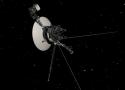
After nearly half a century in deep space, every ping from Voyager 1 is a bonus
Powered by plutonium, running on pure stubbornness
It is almost half a century since Voyager 1 was launched from Cape Canaveral in Florida on a mission to study Jupiter, Saturn, and the atmosphere of Titan. It continues to send data back to Earth.
Although engineers reckon that the aging spacecraft might survive well into the 2030s before eventually passing out of range of the Deep Space Network, the spacecraft's cosmic ray subsystem was switched off in 2025. More of the probe's instruments are earmarked for termination as engineers eke out Voyager's power supply for a few more years.
On September 5, 1977, the power situation was a good deal healthier when the mission got underway. Launched just over two weeks after Voyager 2, Voyager 1 was scheduled to make flybys of Jupiter and Saturn. It skipped a visit to Pluto in favor of a closer look at the Saturnian moon Titan, which had an intriguing atmosphere.
The launch was the final one for the Titan IIIE rocket and was marred slightly by an earlier-than-expected second stage engine cutoff. NASA averted disaster by using a longer burn of the Centaur stage to compensate, and Voyager 1's mission to Jupiter, Saturn, and beyond began.
Voyager 1's journey to the launchpad began with the "Grand Tour" concept of the 1960s, in which Gary Flandro of the Jet Propulsion Laboratory (JPL) noted an alignment of Jupiter, Saturn, Uranus, and Neptune would occur in the 1970s, allowing a probe to swing by all the planets by using gravity assists. //
Voyager 1 could have performed the same Grand Tour as Voyager 2, and would have if disaster had befallen the latter at or soon after launch. However, it was Voyager 2 that swung past Uranus and Neptune, while Voyager 1 took a trip past Titan before finally heading away from the planets. It used its cameras to take one last set of images – the famous "Solar System Family Portrait," comprising six of the solar system's eight planets and, of course, the "Pale Blue Dot" image.
Voyager took the images on February 14, 1990. "That was always our farewell thing," said Hunt. "That was our Valentine's present for 1990."
Farewell? Not quite. Voyager 1 continues to send data back to Earth, 48 years after its launch.

DaveGinOly in reply to ztakddot. | September 5, 2025 at 1:32 am
A portion of deaths during the “Spanish” flu pandemic were almost certainly iatrogenic. Patients, many of them young soldiers, were treated with what we now know were fatally toxic doses of the miracle drug of the day – aspirin. Modern analysis of the day’s post mortems show many deaths displaying characteristics of salicylate poisoning – pneumonia-like wet and hemorrhaging lungs.
lichau in reply to DaveGinOly. | September 6, 2025 at 3:51 pm
Bingo.
I read that they were absolutely pounding aspirin. 20g/day or more.

Turns out anyone can join the International Association of Genocide Scholars. //
Any organization can claim to be an expert on genocide and recruit enough members committed to the destruction of Israel to say that the Jewish state is guilty of it. A functional media would weed out such imposters. Unfortunately, our media is uninterested in vetting its headlines—or even retracting the items proven to be untrue. In the current climate, news consumers should be advised to assume that everything they hear about Israel is an op until proven otherwise. That includes New York Times front page stories like the fake famine picture they published in July.
As for genocide, it really did happen during the Gaza War. What transpired in southern Israel on October 7, 2023 was genocide. It was unusual in a way that the perpetrators accused the Jewish state of that of which they are guilty themselves. Avraham Russel Shalev of Kohelet Policy Forum recently wrote a paper concluding that:
Hamas’ October 7 attack constitutes genocide under international law. This conclusion rests on three interconnected pillars. First, the physical acts committed—the systematic killing of over 1,200 Israelis, accompanied by torture, sexual violence, and mutilations—satisfy the actus reus requirement of the Genocide Convention. Second, Hamas’ specific intent to destroy Israeli Jews is evident through multiple channels: its foundational ideology of eliminationist antisemitism, its decades-long systematic policy of incitement, its detailed operational planning for mass killing, and explicit statements by its leadership before and during the attack.
What distinguishes this case, however, is the third element: the immediate deployment of reverse genocide accusation against the victims.
This is what the media defenders of Gaza call “every accusation is a confession,” only they direct their venom against the Jews. The Jewish case is persuasive. Will the media ever give it a minute of their attention? //
jb4 | September 6, 2025 at 9:37 am
Per Google and Al Jazeera about 65,000 of the 2.1 million Gaza population, or about 3%, has been killed in just under 2 years, most of whom would have been Hamas fighters. Given that Israel had the capacity to wipe out 100% of the population on October 8, this “genocide” may go down in history as the most incompetently ever conducted. /s
GeekyOldFart
Three languages
And I'm not talking about programming languages, where most of us are fluent in half a dozen or so.
1: Regulatorian: This is the language of politicians and lawyers. It sets the mandates on banks, hospitals, schools etc. It contains nuances and terms of art that sometimes make a word mean something totally different to what you would infer if you heard it in general conversation.
2: Beancounterese: Spoken by accountantrs, salesmen and middle manglement. It sounds very similar to regulatorian but is sufficiently different in some of its meanings that it's as big a gulf as between old scots and english.
3: Geekian: The language of hard science, mathematics, real-world realities and the only one to use when specifying what a programmer needs to code. Because they will code what you tell them to, and it will work the way this language describes it.
The same word can mean different things in these three languages.
We have to be fluent in all three to accurately interpret requirements and predict what the emerging software will look like, to take error logs and demonstrate to (sometimes hostile) manglement what corrective action is needed and where it needs to be applied.
Michael H.F. WilkinsonSilver badge
Reply Icon
Re: Three languages
It gets worse, as there are quite a few Geekian dialects. I have learnt to speak a couple over the years, and know the word "morphology" can have radically different meanings, depending on whether you are talking to a medical doctor, an astronomer, or an image processing specialist. Great fun when you are in a project with different geeks each speaking their own dialect.
Shirley Knot
Reply Icon
Re: Three languages
Well said!
When writing specs for dev projects and talking to those speaking Regulatorian or Beancounterese it involves finding out what they actually mean, without saying "What the fuck do you actually mean?!" The skill is in performing iterative attempts without making them blow their stacks! The most frustrated person I had to deal with was a lovely chap that'd been doing his thing for decades, in manufacturing/engineering. He knew exactly what he was doing, but couldn't articulate it - quite understandable, not part of his world. Once he understood that I was just a white collar noob and he was the expert he calmed right down and enjoyed going into as much detail as needed. Explosive decompression averted and job done!

Historic interpreter taught millions to program on Commodore and Apple computers.
On Wednesday, Microsoft released the complete source code for Microsoft BASIC for 6502 Version 1.1, the 1978 interpreter that powered the Commodore PET, VIC-20, Commodore 64, and Apple II through custom adaptations. The company posted 6,955 lines of assembly language code to GitHub under an MIT license, allowing anyone to freely use, modify, and distribute the code that helped launch the personal computer revolution.
"Rick Weiland and I (Bill Gates) wrote the 6502 BASIC," Gates commented on the Page Table blog in 2010. "I put the WAIT command in.". //
At just 6,955 lines of assembly language—Microsoft's low-level 6502 code talked almost directly to the processor. Microsoft's BASIC squeezed remarkable functionality into minimal memory, a key achievement when RAM cost hundreds of dollars per kilobyte.
In the early personal computer space, cost was king. The MOS 6502 processor that ran this BASIC cost about $25, while competitors charged $200 for similar chips. Designer Chuck Peddle created the 6502 specifically to bring computing to the masses, and manufacturers built variations of the chip into the Atari 2600, Nintendo Entertainment System, and millions of Commodore computers. //
Why old code still matters
While modern computers can't run this 1978 assembly code directly, emulators and FPGA implementations keep the software alive for study and experimentation. The code reveals how programmers squeezed maximum functionality from minimal resources—lessons that remain relevant as developers optimize software for everything from smartwatches to spacecraft.
This kind of officially sanctioned release is important because without proper documentation and legal permission to study historical software, future generations risk losing the ability to understand how early computers worked in detail. //
the Github repository Microsoft created for 6502 BASIC includes a clever historical touch as a nod to the ancient code—the Git timestamps show commits from July 27, 1978.

lukem
If you're going to use test values in your test systems, why not use test values allocated for documentation purposes that aren't expected to be used in "live" networks?
IETF RFC 5737 section 3 allocates three IPv4 CIDR ranges for documentation:
192.0.2.0/24, 198.51.100.0/24, and 203.0.113.0/24.
September 5, 2025 at 8:02 am
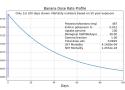
according to LNT, if every human ate a banana a week, bananas would kill 1600 people a year. In the same scenario, SNT kills one person every 2.5 million years.
Now, class, let's get back to basics.
Repeat after me:
It's not dose. It's dose rate profile.
Good.
Repeat after me:
LNT does not say eating a banana is safe or unsafe.
LNT says eating a banana has a 4 in a billion chance of killing you.
Repeat after me:
SNT does not say eating a banana is safe or unsafe.
SNT says eating a banana has a 1 in a billion-billion chance of killing you.
Whether those risks are safe or unsafe is up to you.
Class dismissed.
In less than a few centuries, 250 groundbreaking hydrocarbon processing and refining techniques were discovered. Their impact continues today, benefiting the 8 billion people living on Earth.
Today, over 6,000 products derived from petroleum enrich our lives. They have reduced infant mortality, doubled global life expectancy from around 40 to over 80 years, and made it possible to travel anywhere in the world by plane, train, ship, or car — drastically reducing weather-related deaths to nearly zero. These were all unimaginable in societies before 1800. //
Today, “Net Zero” policymakers setting “green” policies are oblivious to the reality that so-called “renewables” ONLY generate electricity but CANNOT make anything. In addition, everything that NEEDS Electricity, like iPhones and computers, is made with petrochemicals manufactured from crude oil, coal, or natural gas.
Electricity came after oil, as all electrical generation methods, including hydro, coal, natural gas, nuclear, wind, and solar, are built with products, components, and equipment made from oil derivatives manufactured from crude oil. //
If we go back 200 years to the 1800s, we find a decarbonized society, i.e., a very different era and a society without products, transportation fuels, and electricity. Fossil-fuel products weren’t widespread, thus lifestyles were less prosperous, health conditions were precarious, and life expectancy was short.
A renewed shift toward decarbonization and zero-emission lifestyles severely restricts the use of fossil fuels, like coal and oil, and could bring us back to a world of more than 200 years ago. That might mean billions suffering again from disease, malnutrition, and weather-related fatalities.
Moving toward decarbonization risks depriving, or delaying access to, the standards of living and products that wealthy, healthy nations take for granted. Today, around 700 million people, which is roughly 9% of humanity, live below the international poverty line. In other words, halting fossil fuel production and use would reverse many centuries of progress.
Over the last 200 years, after the discovery of the products and transportation fuels that could be manufactured out of crude oil, the world’s population has increased from 1 billion to 8 billion. It was more than 6,000 “products” from oil that supported the tremendous growth in population. //
Wind turbines and solar panels can ONLY generate ELECTRICITY.
All the products and transportation fuels demanded by society, all the infrastructures, and the economy are made from fossil fuels.
It's easier to fool people than to convince them that they have been fooled.
If you can keep your head when all about you
Are losing theirs and blaming it on you;
If you can trust yourself when all men doubt you,
But make allowance for their doubting too:
If you can wait and not be tired by waiting,
Or, being lied about, don't deal in lies,
Or being hated don't give way to hating,
And yet don't look too good, nor talk too wise;
If you can dream---and not make dreams your master;
If you can think---and not make thoughts your aim,
If you can meet with Triumph and Disaster
And treat those two impostors just the same:.
...
If you can fill the unforgiving minute
With sixty seconds' worth of distance run,
Yours is the Earth and everything that's in it,
And---which is more---you'll be a Man, my son!
When the Himalayan peasant meets the he-bear in his pride,
He shouts to scare the monster who will often turn aside.
But the she-bear thus accosted rends the peasant tooth and nail,
For the female of the species is more deadly than the male.
...
It is always a temptation to an armed and agile nation
To call upon a neighbour and to say:--
"We invaded you last night--we are quite prepared to fight,
Unless you pay us cash to go away."
And that is called asking for Dane-geld,
And the people who ask it explain
That you've only to pay 'em the Dane-geld
And then you'll get rid of the Dane!
...
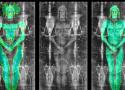
Perhaps the most famous "holy relic" is the Shroud of Turin, an old linen cloth that retains a distinct impression of the body of a crucified mine (both front and back). The legend is that Jesus himself was wrapped in the shroud upon his death around 30 CE, although modern scientific dating methods revealed the shroud is actually a medieval artifact dating to between 1260 and 1390 CE. A 3D designer named Cícero Moraes has created a 3D digital reconstruction to lend further credence to the case for the shroud being a medieval forgery, according to a paper published in the journal Archaeometry.
Moraes developed computer models to simulate draping a sheet on both a 3D human form and a bas-relief carving to test which version most closely matched the figure preserved in the shroud. He concluded that the latter was more consistent with the shroud's figure, meaning that it was likely created as an artistic representation or a medieval work of art. It was certainly never draped around an actual body. Most notable was the absence of the so-called "Agamemnon mask effect," in which a human face shrouded in fabric appears wider once flattened.
Ep. 2.05 When You Comin' Back, Range Rider?
Republic of Liberia Government Boeing 727-25, registration EL-GOL, c/n 18253/11 built in 1963 for Eastern Air Lines.
Please note the Beechcraft King Air hidden by the stairs and cars.

Iran’s wind catchers stand as a reminder of how ancient civilisations have adapted to the region’s harsh desert environment.