What is the max skin temperature?
I heard/read somewhere that the reason the max skin temp of the real thing was 127℃ was because it made the maths easier for the engineers. Which makes sense after a little thinking.
I also heard about an SR-71 crew who were buzzing around the Caribbean being alerted to "Civilian traffic at your altitude" and being "WTF?"
Happy
Re: What is the max skin temperature?
What, so _skintemp could be stored as a 7-bit uint?
So... if any part of Concorde's skin ever reached 128°C, it would instantly flash-freeze?
Re: What is the max skin temperature?
127+273=400. (K)
Re: What is the max skin temperature?
Maximum skin temperature of 127ºC was set by the properties of the aluminum alloy used on the Concorde. Sustained exposures to temperatures above that would weaken the alloy. Sustained Mach 3 flight requires use of Titanium or stainless steel.
IIRC, the SR-71's typical operating altitude was a few km higher than the Concorde.
Re: What is the max skin temperature?
There's an interview with the SR71 pilot in the Omegatau podcast.
He was describing how he was pootling around over Cuba doing SR71 type things, when asked to look out for civilian traffic at his flight level
His observation was that he was wearing a space suit and peeing in a tube, while these businessmen flew past in shirt sleeves eating dinner and sipping champagne.


Tom Lopes flew a 2018 Cessna 172S Skyhawk SP on a ferry flight between California to Hawai’i. He flew the small single-engine general aviation aircraft an incredible 2,425 miles over more than 17 hours over the Pacific Ocean to the aircraft’s new home. This feat is even more mind-blowing when you learn that this was a nonstop flight that was more than three times the normal range of the aircraft. Here’s how Lopes did it.
Perhaps the coolest part about this journey is the fact that it’s something that Lopes has done before. Tom Lopes, the owner of Gateway Air Center, is a ferry pilot. He’s the guy you hire when you’ve just purchased a plane from somewhere far away and you want it delivered to where your home base is. Two years ago, Lopes flew the same crazy journey we’re talking about today. Lopes flew a different Cessna 172 between Merced Regional Airport/Macready Field in Merced, California, and the Daniel K. Inouye International Airport in Honolulu, Hawai’i. I wrote about that trip two years ago and it took Lopes over 18 hours to fly the little plane 2,521 miles, or 2,190 nautical miles.
There may be no greater debate amongst pilots than the “rich of peak” or “lean of peak” (ROP vs. LOP) exhaust gas temperature method of leaning the aircraft engine. //
So that leaves us with the question; is it better to operate rich of peak or lean of peak?
Some engines achieve maximum economy range on the leaner fuel side of peak exhaust gas temperatures (EGT) and maximum power on the rich side of peak EGT. Some achieve both on the rich side of peak EGT. The ultimate answer comes from your engine manufacturer’s engine operator’s manual (EOM).
Exhaust Gas Temperature (EGT) provides pilots a way of monitoring the fuel/air mixture in the engine. It uses the stoichiometric mixture (where Fuel and Air are perfectly balanced so that there is no unburned fuel and no unburned oxygen at the end of the combustion event) as a reference: At this mixture the EGT is at its hottest ("Peak EGT"). Making the mixture richer or leaner will reduce the EGT, and all other mixture settings are described in terms of "Degrees Rich of Peak" or "Degrees Lean of Peak". //
The area of the chart from peak EGT to about 100 degrees Rich of Peak is often referred to as "The Red Box" -- in this range the fuel/air mixture has a low detonation margin, and the combustion event is producing the most internal stress on the engine components (cylinders, pistons).
As you can see from the Lycoming chart the Cylinder Head Temperature (CHT) peaks in this range, and there is a risk of exceeding the CHT limits and seriously damaging your engine by operating in this range for extended periods of time, particularly at high power settings.
The Terminal Procedures Search application allows searching, viewing, and downloading of the U.S. Terminal Procedure Publications (TPPs) as PDF files

https://avgeekery.com/kc-46-flies-around-the-world-nonstop/
Brian Millar about 15 hours ago 2
Search 20-46075 and you should be able to see its most recent flights; RCH046 on June 29 and July 1.
Departed from McConnell June 29 around 21:00Z headed west. Left the CONUS near Ft. Bragg, CA and dropped from tracking. Picked up a brief blip as it passed over Hawaii.
The July 1 RCH046 flight track picks it up again over the UAE, through the Persian Gulf to Turkiye and across Europe. We see a loop off the coast of England north of RAF Mildenhall for refuelling.
It appears again with a brief blip off the coast of Iceland and disappears again until it re-enters the CONUS over Lake Superior.
I searched through all the 16-46.., 17-46.., 18-46.., etc Pegasus aircraft’s in the fleet and any flights around July 1 to try to figure out which one it was.
Once I landed on 20-46075 and googled it I found a good write up on Twitter/X by “MeNMyRC”
https://x.com/MeNMyRC1/status/1808242275710898243 //
srobak about 7 hours ago 2
The funniest part is it also couldn't refuel itself - and instead had to rely on the 135 that it is supposed to replace to keep it in the air lol. //
srobak about 7 hours ago 0
The boomers hate them because the remote boom ops are complete garbage. Latency and precision issues. They've been plagued with design and electrical issues on multiple fronts and the entire fleet has been grounded more times than the max. Read up on the history - the 46 and the 35 alike are the most hated aircraft in the af. The funniest part is it also couldn't refuel itself - and instead had to rely on the 135 that it is supposed to replace to keep it in the air lol.
matt jensen about 5 hours ago 2
We love the KC135 as it only requires three man crew. The 46 needs 8-10 men to do the same job
MCAS was added on at the end as a high-tech Band-Aid to mitigate an unacceptable issue within the underlying MAX design.
Incompatible requirements had the MAX engineering team figuring out how to retrofit a large, next-generation engine (with fuel efficiency to compete with the Airbus A320neo) onto a legacy 737 airframe from 1968 without room for the new engine in the original mounting location. The team moved the engine mounting location forward and higher to fit the larger engine. The new mounting location was analyzed to cause an undesirable, increased tendency for this aircraft design to pitch upward (which can cause a stall in extreme situations).
Instead of pursuing other structural design options such as redesigning the landing gear, the team turned to the engineering elixir of automation. Sound engineering was outsourced to an autonomous MCAS computer with the authority to push the plane downward as it saw fit — tragically so in the 2018-2019 crashes.
An engineering team would not follow this course of action of its own accord. The legacy airframe was an issue; the new mounting location was an issue; inserting automation into the loop to smooth over these issues is unfathomable. Further investigation through a criminal trial should determine whether a trade study (engineering team’s comparative review of design options — a best practice) was conducted and, if so, who decided the outcome. //
Boeing is guilty of fraudulent behavior. But nothing about MCAS or individual engineer communications is the root cause. The grieving families and the public deserve to know who at Boeing directed the 737 MAX competitive strategy fundamentals and to see that party brought to justice.

SODPROPS stands for Simultaneous Opposite Direction Parallel Runway OPerationS. SODPROPS regulations allow airports to move traffic in opposite directions while maintaining safety standards. Opposite direction operations are often useful at airports with noise sensitive neighbors on one side, where arriving and departing traffic over water or away from residential areas might be preferred.
A Batik Air 737-8 MAX landing on Runway 34L, while a Jetstar A320 departs in the opposite direction on Runway 16L during SODPROPS.
SODPROPS is most commonly associated with Sydney Kingsford Smith Airport. At Sydney, traffic can arrive on Runway 34L and depart Runway 16L, keeping flights over the bay.
SODPROPS are only possible during periods of light winds and good visibility, which often makes for excellent photography.
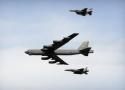
The B-52 has been a stalwart of the U.S. Air Force since the 1950s. Eighty years after its introduction, the bomber is still relevant, with new variants planned to extend the airframe's service life for decades to come. Indeed, the B-52 will likely reach the 100 year mark of active-duty service.
When the B-52 first flew, aviation itself was only 50 years old, so as of today, the B-52 has been in the Air Force for more than half of the time that humans have been flying airplanes. Along the way, it has received consistent upgrades – to avionics, engines, weaponry, and more – allowing the 50s-era airframe to stay useful in a modern air force.
The B-52J is the latest iteration, with a new Rolls Royce F-130 engine that promises to improve fuel efficiency and stealth performance. It also brings a new radar system borrowed from the F/A-18 Super Hornet, as well as improved weaponry. //
That presents lots of options for un-aliving bad guys. Which, of course, is the whole purpose of the Air Force and all our armed forces, at least in the non-DEI world: to close with and destroy the enemy by fire, maneuver, and shock effect, or, in the case of the Stratofortress, bombing bad guys back into the Stone Age. //
War Planner
25 minutes ago edited
Thank you, Ward,
Almighty proud here! It's how I got my sobriquet: worked for USAF SAC DOCODW writing the SIOP (war plan) for these beasts. You know the safe you saw in Dr Strangelove? Yeppers, that's where my work product went every six months whether we needed it or not!
..kinda feel like Steve McQueen in Papillion on the raft floating out to sea, "I'm still here you bastards!"
Soldier on, Buffs*, soldier on! //
War Planner C. S. P. Schofield
19 minutes ago edited
SACism:
A B-52 is powered by engines that generate the horsepower of 100 railroad locomotives and is constructed with 25 miles of wire and enough aluminum to make 1,000 garbage cans.
..and it flies just like driving 100 locomotives hauling 1,000 garbage cans with 25 miles of wire!

On the final leg of the journey, after boarding, the pilot asked for volunteers to leave the plane as they were too heavy to take off.
They had flown a 50 min flight from my final destination to where I was and, without fuelling, were turning around to go back. They were adamant that the plane was too heavy and (with a print out from one of the flight computers in hand) were asking for 27 people to leave the flight. //
LH2327, today (11.2.20) A320 Neo. I'd guess at somewhere around 120 people (two full bus loads). they definitely didn't refuel. They said they filled the plane in Munich the day before to give the plane more balast to cope with the storm winds. //
The filling of the plane with fuel thing might have been a red herring, one of the stewards said it, although they hinted it was to keep it more firmly planted on the ground during the storm, not to affect flight performance in any way.

While American Airlines and Southwest Airlines have used all their lobbying might to try to get the federal government to shut down competitor JSX - because JSX offers a product that consumers prefer to their own - the origin of the fight against JSX stems from the big pilot union. And it wasn't even JSX they were really concerned with. //
That triggered the Air Line Pilots Association, which fought hard to make it more expensive and take longer to become a pilot. They didn’t want an expansion of flying outside of rules meant to limit the supply of pilots.
To go after SkyWest Charter – which fully complies with current rules, but DOT has simply sat on the application for no valid reason – they had to go after JSX which is a bigger scheduled charter operation. There are others, like Contour, but they saw the space growing.
Once the union started going after Dallas-based JSX, they were able to get Dallas-based Southwest Airlines and American Airlines on board for the fight. //
Nonetheless, the FAA plans to issue regulations cracking down on part 135 carriers and then investigate whether there are actual safety issues. This is a solution in search of a problem, because no one wants to talk about the real reason lobbyists have been pushing this.
There is simply no legitimate safety concern with JSX operations.
I know of only a few airliners with overwing exits that specifically direct evacuees over the leading edge of the wings, and two of these are very special cases:
Do split flaps produce lift? I don't see how, because there is no change in camber. It seems like an upside down speed break, producing only drag.
A:
Well, after all lift is created by deflecting air downward, which is exactly what a split flap does - although in a very inefficient way i.e. with a lot of drag.
This NACA TN shows how Cl and Cd increase with the deflection δf of the split flap (left plot):

- The A380 failed in the US partly due to a lack of a central hub structure.
- Fuel inefficiency and high maintenance costs deterred US airlines.
- US carriers prioritized frequent flights over higher capacity. //
The Airbus A380 promised to do what no commercial passenger aircraft had ever been able to do, drastically increasing capacity capabilities and per-seat performance metrics. Introduced into service in 2007 by launch customer Singapore Airlines, the double-decker jumbo was set to be the plane of the future, offering unparalleled passenger comfort and providing airlines with game-changing capacity.
Today, however, the plane's story reads differently. Only around 250 Airbus A380s ever rolled off the manufacturer's assembly lines, and even fewer remain in service today, with production halted back in 2021. The aircraft has undeniably served as a case study of manufacturer sales failure, as the jet was made for a time that no longer existed. //
The most glaring failure of the Airbus A380 was undeniably its inability to impact the American aviation market. No airline from the United States ever placed an order. The aircraft had been unable to perform in the sales department in the world's largest aviation market, a major blemish on its record.
In 2023, the busiest day for airlines was Friday August 11th, when airlines operated 18,586,233 seats. For context, the average daily capacity over the year was 16,582,222, making this peak summer day 12% busier than the average travel day. //
Conversely, the quietest day to travel by air is the third Saturday of the year, at least based on 2023's data. 13,967,001 seats operated on January 21st, making the day 16% less busy than the average for airline operators.

A new video has captured the moment the front of a Delta plane burst into flames after landing at Seattle-Tacoma International Airport last week.
The Airbus A321neo had just arrived Monday from Cancun, Mexico when the 189 passengers onboard were ordered to evacuate on emergency slides due to a fire in the plane’s nose area, according to KOMO News.
The Federal Aviation Administration is the subject of a massive class action lawsuit alleging that since 2013, thousands of qualified applicants have been denied employment as air traffic controllers based on race. //
These programs, run in cooperation with the FAA since 1991 to train and test future air traffic controllers, were the entry point for the overwhelming majority of the ATC workforce.
In 2013, the Obama Administration ended the program to increase diversity in ATC hiring. The screening test stopped being ATC-specific coursework and became a "biographical questionnaire." Allegedly, this questionnaire was based on the personality traits of successful ATCs. But its real purpose was to increase the number of "underrepresented" demographics. As if to underscore the point, the FAA provided the correct candidates with a list of buzzwords to use on the questionnaire. Minority applicants were also coached on how to format their job applications so friendly selection board members could recognize them. //
For reasons that aren't all that clear, this racially discriminatory hiring program continued under Donald Trump, but it really hit high gear under Joe Biden. I swear I'm not making any of this up.
The Secretary of Transportation has set a hiring goal of three (3) percent per fiscal year for individuals with targeted (severe) disabilities. //
In 2023, the situation had deteriorated to the point that even the New York Times had noticed.
They were part of an alarming pattern of safety lapses and near misses in the skies and on the runways of the United States, a Times investigation found. While there have been no major U.S. plane crashes in more than a decade, potentially dangerous incidents are occurring far more frequently than almost anyone realizes — a sign of what many insiders describe as a safety net under mounting stress. //
It is difficult to see how this policy survives a legal challenge. The American Bar Association cautions that under current Supreme Court precedents, diversity hiring cuts two ways.
Diversity initiatives should not be a zero sum game. Lawful diversity initiatives should be designed to expand opportunity for underrepresented groups without also negatively impacting opportunities for those in the majority.

A “diverse” air traffic controller could kill you. //
You see, if there aren’t enough blacks or women it is always because of malicious barriers. The very first sentence of the report says that the secretary “made an historic commitment to transform the Federal Aviation Administration (FAA) into a more diverse and inclusive workplace that reflects, understands, and relates to the diverse customers we serve.” //
So, in 2014, the FAA ditched the AT-SAT – which it had used for decades – and told all the people who had scored 85 or better and were waiting for a job offer that they had to take a brand-new test, called the Biographical Assessment.
This was an online personality test of 114 questions. It asked such things as: The number of different high school sports you played. The number of college credit hours you had in art, music, dance, or drama. Whether you had a job in any of the last three years. It was graded pass/fail, according to mysterious, never-acknowledged criteria.
My guess is that if you played a lot of sports and took no art classes, you were more likely to be black, so you passed. //
The Inspector General of the Department of Transportation found that the FAA fed the right answers to the black coalition, which fed them to black test-takers so they could cheat (and, of course, lie, if they had taken art and played no sports). It’s a crime to cheat on a federal exam or help someone cheat, but there was no punishment. This guy, Joseph Teixeira, resigned from the FAA, and the cheating scandal disappeared like the morning mist. //
The big New York Times investigation I mentioned earlier found that of the 313 air traffic facilities in the country, only three were fully staffed. The New York regional facility, for example, is short hundreds of controllers and is operating at just over 50 percent recommended staffing.
The Times quotes anonymous burnt-out controllers: “The staffing shortage is beyond unsustainable. It has now moved into a phase of JUST PLAIN DANGEROUS.” Also, “Controllers are making mistakes left and right. Fatigue is extreme.”
Guess how many words were about the thousands of top-qualified candidates who were frozen out because they were white? Zero. And about the black cheaters? Can’t mention that. This is the newspaper of record, after all. //
In 2021, we got “United Airlines vows 50% of new pilots hired will be women or minorities to reflect passenger diversity.” //
Who’s going to reflect the passengers who are children? Or blind? Or who don’t know left from right?
And, in case you were wondering, there are already 52 medical schools that no longer require applicants to take the Medical College Aptitude Test or MCAT because, well, you know why.

Supersonic flight without loud booms? NASA is working on that. //
When earlier designs flew faster than sound, individual shockwaves coming from different features like the nose, canopy, and wings merged into one powerful shockwave as they traveled to the ground. “We designed the X-59 so that those individual shockwaves don’t merge, which makes the boom quieter,” said Mike Buonanno, the X-59 air vehicle lead at Lockheed. //
“This way the vast majority of shocks generated by the X-59 are directed upward, and very few go to the ground,” Richardson explained. But perhaps the most unusual victim of eliminating shock-generating features was the canopy. The X-59 has no front-facing windows. //
And it is quiet—the sonic boom it will make should be around 75 PLdB, roughly like a car door slam from 20 feet away. //
On a New York to Paris flight, Concorde burned through roughly four times more fuel than the Boeing 747 while carrying one-fifth of the passengers.
The problem is that you can’t really do much about both fineness and lift-to-drag ratios—they're limitations imposed by pure physics. If you wanted to keep the right fineness ratio and have enough space for over 500 passengers in a supersonic airliner, you’d just need to make it absurdly long. //
Concorde used 119,600 L of fuel to carry 120 people 7200 km. That's 13.8 L/100km per passenger – almost exactly double the consumption of the Boeing 707, at best; it was worse on shorter flights. The subsonic planes that fly its routes now get 2.2 to 3.4 L/100km per passenger.
That, more than anything, is what killed it. Even if you sold every seat in a Concorde, it had six times the fuel bill per ticket of a similarly sized subsonic plane. It would have become uneconomical even if maintenance were negligible and spare parts were free, which they were not.
Can modern engine technology bring that down? Maybe. I can see 7 L/100km per passenger being potentially achievable with lots of R&D. //
RZetopan Ars Scholae Palatinae
8y
1,222
"At Mach 2.2, air friction heated up Concorde’s fuselage to 121° Celsius"
We see this error a lot, even when describing asteroids entering the atmosphere. The temperature rise is due to the rapid compression of air and not due to an alleged friction. A boundary layer forms near any surfaces parallel to the air flow (just like liquids flowing in a pipe) while the heat is generated at the leading and trailing edges where the surface is not parallel to the flow and the air must undergo a rapid change in speed. Any locations where the flow is forced to quickly change speed is where maximum heat is generated due to the rapid compression. These are the same locations where shock waves form in supersonic flows. Given the large number of errors in this article, we can assume that the author is neither familiar with fluid flows nor supersonic aircraft. Relying on mass market newspaper reports often leads to promoting totally nonsensical claims*.
*Having been subjected to newspaper reporters on multiple occasions, it is astonishing how wrong they can be, both before and after "informing" them. For a trivial example, look at what happened to Irving Finkel's report on a 4,000-year-old cuneiform translation: //
Wickwick Ars Legatus Legionis
14y
33,543
paulfdietz said:
I see your claim fairly often, and I find it very annoying. It seems to equate the heating in supersonic flow with the heating air undergoes in adiabatic compression, for example in a bicycle pump.
But heating at a shock is not an adiabatic (entropy conserving) process. Shocks are irreversible. Entropy increases across a shock as fast molecules slam into slow ones in a region a few mean free paths wide. Compression does occur at a shock, but the heating is higher than is required by the increase in density. Indeed, there is a finite upper limit to the density ratio of a gas going through a shock, regardless of Mach number.
At sufficiently high speed, and particularly for the atmospheric entry case you describe there, almost all the heating is due to dissipation. In that respect it's much more similar to friction (a dissipative process) than it is to adiabatic compression.
You're conflating isentropic (reversible) and adiabatic. Adiabatic is the correct term in this case. In the limit of mild shocks (or low-angle oblique shocks), a shock wave of pressure ratio -> approaches an isentropic process.
Almost all shocks are adiabatic. That just means there's no heat transfer during the process. Which is the case. My compressible flow book has a single chapter discussing non-adiabatic shocks at the end of the book. These are when water condenses out of air, e.g. There's no external heat transfer, but the gas phase loses energy to the liquid phase so it's a non-adiabatic process for the gas.
But that dissipation isn't friction. It's compression heating when the compression is done too fast.
Edit: Let's put some numbers on this. Let's consider a Mach 2.2 normal shock (at the tip of the nose) at 15 km. That's 12 kPa and, -56.5C (216.7K), and 195 mg/m^3 density.
My compressible flow tables put the pressure ratio at 5.48 and the temperature ratio at 1.8569 (for gamma = 1.4 or air). That means the density change is 2.95 (Pressure ratio over temp ratio). So we've got a final density of 575 mg/m^3 at 402.3K (129 C). Isentropic compression to achieve a density ratio of 2.95 would be a pressure ratio of 4.54 (again, gamma = 1.4). And the temperature ratio for an isentropic compression of pressure ratio 4.54 is 1.54. So the isentropic temperature rise (so no dissipation) would result in a temperature of 334K or 61 C. So the isentropic compression heating would be 117 deg. C while the adiabatic heating would be 185.6 deg. C. So, in fact, pure reversible heating would do more than half of the heating that is experienced through a normal shock wave at Mach 2.2.
Fascinating analysis of the use of drones on a modern battlefield—that is, Ukraine—and the inability of the US Air Force to react to this change.