United has received its 1,000th mainline jet, claiming the title of the world’s largest mainline fleet. The aircraft ‒ a 737 MAX 9 with registration N77584 ‒ was delivered by Boeing on Monday.
With this latest delivery, the Chicago-based carrier not only has 1,000 aircraft in its mainline fleet but also has the most airplanes of any airline globally. Data from aviation analytics company Cirium shows that United took delivery of 57 total aircraft last year. //
The airline now trumps the mainline fleets of both Delta and American, which were the previous titleholders. According to planespotters.net data, Delta has 985 aircraft, while American has 978.


Today’s ETOPS certifications allow US carriers to fly to Hawaii from the mainland United States using narrowbody aircraft. However, these planes must be specifically certified for the operation to be permitted. Unfortunately, a scheduling mistake from American Airlines once resulted in a non-ETOPS-certified Airbus A321 traveling to the Hawaiian Islands from the US West Coast. //
ETOPS stands for Extended-Range Twin-Engine Operations Performance Standards, though some in the industry humorously refer to it as 'engines turn or passengers swim.' Its foundation stretches back to when piston-powered aircraft were widespread in the commercial aviation market. These engines were unreliable, so traveling too far from a diversion airport could have serious and deadly consequences for those onboard.
In response, the Federal Aviation Administration created its 60-minute rule. This regulation stated that any aircraft with two or fewer engines could not fly more than one hour from a diversion airport. //
As a result of modernized airline fleets, the FAA adjusted its standards for long-distance, over-water flying. It started by issuing certifications for individual twinjet aircraft to fly long-haul flights that extended up to 120 minutes from the nearest diversion airport. This regulation became known as ETOPS 120. Among the first to receive these ratings were the Boeing 767-200ER and Airbus A300. //
services to Hawaii were still required to be operated by aircraft with an ETOPS 180 certification, which is slightly higher than the 120-minute rule established for other operations. //
In 1995, the new Boeing 777 became the first twinjet to receive ETOPS 180 certification. In 1999, a major change occurred when the Next Generation Boeing 737 family received an ETOPS 180 rating. The Airbus A320 family followed suit in 2004. //
American operated its Airbus A321 on several routes to the islands from the US West Coast. These A321s were a mixed fleet, as some had the ETOPS 180 certification, while others were not approved to cross vast distances without a nearby diversion airport.
According to ch-aviation, on August 31, 2015, American Airlines flight AA31 was mistakenly operated by a non-ETOPS-certified Airbus A321. The service departed Los Angeles International Airport and was bound for Daniel K. Inouye International Airport in Honolulu, Hawaii. The mistake reportedly occurred 12 days after the A321 was first deployed on the route.
An employee discovered that the aircraft involved, N137AA, was not ETOPS-certified while the aircraft was in flight. They notified American Airlines management, which then informed the FAA of the problem. Despite the mistake, the A321 touched down in Hawaii uneventfully but was ferried back to the mainland without passengers. //
There are minimal differences between a non-ETOPS-certified and ETOPS-certified A321, the latter simply having auxiliary fuel tanks to extend range in the event of a diversion. Additionally, extra medical equipment and fire suppression tools must be onboard and accessible to the crew.

The upper stage, meanwhile, appeared to fly normally until a telemetry display on SpaceX's webcast indicated that one of the ship's six engines shut off more than seven minutes after liftoff. The display then showed more engines failing, and the data stream froze.
In an update posted on SpaceX's website later Thursday evening, officials said ground teams lost contact with the spacecraft approximately eight and a half minutes into the flight. At the time, information on SpaceX's live video stream showed the vehicle was traveling at about 13,246 mph (21,317 km/hr) at an altitude of about 91 miles (146 kilometers).
"Initial data indicates a fire developed in the aft section of the ship, leading to a rapid unscheduled disassembly with debris falling into the Atlantic Ocean within the predefined hazard areas," SpaceX officials wrote in the update.
The falling debris caused air traffic controllers to divert or reroute commercial flights over the Caribbean and the Atlantic Ocean, according to the Federal Aviation Administration.
Air traffic controllers have the ability to activate a "Debris Response Area" if a spacecraft experiences an anomaly with debris falling outside of identified closed aircraft hazard areas, where the FAA notifies pilots in advance about the risk of reentering space junk. Activating a Debris Response Area "allows the FAA to direct aircraft to exit the area and prevent others from entering," the statement read.
This is what the FAA did Thursday evening. Air traffic controllers closed a swath of airspace between the Turks and Caicos Islands, the Dominican Republic, and Puerto Rico to commercial air traffic for more than an hour, causing some passenger airline flights to enter a holding pattern, return to their departure airports, land at alternate airfields, or delay their takeoffs.

Minister of War
12 hours ago edited
Regardless of whether or not this is just a headfake by the Communist Chinese, China is going to dominate the future development of military equipment & technologies unless we get our shit together soon. And there are three primary reasons for that:
1) There are far more Chinese students focusing their university studies on math, science, engineering and technology than American students. With so many American students focusing their university studies on social sciences & other mostly pointless & BS majors, even American universities are training far more students from China & India in key STEM subjects than they are training Americans. American children today dream of being the next big star of Communist China's TikTok app far more often than they dream of actually building or inventing something. How can we expect to keep up with the Communist Chinese when China is training so many more of their young people than we are in these key fields?
2) The espionage program of the Communist Chinese has become vastly superior to ours. This problem is heavily related to DEI & wokeness in our intelligence services when Communist China doesn't have to worry about that at all. If the best American spy happens to be a white guy, this wouldn't be much help in Communist China because he'll stick out like a sore thumb. But if the Communist Chinese send Chinese nationals to do spy work in the US for them, Americans are forbidden from noticing that the Chinese national looks a lot like a Chinese person & might require additional vetting before being granted a top secret security clearance. The same garbage in America that required that a grandma from Kansas goes through the same TSA vetting process as a single male who appears to be of Middle Eastern descent also requires that we waste a ton of time & money that should be focused on more likely targets when it comes to Communist Chinese spying. The Communist Chinese Ministry of State Security has basically decimated our human intelligence gathering operations in China while we appear to be clueless about the great majority of Communist China's operations in the US or around the world until it is too late in the best case scenario. There is no surprise that at least one of the Chinese Gen 6 fighters bears so much resemblance to our own F-35 since Communist Chinese spying resulted in all specs for the F-35 being stolen by them. Imagine they same white guy American spy being able to steal such info from the Communist Chinese. It ain't gonna happen.
3) We continue to be our own worst enemies since we are the ones paying for Communist China's military buildup & military technology development programs. And this goes far beyond direct payments to develop their next weapons, as was the case with the Communist Chinese asset Anthony Fauci & his use of direct American taxpayer financial assistance to develop the Communist Chinese Military's Wuhan Bioweapon that killed millions, made hundreds of millions more very sick & brought the economies of the world to their knees. Our indirect funding of the Communist Chinese massive military buildup & weapons development programs comes through our enormous international trade imbalance. A not insignificant portion of any of the trade profits going to Chinese companies also goes to fund what has been the most massive "peacetime" military buildup & development program in human history. If we don't begin a serious initiative to completely decouple our economy from the economy of the Communist Chinese Party, then we will continue to be the ones digging our own graves.
China has unveiled two new so-called sixth-generation fighter aircraft designed to demonstrate technological prowess and overawe its potential adversaries, but which could be much less. //
China's two major military aircraft manufacturers rolling out prototypes of what is alleged to be the first flyable models of a new-generation fighter aircraft certainly screams "public relations gimmick." At this stage, no one has had a chance to examine the aircraft, so everything we read about it is speculative. Are they real, or are they supposed to create an aura of technological superiority?
We've seen one version of this picture before. The Soviet MiG-25 first appeared at the 50th October Revolution Airshow on July 9, 1967 at Domodedovo airport. It was unexpected, and it was the star.
US intelligence panicked and our defense industry set about designing an aircraft that could overmatch the MiG-25.
Fast-forward to September 6, 1976, when Lieutenant Viktor Belenko defected to the West by landing his MiG-25 fighter at Hakodate Airport in Hokkaido, Japan. When Western engineers examined the airplane, they discovered it was crudely made and designed for high speeds.
The tear-down revealed that the braggart was a toothless phony, too heavy to be maneuverable at low altitudes, limited in what it could accomplish up high, and with little range and no midair refueling capability. When later compared to the U.S. teen-series fighters, the F-15, -16 and -18, it was powerless, particularly because the Foxbat had a max-G rating of 4.5, and just 2.2 with full fuel. Excess Gs would rip its half-ton air-to-air missiles from their underwing hardpoints, since the airplane was intended to go fast but in a straight line. //
Glenn Diesen @Glenn_Diesen
·
China is building a drone army in preparation for America's "Pivot to Asia" and "Global NATO"
- Yes, this swarm technology also has civilisation application, although it will also be part of its military
Last edited
7:40 AM · Nov 24, 2024
Elon Musk @elonmusk
·
Meanwhile, some idiots are still building manned fighter jets like the F-35 🗑️ 🫠
1:41 AM · Nov 24, 2024. //
You have to ask yourself why China, the owner of the above "drone swarm," is sinking billions of dollars into developing a manned fighter if they believe the drone is the future of warfare. You also have to ask why a continental power like China is investing in a heavy stealth fighter "with long endurance and comparatively massive internal volume to accommodate a very large fuel load, as well as weapons and sensors" for a future battlefield that we are told will be dominated by drones and hypersonic missiles — unless the new fighters are a head fake designed to catch our attention and divert resources to countering them.
At this point, these aircraft are what the late Don Rumsfeld would call "known unknowns." We know these planes exist, but we have no idea what they mean. What we can count on is defense contractors trying to divert as many Pentagon resources as possible into developing an aircraft that can overmatch these two Chinese planes without having any idea of their capability. //
anon-vwl5
7 hours ago
A long range fighter and a drone swarm are answers to two different tactical problems. //
RedLegADC(M)
16 hours ago
Usually we are tracking, but I'll take some small exception to your conclusion. First of all, the F-15 was not developed simply as a response to the Mig-25 - I suspect you actually know that as well as I do. Secondly, while it is always a cheap but wildly applauded diversion to criticize the greedy defense industry, I would hope you are not saying it was a mistake to develop and deploy the F-15, or that the defense industry and services should ignore emerging threats. //
Random US Citizen
16 hours ago edited
Meh. Call me back when China starts doing air operations from carriers at night, or launching nuclear-powered submarines that don’t sink while docked. I’m not saying their military is a paper tiger in the way that Russia’s obviously is, because quantity has a quality all its own. We know that from the human-wave attacks in Korea.
But we also know that China is on its way over a demographic cliff, that their economy is wallpaper covering up the cracks in the wallpaper covering cracks in the wallpaper, and that their culture of “face” means QC is, at very best, a distant afterthought.
China is an adversary with a zillion-man army, which is a threat to its near neighbors, but there’s no reason to freak out over plywood prototypes shaped as if they were stealthy.

Christmas Day, Azerbaijan Airlines Flight JS-8243 crashed while attempting an emergency landing at Aqtau Airport in Aktau, Kazakhstan. There were 67 passengers and crew aboard; at least 38 died in the crash, and the body count may climb as hospitalized passengers succumb to their injuries. Russian aviation authorities blamed the loss on a massive bird strike, but the intact tail section bore the tell-tale marks of a hit by a missile fired from an SA-22 Greyhound (Russian name: Pantsir) surface-to-air missile system. Read the background in my post: Azerbaijan Airline Crash Was Most Likely Caused by a Russian Missile.
Despite warnings from the Kremlin not to speculate on the cause of the crash, Azerbaijani officials have told the media Flight JS-8243 was brought down by a Russian missile. //
It was the drone attack, not fog, that prevented JS-8243 from landing.
Near Grozny, the plane was hit by a Russian missile. The plane asked to divert to airports at Makhachkala or Mineralnye Vody, but permission was denied, and it was told to land at Aqtau Airport. Essentially, it was forbidden to land in Russian territory. As the plane left the Grozny area, it was subjected to GPS jamming and other electronic warfare effects. "According to data, the plane’s GPS navigation systems were jammed throughout the flight path above the sea."
By now, the plane had lost steering, and the pilot and co-pilot were managing direction and altitude by using engine power. This is what the flight looked like with altitude changes. //
By any standard, the flight crew on JS-8243 were heroic. By keeping the fatally damaged aircraft in the air and accomplishing a controlled crash near the Aqtau Airport, they saved nearly half the people on board. //
flyovercountry
11 hours ago
It needs to be said over and over, the reason why the Russians denied landing anywhere except Kazakhstan is the hope the airplane, and evidence, would be at the bottom of the Caspian Sea.

Four backcountry airstrips in Idaho’s Frank Church River of No Return Wilderness known as the “Big Creek Four” have been deemed emergency use only as outlined by a recent legal settlement.
The ruling stems from a lawsuit between environmental groups and the U.S. Forest Service, with the State of Idaho intervening on behalf of recreational aviators. In its complaint, environmental advocates have stated that aircraft use of the Big Creek Four is damaging wilderness character, wildlife habitats and the area's legally protected solitude.
The recent ruling notes that the airstrips will remain technically open for emergencies, but recreational access will be prohibited, with both usage and maintenance subject to monitoring—a major setback for recreational flyers. //
bbgun06
A grass strip that is not used recreationally won’t be maintained for emergency use.
I’d hate for a pilot experiencing an emergency to die after attempting a landing there.
scarlson
This is exactly correct. I know many pilots who help maintain back country strips in Idaho and Montana. Pilots are the least impactful on the environment and what exactly is “damaging the wildlife character”? //
jbmcnamee
I would hope that the NPS also banned surface vehicles with ICE motivators, such as four-wheelers, motorcycles, AWD pickups, etc, or this whole thing is pretty much a sham. Ground vehicles do far more damage to the environment that an airplane does. Airplanes don’t leave trails and ruts in the forest, run over animals, possibly spark fires from poorly maintained exhaust pipes or overheated catalytic converters. Pilots rarely leave their trash behind, throw beer bottles and cans in the brush or use the trees and animals as target practice with the gun they brought along “just for fun”. In fact, if you were to ask park rangers what their biggest problems are for keeping the parks “pristine”, i doubt that pilots and airplanes even make the top ten. //
Slipstream
New backcountry rules from people who never leave the city.

Over 7-8 December, much of Flightradar24’s most tracked flights list was occupied by flights to, from, or near Syria as rebels entered Damascus and news spread that Syria’s Bashar al-Assad had been deposed. With the Russian government announcing it had granted Assad and his family asylum and they were in Moscow, we began to ponder Assad’s possible paths to Russia.
The following options present to us the most likely scenarios, though there are certainly multiple variables that leave open the possibility of additional options.

In an internal American Airlines Jetwire for employees, the company shared what happened to a group of school children visiting Washington, D.C. from Bermuda on June 15th.
Seventy one students and their chaperones had flown non-stop to Washington’s National airport on American. They were ticketed on a connecting flight back through Miami, and their DC to Miami segment was delayed by weather. They were going to miss their connection home. //
So American Airlines decided to add a dedicated flight just for this school trip. //
Since National airport is an American Airlines hub, and crew base, they were able to pick up crew that were on reserve to work the trip. They used a 128-seat Airbus A319 dedicated to the group. //
This was an even more expensive move that American made for these passengers than it seems at first glance. That’s because they didn’t just have to fly an extra plane to Bermuda – they had to get it back, too. They didn’t need to operate an extra Bermuda departure that day. So American paid to ferry the plane back to National airport, too.

The curtains are beginning to close for the A-10 Thunderbolt II (aka Warthog). The United States Air Force is set to retire 56 in fiscal year 2025 (around 20% of the remaining inventory), reducing the number of A-10s in active service to around 200. Meanwhile, the US Air Force has stated it is about to retire the last of its Warthogs based in South Korea, and these will be replaced by F-16 Fighting Falcons (upgraded with fifth-generation-like software).

Emails and tool-tracking software weren't heeded, but nothing scary happened - except to the nylon tool

Have you ever looked up at an aircraft and wanted to know exactly what type of plane it was? Having already taken a look at the key Airbus and Boeing differences, we explore the important features for identifying the wide array of aircraft in the Boeing long-haul fleet.
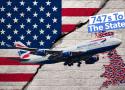
Gone are the glory days of the Boeing 747, the 'Queen of the Skies'. The first commercial double-decker aircraft flew in 1969, and though several are still flying today, only a few airlines operate the type on commercial passenger flights. According to data from Cirium, an aviation analytics firm, there are only four airlines operating 747s this month: Air China, Korean Air, Lufthansa, and Aeroflot. //
In October 2014, 33 airlines operated 747 passenger flights, and British Airways (BA) had the most. Ten years ago, 12,171 747 flights were scheduled worldwide, more than 2,000 of which were operated by BA. More than half of BA's 747 flights were to and from the United States (US). //
Data shows that in October 2014, 1,112 flights were scheduled to and from the US on BA 747s. This included 11 cities and more than 350,000 seats. It should come as no surprise that the busiest 747 route was from Heathrow to John F. Kennedy International Airport (JFK) in New York. Ten years ago, there were 215 flights scheduled in each direction to JFK on 747s, up to eight flights in one day.

Jet engines are known for their unique sounds, from the powerful roar of takeoff to the soothing hum of cruising altitude. For some, the distinct noise of different jet engines can evoke excitement and nostalgia. Whether it’s the distinctive buzz of an RB211 or the roar of a GE90 which sound resonates with you most? Let us know and share your thoughts!
The 51 Factory has been established with the goals of supporting the legendary P51 Mustang, British Spitfire, and other Rolls Royce or Packard Merlin powered aircraft of the WWII era.
These superb aircraft powered by 1650 cubic inch, over 1500 hp, liquid cooled V-12 engines, represented some of the most advanced technologies of the day, and most certainly greatly contributed to the allied victory, both in the Pacific, and in Europe.
The fighters developed in WWII are the pinnacle of piston engine, propeller driven aircraft performance. Even today, the fastest piston engine aircraft in the world are modified WWII fighters with Rolls Royce/Packard Merlin V-12’s, as seen at the annual Reno Air Races.

Around 0800 hrs of 22 December 1992, the Boeing 727 of Libyan Arab Airlines, registered as 5A-DIA, underway on Flight 1103 from Benghazi to Tripoli, was approaching the Libyan capital. The ground control advised the crew per radio to hold its position at 1,067m (3,500ft) above the Papa Echo beacon, about 10 kilometres (5.4nm) from Tripoli International for three minutes, due to military traffic. The ‘military traffic’ in question was a MiG-23UB of No. 1023 Squadron, crewed by Captain Abdel-Majid Tayari and a novice pilot. Following the take-off from Mitiga AB, the ground control advised Tayari to climb, turn and head towards Papa Echo.
Unaware of the airliner ahead of him, the seasoned fighter-pilot followed instructions of his ground controller to the dot and comma.
Moments later, Tayari and the student in the front cockpit were shocked to sense a detonation on the underside or below their aircraft. A fire broke out. A friction of second later, they saw the big fin of the Boeing 727 right in front of them, already separated from the airliner – and then Tayari initiated an ejection. The airliner disintegrated while still on approach to Tripoli International, killing all 157 of its crew and passengers.
The ‘negative effects of international sanctions’
Barely surviving this tragedy – Tayari suffered multiple fractures in his right hand during ejection – the crew of the MiG-23UB was shocked to find itself jailed in the hospital of Mitiga AB. The investigation of the Libyan authorities – unfairly – blamed them of either colliding with the Boeing 727, or opening fire and shooting it down: many of their superior officers and civilian servants wanted them hung on the Green Square in Tripoli.
….actually: Gaddafi ordered the flight to be shot down to demonstrate ‘negative effects of international sanctions’ – imposed on Libya after the bombing of Pan Am Flight 103 in 1989: because of numerous embargos, Libyan Arab Airlines could not fly its planes safely, and thus the victims of the crash were supposed to be presented as victims of ‘Western terrorism’. A bomb with a timer had been placed on board the Boeing 727: when this failed to detonate, Gaddafi personally ordered the aircraft to be knocked out of the sky….
Then it was time for the individual interview. The head of training and the HR guru sat me down and weren’t quite sure what to make of me. I was clearly the first (and probably only) F-14 pilot they’d ever interviewed, so they fumbled with questions like “Um… what makes you think you can handle a 250-knot turboprop?”
‘Then came the clincher: “So, why should we hire you versus all those other people out there?” They expected an answer involving hundreds of carrier landings, flying supersonic, blah, blah so I must be a great pilot. Instead, I thought for a second and said “I’m sure any of us can fly your planes just fine. I’d like to think I’m the sort of person who you can sit next to for ten hours, and not want to slug.”
‘The interview screeched to, a halt. Director of training looked at the HR dude and said “Write that down.” HR said “Already got it.” They thanked me, shook my hand, and I knew I had the job.’
Schiphol will invest €6 billion over the next five years to improve infrastructure. //
The announcement comes amid an 11 per cent year-on-year increase in passenger numbers throughout the first half of 2024, whilst capacity also increased 12 per cent year on year with 230,417 flights recorded between January and the end of June.
In 2023, the hub welcomed more than five million passengers in 2022 but announced that charges will increase by 14.8 per cent in 2024, higher than the 12 per cent rise that was previously anticipated. Schiphol CFO Robert Carsouw said in a statement: “We've notified the airlines and understand that they're not very pleased. At the same time, it's necessary for the quality at Schiphol and for our financial position. It's also how the legislation works. In good years we are not allowed to profit from airport charges and so in bad years we cannot afford any losses.” The airport - which did acknowledge that the charges paid to them by airlines are "strictly regulated by legislation" and cover costs such as runway maintenance, security and cleaning. The CFO added: "Simply put, Schiphol is not permitted to make any profit from airport charges. If what Schiphol earns in airport charges exceeds the costs incurred from facilitating the airlines, the additional revenue is 'given back' to the airlines
Thursday 2nd April 2020 15:11 GMT
BJC
Millisecond roll-over?
So, what is the probability that the timing for these events is stored as milliseconds in a 32 bit structure?
Reply Icon
Re: Millisecond roll-over?
My first thought too, but that rolls over after 49.7 days.
Still, they could have it wrong again.
Re: Millisecond roll-over?
I suspect that it is a millisecond roll over and someone at the FAA picked 51 days instead of 49.7 because they don't understand software any better than Boeing.
Thursday 2nd April 2020 17:05 GMT
the spectacularly refined chap
Reply Icon
Re: Millisecond roll-over?
Could well be something like that, the earlier 248 day issue is exactly the same duration that older Unix hands will recognise as the 'lbolt issue': a variable holding the number of clock ticks since boot overflows a signed 32 bit int after 248 days assuming clock ticks are at 100Hz as was usual back then and is still quite common.
See e.g. here. The issue has been known about and the mitigation well documented for at least 30 years. Makes you wonder about the monkeys they have coding this stuff. //
bombastic bobSilver badge
Reply Icon
Devil
Re: Millisecond roll-over?
I've run into that problem (32-bit millisecond timer rollover issues) with microcontrollers, solved by doing the math correctly
capturing the tick count
if((uint32_t)(Ticker() - last_time) >= some_interval)
and
last_time=Ticker(); // for when it crosses the threshold
[ alternately last_time += some_interval when you want it to be more accurate ]
using a rollover time
if((int32_t)(Ticker() - schedule_time) >= 0)
and
schedule_time += schedule_interval (for when it crosses the threshold)
(this is how Linux kernel does its scheduled events, internally, as I recall, except it compares to jiffies which are 1/100 of a second if I remember correctly)
(examples in C of course, the programming lingo of choice the gods!)
do the math like this, should work as long as you use uint32_t data types for the 'Ticker()' function and for the 'scheduld_time'; or 'last_time' vars.
If you are an IDIOT and don't do unsigned comparisons "similar to what I just demonstrated", you can predict uptime-related problems at about... 49.71 days [assuming milliseconds].
I think i remember a 'millis()' or similarly named function in VxWorks. It's been over a decade since I've worked with it though. VxWorks itself was pretty robust back then, used in a lot of routers and other devices that "stay on all the time". So its track record is pretty good.
So the most likely scenario is what you suggested - a millisecond timer rolling over (with a 32-bit var storing info) and causing bogus data to accumulate after 49.71 days, which doesn't (for some reason) TRULY manifest itself until about 51 days...
Anyway, good catch.
US air safety bods call it 'potentially catastrophic' if reboot directive not implemented //
The US Federal Aviation Administration has ordered Boeing 787 operators to switch their aircraft off and on every 51 days to prevent what it called "several potentially catastrophic failure scenarios" – including the crashing of onboard network switches.
The airworthiness directive, due to be enforced from later this month, orders airlines to power-cycle their B787s before the aircraft reaches the specified days of continuous power-on operation.
The power cycling is needed to prevent stale data from populating the aircraft's systems, a problem that has occurred on different 787 systems in the past. //
A previous software bug forced airlines to power down their 787s every 248 days for fear electrical generators could shut down in flight.
Airbus suffers from similar issues with its A350, with a relatively recent but since-patched bug forcing power cycles every 149 hours.