
One password is believed to have been all it took for a ransomware gang to destroy a 158-year-old company and put 700 people out of work.
KNP - a Northamptonshire transport company - is just one of tens of thousands of UK businesses that have been hit by such attacks.
In KNP's case, it's thought the hackers managed to gain entry to the computer system by guessing an employee's password, after which they encrypted the company's data and locked its internal systems.
KNP director Paul Abbott says he hasn't told the employee that their compromised password most likely led to the destruction of the company.
"Would you want to know if it was you?" he asks.



It’s important to clean and sanitize your backcountry water filter or purifier before storing it away during the winter months. There’s a simple three-stage process for this that involves cleaning the filter to improve its flow rate, sanitizing the filter to kill any microorganisms inside it, and drying it before storing it until you’re ready to use it again. //
odd man out
Filters with a small pore size are susceptible to clogging due to hard water deposits. Most drinking water will have some divalent cations (Ca+2, Mg+2) that forms insoluble carbonate salts (from dissolved CO2) when it dries. The reason to rinse with vinegar is that the acid in vinegar (acetic acid) will dissolve the carbonates salts because carbonate is a base. It reacts with the acid to form soluble acetate salts and carbonic acid that decomposes to form CO2 again (mix baking soda and vinegar if you want to see the reaction). However the salts take some time to dissolve. So what I do is to run some vinegar through the filter, seal it, and let it set for a while (an hour or so), then flush that out and repeat until you get a good flow rate. Then run a large volume of tap water through it to get rid of all the vinegar.
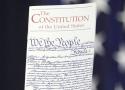
Every member of the military has sworn an oath to the nation since the Continental Army’s creation in 1775. Wording to specify allegiance to the U.S. Constitution was added in 1789, and has remained in all versions of military oaths of enlistment and commissioning since. This tradition sets our military apart from many others around the world, where loyalty is often tied to a ruler or regime. The American oath binds service members to a set of ideals and structures greater than any one administration.
Unfortunately, this noble intent is being misinterpreted. Ill-informed pundits, academics, military officers, lawmakers, and even ordinary American citizens frequently describe the military as “apolitical.” But that isn’t quite right. The military exists to enforce the political will of the United States—by force if necessary. It’s not above politics; it’s an instrument of it. A correct reading of the military oath clarifies this: troops swear to uphold the enduring framework of the nation, not the transient preferences of elected officials.
So, what does loyalty to the Constitution actually mean? How is a service member to judge whether their actions align with that oath? Most don’t know. Those who do have learned through personal initiative—not institutional instruction. //
This problem can be solved. I propose three key reforms:
- Mandatory Annual Constitutional Training
The White House recently mandated an 80-hour Constitution and rule-of-law course for executive branch employees, capped by a two-day in-person session. The military can follow suit by requiring holistic annual constitution training for every military member. Numerous free, reputable programs already exist to support this effort:
National Constitution Center’s Constitution 101 Course
American Bar Association’s Civics Education Series for Military Members
Hillsdale College’s Constitution 101: The Meaning and History of the Constitution. //
- Required Pocket Constitutions
Every service member should be issued a laminated pocket Constitution, worn as part of the uniform. If troops are still required to wear dog tags in this day of DNA identification, there’s no reason that carrying the document to which they swear is a bridge too far.
- Memorization of Founding Principles
In the Army, we are required to know the Soldier’s Creed and Army Song by heart, ready to recite from memory on command. Promotion boards evaluate enlisted soldiers on their ability to recite these and other military codes. Why not include selections from the Constitution—or Declaration of Independence? //
The National Defense Authorization Act (NDAA) provides the fastest route for implementation. With Republican majorities in Congress, there is an opportunity to require annual, rigorous, non-partisan instruction in the U.S. Constitution and the rule of law for all military personnel. This training must reject “living document” ideology in favor of fidelity to textualism.
Military officers have become accustomed to obeying and implementing unlawful directives because they know that the oath is presently meaningless and that all power—in practice—is held by individuals in the chain of command, rather than the nation’s founding documents, U.S. law, and military regulations. Defense Secretary Pete Hegseth must purge ideologues who corrupted the institution—but that alone won’t fix the culture.
Mars, 140 million miles away.
Neck and Upper Shoulder Pain Relief Stretches
You'll need to do these with some consistency to break the cycle of pain
Let's teach kids a thing or two!

Sen. Lisa Murkowski said she feels “cheated” after she won a concession in the recently passed tax and spending law to protect wind and solar projects, only to see the president and his administration issue recent orders that she said seem designed to quickly quash such projects.
“I feel cheated,” she said in an interview Friday. “I feel like we made a deal and then hours later, a deal was made to somebody else.” //
bk
5 hours ago
“I feel cheated.” --Sounds like what Alaskans say about having elected a purported Republican.
Reagan warned about unchecked government spending.

On Jan. 20, President Donald Trump signed an executive order to “Make Federal Buildings Beautiful Again,” calling for a return to neoclassical architecture in federal construction. To some, this may seem like mere aesthetic preference. But a look back at the history of American architecture reveals that there is a lot more to modern art than meets the eye.
Trump’s order is a rebuke of the architectural mediocrity that has overtaken our nation’s capital. It draws a line in the sand: Neoclassical architecture, meant to reflect the ancient ideals of symmetry and proportion, should be the default for our civic spaces—as opposed to the soulless glass and concrete blocks of “brutalism” that permeate Washington today.
Neoclassical architecture is not outdated; it is timeless, rooted in the principles of harmony, proportion, and human scale. It endures because it reflects the things we inherently long for: order, dignity, meaning. In our increasingly fragmented age, it reconnects us with something permanent. Beauty is not a luxury, but a civic necessity. //
The Industrial Revolution, beginning in 18th-century Britain and arriving in the U.S. by the 19th century, brought new materials—iron, steel, and, eventually, reinforced concrete—that allowed buildings to rise higher and span wider.
Even as late as the mid-19th century, these innovations were dressed in traditional forms: Gothic facades, neoclassical orders, familiar silhouettes. Function had not yet eclipsed form.
Then came London’s Crystal Palace in 1851, a revelation in cast iron and glass. Its vast transparency and towering scale stunned the world. Traditional columns and ornamentation were gone. Instead, it inverted the rules of classicism, appearing top-heavy and weightless, a cathedral of industry.
In the following decades, engineers and architects, specifically in America, embraced steel-frame construction. The 1880s post-Chicago fire building boom made clear that the future belonged to those who could build fast, tall, and efficiently. Aesthetic considerations became secondary.
Then, the ideology arrived. In 1896, American architect Louis Sullivan famously declared that “form follows function,” a maxim that reverberated across continents. Walter Gropius took it to heart when he founded the Bauhaus School in 1919. Le Corbusier followed by founding L’Esprit Nouveau, a magazine declaring ornament a “crime” and tradition a “shackle.”
Architecture, once the art of a building, became a theory of abstraction.
At its core, modernism rejects inherited wisdom, seeking to sever architecture from the past—and from the people. //
Many of our cities today, especially Washington, are speckled with boxy, concrete buildings of brutalism. The architectural degradation can be seen on a short walk around Capitol Hill.
At the top of the Hill, just past the Capitol building, sits the Jefferson Building of the Library of Congress. Finished at the height of the Gilded Era in 1897, that building provides a magnificent example of the Beaux-Arts style, adorned with reminders of our history and leading literary and philosophical figures.
As you descend the Hill, you’ll see the three U.S. House office buildings in order of construction, which visually represent the shift from neoclassical to modernist architecture.
Then, finally, you’ll be confronted with the brutalist Department of Health and Human Services building.
These two bookend buildings—the Jefferson Building and the HHS building—were opened and dedicated only 80 years apart.
Standing there, on the south corner of the Capitol, I find myself afraid we have taken for granted the beauty of the ancient, time-tested styles of old. //
Take Winston Churchill’s word for it: “We shape our buildings; thereafter they shape us.”
When President Trump first started ranting, really out of nowhere, about the so-called “Epstein files” being “made up” by his Democrat predecessors, as well as former F.B.I. Director James Comey, it was bizarre and suspiciously defensive. It’s now a lot less weird and a lot less suspicious.
The Wall Street Journal reported Thursday on a “leather-bound book” containing, among other things, a doodle of a naked woman’s body framing an odd “typewritten” note, both supposedly penned by Trump and addressed to convicted child sex trafficker Jeffrey Epstein in 2003. The Journal called the letter and illustration “bawdy” and described the signature as “a squiggly ‘Donald’ below [the drawing’s] waist, mimicking pubic hair.” //
Trump told the Journal that the note, included in a book allegedly compiled for Epstein’s 50th birthday, was fraudulent. “I never wrote a picture in my life. I don’t draw pictures of women,” he said. “It’s not my language. It’s not my words.” //
We also know that this all sounds almost exactly like another story involving the F.B.I. and a newly discovered document that was damaging to Trump: the case of Paul Manafort and the “black ledger.” //
The two events are almost comically identical. An office space in Ukraine was pillaged by political activists, but what luck! A little paper book was eventually recovered — oh, my! Inside is damaging information associated with Trump! In 2025, as Trump set about quickly restructuring the executive branch of the federal government and attempting to hold corrupt Democrats accountable, well, I’ll be — a leather-bound book that makes him look like the dear friend of a notorious pedophile. //
And subsequent reporting by the Times acknowledged that the ledger may very well have been fraudulent, noting in 2022 that there was “the view within the Ukrainian government that a Trump presidency would be potentially ruinous, and the admission that the ledger had not been fully authenticated and did not prove actual payments made to Manafort.”
I think I understand what Trump was saying about the Epstein files being “made up” now.

On a chilly October evening in 1958, a group of MIT students shuffled onto the Harvard Bridge, which separates the university town of Cambridge from Boston proper. The shortest among them lay down on the sidewalk at the bridge's start, his friends marked his length, he got up, moved forward, and repeated the process.
The man in question was Oliver Smoot, then a freshman at the institution who was pledging to join the Lambda Chi Alpha fraternity. As part of his initiation, he was tasked with measuring the Harvard Bridge using his own height. The resulting unit, the "smoot," remains visible on the bridge today, with its markings repainted annually.
Local police even use these markings to pinpoint locations of traffic incidents. Google Earth also includes it as a unit, measuring five feet seven inches (170.18 cm) - you can find it as the last item under "Settings," then "Distance units."
Smoot went on to a career in standards and policy within the technology sector. After holding various roles, he served as chairman of the American National Standards Institute (ANSI) from 2001 to 2002 and later as president of the International Organization for Standardization (ISO) from 2003 to 2005.


It’s been 293 days since appellate judges heard arguments in President Donald Trump’s appeal of a $454 million fraud ruling in a civil case brought by state Attorney General Tish James.
The average time for an appellate decision from such a point is 30 days.
Signed decisions can take longer, but almost never this long. //
Any judge on the panel can delay the release of a decision without having to give a reason. //
Court observers suspect that Presiding Justice Dianne Renwick — appointed by Gov. Hochul and a political ally — may be sitting on the decision.
Why?
Keeping the judgment on hold gives Hochul leverage over Trump on matters from federal aid to congestion-pricing to wind farms.
“Pure extortion,” as one attorney familiar with the case has remarked.

What infuriates me most about this crisis is how it will devastate the very people Democrats claimed to help. Rural states and communities will see the highest rates of coverage disruption, with larger percentages of residents losing marketplace coverage and becoming uninsured. Nearly 5 million midlife adults will face higher premiums, with middle-income enrollees seeing average annual increases of more than $4,000.
Look at the real families behind these statistics: a middle-class family of four in Charlotte, North Carolina, could see their annual marketplace premium costs increase by nearly $9,500. A 60-year-old couple making $85,000 per year would see their annual premium costs jump by $15,400, from about $6,900 to about $22,300. //
This is governance by crisis, the oldest trick in the Democratic playbook. Create unsustainable programs, get people dependent on them, then blame Republicans when fiscal reality intervenes. It's political malpractice disguised as compassion. //
This crisis was entirely avoidable. If Democrats had respected constitutional limits and allowed free markets to develop affordable healthcare solutions, we wouldn't face this cliff. Instead, they chose to expand federal power, create massive dependencies, and leave Republicans to clean up the wreckage.
The Congressional Budget Office projects that 5.7 million people could lose coverage when reality breaks through Democratic fiscal fantasies. That human cost lies squarely with those who created an unsustainable system and called it reform. //
The question isn't whether Congressional Republicans will fund this broken system indefinitely. The question is whether Democrats will finally accept responsibility for the chaos they've created and work toward sustainable, constitutional solutions that serve American families without bankrupting the federal government. //
charlie
2 hours ago
We can thank John Roberts for changing his mind on the (un)constitionality of Obamacare and John McCain for being, well, John McCain. //
Jprs
3 hours ago
“The question is whether Democrats will finally accept responsibility for the chaos they've created and work toward sustainable, constitutional solutions that serve American families without bankrupting the federal government.”
Hint: they won’t. They will point to rising healthcare cost and say it was because of the BBB that was just passed. And the dishonest media will repeat this ad nauseam and many Americans will believe it. //
Obnoxious and entitled federal bureaucrats’ attempts to resist reform are making it hard to say good things about public service. //
Well, having been a political reporter in D.C. for 26 years, the fact there are extraordinary federal workers is unsurprising to me. I personally know good, talented people in the trenches. What is likely surprising to Lewis’ affluent center-left readers is that the bad federal workers are so, so much worse than unmotivated nine-to-fivers. //
So I would encourage you to read Who Is Government? and do it with an open mind. Let’s build a “culture of recognition” that rewards good federal employees, and better educates the public on the good things our federal agencies are doing for us. I would just humbly suggest that a culture of recognition is worthless without also building a strong culture of accountability. Based on the petulant reaction and baseless legal resistance to an elected president’s fairly modest attempts at reforming and downsizing an unelected bureaucracy, we have a long way to go before we get bureaucracy that puts the citizens’ needs before its own.
Indeed, the sin of Adam is a “felix culpa” (a “happy fault”) because, through it, God — in His benevolent care for us — caused an even greater good to come from it: the incarnation, the sacrifice of Christ on the cross, His resurrection, our salvation, and the redemption of the world.
Christian philosopher Alvin Plantinga writes in his felix culpa theodicy, “Perhaps God sees that the best worlds he can actualize are ones that include the unthinkably great good of divine incarnation and atonement. Suppose he therefore actualizes a … world that includes incarnation and atonement, and in which human beings fall into sin, evil and consequent suffering.”
In his encyclical Salvifici Doloris, Pope John Paul II reflected upon the possibility of redemptive suffering. That is, the possibility that God can — and does — redeem our suffering for good. “One can say that with the Passion of Christ all human suffering has found itself in a new situation,” he writes. “In the Cross of Christ not only is the Redemption accomplished through suffering, but also human suffering itself has been redeemed.”
In other words, through Christ — and because of Christ’s sacrifice — our very suffering can also be redeemed and provided with new purpose and meaning. Moreland and Craig make a similar point, writing, “the chief purpose of life is not happiness, but the knowledge of God.”
“Many evils occur in life that may be utterly pointless with respect to the goal of producing human happiness,” they observe, “but they may not be pointless with respect to producing a deeper knowledge of God.”
A Christian response to the problem of evil acknowledges it is possible that God permits evil and suffering because He can bring about a greater good from it. //
Only Christianity addresses the problem of evil with an entirely unique answer among the world’s religions: God Himself — in the person of Christ — came to suffer with us, for us, and because of us.
Reflecting upon this fact, Christian philosopher Marilyn Adams writes, “[God] is not content to be immutable and impassible, to watch his writhing creation with the eye of cool reason. He unites himself to a human consciousness and takes the suffering to himself.” Only in Christianity does God enter His creation, live among His creatures, and ultimately bleed and die on behalf of and at the hands of His creation. Because He loves His creation. Because He loves us.
That, indeed, is a God we can trust in.

Gabbard followed up her initial thread with the announcement that her office was turning over all of the documents to the Department of Justice for a criminal referral. //
The issue I am raising is not a partisan issue. It is one that concerns every American. The information we are releasing today clearly shows there was a treasonous conspiracy in 2016 committed by officials at the highest level of our government. Their goal was to subvert the will of the American people and enact what was essentially a years-long coup with the objective of trying to usurp the President from fulfilling the mandate bestowed upon him by the American people. Their egregious abuse of power and blatant rejection of our Constitution threatens the very foundation and integrity of our democratic republic. No matter how powerful, every person involved in this conspiracy must be investigated and prosecuted to the fullest extent of the law, to ensure nothing like this ever happens again. The American people’s faith and trust in our democratic republic and therefore the future of our nation depends on it. As such, I am providing all documents to the Department of Justice to deliver the accountability that President Trump, his family, and the American people deserve.

Regulations are always fully thought through and serve a clear purpose—thus always achieving their goals, right? Recently, I’ve started to question some of them and invite everyone to second-guess with me.
In Europe, many airports have strict curfews for noise abatement purposes. We can all agree on how important a good night’s sleep is. But is it always sensible to comply with a restriction if the outcome doesn’t actually uphold its intended purpose? If that sounds puzzling, the real-world example I’m about to share might strike you as equally amusing and frustrating. //
However, the point of this article isn’t to speculate on what-ifs. The pilots of NH203 and the tower controller played the cards they were dealt. And it all culminated at 04:59:42—just 18 seconds before the earliest allowed landing time—when the radio transmitted: “ALLNIPPON 203, GO AROUND”
A go-around call requires immediate compliance—no discussion, no delay. It’s part of our safety culture and rigorous training. Once stabilized, we can begin to ask “why.” Moments later, the tower controller explained: the aircraft had arrived too early. And this is why I’m writing this.
Have We Lost Sight of the Original Goal?
Somewhere along the line, we’ve lost the plot. Pilots, passengers, airlines—and the environment—were penalized for being early. //
The direct consequences?
- An additional 16 minutes of flight time
- Additional high-workload scenarios for the crew after nearly 14 hours of overnight flying
- A stressful experience for passengers, many of whom may never have experienced a go-around
Environmentally, an extra 1,900 kg of fuel burned, additional uncalled for CO₂ emitted, and perhaps the loudest possible noise event as the aircraft roared over Frankfurt and its surroundings—including, no doubt, a wake-up call—before the official opening hour.
All of this—done in the name of avoiding noise pollution.
I have to ask again, what was achieved here?
Two added critical phases of flight.
Higher operating cost.
And the very thing the regulation was supposed to prevent: excessive noise.
WallTime is a NTP synchronized studio clock and notification system that works with your standard computer monitor or television. The clock is kept always in sync using Network Time Protocol (NTP). It can take the place of stand alone clock systems, notification systems, on-air lights and more.
Complete system ready to connect to your monitor. No PC is required.
$450
Includes WallTime device, power supply, HDMI cable and velcro for attaching to monitor.
Sometimes you only want to modify files containing specific content. Combine find, grep, and sed:
# Only replace in files that contain the old text
find . -name "*.yaml" -type f -exec grep -l "oldValue" {} \; | xargs sed -i 's/oldValue/newValue/g'