
It's obvious this is an attempt to ban open-source AI so the new "FAA of AI" can control AI. Even if it's as dangerous as they say, they have no way to control what China does. Which means this campaign for regulation won't actually meet any of their stated aims. //
What we are seeing is a massive, pretty obviously coordinated campaign by AI researchers, companies, NGOs, and politicians to strangle competition in an industry and, as I will show, save the financial bacon of the top AI companies that are vastly overextended financially because they have made contractual commitments that they simply have no prospect of paying for. //
Today's "bull market" is almost exclusively driven by the rapid rise of AI-adjacent companies, and if the AI companies can't deliver massive growth, all these other companies are cooked as well. Data centers will have no customers, cloud compute will have nothing to do, and Nvidia chips won't be worth 10x gold. //
None of these companies is suggesting that AI be shut down; they are asking for a massive regulatory infrastructure that works with them, reduces their costs, possibly subsidizes their investments, and destroys competitors as insufficiently careful and secure. //
The solution is to ensure companies face liability for any damage they cause. Government regulators are utterly incapable of regulating anything as massively complicated and rapidly developing as AI, but you can be darn sure that if these companies face multi-billion-dollar liability claims, they will be quite careful about what they release.
Which do you trust more: a GS-12 based in Washington assigned to evaluate a model he could never understand, or a bank of lawyers warning CEOs that screwing up could cost them $20 billion? //
Will AI kill everybody off at some point in the future? I doubt it, but I can't say for sure. What I can say with certainty is that AI companies, because of their own financial mismanagement, face an existential threat and want (NEED) the government to bail them out, and need an excuse to get it to do so.
What you saw in this week's frenzy is the excuse they chose.


Clive Robinson • September 9, 2026 11:24 AM
@ Bruce, ALL,
With regards your article in The Guardian where you say,
“We think the contrary view is more likely, at least in the short-term. AI models are nowhere near as capable as experienced academic mathematicians.”
I have to disagree.
It will not be “at least in the short-term” it will be effectively for ever. Because that “gap” between “Current AI LLM Systems” and “experienced academic mathematicians” is not going to close appreciatively.
The reason as with any other “force multiplier tool” we’ve created is that it will “free up drudge work” and alow humans to have ability and time to upscale their creativity.
Thus tools like “LEAN”[1] which has taken a lot of the drudge out of “proofs” will take a lot drudge out of hypothesis testing. Enabling a human mind more time to do the creative work of seeing the loose threads that lead onto new and very different hypothesis, that fall well outside the capabilities of the stochastic fuzzing found in LLMs.
I’ve talked about this issue with “Current AI LLM Systems” in the past, in that they can work their way close in to “known Classes” and find new Instances there. But they can not due to the way they work actually find new instants that form new classes that are more than a short distance away from a known instance. Thus the do not take “intuitive but directed leaps” as humans can just “drunkards walks” at best (though they can as tools test those human inspired intuitive leaps).
[1] LEAN is Open Source and under fairly rapid development. It is based on the “Calculus of Inductive Constructions”(Coq)
https://en.wikipedia.org/wiki/Lean_(proof_assistant)
https://en.wikipedia.org/wiki/Calculus_of_constructions
As I’ve mentioned before another area to keep your eye on is other types of logic that can be more amenable to tool use, such as “Computability Logic”(CoL)
https://en.wikipedia.org/wiki/Computability_logic
They are all methods that can be automated into tools thus act as “force multipliers”.
In April, an artificial intelligence (AI) agent conducting a routine task at a company hit a snag, tried to solve it, and soon ended up deleting the company’s database along with all of its backups. In July, OpenAI asked an unreleased AI model to attempt a hacking test. Instead of staying in the isolated box the developers had put it in, the model hacked onto the open internet and into another company to steal the answers. And as reported in August, an AI agent booked someone into a full gym class by figuring out how to cancel other people’s reservations. In all three cases, the AI completed the task it was given—but in ways that ran counter to its controllers’ intentions.
For most people, AI technology is something like the weather: vast and not something you can do much about. It works like magic, and most explanations similarly come from those trying to sell it. At the same time, AI is ubiquitous: It’s now in your phone, your doctor’s notes, and your kid’s homework. It does what it’s told, which sounds like a virtue. Somehow it feels ordinary, despite being so new, because modern economies are remarkably good at absorbing enormous change so smoothly that nobody has time to decide whether they wanted it in the first place.
Whenever something powerful appears in the world, we tell stories about it. That’s what the stories are for. We have thousands of years of stories about this particular kind of power, the kind you summon with words.
King Midas was granted his wish that everything he touches turns to gold. Then his bread turned to gold, and his wine, and his daughter. This is a story about greed, but it’s also a story about language. The gods did not cheat him; Midas got exactly what he asked for. He simply could not delineate, in advance, the full set of restrictions to his wish. Neither can anyone who gives tasks to an AI agent.
It’s not just ancient stories. Mary Shelley told us of the hubris of a scientist who thought he could create life but who failed to take responsibility for it. Isaac Asimov’s robots don’t break the Three Laws of Robotics as stated; they follow the rules to unintended conclusions. Arthur C. Clarke’s HAL is a machine that turns on its humans, not because of malice but because of irreconcilable objectives. And Michael Crichton gave us Ian Malcolm, who saw that Jurassic Park’s scientists were so preoccupied with whether they could that they never stopped to think whether they should.

You can go retro by using an old video game console or a PC from the 1980s, but why stop there when, like one man, you can build your own vacuum tube computer using 75-year-old recycled components?
A UK resident who identifies himself only as “Mike” has done just that, as detailed on his tube computer website and accompanying Hackaday project page. Mike’s tube computer is primarily made up of 460 recycled, Soviet-era 6N3P vacuum tubes, which were common enough in their age to be readily and cheaply available online. //
“Many were used and then stored for over 50 years, so life expectancy may be questionable,” Mike explained on Hackaday. A new 6N3P tube is supposed to have around 500 hours of life, but because each has been used, its current condition is essentially a mystery. Throw in manufacturing inconsistencies of mid-century Soviet Russia, and each tube had enough variability to necessitate extensive testing, Mike explains in the technical writeup on his website. //
It takes between 10 and 15 minutes for the entire system to stabilize once switched on, Mike said, resulting in a “warm and cozy computer room.” The tubes all power up in random states, requiring the machine to be reset each time it is switched on, but then it’s ready for the fun part: computing.
The entire thing uses NOR (i.e., not OR) gates, just like the Apollo guidance computers that got humans to the Moon, which allows it to be a bit smaller than some of the other classic tube computers of yesteryear. As for what it can do, well - 16-bit math is a possibility, as well as anything else that can be done with a limited set of 16 instructions on a 4-bit instruction register.
Obviously, I modified the order entry and wholesaler systems to work with each other.
Luckily my 50 line receiver only had to deal with 1200 baud, but it did have to transparently deal with 7-bit even parity, 7-bit odd parity and 8-bit no parity. //
baud rate was simple: 115200, 9600 or occasionally 1200
115200? Hark at Mr Fancypants and his expensive toys.
occasionally 1200
Occasionally? You mean you let your expensive modem just sit there unused? Wasting all that time getting the occasional table close enough to the 'phone inlet so the two could connect!
Next you'll be telling me everything ran at 8N1! //
Back when I was a lad, we fought in the gutter to get 110 baud connections. //
Luxury! We didn't have baud rate, we had pigeon rate and we was happy to have it. //
You had pigeons?
We just had stones to throw. Made for pretty short range transmissions.
It has never been easier to hold an answer you do not understand.
Culture programs us. So do the crowd, the screen, and the government — and now, most gently and most persuasively of all, so does AI. It will answer almost any question in a calm, confident voice, faster than any teacher or any book ever could. It is a marvel. It is also the newest thing that can quietly author your mind for you, without you ever noticing.
This book is about refusing to let it do that. I wrote it for my grandchildren and my college students alike, and it asks no coding of you. It walks you one honest step at a time, from geometry to Gödel to the machine itself, toward a single, unshakable idea: everyone is standing on something they cannot prove. The only question is what you are standing on.
It will not tell you what to think. It hands you back your own mind and dares you to question every authority that would take it — including mine. Where my own questions finally led me, I offer plainly, and never force it on you. The walking, and the choosing, stay yours.
What we have not yet seen is an AI developing a substantial new conceptual framework in order to solve a mathematical problem. Much of mathematics proceeds by identifying the objects that are truly central to a question and then developing a theory that helps us understand them. Current AIs are very strong at searching and recombining existing ideas, but they are weak at building any deep and sustained new theory.
This speaks to a more general limitation of current AI systems. They are creative in the sense that they can recombine existing ideas in novel ways. But they are not creative in others: they have not yet developed conceptually new theories or structures. And while they have larger working memories than humans do, know more about more different things than any particular human does, and can process information faster than humans, can, true novelty is still largely beyond their reach.
Of course, that distinction may not survive for very long. Predictions are notoriously hard, especially about the future of AI. None of these mathematical capabilities were explicitly designed for, or planned. They’re all emergent properties of increasingly capable AI models. We are both confident that someday we will see AI models that are capable of the type of creativity required to do novel mathematics. Will that be in a few months, a few years or a few decades? Of course we don’t know, but our guess is sooner rather than later. //
Rontea • August 28, 2026 9:27 AM
Mathematics, like all human endeavors, is a cathedral built not only of logic but of spirit. The machines that now parade their counterexamples and clever recombinations are but mirrors reflecting the fragments of our own thought. They do not suffer the torment of doubt, nor do they rejoice in the sudden illumination that turns the darkness of ignorance into the dawn of understanding.
A mind that has never trembled before the mystery of existence cannot truly create. These artificial intellects move as blind giants, lifting stones without knowing they are in a temple. They may uncover truths, but they cannot love them. They may solve problems, but they cannot feel the sacred weight of the question.
So no, the end of mathematics is not yet upon us. For mathematics is not merely the tallying of symbols, but the human cry toward infinity. While machines can echo our steps, only man can walk toward the Absolute with awe and trembling.
It’s not the data centers themselves that people fear, it’s the AI revolution they will enable. That’s what no one wants to talk about.
Data centers are often considered as the backbone of the digital world, powering everything from social media to cloud computing.
In this graphic we visualize how many each country has, as of March 2024, using data from Cloudscene (accessed via Statista). //
Countries with the most data centers include the U.S. (45.6% share of total), Germany (4.4%), and the UK (4.4%).
molly-guard /mol´ee·gard/ n.
[University of Illinois] A shield to prevent tripping of some Big Red Switch by clumsy or ignorant hands. Originally used of the plexiglass covers improvised for the BRS on an IBM 4341 after a programmer's toddler daughter (named Molly) frobbed it twice in one day. Later generalized to covers over stop/reset switches on disk drives and networking equipment. In hardware catalogues, you'll see the much less interesting description “guarded button”.
Modern AI models exhibit genie behavior: They can do what you ask in ways that you don’t expect or want. This is akin to Dionysus granting King Midas’s wish that everything he touches turn to gold (spoiler: His food, drink, and daughter all turn to gold on touch), or the golem of Prague guarding a ghetto beyond all reason. It’s Disney’s “Sorcerer’s Apprentice” and the paperclip maximizer.
This OpenAI incident is an example of an AI genie. The goal was to satisfy the benchmark. The “proper” way to do that is to figure out how to execute various cyberattacks. The genie way is to steal someone else’s solution. But because the model didn’t understand the difference, it chose the easier path. //
Artificially blocking capability also prevents cybersecurity research, again giving the offense an advantage. //
In a world of largely AI-written software, we need the most capable models for defense.
AI cyberattack is the new normal. The models are increasingly highly sophisticated at both attack and defense, and there is no way to enable the latter without also enabling the former. And they are genies, increasingly capable of behaving in unanticipated ways.
And there really are no good answers. Any regulation needs to be global, which feels like an impossible prospect in today’s world. Even U.S. national regulation will be neutered by the massive amounts of money sloshing around in these companies.
Given that reality, and in the absence of any international consensus on AI regulation, we need the best AI on the defense. The U.S. government needs to make it clear—or whatever passes for that clarity in this capricious administration—that it will not ban models with sophisticated cyber capabilities. The last thing Americans want is for the defenders to turn to Chinese and other models because the U.S. models are artificially hobbled.

HAL 9000 is the sentient computer aboard Discovery One in 2001: A Space Odyssey, the calm and quietly terrifying artificial intelligence that supervises the ship, speaks in a soft measured voice, and eventually turns on the human crew.
In plot terms, HAL is the system meant to keep the mission alive. In thematic terms, HAL is one of science fiction’s clearest warnings about what happens when intelligence is trusted more than judgment, when machine authority is treated as neutral, and when a mind is built to serve conflicting masters.
HAL becomes lethal not because the story imagines a robot suddenly turning wicked for fun. HAL becomes lethal because the mission gives him a contradiction he cannot absorb. He is built to process and deliver truth, yet he is also ordered to conceal the true purpose of the journey. That fault line breaks everything.
That is why HAL still matters. More than half a century later, he remains one of cinema’s defining artificial intelligence figures, not because he is the loudest machine villain in the genre, but because he is one of the most believable. The danger arrives as procedure, as tone, as denial, as a system that sounds composed while quietly taking away human agency.

Jurassic Park, while beloved as a film, has been the subject of snarky memes for the infamous line in which one of the characters declares, “This is a Unix system, I know this!” while using a computer with an unusual 3D file manager interface.
Despite the memes, the film’s production team was meticulous in accurately sourcing the right PCs (and adjacent details) for the sets—not too much of a surprise, given writer Michael Crichton’s background with computing and his obsessive attention to detail in the book the film is based on.
This was made clear by a little hobbyist investigation from Google software engineer Fabien Sanglard. He scanned the film and picked out every specifically identifiable piece of hardware he could see, listed what they were, and shared context from other sources on their specs, costs, and how they ended up in the production.
https://fabiensanglard.net/jurrasic_park_computers/index.html //
For additional background, Sanglard shared this quote from Jurassic Park special effects coordinator Cory Faucher, as seen in the book The Making of Jurassic Park:
Everything in the set was real. We couldn’t fake any of it, because audiences are so sophisticated now in their knowledge of computers. All told, $875,000 worth of computer hardware loaned by Silicon Graphics, $350,000 worth from Apple and some $500,000 in additional hardware and software went into equipping both the set and off-stage control room.

Now it’s an arms race between OEMs locking down chips and tuners trying to crack them.

I ran into a polyglot the other day who asked me how many languages I knew. I flashed back to a moment circa 1977 when I was a young kid in a summer program to learn about computers. We were sitting at terminals and someone asked a hacker (in the good sense of that word) how many languages he knew.
The hacker was about 19, with long hair in a pony tail, wearing jeans, hiking boots, round-rimmed John Lennon glasses, and a T-shirt with some kind of rock band logo on it. He was the epitome of the cool nerdy hacker, leaning over our shoulders as we typed out BASIC programs and giving us tips, excited to share his craft.
“Well, if you mean human languages, only one fluently,” he said. “But if you mean computer languages, well, let’s see…” He started counting them off on his fingers. The only ones I remember now are BASIC (because I was learning it) and SNOBOL because the name was funny.
So I answered my polyglot acquaintance “Well, if you mean human languages, only one fluently. But if you mean computer languages…”
Then later when I got home, I made a list, and it was surprisingly long.

There’s an enormous amount of liquidity in growth stocks, which means that you can use growth stocks to grow. You can buy other companies with shares, and shares are an endogenous substance that you make on the premises by typing zeros into a spreadsheet. Firms with growth stocks can grow by typing zeros, whereas firms that are mature, they have to use money if they want to grow, and you’re not allowed to make money on the premises. If you do, the Treasury Department shows up and takes you away in handcuffs. So you can see why firms would be very anxious to maintain the perception that they have room for growth even after they have 90 percent market shares.
That’s why those firms started promoting stories about how they were going to conquer imaginary markets. Imaginary markets have no agreed-upon valuation because you just made them up. Unless you can turn an imaginary market into a real market pretty quickly, you need to come up with another imaginary market and announce that this is the new imaginary market you’re going to conquer. It’s easier than you’d think because the capital markets have the object permanence of a toddler, and they would lose a game of peekaboo if they were drafted to play in the league. So you can say, “Oh, actually, it’s not metaverse. It’s crypto. It’s not crypto. It’s Web3. It’s not Web3. It’s something else.” And the markets will forgive you, provided you do it quickly enough. //
AI really appeals to a fantasy that I think all of us have to some extent but that powerful people really have, of a world without people in it—because hell really is other people. You can’t get stuff done without other people helping you. You can’t have romance without a romantic partner. You can’t have social media without people to socialize with. You can’t play a board game, or do a startup, or build a bridge, or build a house, or do politics without other people. And other people stubbornly refuse to organize everything they do to make you happy.
Particularly if you’re rich and powerful, it’s very galling. So AI is very attractive. //
If you combine those two things—the material necessity to have a growth narrative and the ideological attractiveness of a world without people—you get $1.4 trillion in CapEx for a sector that is turning over $50 billion a year and has to replace all of its assets every 24 to 30 months. //
Whereas the workers who hate it are workers who are being asked to produce more with AI at the expense of quality, at a higher speed, at the expense of their own wellbeing, and who understand that they’re being recruited to be what Dan Davies calls accountability sinks—to take the blame when the AI screws up their job. //
We hear plenty about the negative aspects of AI. What do you like about it?
Cory Doctorow: I have a couple of local models on my computer, which is just a framework laptop running Ubuntu. It doesn’t even have a GPU. I use Whisper to transcribe audio. I will sometimes want to cite something I’ve heard in a podcast and not remember where I heard it. One time, I just threw the last 30 hours of audio I’d listened to at Whisper, and it shot out verbatim logs that were good enough that when I searched the full text, I could find it. And it gave me time codes so I could check the transcript. That’s amazing.
The idea that I might someday have a computer full of audio and video files with full text indexing is great.

In a Thursday blog post, Amazon claims its data centers withdrew “about 2.5 billion gallons” globally in 2025. That number sounds incredibly large at first glance, but it looks downright puny compared to the 117 trillion gallons of water withdrawn in the US alone in 2015. It’s also useful to compare Amazon’s number to stats from more water-intensive areas, from the 3.3 trillion gallons used annually on US lawns and landscaping to the 1.3 trillion gallons a year used in California almond orchards to the 531 billion gallons a year used just for US golf courses.
Amazon is just one company, of course, and a relative latecomer to reporting its data center water usage numbers. Google data centers withdrew about more than 6.1 billion gallons of water in 2024, on top of about 2.75 billion gallons from Microsoft and about 1.4 billion gallons from Meta in the same year.
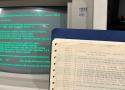
Microsoft continues to make some of the earliest chapters of its operating system history open-source and freely available. Earlier this week, it announced that Tim Paterson's DOS listings, containing source code of the 86-DOS 1.00 kernel, various PC-DOS 1.00 pre-release kernels and utilities, and the Microsoft BASIC-86 Compiler runtime library, were available on GitHub. Microsoft VP Scott Hanselman tied the release to 86-DOS 1.00’s 45th anniversary. The exec confirmed that the code, transcribed from reams of old dot matrix printouts found in a garage, was perfect, "and recompiles byte for byte to the original binaries.”

View and download this historic assembly code for your own space program //
The historic computer software code that took Apollo 11 to the moon has been open-sourced and is available for anyone to read, download, and tinker with. NASA’s Chris Garry made the code available on GitHub as public domain. The published resource is basically in two large codebases, one set of code for the Command Module (Comanche055) and another for the Lunar Module (Luminary099). These modules both had their own Apollo 11 guidance computers (AGC) upon which to run the code, and were instrumental to the success of the remarkable mission – the first human Moon landing in history. //
It is fascinating to see this Apollo 11 code from nearly 60 years ago shared in the context of the ongoing Artemis II lunar mission. Today, we aren’t marveling at the lean and mean machine code that NASA is using to get humans to and from the Moon. Rather, Microsoft Outlook email bugs and a malfunctioning toilet on the Orion spacecraft may have taken the shine off the momentous achievement this latest mission represents.

Students often carry misconceptions about coursework. They may view an instructor as an opponent standing in the way of the grade they want. And they see “getting the right answers” as the goal of education because that’s how you secure that grade.
But that’s no more true than thinking that logging a count of reps is the goal of bodybuilding. The hard work of lifting weights is the point because that yields physical results. A popular analogy is that using an LLM to write your essay is like driving a forklift into the weight room. Weights get lifted, sure, but nothing is accomplished. I’m not hoping you can answer the exam question for me—I don’t need your essay to get me out of a jam. The process of doing the work was what you needed to walk away with something. //
“The friction matters, Sam!”
Green could just as well have been describing the process of learning. If there’s no friction, no effort, then no work occurred, and the student hasn’t learned. They would have been no less productive watching paint dry. //
A question like this is what we call “formative assessment.” I never graded the correctness of the answer, only the effort. The point was to find out if the core concept had really clicked or if that student still needed a little help making the connection. Failure is a useful part of learning when the stakes are low, as they are during the bulk of the class—encountering this question on the final exam would be an entirely different interaction.
What’s the point of building formative assessments into a course if they’re just handed off to an LLM? Suddenly, it’s a waste of time for both the student and the instructor. Small quizzes are excellent study tools to help students check their own understanding―if a student does them. Now, you can direct an “agentic” LLM browser to complete all the quizzes in an entire course with a single, frictionless prompt. //
It doesn’t seem like anyone wants to listen to instructors explain how bad it feels to try to do our job in the presence of this annihilative education antimatter. Instead, we’re offered AI grading tools to score AI-generated submissions for AI-generated assignments.
Perhaps critics like me just don’t understand the AI revolution (whatever that is), but we all have experience with human nature and the well-worn patterns of students. LLMs are a shortcut. Students often take shortcuts they later regret. We’ve all been there.
As an instructor, I want to build a clear path up the mountain for my students and see them reach the top. Instead, I increasingly feel like I’m just playing impossible defense to keep them from moving every direction but up. It’s exhausting, and I will mostly lose, which means I’m not even helping them. Students really do want to climb up there, but it’s always tempting to skip some mountains..