
Milt Windler, one of the four leaders of Mission Control who in 1970 directed the round-the-clock efforts to bring the Apollo 13 astronauts back to Earth safely, has died at the age of 94. //
“Apollo was such a rapid pace that I don’t think people had the chance to think about it very much. It has only become more clear to me later on that we were making history,” said Windler in a 2006 oral history interview for the University of North Texas. “You’d do a mission and then you’d immediately turn around and get ready for another mission.”
“It was not [a] time for reflection,” Windler said. //
“If I did it again, I’d probably try to do something more about trying to pay more attention,” said Windler. “Apollo was — well, all of [the missions] were … bang-bang-bang. You couldn’t enjoy, really, in a way you couldn’t savor it, like maybe it would have been better to have done.”



“Beijing’s intended strategy is to dominate the high ground of the twenty-first century.” //
In a forthcoming memoir, former US politician and NASA Administrator Bill Nelson offers a blistering assessment of China, saying the United States must do all it can to retain its leadership in space exploration.
“Beijing’s intended strategy is to dominate the high ground of the twenty-first century,” writes Nelson in Space Odyssey, a book to be published by Harper Horizon in January 2027. //
Nelson has long been wary of China as a threat to the United States, noting his concerns about technology theft from the West. Unlike his predecessor under a Democratic president—former astronaut Charlie Bolden, who served as NASA leader under President Obama—Nelson supported the Wolf Amendment, which strictly limits cooperation between NASA and China’s space program.
The reason, Nelson says, is that China’s space program is militarized and highly secretive.
“China is not a partner to be trusted,” he writes. “Partnership requires trust, and trust is founded on transparency. With China, despite repeated efforts to build verifiable, rules-based cooperation and set commonsense guard rails for engagement, there has never been much of either.” //
Although he’s no fan of the Trump administration, Nelson does seem to agree with NASA’s current administrator, Jared Isaacman, that this competition is urgent and requires the agency to pursue more than a flags-and-footprints approach. In his 10 months as administrator, Isaacman’s signature initiative has been to launch an effort across NASA and its commercial space ecosystem to build a Moon Base at the lunar South Pole.
China, Nelson writes, is planning “infrastructure for lunar permanence,” seeking to occupy the limited area at the South Pole of the Moon where the most resources are. “They are not sprinting against us to plant another flag; they are settling in for a marathon, an endurance race that will take us deeper into space than humankind has ever dared to venture before,” Nelson writes. //
Being first, and being there for the long haul, matters, Nelson says. And he tells his readers to not be fooled by talk of exploration, especially when it comes to China’s space program. This is a competition for the high ground of the 21st century.
“What looks like exploration on the surface is, in truth, also a raging struggle for space supremacy,” he writes. “This race will determine who sets the rules for a new era of human expansion beyond Earth. For Beijing, this race is not about exploration but about domination, securing the infrastructure of orbit in much the same way empires once seized trade routes and aggressively defended sea lanes.”
Should the United States lose this competition, Nelson writes, “we’ll watch the next frontier slip from our grasp.”
This is the unique story of observing a total solar eclipse for no less than 74 consecutive minutes. On the summer morning of June 30, 1973, the Sun rises on the Canary Islands. But it is strangely indented by the Moon. The eclipse of the century has just begun. From the west, the lunar shadow rushes to the African coast at a velocity of over 2000 kilometers per hour. Astronomers on the ground will enjoy seven short minutes of total eclipse to study the solar corona - too short for Pierre Lena and seven scientists who board the Concorde 001 prototype, an extraordinary plane to become the first commercial supersonic aircraft. With André Turcat as chief pilot and a crew of five, at 17000 m altitude, the aircraft remains in the lunar shadow for 74 minutes, a record time of scientific observations not yet beaten and allowing for exceptional measurements. ////
Epub, PDF
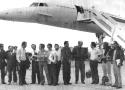
Fitted with telescopes, the plane did our longest imaging of the Sun’s corona. //
The Concorde Prototype 001 at the National Air and Space Museum of France in Le Bourget, with a map of Africa painted on it. The map depicts the aircraft’s path in the shadow of the total solar eclipse of June 30, 1973. //
“In 1970, the Concorde 001 prototype flew supersonic for the first time,” Léna told Ars. “The newspapers were full of these results. By 1972, I thought it was worth trying to approach André Turcat, the chief of test flights at Aerospatiale in Toulouse, and ask him about the possibility of using the 001 prototype to follow the June 1973 eclipse. He was very interested.”
With his plan accepted, Léna began organizing experiments for the historic flight. Flying at nearly 17 km above the Earth’s surface had many benefits. “Flying very high in the stratosphere had several advantages, including no humidity, which meant an excellent infrared transmission of the solar light.” //
With the shadow moving east at a slightly higher speed than the Concorde’s Mach 2.2, the scientists had 80 minutes of observation time in the totality before the aircraft fell behind the eclipse’s shadow. However, due to headwinds, that was reduced to 74 minutes, which was and still continues to be an astonishing achievement. “No one has achieved even half of it during the past 53 years,” Léna said.
Following this remarkable eclipse chase, the Concorde 001 landed in the Chadian capital of N’Djamena (then Fort-Lamy). “After we landed, a partial solar eclipse went on for an hour and a half or so. There were people (celebrating) on the streets with music as they were very happy to see us. It was a very special moment in my life,” Léna said.
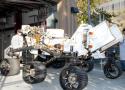
NASA officials said Tuesday that they are seriously considering sending the full-scale engineering model of the Perseverance rover, which is currently housed at the Jet Propulsion Laboratory in California, to the Moon to expedite their efforts to explore the south pole region.
The car-sized rover nicknamed “Promise,” which serves as a testbed for Perseverance and was not otherwise planned for a launch, would land equipped with a multi-mission radioisotope thermoelectric generator (MMRTG) to power it across difficult terrain and through the lunar night. //
NASA has an MMRTG available, with a supply of Plutonium-238 that is just decaying away. It is likely the rover, with a mass of about 1 ton, would need to be delivered by Blue Origin’s Blue Moon lander or SpaceX’s Starship due to its size. //
Over the years, Promise has served as a test bed for problems that Perseverance might encounter on Mars. Commands are often tested on this vehicle in the “Mars yard” at the California laboratory before similar commands are sent to the rover on the surface of Mars. It has also helped ensure Perseverance can safely traverse various areas on Mars.
Perseverance launched to Mars in July 2020, and its predecessor, the similarly sized Curiosity rover, launched to the red planet in November 2011. //
Curiosus Novitius Wise, Aged Ars Veteran
2y
105
semyorka said:
To be clear, there is no pre-existing "Promise" rover. "PROMISE" stands for "Polar Rover for Observation, Mapping, and In-Situ Exploration"
At least it wasn't Prototype Repurposed from Old Mars Inventory for Secondhand Expeditions. //
brokescientist Wise, Aged Ars Veteran
7y
135
I was just at JPL last week and they have also recently dusted off ATHLETE (All-Terrain Hex-Limbed Extra-Terrestrial Explorer). After over a decade in storage they were surprised everything seemed to be operational. Having the test bed is likely important, but actually using hardware and working to deploy long shelved ideas is really cool, and likely much more exciting for the engineers.
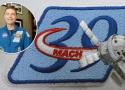
Mission Commander Reid Wiseman, pilot Victor Glover, and mission specialists Christina Koch and Jeremy Hansen (the latter with the Canadian Space Agency) spent 10 days in early April flying by the Moon. Their journey took them farther away from Earth than any humans have gone (52,756 miles [406,771 km]) and then, on the way back on board their Orion spacecraft Integrity, they sped up to about 24,664 miles per hour (39,693 k/ph) reentering the atmosphere.
Only three other people in history have traveled faster. NASA’s Apollo 10 astronauts Thomas Stafford, John Young, and Eugene Cernan set the record for the highest speed attained by a crewed vehicle relative to the Earth’s surface: 24,791 mph (39,897 kph) on May 26, 1969.
Cernan died in 2017, Young in 2018, and Stafford in 2024.
View and download this historic assembly code for your own space program //
The historic computer software code that took Apollo 11 to the moon has been open-sourced and is available for anyone to read, download, and tinker with. NASA’s Chris Garry made the code available on GitHub as public domain. The published resource is basically in two large codebases, one set of code for the Command Module (Comanche055) and another for the Lunar Module (Luminary099). These modules both had their own Apollo 11 guidance computers (AGC) upon which to run the code, and were instrumental to the success of the remarkable mission – the first human Moon landing in history. //
It is fascinating to see this Apollo 11 code from nearly 60 years ago shared in the context of the ongoing Artemis II lunar mission. Today, we aren’t marveling at the lean and mean machine code that NASA is using to get humans to and from the Moon. Rather, Microsoft Outlook email bugs and a malfunctioning toilet on the Orion spacecraft may have taken the shine off the momentous achievement this latest mission represents.
These captivating reads offer some needed and expert perspectives on our quest to understand the universe and our place within it.
Welcome to the Artemis II multimedia resource collection. Here, you can view and download mission photographs, behind‑the‑scenes videos, podcasts, and more. The Artemis II mission—NASA’s first crewed lunar flyby in over 50 years—is a key step toward a long‑term return to the Moon and future crewed missions to Mars.
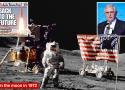
Dr. Harrison “Jack” Schmitt, 90, an Apollo 17 astronaut who spent three days on the moon in 1972, told The Post this week that there is a superfuel locked within the lunar dust that could provide Earth with an abundance of clean and safe energy for generations.
“I’ve been working on this for many decades — harvesting the light isotope of helium-3 from the moon,” said Schmitt, who is from New Mexico and lives in Albuquerque.
Schmitt is one of just 12 humans to ever walk on the moon, and four who are still alive. Buzz Aldrin, Charlie Duke and David Scott are also all in their 90s.
Since his Apollo 17 commander, Gene Cernan, died in 2017, Schmidt has been the last man alive to step off the lunar surface.
He also stands out for another reason: Unlike the other Apollo astronauts, who came from the military, Schmitt was a geologist and the only trained scientist to make the historic trip. //
“The question is, will that momentum keep going forward?”
Schmitt says he believes it will through a viable business model for interlunar travel — fueled by an industry involving the reaping of helium-3.
Helium-3 is a key ingredient needed to run nuclear fusion reactors, which operate with extreme efficiency and without the dangerous radioactive waste today’s fission-based power plants create.
But helium-3 is extremely rare on Earth — so rare that it’s rationed by the federal government — meaning fusion reactors have never been viable on a large scale.
But the moon is believed to be ripe with it, since the sun has been bombarding its atmosphere-free surface with the isotope for billions of years and building it up in the grey lunar dust.
Perhaps because I wasn’t alive during Apollo, part of me has often gravitated to robotic space missions. I identified with spacecraft like Voyager, Cassini, New Horizons, and the rovers traversing Mars as examples of real exploration. It was still possible to connect crewed platforms in low-Earth orbit, like the International Space Station, with the idea of exploring through the attainment of knowledge. With more than 25 years of uninterrupted crewed operations, the ISS has taught NASA and its international partners how to live and work in space and paved the way for the establishment of a permanent base on the Moon.
But it was easy to connect the innate drive to explore with the excitement of seeing new landscapes on Mars, the ghostly plumes of Enceladus, and the heart of Pluto. These were new worlds revealed for the first time, and each discovery sparked a bevy of new questions.
Artemis II struck the same vein, revealing things unseen by human eyes before. Like those missions far out in the Solar System, this was exploration in action. But seeing and hearing what the Artemis II astronauts saw added another dimension. It scratched an itch that a robot can’t reach. Here were human beings, people I’ve met and people you might someday meet, going through an entirely new experience. //
Sure, Artemis II didn’t land on the Moon. That will come on a future Artemis flight. But these four astronauts ventured to greater distances than Apollo and saw parts of the far side of the Moon hidden from view during those missions more than 50 years ago. Modern technology provided new opportunities for the astronauts to share their views with the world—from their view, just a fragile blue marble suspended in a cosmic void.
Speaking from the Orion spacecraft on April 4, Glover, the mission’s pilot, remarked on the view in a long-distance virtual interview with CBS News.
“One of the really important personal perspectives that I have up here is I can really see Earth as one thing,” Glover said on the eve of Easter. “You guys are talking to us because we’re in a spaceship really far from Earth, but you’re on a spaceship called Earth that was created to give us a place to live in the Universe, in the cosmos.
“Maybe the distance we are from you makes you think what we’re doing is special, but we’re the same distance from you, and I’m trying to tell you—just trust me—you are special. In all of this emptiness—this is a whole bunch of nothing, this thing we call the Universe—you have this oasis, this beautiful place that we get to exist together.
“As we go into Easter Sunday, thinking about all the cultures all around the world, whether you celebrate it or not, whether you believe in God or not, this is an opportunity for us to remember where we are, who we are, and that we are the same thing, and that we’ve got to get through this together.” //
“When we saw tiny Earth, people asked our crew what impressions we had, and honestly, what struck me wasn’t necessarily just Earth. It was all the blackness around it. Earth was just this lifeboat hanging undisturbingly in the Universe,” she said. “I know I haven’t learned everything that this journey has yet to teach me, but there is one new thing I know, and that is planet Earth, you are a crew.”
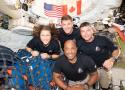
Commander Wiseman, Reid, you said in an interview back in February that you hoped this mission would be forgotten, overshadowed by all that was to come after. But I'm very sorry to disappoint you all. Artemis II will always be remembered. It was the moment we all saw the Moon again. Where childhoold dreams became missions. You helped the world to start believing again, and this is something that no one's ever going to forget. So, on behalf of NASA and the space-loving community from around the world: Thank you, for showing us your courage, your professionalism, your unity, and your humanity. Thank you, for showing us the Moon again. Thank you, for showing us Planet Earth again. And Thank you, for contributing to the greatest adventure in human history. Welcome home, Artemis II. //
So, when we saw tiny Earth, people asked our crew what impressions we had. And honestly, what struck me wasn't necessarily just Earth. It was all the blackness around it. Earth was just this lifeboat hanging, undisturbingly in the universe.
Artemis II Journey to the Moon
Pictures
Every 10 years, the National Academies convene a panel of planetary scientists to set priorities for Solar System exploration. These decadal surveys help NASA decide where to send missions and what scientific questions they should seek to answer. None of the results from Artemis II are likely to answer these big questions.
“Is there going to be decadal-level science out of Artemis II? Probably not,” Neal told Ars in an interview this week. “This is a technology demonstration mission… This is primarily to have a crew there to check out the engineering and make sure that things are working.”
From a scientific perspective, what’s most intriguing about Artemis II is figuring out how to incorporate humans into planetary exploration. For more than 50 years, generations of scientists have learned to explore other worlds only through the electronic eyes of robots. With NASA’s return to the Moon, they must learn to take advantage of human observations.
This requires a shift in how ground teams design instruments, plan science campaigns, and select targets for their observations. It also necessitates a change in culture. Astronauts on the lunar surface or in lunar orbit will provide a real-time feedback loop for the army of scientists looking over their shoulders from Earth. During the Apollo program, it took multiple landings to fine-tune how this works.
Should we take a closer look at this rock? Should we go see that outcrop? Humans can make these key decisions in seconds or minutes rather than days, weeks, months, or in some cases, years.
The experience of the Artemis II flyby also informed spacecraft engineers about the utility of the Orion spacecraft as an observation platform and the optical quality of the capsule’s windows. The astronauts reported some issues with glare from the Sun and the Earth. They MacGyvered a makeshift window shroud using a T-shirt to help overcome the glare so they could better see the lunar surface.
“We confirmed that we can achieve science through orbital observations and through integrating science into flight operations,” said Kelsey Young, NASA’s science lead for the Artemis II mission.
Human eyes are remarkably good at sensing color gradients and brightness changes. “Right away, they started describing the green around Aristarchus plateau and different brown hues, and these colors really help tell us nuances about the chemistry of lunar material,” Young said after the flyby.
Glover, Artemis II’s pilot, noted his perception of the Moon’s three-dimensionality during the flyby: “You really get a sense that we’re flying over something with elevation and terrain.” The astronauts were able to glimpse craters, mountains, and ridges at different angles as the Orion capsule arced behind the Moon. “Every vantage point is different,” Young said. //
“You might think that, after looking at hundreds of images taken of the lunar surface, I would get sick of it,” Young said. “I have not, nor do I anticipate getting sick of it.”
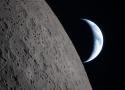
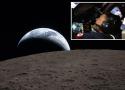
“It was quite infectious,” Neal said. “The Earthrise image that they took is one for the ages.”
One of my favorite Apollo astronauts is the late Jim Lovell. He flew in two missions yet never walked on the moon. His unflappable leadership during the ill-fated Apollo 13 mission helped make it what some called a “successful failure.”
Lovell also flew on Apollo 8, the mission that first flew around the moon. It was Christmas Eve 1968, and Lovell, William Anders, and Frank Borman delivered a Christmas message to the world from their orbit around the moon, which included a reading from Genesis 1: //
Lovell passed away at the age of 97 in August of last year, but a couple of months before he died, he recorded a message for Artemis II. NASA kept Lovell’s message a secret, but mission control played it to wake the crew up on Monday.
Hello Artemis II! This is Apollo astronaut Jim Lovell. Welcome to my old neighborhood. When Frank Borman and Bill Anders and I orbited the moon on Apollo 8, we got humanity's first up close look at the moon and got a view of the home planet that inspired and united people around the world. I'm proud to pass that torch on to you as you swing around the moon and lay the groundwork for missions to Mars, for the benefit of all. It's a historic day, and I know how busy you'll be, but don't forget to enjoy the view. So, Reid and Victor and Christina and Jeremy, and all the great teams supporting you, good luck and Godspeed from all of us here on the good earth.
Most of the out-of-this-world photos being beamed home from Artemis II were taken with an old-model Nikon camera that can be bought for about $1,000.
NASA traded in the legendary Hasselblad model it used on Apollo missions years ago for the Nikon D5 DSLR — a classic digital single-lens-reflex camera first released in 2016.
The Nikon was carefully selected for its proven track record as a workhorse space camera, as well as its extraordinary ability to pick up detail even in extreme darkness, Nikon’s top NASA consultant told The Post on Tuesday.
He said the Nikon D5 has been used successfully in space since 2017 — and “is still producing amazing images for them.”
One of the camera’s top-selling points for Artemis II was its incredible low-light capabilities, Corrado said.
The camera is able to shoot at an ISO — or light-sensitivity rating — of up to 3.2 million. //
“After this mission, it should be Z9. They won’t go back to the D5 after this,” he said. “Once they fully test and continue to test, the Z9 will be the camera going to the moon.”
Artemis II brought a total 32 cameras onboard for their 10-day mission.
Fifteen were mounted on the spacecraft, and 17 were handheld cameras the crew operated while peering out the cabin windows during their historic flyby of the lunar far side.
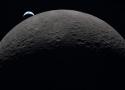
As the Artemis II crew came close to passing behind the Moon and experiencing a planned loss of signal, they captured this image of a crescent Earth setting on the Moon’s limb.
Excors Ars Centurion
12y
365
Subscriptor++
Resistance said:
I thought the current trajectory has the spacecraft and everything near it returning to Earth?
Yes - NASA says the translunar injection burn was also the deorbit burn. It's a very long deorbit trajectory, and there's six opportunities for correction burns to ensure a safe reentry angle and splashdown location, but they're already on their way to Earth. And they've skipped the first two correction burns because the trajectory is close enough to optimal.
If I'm interpreting this paper right, the requirement is to reach the entry interface with a max downrange error of 25.6km (figure 4), with up to 20 m/s delta-v of corrections, so this is just about fine-tuning. I presume that means anything that's still floating near the spacecraft, and not flying off at many m/s, is close enough to the optimal trajectory that it's still going to impact the Earth.
One can get away with “roughing it” when using the bathroom during trips to the Moon. Going to Mars, requiring months in space, is a different matter. If the toilet breaks on the way to Mars, there is a non-zero chance the crew is dying. So it’s great to try out these systems now, on Orion. This really is the purpose of this test flight, to make sure life support systems work for the crew, to identify problems, and to implement fixes in the future.
In the big picture, the Artemis II mission continues to go splendidly. The deputy manager of the Orion program for NASA, Debbie Korth, said Saturday that the spacecraft is performing “remarkably well,” and that the vehicle’s overall performance has “pleasantly surprised” the engineers working on the program.
Everything is going so well, in fact, that much of the focus has been on frozen urine. And considering all of the things that could go wrong with a dangerous deep space journey like this, a wee problem like this seems like a big win. //
Zapfenzieher Wise, Aged Ars Veteran
15y
137
Go, Artemis, go!
Oh, wait ... 😋
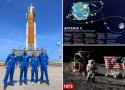
It’s a playbook that closely mirrors the missions that preceded Apollo 11’s historic first moon steps in 1969 — Apollo 7 and 9 tested systems in Earth orbit, while Apollo 8 flew its own figure-eight around the moon with a series of lunar orbits to test the Saturn V rocket’s ability to send a capsule across huge distances.
But Artemis II’s figure-eight will differ from Apollo 8’s and nearly every manned mission in history — it will skip the lunar orbits, but give humans the first extensive look at the far side of the moon through their own eyes.
All previous manned missions routinely flew around the far side of the moon — which perpetually faces away from Earth — but were planned so that the sun constantly shone on the nearside to allow for safe landings and productive moonwalks.
That meant the far side was almost entirely hidden in shadow throughout Apollo — and that most of it has only ever been seen through photographs from unmanned probes.
Artemis II will change that. The mission will pass over the far side in full sunlight and allow for direct observation of the moon’s hidden surface by the astronauts onboard.