Daily Shaarli
Yesterday - March 15, 2026
Preformed Line Products -- PLP protects the world’s most critical connections by creating stronger and more reliable networks. The company’s precision-engineered solutions are trusted by energy and communications providers worldwide to perform better and last longer. With locations in over 20 countries, PLP works as a united global corporation, delivering high-quality products and unparalleled service to customers around the world.

The author of the Mitford Years series married at 14, protested segregation, and wrote her first book at 57. //
The idea for Father Tim came in a vision of sorts as Mitford unfolded in her mind. Aware that a Baptist preacher conjured too many negative literary stereotypes, Karon crafted him as an Episcopalian, she said. His life began as a weekly serial publication in the local Blowing Rocket newspaper of Blowing Rock, North Carolina. Karon drew the illustrations. They paid her with a free copy of the 10-cent paper.
Circulation surged. But despite the local acclaim, Karon struggled through 11 publishing house rejections before Lion, a small Christian press, accepted At Home in Mitford. Two novels followed, as she used all her marketing skills to self-promote the books. But there was no national market for wholesome stories of simple characters, let alone with a Christian theme, Karon told World magazine. People preferred Stephen King.
“I don’t give you much of a ride. I just give you sort of a float!” Karon stated. “A lot of people tell me that my books put them to sleep, and I consider that a huge compliment.”
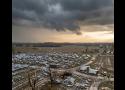
On Tuesday, March 10th, an EF-1 tornado destroyed the Dunns Bridge Solar I and II facilities owned by the Northern Indiana Public Service Company (NIPSCO). The facilities, located outside of Wheaton, Indiana, had 2.4 million solar panels, totaling 700 megawatts (MW) of power capacity, and reportedly cost $1 billion to construct—a little over $1,400 per kilowatt (kW).
NIPSCO issued the following statement in the aftermath:
On the evening of March 10, while actively monitoring severe weather and responding to storm‑related outages across our service area, NIPSCO became aware of damage to its Dunns Bridge I and Dunns Bridge II solar facilities in Starke and Jasper counties. Our team was tracking the storm in real time and moved in to assess conditions and respond as soon as it was safe to do so. Debris from the damage could have been displaced, and we are working to safely secure the area, assess the damage and proactively communicate with the community.
We recognize there may be questions and concerns about potential environmental impacts related to the damage at the solar farm. Solar panel leaching concerns have been thoroughly evaluated in industry-leading research, which shows that the risk is extremely low. Overall, the available evidence demonstrates that both crystalline silicon and thin-film PV (i.e., photovoltaic) modules do not pose a meaningful risk of environmental or human exposure from leaching, even when damaged. //
While the solar panels were damaged by the tornado, we are not aware of any reports of damage at the nearby R.M. Schahfer Generating Station, a 950 MW coal facility that NIPSCO was planning to retire at the end of 2025. However, it is still running thanks to a 202(C) order issued by the U.S. Department of Energy requiring the plant to continue operations. //
Let’s be incredibly uncharitable and look at the anticipated levelized cost of energy (LCOE) of the solar facility over its projected 25-year useful lifetime, and its actual, tornado-truncated lifetime.
Dunns Bridge I began generating power in June of 2023, producing a total of 1.3 million megawatt hours (MWh) up until December of 2025, the most recent month for which data are available. Dunns Bridge II began generating power in January of 2025, and through December, it produced 812,439 MW of power, which is good for a 21.3 percent capacity factor.
We calculated the LCOE over two time periods: a 25-year lifecycle, a standard assumption in the industry, and a 2-year lifecycle to account for the facility being destroyed very early in its lifecycle. The results are about what we would expect. Our estimated subsidized costs over 25 years are approximately equal to S&P Global’s reported PPA cost for the facilities, including subsidies.
Because the LCOE is like calculating the cost of driving your car over the number of miles driven, if your car dies after two years when you expected to drive it for 10, the cost per mile obviously increases. This is why the cost of electricity from the Dunns Bridge I & II facilities skyrockets in this analysis, reaching a subsidized cost of $289.61 per MWh, and an unsubsidized cost of $405.09 per MWh. [Compared to $63.87/MWh subsidized over 25 years, or $82.61/MWh unsubsidized over 25 yrs] //
In our upcoming LCOE study for Reliable Energy Inc. in Indiana, we found that the R.M. Schahfer plant was the most expensive coal plant in the state, due primarily to very high delivered fuel costs at the plant ($50 per MWh).
However, the December 2025 data from S&P Global, the most recent available, show the delivered fuel cost was about $27 per MWh, which substantially improves the economics of the plant, although this could possibly be the result of the company assuming the plant would retire at the end of the year, rather than being required to stay open.
At $70 per MWh, the Schahfer plant is competitive with subsidized solar over a 25-year lifespan, cheaper than the unsubsidized cost over 25 years, and a bargain compared with our admittedly uncharitable comparison to the facility’s actual 2-year lifespan. //
For our part, we would encourage those in the surrounding areas not to worry too much about chemicals leaching from the panels into the soil or water. Photovoltaic panels are made mostly of glass, and the small amounts of toxic materials, such as lead used in soldering, are not a significant concern because they are present in small quantities and there is probably no realistic exposure pathway for humans. //
The storm likely blew debris well beyond the solar site, which could create issues for nearby farmers, especially if they are growing root crops.
Anecdotally, we’ve heard that large potato buyers won’t purchase potatoes from growers located within a mile of a glass recycling facility for precisely this reason. In other words, the real concern here isn’t chemical contamination, it’s debris.

There was a time in America when you could punch your Army captain, skip town, grow a beard, head west, and become “Samuel Whitaker, cattleman and church deacon.”
Today? You can’t change your Instagram handle without a two-factor authentication code, three archived screenshots, and your ex forwarding it to your employer.
We romanticize the 1800s as rough, lawless, and dangerous. And they were. But they were also gloriously anonymous. Identity wasn’t a federal project. It was a handshake and a story. If you said your name was John Carter and no one in Kansas knew you from Ohio, congratulations — you were John Carter.
Try that today and watch your credit report laugh at you. //
Now let’s be clear: this isn’t a defense of criminals dodging consequences. Murderers should not get a prairie do-over. But the cultural cost of total traceability is rarely discussed.
We used to believe in redemption arcs. The disgraced soldier who became a rancher. The bankrupt merchant who moved west and rebuilt. The man who made a mess in one town and quietly matured in another.
Today we say we believe in second chances — but we engineered a system that never forgets the first mistake.
The modern world is one giant memory palace. A Tower of Babel made of servers and compliance officers. Every institution, public and private, hoards information not because it makes us better — but because bureaucracies exist first to preserve themselves. Information is leverage. Leverage is control. Control is stability.
Or at least the illusion of it.
We’ve scaled record-keeping beyond what human forgiveness can handle.
The irony? In the 1800s, it was easier to vanish — but harder to fake competence. If you showed up calling yourself a blacksmith and couldn’t shoe a horse, you were exposed by noon. Reputation rebuilt itself through actual skill and conduct.
Today you can curate a flawless LinkedIn persona while your past mistakes sit quietly indexed beneath it. We don’t test character locally anymore; we audit it digitally.