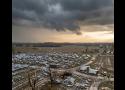
On Tuesday, March 10th, an EF-1 tornado destroyed the Dunns Bridge Solar I and II facilities owned by the Northern Indiana Public Service Company (NIPSCO). The facilities, located outside of Wheaton, Indiana, had 2.4 million solar panels, totaling 700 megawatts (MW) of power capacity, and reportedly cost $1 billion to construct—a little over $1,400 per kilowatt (kW).
NIPSCO issued the following statement in the aftermath:
On the evening of March 10, while actively monitoring severe weather and responding to storm‑related outages across our service area, NIPSCO became aware of damage to its Dunns Bridge I and Dunns Bridge II solar facilities in Starke and Jasper counties. Our team was tracking the storm in real time and moved in to assess conditions and respond as soon as it was safe to do so. Debris from the damage could have been displaced, and we are working to safely secure the area, assess the damage and proactively communicate with the community.
We recognize there may be questions and concerns about potential environmental impacts related to the damage at the solar farm. Solar panel leaching concerns have been thoroughly evaluated in industry-leading research, which shows that the risk is extremely low. Overall, the available evidence demonstrates that both crystalline silicon and thin-film PV (i.e., photovoltaic) modules do not pose a meaningful risk of environmental or human exposure from leaching, even when damaged. //
While the solar panels were damaged by the tornado, we are not aware of any reports of damage at the nearby R.M. Schahfer Generating Station, a 950 MW coal facility that NIPSCO was planning to retire at the end of 2025. However, it is still running thanks to a 202(C) order issued by the U.S. Department of Energy requiring the plant to continue operations. //
Let’s be incredibly uncharitable and look at the anticipated levelized cost of energy (LCOE) of the solar facility over its projected 25-year useful lifetime, and its actual, tornado-truncated lifetime.
Dunns Bridge I began generating power in June of 2023, producing a total of 1.3 million megawatt hours (MWh) up until December of 2025, the most recent month for which data are available. Dunns Bridge II began generating power in January of 2025, and through December, it produced 812,439 MW of power, which is good for a 21.3 percent capacity factor.
We calculated the LCOE over two time periods: a 25-year lifecycle, a standard assumption in the industry, and a 2-year lifecycle to account for the facility being destroyed very early in its lifecycle. The results are about what we would expect. Our estimated subsidized costs over 25 years are approximately equal to S&P Global’s reported PPA cost for the facilities, including subsidies.
Because the LCOE is like calculating the cost of driving your car over the number of miles driven, if your car dies after two years when you expected to drive it for 10, the cost per mile obviously increases. This is why the cost of electricity from the Dunns Bridge I & II facilities skyrockets in this analysis, reaching a subsidized cost of $289.61 per MWh, and an unsubsidized cost of $405.09 per MWh. [Compared to $63.87/MWh subsidized over 25 years, or $82.61/MWh unsubsidized over 25 yrs] //
In our upcoming LCOE study for Reliable Energy Inc. in Indiana, we found that the R.M. Schahfer plant was the most expensive coal plant in the state, due primarily to very high delivered fuel costs at the plant ($50 per MWh).
However, the December 2025 data from S&P Global, the most recent available, show the delivered fuel cost was about $27 per MWh, which substantially improves the economics of the plant, although this could possibly be the result of the company assuming the plant would retire at the end of the year, rather than being required to stay open.
At $70 per MWh, the Schahfer plant is competitive with subsidized solar over a 25-year lifespan, cheaper than the unsubsidized cost over 25 years, and a bargain compared with our admittedly uncharitable comparison to the facility’s actual 2-year lifespan. //
For our part, we would encourage those in the surrounding areas not to worry too much about chemicals leaching from the panels into the soil or water. Photovoltaic panels are made mostly of glass, and the small amounts of toxic materials, such as lead used in soldering, are not a significant concern because they are present in small quantities and there is probably no realistic exposure pathway for humans. //
The storm likely blew debris well beyond the solar site, which could create issues for nearby farmers, especially if they are growing root crops.
Anecdotally, we’ve heard that large potato buyers won’t purchase potatoes from growers located within a mile of a glass recycling facility for precisely this reason. In other words, the real concern here isn’t chemical contamination, it’s debris.

