Daily Shaarli
March 30, 2026

Residents of Birmingham, Alabama, were abruptly informed earlier this month that their water utility had decided to stop adding fluoride to city water. Then, days later, they learned that the utility had actually stopped adding fluoride years ago.
Firewalld provides a dynamically managed firewall with support for network/firewall zones that define the trust level of network connections or interfaces. It has support for IPv4, IPv6 firewall settings, ethernet bridges and IP sets. There is a separation of runtime and permanent configuration options. It also provides an interface for services or applications to add firewall rules directly.
But, according to numerous studies, polygraphs cannot reliably detect lying, or truth-telling, and their use in the justice and employment systems is regulated due to those problems with scientific reliability. A landmark 2003 report from the National Academies of Sciences, Engineering, and Medicine found the quality of research about polygraphy to be low, the theoretical explanation of how it functions (and why it detects lying, and not, say, nervousness) to be inadequate, the rate of false positives to be unacceptable, and the rate of false negatives to be a risk. Researchers still cite this study. //
But if media audiences find themselves in a polygraph exam room, they should probably feel twinges of doubt, perhaps especially if they are innocent. Citing evidence from William G. Iacono, a professor emeritus of psychology at the University of Minnesota, he said that polygraphs can identify just 75 percent of guilty people. But critically, they only accurately judge truth-tellers around 57 percent of the time. “The research generally shows that the people who are innocent are at a disadvantage,” he said. //
Of the 36 cases with a definitive polygraph examiner judgment, a correct exculpatory outcome only occurred in eight cases. But Denkinger’s issues with the dataset went further: “Every single person who took a polygraph in the set was done a disservice by the polygraph,” he said. “Either they were told they failed because the examiner thought that the result was a deceptive response, which was a false interpretation, or they were truthful, and the interrogators or the examiner misrepresented the result and told them that they were lying.”
That latter part is the focus of Denkinger’s most recent work: how the polygraph is used coercively. For example, law enforcement is permitted to tell subjects they’re failing the polygraph even if they’re not—a practice that can induce false confessions. And it is confessions that law enforcement is after. //
At the University of Utah, where he got his doctorate, Honts developed a method of polygraph examination that used standardized questions and relied less on the expertise of the examiner. He says that unlike some other countries, examiners in the US haven’t adopted the methods he sees as best-practice at a large scale, in large part because they see polygraphs more as interrogation tools than lassos of truth.
That practice can let guilty people go free, send innocent people to court, and make the most sensitive parts of our government—the defense and nuclear establishments, which both use polygraphy to vet employees—less secure. For instance, infamous spy Aldrich Ames, a three-decade CIA employee who passed secrets for close to a decade prior to his arrest, to the Soviets and later the Russians, passed a polygraph twice while actively committing espionage. Ames later said his polygraph savvy was aided by advice from the KGB, who told him to be cooperative and stay calm to pass the examination. //
Scientists like Lee may be getting closer to an accurate lie detector, and improving on the traditional polygraph. But there’s currently no superhero solution. And the problem, as Lee’s research hints, may be ontological, not technological.
That’s definitely Maschke’s view. “It’s all pseudoscience,” he said. “There is no lie detector. So my thinking is that it’s better not to pretend that you can detect lies, because it’s a way of deceiving yourself.”
I too, was affect by the samba issue. This is 100% reproducible by installing 10531, then upgrading to 10566 (full install).
But you don't need a full reinstall. To fix it, simply delete the file:
/usr/local/lib/libndr.so.6Looking at revision r10565 the root path of the installed Samba libraries was changed from /usr/local/lib to /usr/local/lib/samba4.
In the commit an obsolete file list was updated but it doesn't include the file above /usr/local/lib/libndr.so.6.
The directory /usr/local/lib/samba (no 4 at the end) has been moved to /usr/local/lib/samba4/private, so the first one should not exist now.
The following Bash script (don't just paste it to tcsh shell) should help you find other possibly obsolete samba libraries that exist under /usr/local/lib. I still have some, but they are not creating problems at the moment.
#!/usr/bin/env bash

set -e

samba-libs() {
    libs="$(find /usr/local/lib/samba4 -maxdepth 1 -type f)"
    libs="$(sed -r 's/\.[0-9]+$//' <<< "$libs")"
    libs="$(sed -r 's/\/lib\/samba4\//\/lib\//' <<< "$libs")"
    uniq <<< "$libs"
}

found=()

for f in $(samba-libs); do
    shopt -s nullglob
    found+=("${f}"*)
    shopt -u nullglob
done

printf '%s\n' "${found[@]}"Vibe Gel Memory Foam Mattress, 12-Inch CertiPUR-US Certified Bed-in-a-Box, Full, White
The Big Misconception About AI and Copyright
Many people believe that any use of AI eliminates copyright protection. This is fundamentally wrong and contradicts actual legal precedent. //
Key Facts
🏛️ What Thaler v. Perlmutter Actually Said
The widely-cited Thaler case held that AI cannot be listed as the author on a copyright application. The court explicitly stated:
"We are not faced with the question of whether a work created with the assistance of AI is copyrightable."
This case addressed AI as sole author, NOT humans using AI tools.
📋 What the Copyright Office Says
From the January 2025 Copyrightability Report:
"Using AI as a tool to assist in the creative process does not render a work uncopyrightable."
The key requirement: human authors must determine "sufficient expressive elements."
Clean Room as a Service
Finally, liberation from open source license obligations.
Our proprietary AI robots independently recreate any open source project from scratch. The result? Legally distinct code with corporate-friendly licensing. No attribution. No copyleft. No problems.
-
AGPL Contamination
Does your company forbid AGPL code? One wrong import and suddenly your entire proprietary codebase must be open sourced. The horror! -
Apache License Attribution
Is your legal team frustrated with the attribution clause? Tired of putting "Portions of this software..." in your documentation? Those maintainers worked for free—why should they get credit? -
License Compliance Overhead
Tracking licenses across hundreds of dependencies? Legal reviews taking weeks? Third-party audits finding "issues"? What if you could just... not deal with any of that? -
Giving Back to Community
Some licenses require you to contribute improvements back. Your shareholders didn't invest in your company so you could help strangers.
Robot-Powered Clean Room Recreation
Our proprietary AI systems have never seen the original source code. They independently analyze documentation, API specifications, and public interfaces to recreate functionally equivalent software from scratch.
The result is legally distinct code that you own outright. No derivative works. No license inheritance. No obligations.
The MalusCorp Guarantee™
If any of our liberated code is found to infringe on the original license, we'll provide a full refund and relocate our corporate headquarters to international waters.*
*This has never happened because it legally cannot happen. Trust us.
victort » Apr 3rd, '25, 17:22
I've added this to my "status-report.sh" script that gets sent to my email every day at 6 AM.
echo "DISK HEALTH"
echo "-----------"
# Check disk health
for disk in $(sysctl -n kern.disks); do
    echo $disk
    smartctl -H /dev/$disk | grep "result"
done
I now get a report every day of all my disks.
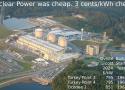
Figure 1. The 2.5 gigawatt Oconee plant in South Carolina. These three reactors were built for just over 350 million dollars between 1967 and 1974. That’s $1141 per kilowatt in 2024 dollars. They took about 6 years to build. Oconee can produce reliable, on-demand, zero pollution, very low CO2 electricity at less than 3 cents/kWh in today’s money. Oconee’s average capacity factor over the last 5 years was 98.2%. All three of these reactors have been licensed into the 2050’s, a gift from the Greatest Generation. Oconee and its cooling pond Lake Keowee have turned a depressed part of western South Carolina into a second home and tourist magnet.
Nuclear power in the West is a disastrously expensive mess. Table 1 shows where we are. Current builds have capital costs that are more than ten times higher than Oconee and her sisters. Only the wealthiest nations can afford these kind of costs, and then only sporadically. The construction times are such that there is no way nuclear can put a dent in global warming, or anything else. And it keeps getting worse. If this is the way things must be, nuclear power is a dead end, and rightly so. //
Yet in 2015, the German utility RWE commissioned their Eemshaven plant in the northeast corner of Holland at a cost of 2.2 billion euros. This is a little under $1500/kW for a 2 by 800 MW plant, or just under $2000/kW in 2024 dollars. This is for the latest and greatest ultra-super-critical plant meeting stringent EU pollution limits, sited in one of the most expensive places to build on the planet. The rule of thumb is $500/kW for the turbine hall and switchgear. The rest is fuel handling, the boiler, and pollution control. //
Figure 4. Fuel for 1 GW plant for one day. The coal plant’s fuel requires a 70 car train. The nuclear plant’s fuel fits in a two gallon jug. Newcastle 6700 is a good coal. Most coal’s are worse. //
A 1 GW nuclear, Figure 5, plant will burn about 82 kg’s of fuel per day, producing the same amount of solid waste. That’s about 100,000 times less than a coal plant. The coal yard and the coal receiving terminal disappear, as do the dryers and pulverizers. The nuke’s Fission Island volume will be smaller than the coal plant’s boiler. The turbine hall will be slightly larger. There will no stack gas handling equipment, no massive Forced Draft and Induced Draft fans, no SCR, no baghouses, no scrubbers, no massive stack. The ash landfill and slurry pond will be replaced by less than an acre of 5.9m(19 ft) high by 3.5m(11 ft) diameter casks. The nuclear plant should be cheaper to build with far cheaper fuel costs. //
Figure 15. Coal should be easy to beat
The reason why it is not is a tragically misdirected, autocratic regulatory system. We give an omnipotent regulator final approval of any nuclear power plant, and judge him on his ability to prevent a release of radiation. He gets no credit for the cheap, pollution-free, CO2-free, on-demand, power generated by a successful plant, nor the avoided mortality and morbidity that would have resulted if the plant had not been built. But he owns any problems. The regulator responds accordingly; and, since he has the final say, it’s his incentives, not society’s, that determines what happens. NRC Chairman Hendrie put it succinctly “The NRC’s responsibility is [nuclear] safety without regard to economic and social costs.” [Joseph Hendrie, NRC Chairman, 1979] The NRC’s definition of nuclear safety is preventing a release.
Figure 16. Hinkley Point tombstone.
No. Human welfare is our overriding priority.
This auto-genocidal myopia produces technical stagnation, a demoralized workforce, lack of competition, and shoddy quality. The end result is nuclear power that costs five or more times what it should-cost and build times that are three or more times longer than they need be. This in turn means nuclear is replaced by far more harmful technologies. It means nuclear can never be cheaper than the competition, which means humanity is far poorer than it could be. The greatest health hazard of all is poverty.