Daily Shaarli
June 3, 2026

When they’re being eaten, bean plants release chemicals that draw in parasitic wasps.

There is a wonderful and slightly awkward secret at the heart of the modern Aston Martin. For years, the company has cultivated an image of bespoke, blue-blooded, British excellence. The soul of that image has been its magnificent V12 engine. The problem is, this quintessentially British heart isn't entirely British at all. If you scratch beneath the surface, you'll find that its DNA is about as exotic as a Ford Mondeo. //
Aston Martin, now safely under Ford ownership, needed a world-class engine for its next generation of cars. Ford's accountants had a much cleverer and cheaper idea than a clean-sheet design. They looked at their excellent 3.0-liter Duratec V6 engine, found in countless sensible family saloons, and had a thought: what would happen if we just glued two of them together?

jdhardy Wise, Aged Ars Veteran
15y
127
Subscriptor++
eoink said:
Voicing = Speaking about that? Asking as a European.
Yep. Classic English register split - "speak" is the native (low register) Old English/Germanic version, "voice" is the mid-register (Norman) French-derived version, and "communicate" would be the high-register Latin-derived version.
Lots of terms follow this pattern - hence the expression that English is really three languages in a trench coat.
Nations are not economic zones.
That matters, because from a pure GDP standpoint the ideal citizen is someone who gets cancer, gets divorced, crashes the car, and hires a small army of professionals before dying.
Nobody contributed more to UK GDP this week than Henry Nowak’s killer.
Think about that.
Police response. Medical response. Detectives. Public affairs officers. Dozens of lawyers. Prison for life. All of it staggeringly expensive. Vickrum Digwa has already made up the entire lifetime GDP contribution of the man he killed. Probably a hundred times over.
Migration isn’t just about votes.
Consider yourself. A patriot who lives a simple life.
You are not a burden on society, so you contribute little to GDP. //
Your pastor told you that becoming an electrician, a plumber, a nurse, a firefighter, a teacher would contribute to society. He told you to live a simple life. To love and protect your family and your neighbors. He told you not to gamble or drink or have affairs.
Don’t you see why they hate the church?
Why they hate you?
In their eyes you are wasted space.
You may contribute enormously on the human scale, the only scale that has ever actually mattered, you may contribute non economic values like love, honor and duty. You might contribute locally on a micro-economic scale.
But in the big picture you are an economic loss. Because you contribute almost nothing to GDP.
You contribute far far leas than a criminal migrant with a mental disorder, gambling addiction and cancer.
You are a great American in the eyes of your church.
But on an economic GDP scale you are the very worst type of American.

Is it a hidden gem, a cult classic, or hopelessly dumb? We vote “all of the above.” //
Even operating at its most frantic peak in 1985 just before Challenger’s loss, the shuttle hardware managed a maximum of nine flights in one calendar year; for most of the 1990s, it performed at five or six flights per year. Civilians in space—to say nothing of Big Bird—would have to wait.
And into that post-Challenger disillusioned summer of 1986, Hollywood brought us SpaceCamp. It had all the right ingredients: A stacked cast with a solid leading duo (Kate Capshaw and Tom Skerritt), tons of real NASA location footage, and a big, brassy score by none other than John Williams. The film was completed before the Challenger disaster, leaving 20th Century Fox with something of a nightmarish choice on their hands—to shelve the film and lose millions, or send it to theaters and risk a PR disaster.
For better or for worse, Fox chose to release the film, which ultimately made about $9.6 million on a reported $25 million budget. Ouch.
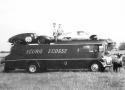
The story of the Ecurie Ecosse Tojeiro at Le Mans is not a story of victory. It is something much more important than that. It is a perfect reminder of the spirit of the great privateer teams, a time when a small group of determined, passionate, and slightly mad enthusiasts could build a world-beating car in a shed, crash it, fix it, paint it in a field, and then turn up at the world's greatest race and give the giants a proper scare. It was a magnificent failure.

For anyone who's owned a classic British car, three words guaranteed to send a shiver down the spine: Lucas Electrical Systems. For decades, the products made by this Birmingham company became the source of endless, infuriating failures that turned British motorists into unwilling comedians. Headlights would dim to a romantic glow just as you needed them most. Indicators would flash with the random enthusiasm of a broken disco ball. Windscreen wipers would choose the exact moment of a downpour to take early retirement. It's for this reason that Joseph Lucas, the company's long-dead founder, earned the posthumous nickname "Prince of Darkness."
Which makes the story all the more remarkable, because Joseph Lucas himself built his business on exactly the opposite reputation: rock-solid reliability and genuine innovation. //
In the 1920s, Lucas signed cross-licensing deals with Bosch, Delco, and other major electrical suppliers that carved up the world between them. Lucas agreed not to sell in their territories; they agreed not to sell in Britain. By the 1930s, Lucas had achieved something close to a complete monopoly on automotive electrics in Britain.
If you were building cars in Britain, you bought your headlamps, starter motors, alternators, and wiring from Lucas. Austin, Morris, Jaguar, Rover, Triumph, MG - they were all captive customers. There was literally nowhere else to go. This should have been a recipe for excellence, with guaranteed demand allowing investment in the best possible products. Instead, it became a lesson in how monopolies breed complacency. //
The folklore that grew up around Lucas failures became part of British motoring culture. "The Lucas motto: Get home before dark." "Why do the British drink warm beer? Because Lucas makes their refrigerators." "Alexander Graham Bell invented the telephone, Thomas Edison invented the light bulb, Joseph Lucas invented the short circuit." The jokes were funny precisely because they reflected real experiences shared by thousands of frustrated drivers.