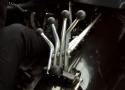
These levers control the Lenco transmission, which is stout enough to harness the power of a spinning neutron star and convert its energy into quarter-mile domination and tire smoke.
Lencos' design is unique. It's as if Lenco racing transmissions snuck up behind some automatic and manual gearboxes in the dark and pilfered the finest attributes of each. From the automatic, it pickpocketed the planetary gears and clutch packs, but left behind the fluid valve-actuated gear selection. From the manual, it nabbed the clutch and flywheel, but ditched the slow H-pattern and dogleg shifters in favor of a series of levers the driver can simply slam into place. Also, the Lenco decided that the clutch directly connected to the engine would only be necessary when starting out in first or reverse. Otherwise, it acts like a dog box transmission, letting you run through the gears sans clutch pedal.
Giving each gear its own lever is kind of an odd decision, though. The setup deserves a place among the weirdest car shifters, looking kind of like the Hurst Lightning Rod from the 1980s Hurst/Olds. Why not a single lever like a sequential gearbox?
Well, the reason many Lenco applications use individual levers is that multi-speed Lencos aren't just one transmission in a single case, but rather separate two-speed transmissions centipeded together. So as the driver pulls a lever, one of the transmissions goes from "low" to "high," which then stacks with the ratio in the next transmission, and the next, and so on. It's separate levers for separate segments, which keeps things simpler, mechanically.
Racers looking for ultimate power handling and direct control over shifting turn to Lenco's magnesium-cased CS1 Standard Design racing transmission, which can handle in excess of 3,500 horses. Lenco also offers more compact CS2, CS3, and CS4 gearboxes, as well the ST1200 Street Strip model and the Lencodrive Automatic.
I called Lenco to see what the fluid change intervals are, and here's what the company told me: For street use, you need to change it after 500 miles following the install, then every time you change the engine oil. For drag racing, high-horsepower applications necessitate new fluids after each event. Lower-horsepower drag racing can extend that to every two or three events. Always inspect the fluid, though, because if it's still clean, you're good. If there's clutch material floating in there, change it. The recommended fluid is a light-grade petroleum-based motor oil.

