Every 10 years, the National Academies convene a panel of planetary scientists to set priorities for Solar System exploration. These decadal surveys help NASA decide where to send missions and what scientific questions they should seek to answer. None of the results from Artemis II are likely to answer these big questions.
“Is there going to be decadal-level science out of Artemis II? Probably not,” Neal told Ars in an interview this week. “This is a technology demonstration mission… This is primarily to have a crew there to check out the engineering and make sure that things are working.”
From a scientific perspective, what’s most intriguing about Artemis II is figuring out how to incorporate humans into planetary exploration. For more than 50 years, generations of scientists have learned to explore other worlds only through the electronic eyes of robots. With NASA’s return to the Moon, they must learn to take advantage of human observations.
This requires a shift in how ground teams design instruments, plan science campaigns, and select targets for their observations. It also necessitates a change in culture. Astronauts on the lunar surface or in lunar orbit will provide a real-time feedback loop for the army of scientists looking over their shoulders from Earth. During the Apollo program, it took multiple landings to fine-tune how this works.
Should we take a closer look at this rock? Should we go see that outcrop? Humans can make these key decisions in seconds or minutes rather than days, weeks, months, or in some cases, years.
The experience of the Artemis II flyby also informed spacecraft engineers about the utility of the Orion spacecraft as an observation platform and the optical quality of the capsule’s windows. The astronauts reported some issues with glare from the Sun and the Earth. They MacGyvered a makeshift window shroud using a T-shirt to help overcome the glare so they could better see the lunar surface.
“We confirmed that we can achieve science through orbital observations and through integrating science into flight operations,” said Kelsey Young, NASA’s science lead for the Artemis II mission.
Human eyes are remarkably good at sensing color gradients and brightness changes. “Right away, they started describing the green around Aristarchus plateau and different brown hues, and these colors really help tell us nuances about the chemistry of lunar material,” Young said after the flyby.
Glover, Artemis II’s pilot, noted his perception of the Moon’s three-dimensionality during the flyby: “You really get a sense that we’re flying over something with elevation and terrain.” The astronauts were able to glimpse craters, mountains, and ridges at different angles as the Orion capsule arced behind the Moon. “Every vantage point is different,” Young said. //
“You might think that, after looking at hundreds of images taken of the lunar surface, I would get sick of it,” Young said. “I have not, nor do I anticipate getting sick of it.”
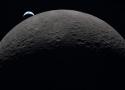
“It was quite infectious,” Neal said. “The Earthrise image that they took is one for the ages.”

