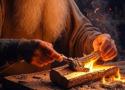
Yakisugi is a Japanese architectural technique for charring the surface of wood. It has become quite popular in bioarchitecture because the carbonized layer protects the wood from water, fire, insects, and fungi, thereby prolonging the lifespan of the wood. Yakisugi techniques were first codified in written form in the 17th and 18th centuries. But it seems Italian Renaissance polymath Leonardo da Vinci wrote about the protective benefits of charring wood surfaces more than 100 years earlier, according to a paper published in Zenodo, an open repository for EU funded research. //
Leonardo produced more than 13,000 pages in his notebooks (later gathered into codices), less than a third of which have survived. //
In 2003, Alessandro Vezzosi, director of Italy’s Museo Ideale, came across some recipes for mysterious mixtures while flipping through Leonardo’s notes. Vezzosi experimented with the recipes, resulting in a mixture that would harden into a material eerily akin to Bakelite, a synthetic plastic widely used in the early 1900s. So Leonardo may well have invented the first manmade plastic. //
The benefits of this method of wood preservation have since been well documented by science, although the effectiveness is dependent on a variety of factors, including wood species and environmental conditions. The fire’s heat seals the pores of the wood so it absorbs less water—a natural means of waterproofing. The charred surface serves as natural insulation for fire resistance. And stripping the bark removes nutrients that attract insects and fungi, a natural form of biological protection.

