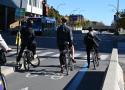
The uniform application of traffic rules may seem fair, but in reality, it can create a false sense of equality.
On the one hand, the risks associated with different modes of transport are incommensurate. A car that runs a red light can cause serious or even fatal injuries. A cyclist, on the other hand, is unlikely to cause the same degree of damage. //
Furthermore, the efficiency of cycling depends on maintaining speed. Having to stop completely over and over discourages people from cycling, despite its many benefits for health, the environment and traffic flow.
Treating two such different modes of transport the same way, therefore, amounts to implicitly favouring cars, something akin to imposing the same speed limit on pedestrians and trucks. //
Rather than treating bicycles and cars as equals, some jurisdictions have opted for a different approach. The state of Idaho is one good example.
Since 1982, cyclists in Idaho have been able to treat a stop sign as a yield sign and a red light as a stop sign. Several American states (such as Arkansas, Colorado, and Oregon) and countries, such as France and Belgium, have adopted similar regulations. //
In short, adopting the Idaho stop rule would not create chaos, but would regulate an already common practice without compromising public safety, contrary to some concerns. Cyclists who rarely come to a complete stop when there is no traffic generally slow down before crossing because they are aware of their vulnerability.

