Every member of the military has sworn an oath to the nation since the Continental Army’s creation in 1775. Wording to specify allegiance to the U.S. Constitution was added in 1789, and has remained in all versions of military oaths of enlistment and commissioning since. This tradition sets our military apart from many others around the world, where loyalty is often tied to a ruler or regime. The American oath binds service members to a set of ideals and structures greater than any one administration.
Unfortunately, this noble intent is being misinterpreted. Ill-informed pundits, academics, military officers, lawmakers, and even ordinary American citizens frequently describe the military as “apolitical.” But that isn’t quite right. The military exists to enforce the political will of the United States—by force if necessary. It’s not above politics; it’s an instrument of it. A correct reading of the military oath clarifies this: troops swear to uphold the enduring framework of the nation, not the transient preferences of elected officials.
So, what does loyalty to the Constitution actually mean? How is a service member to judge whether their actions align with that oath? Most don’t know. Those who do have learned through personal initiative—not institutional instruction. //
This problem can be solved. I propose three key reforms:
- Mandatory Annual Constitutional Training
The White House recently mandated an 80-hour Constitution and rule-of-law course for executive branch employees, capped by a two-day in-person session. The military can follow suit by requiring holistic annual constitution training for every military member. Numerous free, reputable programs already exist to support this effort:
National Constitution Center’s Constitution 101 Course
American Bar Association’s Civics Education Series for Military Members
Hillsdale College’s Constitution 101: The Meaning and History of the Constitution. //
- Required Pocket Constitutions
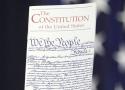
Every service member should be issued a laminated pocket Constitution, worn as part of the uniform. If troops are still required to wear dog tags in this day of DNA identification, there’s no reason that carrying the document to which they swear is a bridge too far.
- Memorization of Founding Principles
In the Army, we are required to know the Soldier’s Creed and Army Song by heart, ready to recite from memory on command. Promotion boards evaluate enlisted soldiers on their ability to recite these and other military codes. Why not include selections from the Constitution—or Declaration of Independence? //
The National Defense Authorization Act (NDAA) provides the fastest route for implementation. With Republican majorities in Congress, there is an opportunity to require annual, rigorous, non-partisan instruction in the U.S. Constitution and the rule of law for all military personnel. This training must reject “living document” ideology in favor of fidelity to textualism.
Military officers have become accustomed to obeying and implementing unlawful directives because they know that the oath is presently meaningless and that all power—in practice—is held by individuals in the chain of command, rather than the nation’s founding documents, U.S. law, and military regulations. Defense Secretary Pete Hegseth must purge ideologues who corrupted the institution—but that alone won’t fix the culture.

