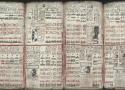
Eclipse tables in the Dresden Codex were based on lunar tables and adjusted for slippage over time. //
The Maya used three primary calendars: a count of days, known as the Long Count; a 260-day astrological calendar called the Tzolk’in; and a 365-day year called the Haab’. Previous scholars have speculated on how awe-inspiring solar or lunar eclipses must have seemed to the Maya, but our understanding of their astronomical knowledge is limited. Most Maya books were burned by Spanish conquistadors and Catholic priests. Only four hieroglyphic codices survive: the Dresden Codex, the Madrid Codex, the Paris Codex, and the Grolier Codex. //
They concluded that the codex’s eclipse tables evolved from a more general table of successive lunar months. The length of a 405-month lunar cycle (11,960 days) aligned much better with a 260-day calendar (46 x 260 =11,960) than with solar or lunar eclipse cycles. This suggests that the Maya daykeepers figured out that 405 new moons almost always came out equivalent to 46 260-day periods, knowledge the Maya used to accurately predict the dates of full and new moons over 405 successive lunar dates.
The daykeepers also realized that solar eclipses seemed to recur on or near the same day in their 260-day calendar and, over time, figured out how to predict days on which a solar eclipse might occur locally. “An eclipse happens only on a new moon,” said Lowry. “The fact that it has to be a new moon means that if you can accurately predict a new moon, you can accurately predict a one-in-seven chance of an eclipse. That’s why it makes sense that the Maya are revising lunar predicting models to have an accurate eclipse, because they don’t have to predict where the moon is relative to the ecliptic.” //
“The traditional interpretation was that you run through the table, eclipse by eclipse, and then you rebuilt the table every iteration,” said Lowry. “We figured out that if you do that, you’re going to miss the eclipses, and we know they didn’t. They made internal adjustments. We think they’d restart the table midway. When you do that, you go from having missed eclipses to having none. You would never miss an eclipse. So it’s not a calculated predictive table, it’s a calculated predictive table plus adjustments based on empirical observations over time.”
“This is the basis of true science, empirically collected, constant revision of expectations, built into a system of understanding planetary bodies, so that you can predict when something happens,” said Lowry.

