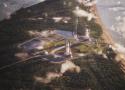
“Until we get that data from the testing that is ongoing and the analysis that needs to occur, we’re going to continue to treat any LOX-methane vehicle with 100 percent TNT blast equivalency, and have a maximized keep-out zone, simply from a public safety perspective,” Chatman said.
The data so far shows promising results. “We do expect that BDA to shrink,” he said. “We expect that to shrink based on some of the initial testing that has been done and the initial data reviews that have been done.”
That’s imperative, not just for Starship’s neighbors at the Cape Canaveral spaceport, but for SpaceX itself. The company forecasts a future in which it will launch Starships more often than the Falcon 9, requiring near-continuous operations at multiple launch pads. //
The Commercial Space Federation, a lobbying group, submitted written testimony to Congress in 2023 arguing the government should be using “existing industry data” to inform its understanding of the explosive potential of methane and liquid oxygen. That data, the federation said, suggests the government should set its TNT blast equivalency to no greater than 25 percent, a change that would greatly reduce the size of keep-out zones around launch pads. The organization’s members include prominent methane users SpaceX, Blue Origin, Relativity Space, and Stoke Space, all of which have launch sites at Cape Canaveral.
The government’s methalox testing plans were expected to cost at least $80 million, according to the Commercial Space Federation.
The concern among engineers is that liquid oxygen and methane are highly miscible, meaning they mix together easily, raising the risk of a “condensed phase detonation” with “significantly higher overpressures” than rockets with liquid hydrogen or kerosene fuels. Small-scale mixtures of liquid oxygen and liquified natural gas have “shown a broad detonable range with yields greater than that of TNT,” NASA wrote in 2023. //
SpaceX said it has conducted sub-scale methalox detonation tests “in close collaboration with NASA,” while also gathering data from full-scale Starship tests in Starbase, Texas, including information from test flights and from recent ground test failures. //
The company did not disclose the yield calculation, but it shared maps showing its proposed clear areas around the future Starship launch sites at Cape Canaveral and Kennedy Space Center. They are significantly smaller than the clear areas originally envisioned by the Space Force and NASA, but SpaceX says it uses “actual test data on explosive yield and include a conservative factor of safety.” //
Concerns as mundane as traffic jams are now enough of a factor to consider using automated scanners at vehicle inspection points and potentially adding a dedicated lane for slow-moving transporters carrying rocket boosters from one place to another across the launch base, according to Chatman. This is becoming more important as SpaceX, and now Blue Origin, routinely shuttle their reusable rockets from place to place. //
Space Force officials largely attribute the steep climb in launch rates at Cape Canaveral to the launch industry’s embrace of automated self-destruct mechanisms. These pyrotechnic devices have largely replaced manual flight termination systems, which require ground support from a larger team of range safety engineers, including radar operators and flight control officers with the authority to send a destruct command to the rocket if it flies off course. Now, that is all done autonomously on most US launch vehicles.
The Space Force mandated that launch companies using military spaceports switch to autonomous safety systems by October 1 2025, but military officials issued waivers for human-in-the-loop destruct devices to continue flying on United Launch Alliance’s Atlas V rocket, NASA’s Space Launch System, and the US Navy’s ballistic missile fleet. That means those launches will be more labor-intensive for the Space Force, but the Atlas V is nearing retirement, and the SLS and the Navy only occasionally appear on the Cape Canaveral launch schedule.

