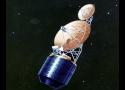
The JUMPSEAT satellites loitered over the North Pole to spy on the Soviet Union. //
In a statement, the NRO called Jumpseat “the United States’ first-generation, highly elliptical orbit (HEO) signals-collection satellite.” //
The Soviet Union was the primary target for Jumpseat intelligence collections. The satellites flew in highly elliptical orbits ranging from a few hundred miles up to 24,000 miles (39,000 kilometers) above the Earth. The satellites’ flight paths were angled such that they reached apogee, the highest point of their orbits, over the far northern hemisphere. Satellites travel slowest at apogee, so the Jumpseat spacecraft loitered high over the Arctic, Russia, Canada, and Greenland for most of the 12 hours it took them to complete a loop around the Earth.
This trajectory gave the Jumpseat satellites persistent coverage over the Arctic and the Soviet Union, which first realized the utility of such an orbit. The Soviet government began launching communication and early-warning satellites into the same type of orbit a few years before the first Jumpseat mission launched in 1971. The Soviets called the orbit Molniya, the Russian word for lightning. //
The disclosure of the Jumpseat program follows the declassification of several other Cold War-era spy satellites. They include the CIA’s Corona series of photo reconnaissance satellites from the 1960s, which the government officially acknowledged 30 years later. The NRO declassified in 2011 two more optical spy satellite programs, codenamed Gambit and Hexagon, which launched from the 1960s through the 1980s. Most recently, the NRO revealed a naval surveillance program called Parcae in 2023.

