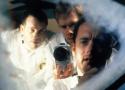
Ron Howard's 1995 love letter to NASA's Apollo program takes a few historical liberties but it still inspires awe. //
This year marks the 30th anniversary of the 1995 Oscar-winning film, Apollo 13, director Ron Howard's masterful love letter to NASA's Apollo program in general and the eponymous space mission in particular. So we're taking the opportunity to revisit this riveting homage to American science, ingenuity, and daring. //
Howard ultimately shot most of the weightless scenes aboard the KC-135 since recreating those conditions on a soundstage and with CGI would have been prohibitively expensive.
In fact, Howard didn't rely on archival mission footage at all, insisting on shooting his own footage. That meant constructing realistic spacecraft interiors—incorporating some original Apollo materials—and reproducing exactly the pressure suits worn by astronauts. (The actors, once locked in, breathed air pumped into the suits just like the original Apollo astronauts.) The Mission Control set at Universal Studios was so realistic that one NASA consultant kept looking for the elevator when he left each day, only to remember he was on a movie set. //
Is every button pressed in the right way? No. Does it bug the crap out of me every time Kevin Bacon answers Tom Hanks' "How's the alignment?" question by nonsensically saying "GDC align" and pressing the GDC align button, which is neither what Lovell was asking nor the proper procedure to get the answer Lovell was looking for? Yes. But's also pure competence porn—an amazing love letter to the space program and the 400,000 men and women who put humans on the Moon.
And like Lovell says: "It's not a miracle. We just decided to go." //
Purpleivan
For anyone wanting a more extensive Apollo 13 experience, then have a look at LunarModule5's YouTube channel.
They've created an end to end (from a few hours before launch, to a few after splashdown) series of videos. These use the entire recorded audio for the mission, both for the crew and controllers on the ground. Long periods of silence have been edited our, but enough silence/static gaps between audio, for the cuts not to feel strange. They've also included some backroom discussion recordings, to fill some of the empty sections audio.
The videos show a simulation (I don't know the software used) to visualise the events of the mission, as well as a huge collection of photos from the mission.
I've watched a few of the videos and plan at some point to watch them all (something like) end to end. However, as the set of mission videos comes in 19 parts, with many 10 hours long, for a total of about 120 hours, it's a serious commitment of time.
https://www.youtube.com/watch?v=x4gb6Eb_Mes&list=PLC1yaZz2qeGrj_-TCMeupfzRUmf6CysdF
June 29, 2025 at 7:15 pm //
postpar Ars Centurion
6y
221
Subscriptor
FWIW, and this is a throwaway here, Chrysler never really got the credit they deserved for their stellar work on those rockets, or on the electronic communication and diagnosis devices, which were quite advanced and reliable under tough circumstances. When Apollo ended, a lot of those guys went back to Detroit. Some of them worked on the racing program, doing aero and diagnostic work; others worked on electronic ignition and on-board automotive computers. They did all this for relatively small profits.
https://www.motales.com/chrysler-corp/aerospace-defense/rockets-by-chrysler.php //
Those Mission Control consoles were built by Ford (Philco division.https://www.youtube.com/watch?v=1XbEIMcxl04)
Most fittingly, the Lunar Roving Vehicle was built in part by General Motors.
And with all that fresh space-age engineering experience under their belts, the American auto industry...basically fell apart at the seams for the next decade. //
JoHBE Ars Tribunus Militum
14y
2,881
Subscriptor++
The movie is now older than the mission was at [the movie's] release.

