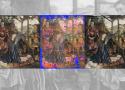
Removable transparent films apply digital restorations directly to damaged artwork.
MIT graduate student Alex Kachkine once spent nine months meticulously restoring a damaged baroque Italian painting, which left him plenty of time to wonder if technology could speed things up. Last week, MIT News announced his solution: a technique that uses AI-generated polymer films to physically restore damaged paintings in hours rather than months. The research appears in Nature.
Kachkine's method works by printing a transparent "mask" containing thousands of precisely color-matched regions that conservators can apply directly to an original artwork. Unlike traditional restoration, which permanently alters the painting, these masks can reportedly be removed whenever needed. So it's a reversible process that does not permanently change a painting.
"Because there's a digital record of what mask was used, in 100 years, the next time someone is working with this, they'll have an extremely clear understanding of what was done to the painting," Kachkine told MIT News. "And that's never really been possible in conservation before."
Nature reports that up to 70 percent of institutional art collections remain hidden from public view due to damage—a large amount of cultural heritage sitting unseen in storage. Traditional restoration methods, where conservators painstakingly fill damaged areas one at a time while mixing exact color matches for each region, can take weeks to decades for a single painting. It's skilled work that requires both artistic talent and deep technical knowledge, but there simply aren't enough conservators to tackle the backlog. //
For now, the method works best with paintings that include numerous small areas of damage rather than large missing sections. In a world where AI models increasingly seem to blur the line between human- and machine-created media, it's refreshing to see a clear application of computer vision tools used as an augmentation of human skill and not as a wholesale replacement for the judgment of skilled conservators.

