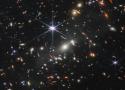
In a recent paper in Nature, a team of scientists led by Kimihiko Nakajima, an astronomer at the Kanazawa University, Japan, used the James Webb Space Telescope to observe an ultra-faint galaxy called LAP1-B as it existed roughly 800 million years after the Big Bang. It’s the most chemically primitive galaxy we’ve ever seen.
The magnifying glass
The LAP1-B is 13 billion light-years away from Earth. To observe an object that faint and distant, even the huge, gold-coated beryllium mirrors of JWST were not enough on their own. We spotted it due to a massive cluster of galaxies called the MACS J046, which warps the spacetime between us and the LAP1-B.
“The galaxy was strongly magnified through the gravitational lensing effect,” Nakajima said. Specifically, the spacetime warped by the MACS J046 clusters magnifies light traveling from LAP1-B toward Earth by roughly 100-fold. //
This analysis revealed a profound shortage of elements heavier than hydrogen and helium. The gas-phase oxygen-to-hydrogen ratio stood at just 0.4 percent of what we find in our Sun.
Another detail in the spectrum indicated the type of radiation that made the gas glow. The team detected emission lines from triply ionized carbon—a state where a carbon atom has lost half of its six electrons. Stripping multiple electrons away from carbon atoms requires extreme-ultraviolet photons, with energies exceeding 47.9 electronvolts. Standard stars, even the massive ones we see in our galactic vicinity, are not hot enough to produce radiation this intense.
The stars that could get this hot, Nakajima’s team suggests, were the very first that ignited in the Universe. These were made exclusively of hydrogen and helium forged in the Big Bang and lacked heavy elements to help them cool as they formed. “Such stars should be formed from primordial gas,” Nakajima said. //
The stars we see today, including our Sun, are Population I stars. The older generation, found in the halo of our galaxy, are Population II stars, which have far lower levels of elements heavier than helium. Population III stars were the first to appear in the cosmos, and they’re theorized to be violent monsters with masses hundreds of times higher than the Sun squeezed into surprisingly small volumes. They burned extremely hot and died young in supernova explosions. Nakajima’s team has likely found traces of these explosions in LAP1-B.

