Rirere Ars Centurion
12y
263
Subscriptor++
Wheels Of Confusion said:
Seems to me competence might include not making a voyage in a ship you're well-informed isn't up to the task. That's like having to make an important cross-continental road trip on a beater with bad spark plugs.
Now now, I didn't say that the competence was all Shackleton!
While I do think Shackleton demonstrated some admirable on-the-ice leadership (but also some questionable decisions, of which the most infamous is probably his treatment of the carpenter, McNish), the name I was actually thinking of was Frank Worsley, who navigated during the journey of the James Caird through 800 miles of the nastiest weather and waves imaginable using a sextant and brief moments of sun, hitting an island at that distance that was more or less the size of a speck compared to the open seas.
wow, that's a long sentence oops //
ramases Ars Tribunus Angusticlavius
14y
8,332
Subscriptor++
Wheels Of Confusion said:
Seems to me competence might include not making a voyage in a ship you're well-informed isn't up to the task. That's like having to make an important cross-continental road trip on a beater with bad spark plugs.
It is called the Action Fallacy. It describes our tendency to elevate leaders who appear decisive in a crisis over leaders who manage to avoid the crisis in the first place.
Martin Gutmann talks about it specifically within the context of Ernest Shackleton:
View: https://www.youtube.com/watch?v=b0Z9IpTVfUg //
Nooge Wise, Aged Ars Veteran
11y
188
Subscriptor
TheColinous said:
There is no accounting for the urge "If I don't get there first, the wrong 'un will get there before me" to explain why people take risks that in hindsight prove less than intelligent.
The thing is this was his already his third trip to Antartica, having failed twice (on the Discovery and Nimrod expeditions) to be first to the pole (Amundsen was first). He was already knighted. But he wanted to be first to cross the entire Antarctic from sea to sea. Despite his failure on Endurance he chose to return to the Antarctic a fourth time but died of a heart attack en route. The guy just couldn’t get enough.
There’s a podcast called Cautionary Tales that I highly recommend in general, but especially the mini series on the Antarctic expeditions of Scott and Amundsen, the two explorers whose race to the South Pole was intertwined. It explores the motivations of the men and how that affected their decisions and errors.
Here’s the first episode
View: https://omny.fm/shows/cautionary-tales-with-tim-harford/south-pole-race-david-and-goliath-on-ice //
c1josh Seniorius Lurkius
15y
5
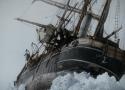
When the 'Endurance' was launched (as 'Polaris') in Dec. 1912, as a ship designed for interaction with ice, it was not designed for extended polar exploration. It was built to bring wealthy tourists to the edges of the ice for hunting big game. 'Fram' a true polar exploration ship was launched 20 years earlier and successfully survived extended periods of time frozen into pack ice in the Arctic. She was designed by Colin Archer for the Norwegian explorer Fridtjof Nansen.
The key design feature was a hull that didn't include any vertical portions below the waterline. It was designed to be lifted by the ice as the pressure increased, not crushed. And it was build HEAVILY, at 5m shorter and 50 tons heavier than 'Endurance'. //
Oldmanalex Ars Legatus Legionis
13y
11,321
Subscriptor++
citizencoyote said:
It's not criticizing Shackleton, it's asking a very valid question: why did someone with so much experience, knowledge, and preparation make such an obvious mistake/gamble? Was it hubris? Lack of funding? A combination of both? Some other reason? We won't ever know because Shackleton never explained his reasoning.
In a nutshell: the article doesn't say, "Wow, what a bonehead Shackleton was," it asks, "Why would someone otherwise so experienced make this choice?"
Because it was that or nothing. And Shackleton, like the other great explorers of the age, was a risk-taker. Any person who would take a wooden boat deep into the Weddell (or the Beaufort) Sea is someone who has more than my tolerance for risk. And risk-taking involves an assumption that bad luck will not occur. Erebus and Terror sailed on an assumption that they would not enter the Arctic in the three coldest successive years of the 19th century, and when they did, they were buggered. Scott did not assume that the Antarctic winter would be so unusually cold that his sled runners would be unable to melt a lubricating water layer, and Shackleton did not assume that he would be caught in an unusually bad Antarctic ice season.
And look at the timing. In August 1914, there were other things on most peoples' minds. And Shackleton's misjudgments here cost several men great hardship, and one several appendages. At the same time, the world leaders made decisions that killed over 20 million.
And look at ourselves. We know the risks we are taking, and the consequences. But, we are drifting into both a loss of our (relative) freedom, and a possible human extinction, because we cannot tell a few hundred greedy psychopaths to change course on global destruction. I think Shackleton would have been embarrassed on our behalf. //
matt_w Ars Scholae Palatinae
17y
1,169
One of my favorite songs is a Chris Thile cover of a Josh Ritter song that romanticizes this story.

