While Rocketdyne’s ownership merry-go-round kept spinning, the company’s competitors pushed forward. SpaceX and Blue Origin, backed by wealthy owners, took a fresh approach to designing rockets. Apart from the technical innovations that led to reusable rockets, these newer companies emphasized vertical integration to cut costs and minimize reliance on outside supply chains. They wanted to design and build their own rocket engines and were not interested in outsourcing propulsion. Rocketdyne’s business was—and still is—entirely focused on selling ready-made engines to customers.
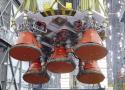
The launch startups that followed in the footsteps of SpaceX and Blue Origin have largely imitated their approach to insourcing. There are at least nine medium to large liquid-fueled rocket engines in production or in advanced development in the United States today, and just one of them is from the enterprise once known as Rocketdyne: the RS-25 engine used to power the core stage of NASA’s Space Launch System (SLS) rocket. //
The RS-25 engine, by far the largest in L3Harris’ portfolio and a former Rocketdyne product, is not part of the sale. The RS-25 was initially known as the Space Shuttle Main Engine and was designed for reusability. The expendable heavy-lift SLS rocket uses four of the engines, and NASA is burning through the 16 leftover shuttle-era RS-25 engines on the first four SLS flights for the agency’s Artemis Moon program. The second SLS flight is set to launch in the coming months on a mission carrying four astronauts beyond the Moon.
L3Harris will retain total ownership of the RS-25 program. The company has a contract with NASA to build new RS-25 engines for SLS flights beyond Artemis IV. But the new RS-25s will come at an expense of about $100 million per engine, significantly more than SpaceX sells an entire launch on a Falcon 9 rocket. The engine contract is structured as a cost-plus contract, with award and incentive fees paid by the government to L3Harris.

