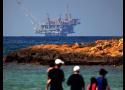
The war on Iran revealed how dependent Israel’s Arab neighbours are on its gas exports, a dependency that could extend to Syria and Lebanon. //
Last year, Cairo signed a $35bn deal to import Israeli gas from Israel until 2040, boosting its previous supplies by another 2bcm (70.6 billion cubic feet) per year. //
Unlike Egypt, Jordan is not a major gas-producing country. Local production accounts for less than 5 percent of gas (PDF) needs. It imports the rest, about 3.6bcm (127 billion cubic feet) per year, mostly from Israel, but also Egypt and some LNG sources. //
The Arab Gas Pipeline—once a symbol of joint Arab development projects—has become the primary conduit for exporting Israeli gas to both Jordan and Egypt. Pipelines carrying gas from the Leviathan field off the coast of Haifa connect to the pipeline network in northern Jordan’s Mafraq governorate, from which gas flows southward towards the Egyptian border. //
Even when Israel is not the immediate supplier in a given transaction, the system itself depends structurally on Israeli gas. Once Israeli exports stop, the entire network falters. //
This is a clear example of how the Zionist settler-colonial project is expanding not only through military aggression but also through economic power and energy networks.
It advances through an infrastructure that appears mundane and technical, yet ultimately grips societies by the throat. Once embedded, disengaging from such systems becomes extraordinarily difficult, because they govern the essentials of everyday life: electricity, water and energy. //
Today, Syrian and Lebanese political leaders may be lured by the promise of quick and easy economic security and reliable living conditions. But such security would be illusory. Ultimate control would rest in the hands of a state whose capacity to cut supply – and to use that interruption as a tool of destruction, political coercion and colonial expansion – is already visible for all to see.

